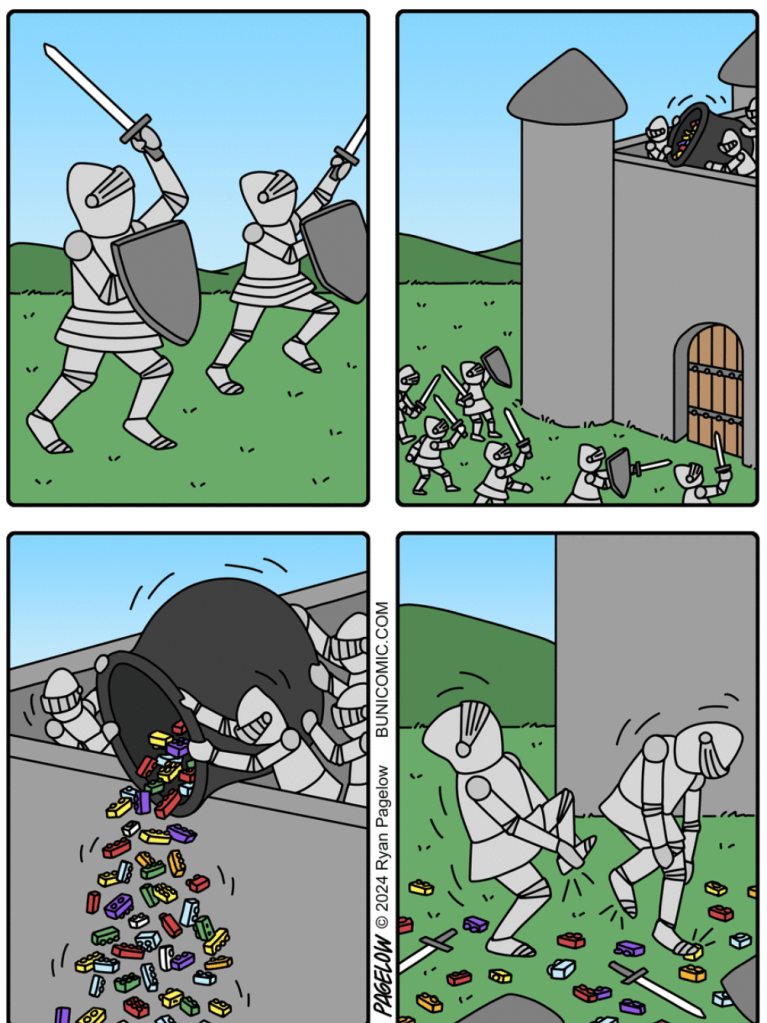
Pete sent this in. It’s also a bit of a CIDU, since wouldn’t knights in armor have metal plate on the bottom of their feet?
And here’s one sent in by Usual John, a bit more of a comic scene-rendering than a gag LOL:


In particular, local rules can cause problems. In the card game Hearts, does the jack of diamonds mean anything special? Can you dump on the first trick? In Monopoly, do you complain that the game takes too long, but put $500 on Free Parking, and allow houses to be turned in for full value? In poker, is the worst low hand A-2-3-4-6 or 2-3-4-5-7? Complain about your favorite example of local rules in the comments.
From the Ask-Me-Anything episode:

 Comics I Don't Understand
According to Wikipedia, armored shoes only covered the top of the foot, and weren’t worn when fighting on foot.
I mean, no, knights didn’t plate the bottom of their boots. That would be tremendously impractical. You’d be unstable on any smooth or uneven surface. Youu’d see chain or interlocking plates that strap on to a regular boot, covering the top and heel, extending up to the lower calf. More often, they’d just wear boots alone, because armor is pretty expensive.
Of course, the “boot” part of the equation matters. Certainly they wouldn’t have bare feet to be the victim of floor Legos.
In the comic, I suppose they may have taken off their boots for their line dancing. They clearly aren’t attacking, just having a little fun dancing in armor with swords.
Oh gosh, now I can’t remember the standard Monopoly rule for what you get for turning in houses or hotels. Is it half the purchase price? I do recall that mortgaging a property gets you a loan of half the purchase price.
But yes, my family did like to put a bonus on Free Parking. The cash sat in the center of the board, not on the FP square; and besides a seed of maybe $200 the kitty would also be built up by fines that players paid based on Chance and Community Chest cards.
RISK had variant rules right there in the booklet, in a section for rapid start playing.
Farkle, a game with 6 dice, has variant scoring that needs to be sorted out ahead. Are three 1s worth 300, or 1000? Is there a minimum score on your roll before you can start counting points? Is there a penalty (negative score) for multiple farkles? Three pairs can be worth anything from 500 to 1500.
For even more alternatives, see farkle-scoring-rules-dicegamedepot.pdf
To add to the Hearts options, I was surprised to learn that “shoot the moon” was just a widespread convention and not a standard rule. (For those unfamiliar, Hearts is played in Bridge-like tricks. The object in a hand is to avoid capturing cards with points, which are 1 point for any Heart card and 13 for the Queen of Spades. As the post indicates, there is a popular “local rule” that the Jack of Diamonds will count to your favor, subtracting some of those penalty points, typically for 11 points.) If a player manages to capture all 13 Hearts and the Queen of Spades, that penalty of 26 points is instead imposed on all the other players, and the one who accomplishes this is said to “shoot the moon”. So in the early stages of a hand you need to take care not to offload all those points onto a single player, in case they can turn that into a shoot. You want to make sure at least two different players have gotten point cards, or as the lingo goes “hearts have been split/broken”.
I should have looked up an authority before launching into an over-confident description. According to Britannica (no particular reason), 1) shooting the moon is a standard rule; and the scoring for that can be accomplished by subtracting 26 from the successful player’s score 2) capturing the Jack of Diamonds is worth 10 points, not the 11 I said, and this is a non-standard option 3) “hearts are broken” is here said to mean some Hearts have been discarded to a trick — and it is disallowed to lead a trick with a Heart until Hearts have been broken. My sense of “Hearts have been split” (hence there is no danger of someone shooting the moon) is not mentioned in the article.
That comicon floor looks kinda thinly populated. Everyone must be off at a Famous Person panel.
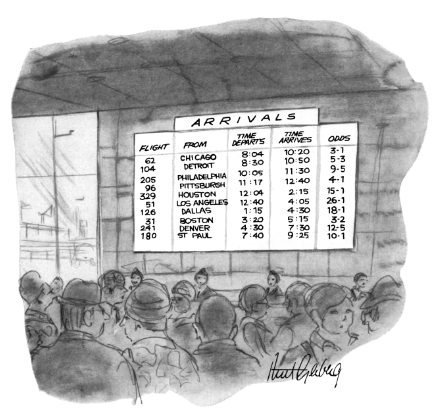
The airport one actually made me LOL. Norway just went through two days of major airport snafus due to technical failures. It very much was a gamble whether you’d be flying or not.
Hearts is played in Bridge-like tricks.
Sort of, but the tricks themselves have no meaning in scoring. As noted, the adverse points from Hearts or the Queen are what matter. When I first started at Megacorp, playing Hearts at lunch was popular. I had played both Hearts and Spades with my friends in college, so I fit right there.
As there were a number of guys that wanted to play, we often had games with five or six players. These don’t divide evenly into 52, so the leftover cards were put in the “kitty” and the first person to take a point also go that, which might have some unpleasant surprises. The players liked that so much that even when there four players they’d still insist on a kitty.
One of the problems in those games was “table talk”. That is, saying things about people trying to shoot or what you passed, that kind of thing. Doing much of that would get you tossed out.
Spades is much more like “bridge lite”. You bid the number of tricks you think you’ll take, it’s often played with partners, and there’s trump (always Spades). There’s only one round of bidding.
The rules we played with in our family allowed us to throw out points in the first round. Like Brian in St. Louis we often played games with more than 4 players which could make taking the first round dangerous between the kitty and the increased likelihood of someone not having clubs. The dealer got to decide if we were passing any cards and how many and what direction , we would set a limit on how many cards could be passed based on how many people were playing and how many cards we had. If you shot the moon you could either choose to go back 26 or have everyone else go ahead 26. We also had a rule if anyone got exactly 100 they would go back to 0.
Right, passing. always three cards in our games. For four players, it was Left, Right, Across, Hold. For more, it was clockwise to every other player then Hold.
I guess. “Hold” was sort of passing to yourself.
The object of Monopoly is to impoverish everyone but yourself. The game was designed to demonstrate the evil of unfettered Capitalism. But it has become a very popular game, and exploiting unfettered Capitalism to impoverish everyone but oneself is now considered admirable and virtuous, both in the game and in real life.
I love Monopoly. I have not played in decades and there is a good chance that I will never play again.
I used to play when young with my middle sister who was 5 years younger. I would help her – trade her properties she needed for example. Our games could go for days. A couple of decades ago I was complaining to her about the fact that Robert does not play any board games (or card games) and she told me that she hated playing Monopoly with me and that I was (forget her exact words) not nice for making her play all the time!
Now I know that Robert and I have/had some version of Monopoly for some computer game setup but not sure which – Atari 800 jumps into my head – but that was his game from before we got married – maybe Atari or Commodore computer - but those also were his. So I am guessing it was a DOS version and I could play alone.
Monopoly: The house rule concerning “Free Parking” is so widespread that the official rules now contain a paragraph that explicitly forbids it. When used, this rule actually tends to shorten the game, because the cash infusion helps players acquire properties and houses somewhat faster. However, the best way to really shorten the game is to insist on using the “auction” procedure to sell off properties that are not purchased by a player who just landed on an available one. We never used that rule when I was a kid, because it seemed a little too “cutthroat” for a family game.
Hearts: When I was in college, we had several rules that significantly elevated the game’s skill level. First: instead of the traditional “deuce of clubs“, the lead for the first trick was “left of dealer” (similar to Bridge, which uses “left of declarer“). Beside reducing predictability and allowing for more strategic initial leads, this also made clubs and diamonds equivalent suits, which was especially important when selecting cards to pass. Second: instead of “hold”, the fourth passing mode was “scatter”, in which each player gave one card to each of the other three, which again multiplied the possible passing strategies. Third: dropping points on the first trick was explicitly allowed. Unfortunately, I have never seen any of these excellent options in any mobile app version of Hearts.
Poker: I have never heard of a “standard” version of Poker that did not treat an ace as the highest card, but there may be “lowball” variations (in which players try to get the worst possible hand) that permit a low Ace.
P.S. @ Keera (8) – That table of flights reminded me of a story about a racehorse that started off at five to one, but came in at quarter past two (respectively: betting odds 5:1, and clock time 2:15).
P.P.S. @ Mitch (6): I have never played Hearts with the “Jack of Diamonds” rule, but it is common enough that it is an optional setting in many of the mobile app versions that I have tried. At least one of them permitted setting a specific value for the card.
& @3: The official trade-in value for houses & hotels in Monopoly is one-half of the purchase price. Before a built-up property can be mortgaged or transferred to another player, all buildings on the entire color group must be liquidated.
… which is why people hate Monopoly – or is among the reasons why – because that literally is the game. If you don’t go with the auction-off-the-properties rule, you don’t have a playable game. I remember when I first actually read the rules of Monopoly before family game night, and on the first turn, when Dad landed on a property and didn’t buy it, I offered one dollar.
Everyone was confused, and I said I read the rules and that’s what you are supposed to do. The point is that every turn should end with a property being bought or a rent being paid – you shouldn’t ever just move and stop. Either there’s a sale, an auction, or someone pays rent to someone. Every turn that someone lands on a property. Someone needs to bid at least one dollar.