I performed 4’33” when I was in college. There are some things most people don’t know about 4’33”:
It is in three movements.
It is written “for any instrument or combination of instruments”.
When performed, there has to be a way to let the audience know when a movement starts and when it ends. Often it is performed on the piano. The keyboard cover is opened to signal the start of a movement and closed to signal the end. But that is one possibility; there is no prescribed way. A vocalist or other instrumentalist would find a way.
It is one of the pieces for which Cage was experimenting with a new notation. In this notation, horizontal distance across the page exactly coincides with timing. For instance, if there were a note to be played exactly 1/3 of the way into the movement, the note would be written 1/3 of the way across the page.
There are no notes or other events. The start of a movement is indicated by a vertical line, and the end of the movement by another vertical line a precise distance to the right of the first. The timing of the movement is written under the second vertical line. Most performers use a stopwatch, but I suppose you could use a pointer or something to slowly track across the page.
The second movement is the longest and is spread across three pages. This means that if you use the published score there will be a page turn. When I performed it, I turned the page at precisely the right time.
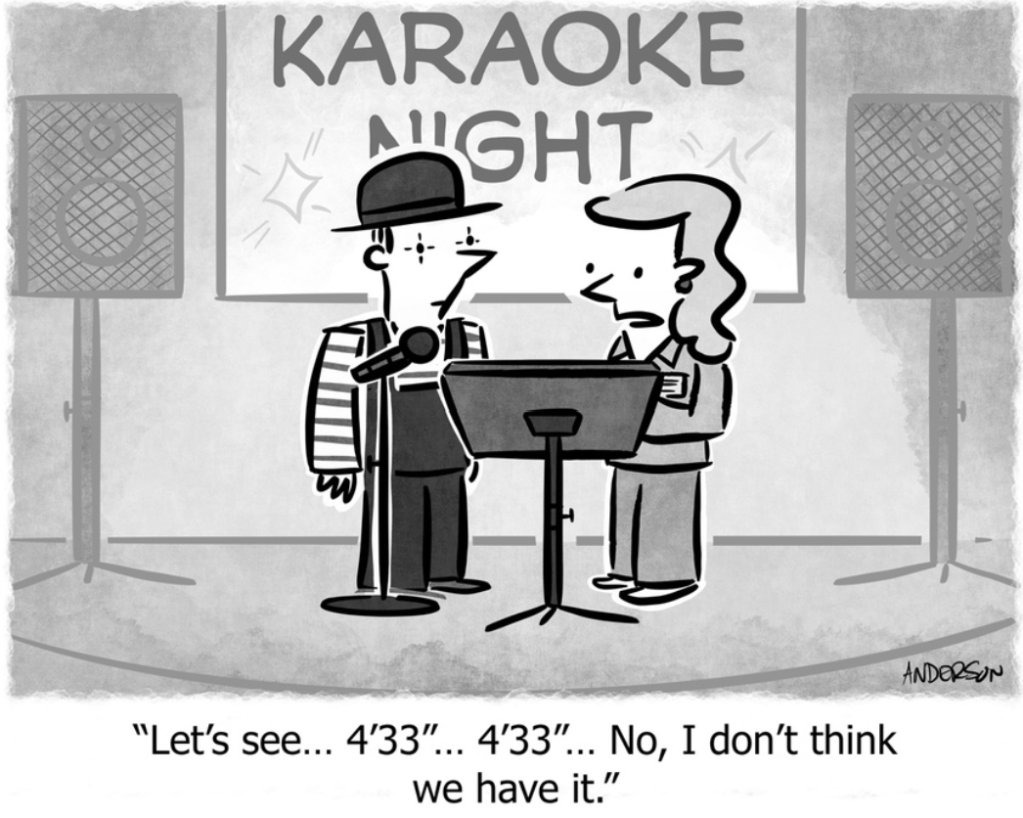
Relating to the comic, I always thought the song was an instrumental.
Coincidentally, my FB feed brought up a random posting of a comic with a similar setup to the one above, with the same song. The caption read to the effect of, “Oh no…not this guy again.”
The word “karaoke” actually comes from Japanese, and it’s made up of two parts: “kara,” which means “empty,” and “oke,” which is short for “orchestra.” In other words, the karaoke meaning in Japanese is “singing without music,” and the word translates to “empty orchestra.”
@Kilby: Why is it so surprising that 4’33” was published in 1952? One year previously, Robert Rauschenberg had painted the visual-arts equivalent, “White Paintings”. https://www.sfmoma.org/artwork/98.308.A-C/ The three-panel painting even looks a bit like the score of 4’33”.
 Comics I Don't Understand
I’ve had 4’33” stuck in my head all day…
LikeLike
I agree with Grawlix @1: John Cage‘s 4‘33“ is the worst of all possible earworms.
P.S. I’m not sure whether that guy’s outfit is supposed to be a “mime” costume, but if it isn’t, then it certainly should have been.
LikeLike
Yeah, it’s a mime with face makeup and the striped shirt and stuff.
LikeLike
Recordings don’t do 4’33” justice. It’s much better as a live performance.
LikeLike
Kilby, it seems to me that 4:33 would be the *best* of all possible earworms.
LikeLike
I finally got the Simon & Garfunkel reference…
LikeLiked by 1 person
LikeLike
I see what you did there, Max…
LikeLike
I must agree with Chak (5). And if it weren’t for allanasaph (6), I wouldn’t have known there was a S&G reference. I’ll leave now, silently.
LikeLike
I saw the post title, but I didn’t make the connection until seeing allanasaph’s comment.
LikeLike
I performed 4’33” when I was in college. There are some things most people don’t know about 4’33”:
LikeLike
Relating to the comic, I always thought the song was an instrumental.
Coincidentally, my FB feed brought up a random posting of a comic with a similar setup to the one above, with the same song. The caption read to the effect of, “Oh no…not this guy again.”
LikeLike
I wish I could remember where I read that the Japanese word “karaoke” originally meant “tone-deaf drunk with microphone”.
LikeLike
Grawlix, check out comment #7 in this thread, by Max Webster. That is probably the comic you’re describing.
LikeLike
Speaking of re-shuffling CD tracks, the re-ordered view of comments in the “reader thread” display appears to have some definite disadvantages.
P.S. @ MiB (11) – I think the most surprising detail about 4’33” is that the piece is 72 years old.
LikeLike
According to one online source I found:
The word “karaoke” actually comes from Japanese, and it’s made up of two parts: “kara,” which means “empty,” and “oke,” which is short for “orchestra.” In other words, the karaoke meaning in Japanese is “singing without music,” and the word translates to “empty orchestra.”
LikeLike
I don’t see anything at #7, but the one I’m thinking of is by Asher Perlman.
Let’s see if this works:
LikeLike
Yes, your embedding technique worked fine! (And also, yes, it is the same cartoon. ;-) )
LikeLike
@Kilby: Why is it so surprising that 4’33” was published in 1952? One year previously, Robert Rauschenberg had painted the visual-arts equivalent, “White Paintings”. https://www.sfmoma.org/artwork/98.308.A-C/ The three-panel painting even looks a bit like the score of 4’33”.
LikeLike