Buffalo buffalo buffalo buffalo. Teamwork makes the team work. Hurt people hurt people.
/
Exercise in indexicality.
Quite an interesting question!
Related
12 Comments
The Frank And Ernest is a really good joke! And definitely a pun, based on settle (for).
IDU the Cornered entirely. Are the editorial remarks meant to illuminate it? Didn’t work, for me.
@ Dana – The caption in “Cornered” is easier to understand with a little strategic expansion: “The support staff supports the staff“. The editorial subtitles are similar examples, but I have to admit that I only understand two out of three, perhaps one has to have lived in New York State (or on the prairie) to get the first one.
P.S. There’s a German tongue twister with a similar gimmick: “Wenn Fliegen hinter Fliegen fliegen, fliegen Fliegen hinter Fliegen her“. In written form, the standard German capitalization of the nouns gives the meaning away (roughly: “When flies fly after flies, (then) fly flies after flies“). But when spoken (and heard for the first time), it is a very difficult puzzle to parse.
Yes, it could be said that malcontents are precisely the ones who will not settle!
@ Phil (3) – Thanks for the link to the explanation. I see that I correctly understood the names of the city and the prairie animal, but what failed was “the verb ‘buffalo‘, meaning to outwit, confuse, deceive, intimidate, or baffle“. I have never heard that word used in that manner.
@Kilby (5): Really? I’m…buffaloed by that! (sorry, couldn’t resist)
I think I have almost always (as a teen or adult) known the verb buffalo. My difficulty with that sentence (in its longer version) and some of the others is the use of a restrictive relative clause without linkage via a relative pronoun. I almost always write or say the “that” even when considered optional, and cringe at writing advice that suggests omitting them as one among many ways to avoid being wordy.
@ mitch (7) – “relative pronoun” – I agree: notice, for instance, the “then” that I interpolated into the English translation of that German tongue-twister @2.
He’s using the fork in his left hand, she’s using the fork in her right hand. Clearly a failed relationship.
Reminds me of the old puzzle: punctuate the following:
That that is is that that is not is not is not that it it is
or this one:
John where Bill had had had had had had had had had had had the teacher’s approval
I’ve only ever heard the verb “buffalo” to mean “confuse” or the like.
I have always heard the verb used same as Brian in STL


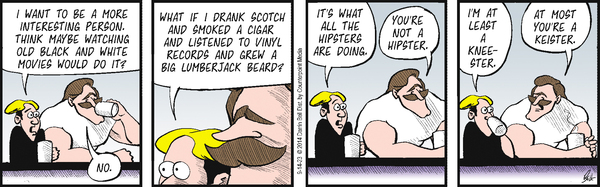


 Comics I Don't Understand
The Frank And Ernest is a really good joke! And definitely a pun, based on settle (for).
IDU the Cornered entirely. Are the editorial remarks meant to illuminate it? Didn’t work, for me.
@ Dana – The caption in “Cornered” is easier to understand with a little strategic expansion: “The support staff supports the staff“. The editorial subtitles are similar examples, but I have to admit that I only understand two out of three, perhaps one has to have lived in New York State (or on the prairie) to get the first one.
P.S. There’s a German tongue twister with a similar gimmick: “Wenn Fliegen hinter Fliegen fliegen, fliegen Fliegen hinter Fliegen her“. In written form, the standard German capitalization of the nouns gives the meaning away (roughly: “When flies fly after flies, (then) fly flies after flies“). But when spoken (and heard for the first time), it is a very difficult puzzle to parse.
Kilby: see https://en.wikipedia.org/wiki/Buffalo_buffalo_Buffalo_buffalo_buffalo_buffalo_Buffalo_buffalo
Yes, it could be said that malcontents are precisely the ones who will not settle!
@ Phil (3) – Thanks for the link to the explanation. I see that I correctly understood the names of the city and the prairie animal, but what failed was “the verb ‘buffalo‘, meaning to outwit, confuse, deceive, intimidate, or baffle“. I have never heard that word used in that manner.
@Kilby (5): Really? I’m…buffaloed by that! (sorry, couldn’t resist)
I think I have almost always (as a teen or adult) known the verb buffalo. My difficulty with that sentence (in its longer version) and some of the others is the use of a restrictive relative clause without linkage via a relative pronoun. I almost always write or say the “that” even when considered optional, and cringe at writing advice that suggests omitting them as one among many ways to avoid being wordy.
@ mitch (7) – “relative pronoun” – I agree: notice, for instance, the “then” that I interpolated into the English translation of that German tongue-twister @2.
He’s using the fork in his left hand, she’s using the fork in her right hand. Clearly a failed relationship.
Reminds me of the old puzzle: punctuate the following:
That that is is that that is not is not is not that it it is
or this one:
John where Bill had had had had had had had had had had had the teacher’s approval
I’ve only ever heard the verb “buffalo” to mean “confuse” or the like.
I have always heard the verb used same as Brian in STL