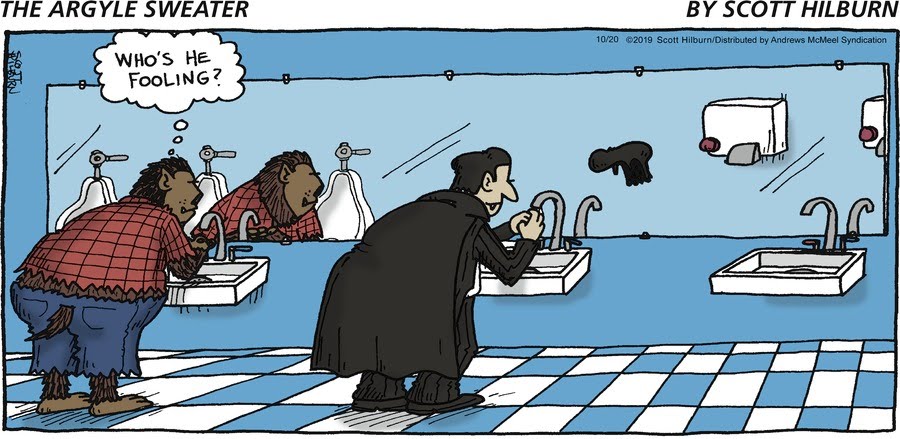
Not a CIDU really, but there is an unspoken line someone may want to fill in for us.
(Yes, this one was previously seen here.)
Related
28 Comments
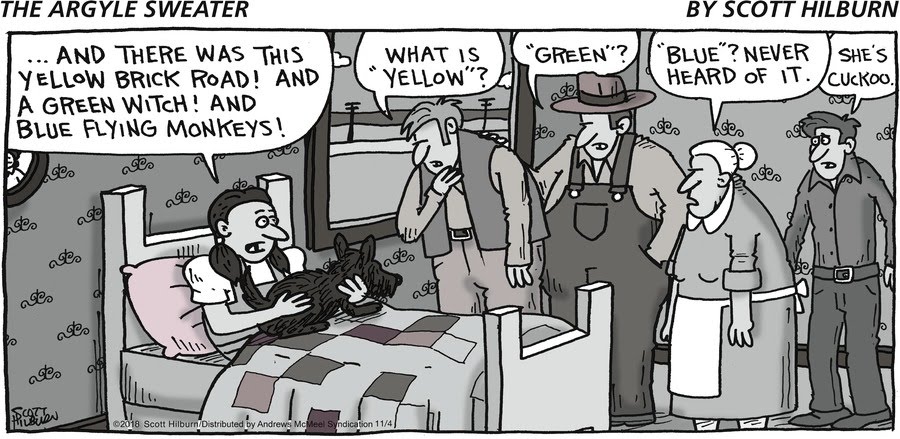
This week’s “Invitational” results list “realistic revisions to famous scenes”, including this change to “The Wizard of Oz“, by Beverley Sharp: “At the end of the film, when Dorothy wakes up in Kansas and realizes it was all a dream, she becomes severely depressed, because frankly, life on the farm can get pretty boring — especially when all of a sudden everything’s in black and white.”
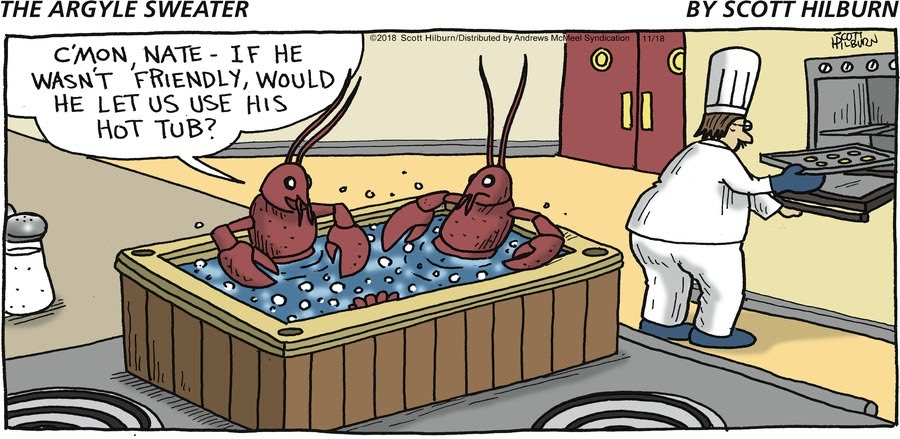
P.S. That last comic (with the eels) may not be a CIDU now, but that’s mostly thanks to this discussion.
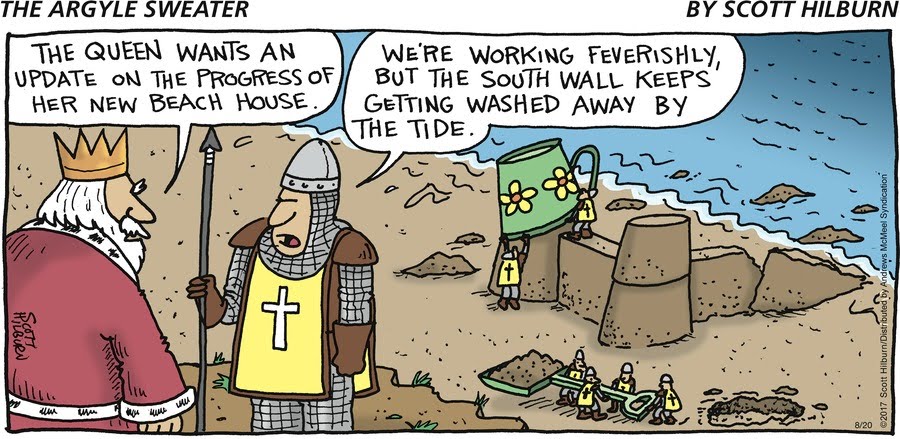
P.P.S. Addendum for the first one: “…and somebody laid a big egg on the north wall, but it fell down and broke, and then the horses trampled it to bits.“
I’m seeing a weird notice about “This post is just for subscribers” and also that the comments are closed. We’re trying to track down these anomalous settings…
@ Mitch – An additional anomaly is that larK’s comment scraper reports just ONE comment in this thread, posted by “Anonymous”.
There was indeed a novel setting, about “newsletter access”. I think it should be cleared up.
Kilby, thanks for checking. Is the “subscribers only” notice gone? (I had to switch browsers too). And in re larK’s scraper, remember it runs periodically, at something like ten minute intervals. So the count of one comment may have been accurate as of the latest check.
If a hairpiece is properly reflected in-mirror, wouldn’t Dracula’s clothing be as well?
The penultimate one (restroom washbasins scene) is a bit of CIDU for me.
(No subscribers only warning)
Dana, does Powers’s comment on that same strip help you at all? One bit of vampire tradition is that they don’t visibly reflect in mirrors…
@ Mitch – Like Dana, I never saw any “subscribers only” message, and as for comment scraping, I wasn’t worried that my comment had not (yet) been scraped, I was simply puzzled that larK’s system picked up an “anonymous” comment than seems to have preceeded mine, but is now nowhere to be found.
P.S. @ Dana – The idea is that since his hair shows up in the mirror†, it proves (to the werewolf) that Drac is wearing a toupee, but as Powers pointed out, it would then seem logical that his clothes should show up there, too. On the other hand, in most movies in which the transformation is shown, he goes from being a (naked) bat to become an elegantly attired vampire, so perhaps his “clothes” count as “fur”.
P.P.S. † Hilburn did a very good job of getting the perspective on the “reflected” toupee exactly right.
I’ve always wondered about that. Maybe next year the movie “Dracula’s Tailor” will come out, and we’ll all find out.
Kilby – Having read the invitational last night, that was my first thought too when I saw the Oz/Argyle.
Does the guy saying “Green?” have a brown hat in an otherwise black-and-white picture? Actually, on closer examination, the bedclothes and pillow have some light pink in them, and the clothes on the two guys closest to the bed aren’t greyscale either. Or is this just my eyes??
Well somebody had to say it: a moray is amore isa more, eh?
To reassure phiiicidu, I too detect subtle colours in Dorothy’s bedroom scene. I’ve long wondered what it would have been like to experience that transition from the usual black and white movie to Technicolor and back again for the first time.
Looks like Dorothy came back to a sepia-tinted Kansas.
Kilby: There actually is a movie, “Return to Oz” made in 1985, in which Dorothy, although not depressed, is sent to a sanatorium by Aunt Em and Uncle Henry for shock treatments. All her talk of being in Oz makes them think she is delusional. Supposedly the plot comes right out of the original Oz books.
@ MiB – About a year ago I picked up a copy of the first “Oz” book (in English) at our local bookstore. The artwork was from some spastic klutz in the 1980s, but the text was just as Baum had written it. Even though the original movie is vastly different from that book, I gained a lot of respect for the scriptwriters ability to ferret out the elements that could be used, in contrast to other parts that just wouldn’t work in a movie, especially not back when it was made.
P.S. I had that same respect for Jackson’s scriptwriters in the first two “Lord of the Rings” movies, but then the idiots who wrote the third movie went and destroyed the fabric of the story just for the sake of some superfluous special effects.
You can get e-book versions of many of the early ones with illustrations at Gutenberg.org. The one I have has the original Denslow illustrations.
I’d quibble about the movie being vastly different. Other than the “was it a dream” and the truncating of the last part featuring the trip to the Witch of the South, I think events were pretty faithful. I did like the different take on the flying monkeys in the book.
Everyone seems to forget that Dorothy’s original problem in “Wizard of Oz” remains unresolved at the end. The sheriff has issued an order for Toto to be destroyed; that doesn’t just go away because she either had some weird dream, or actually visited a magical land. Even if Ms Gulch were killed in the tornado, Toto’s death sentence for biting would remain in effect.
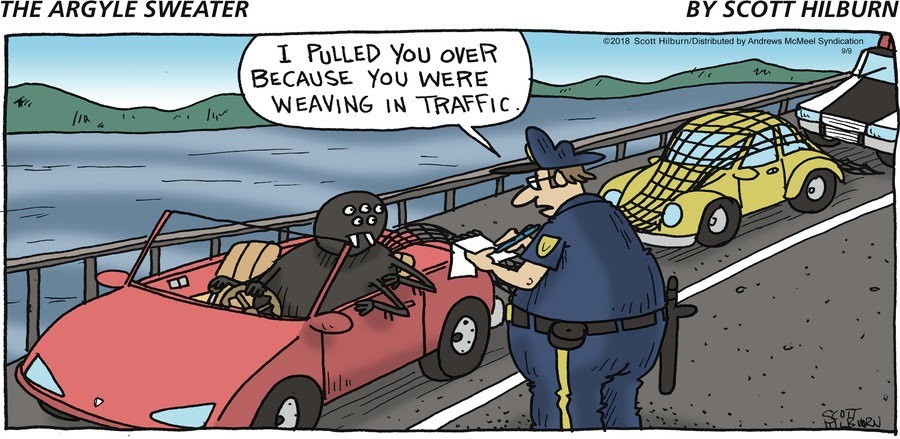
I do like the “weaving in traffic” one, though.
The first Oz movies were made by Baum himself, around 1915. Baum didn’t have a problem with adding stuff or changing stuff for the movie, although he kept things fairly consistent with both what we would today call the Oz Cinematic Universe and the Oz Book Universe.
As for Toto, he never made it to wherever Ms. Gulch was taking him. Elvira Gulch appears not to have been particularly well-liked in the town, so most likely the sheriff filed the execution order somewhere when she didn’t show up.
He also was involved with a stage production, which had a lot of differences, although there were many changes to his original contributions.
@ Brian – Thanks very much for the Gutenberg link. That website was involved in a petty copyright war with a German publishing house, and had blocked all German users from accessing the website. It’s nice to see that they’ve settled their differences.
P.S. The first time I saw a copy of “The Wizard of Oz” in German (a couple of decades ago), I was astonished to see that the credited “author” was not Baum, but “Aleksandr Volkov“, a Russian writer who “adapted” the “Oz” books. Before unification, translations of the “Volkov” versions were the only ones available in East Germany.
Larry Semon made a full-length silent version of The Wizard of Oz in 1925, working with Baum’s son Frank Joslyn Baum on the writing. It is truly strange. Dorothy is 18 years old when a big secret is revealed to her: she is the heir to the throne of Oz and the intended bride of Prince Kynd. She travels to Oz with three farmhands: Larry Semon, Oliver Hardy, and a Black actor who gets to be the butt of some terrible racist gags, not the least of which is having his name listed in the credits as “G. Howe Black”. Together they must help Prince Kynd defeat the usurpers Prime Minister Kruel and Lady Vishuss. No Toto. No Wicked Witch. In the course of their efforts the farm hands briefly disguise themselves as a scarecrow, a tin man, and a lion respectively. Yes, there is a Wizard; he does parlor tricks to help Kruel keep the people distracted.
The movie was not a success, but is it canonical, considering that the younger Baum was involved? I suppose we can compare the case of Christopher Tolkien.
The scene in the 1939 Wizard Of Oz film where it transitions from monochrome to color was filmed on color stock with some set and costume elements painted monochrome to complete the illusion. The monochrome opening and closing scenes were shot on B&W film with sepia toning applied, a chemical process.
Also, the cartoon with the spider in his car is interesting since an open sports car is sometimes referred to as a “spyder”, especially in Europe.
@ MiB – Those two cases are certainly (somewhat) “comparable”, but by no means “equivalent”. Another one worth mentioning is Christopher (Robin) Milne, who wrote at least five books, in part describing his experiences as “the most famous boy in literature” (as the German translator Harry Rowohlt described him). For anyone who has read and enjoyed the two “Pooh” books, I would definitely recommend “The Enchanted Places” and “The Path Through the Trees“.
@ Kilby: Another case would be Maeve Gilmore, the widow of Mervyn Peake. Peake died in 1968, and his three novels Titus Groan, Gormenghast, and Titus Alone were re-published as a trilogy to capitalize on the success of The Lord of the Rings. Never mind that The Lord of the Rings was intended to be a single publication, not a trilogy. And never mind that the Gormenghast books were intended not to be a trilogy but a continuing series of novels Peake left a few pages of notes for the fourth novel, Titus Awakes. Gilmore turned it into a complete novel and it was published long after her death. I tried to read it, but it reads like fanfiction to me.
For some reason a few months ago I was getting ready to refer to “The Gormenghast Trilogy” and was astonished to see that it is now treated (by some) as a series of five!
The Argyle Sweater gave me a great idea.
Next time Robert is changing lanes too often I will use a version of this idea on him. His latest (of maybe a decade’s time) craft is weaving. He has two looms and our living room serves as his “loom room” from mid January through mid December. (I get it back for the month between to decorate for Christmas and it again becomes the living room.)

 Comics I Don't Understand
This week’s “Invitational” results list “realistic revisions to famous scenes”, including this change to “The Wizard of Oz“, by Beverley Sharp: “At the end of the film, when Dorothy wakes up in Kansas and realizes it was all a dream, she becomes severely depressed, because frankly, life on the farm can get pretty boring — especially when all of a sudden everything’s in black and white.”
P.S. That last comic (with the eels) may not be a CIDU now, but that’s mostly thanks to this discussion.
P.P.S. Addendum for the first one: “…and somebody laid a big egg on the north wall, but it fell down and broke, and then the horses trampled it to bits.“
I’m seeing a weird notice about “This post is just for subscribers” and also that the comments are closed. We’re trying to track down these anomalous settings…
@ Mitch – An additional anomaly is that larK’s comment scraper reports just ONE comment in this thread, posted by “Anonymous”.
There was indeed a novel setting, about “newsletter access”. I think it should be cleared up.
Kilby, thanks for checking. Is the “subscribers only” notice gone? (I had to switch browsers too). And in re larK’s scraper, remember it runs periodically, at something like ten minute intervals. So the count of one comment may have been accurate as of the latest check.
If a hairpiece is properly reflected in-mirror, wouldn’t Dracula’s clothing be as well?
The penultimate one (restroom washbasins scene) is a bit of CIDU for me.
(No subscribers only warning)
Dana, does Powers’s comment on that same strip help you at all? One bit of vampire tradition is that they don’t visibly reflect in mirrors…
@ Mitch – Like Dana, I never saw any “subscribers only” message, and as for comment scraping, I wasn’t worried that my comment had not (yet) been scraped, I was simply puzzled that larK’s system picked up an “anonymous” comment than seems to have preceeded mine, but is now nowhere to be found.
P.S. @ Dana – The idea is that since his hair shows up in the mirror†, it proves (to the werewolf) that Drac is wearing a toupee, but as Powers pointed out, it would then seem logical that his clothes should show up there, too. On the other hand, in most movies in which the transformation is shown, he goes from being a (naked) bat to become an elegantly attired vampire, so perhaps his “clothes” count as “fur”.
P.P.S. † Hilburn did a very good job of getting the perspective on the “reflected” toupee exactly right.
I’ve always wondered about that. Maybe next year the movie “Dracula’s Tailor” will come out, and we’ll all find out.
Kilby – Having read the invitational last night, that was my first thought too when I saw the Oz/Argyle.
Does the guy saying “Green?” have a brown hat in an otherwise black-and-white picture? Actually, on closer examination, the bedclothes and pillow have some light pink in them, and the clothes on the two guys closest to the bed aren’t greyscale either. Or is this just my eyes??
Well somebody had to say it: a moray is amore isa more, eh?
To reassure phiiicidu, I too detect subtle colours in Dorothy’s bedroom scene. I’ve long wondered what it would have been like to experience that transition from the usual black and white movie to Technicolor and back again for the first time.
Looks like Dorothy came back to a sepia-tinted Kansas.
Kilby: There actually is a movie, “Return to Oz” made in 1985, in which Dorothy, although not depressed, is sent to a sanatorium by Aunt Em and Uncle Henry for shock treatments. All her talk of being in Oz makes them think she is delusional. Supposedly the plot comes right out of the original Oz books.
@ MiB – About a year ago I picked up a copy of the first “Oz” book (in English) at our local bookstore. The artwork was from some spastic klutz in the 1980s, but the text was just as Baum had written it. Even though the original movie is vastly different from that book, I gained a lot of respect for the scriptwriters ability to ferret out the elements that could be used, in contrast to other parts that just wouldn’t work in a movie, especially not back when it was made.
P.S. I had that same respect for Jackson’s scriptwriters in the first two “Lord of the Rings” movies, but then the idiots who wrote the third movie went and destroyed the fabric of the story just for the sake of some superfluous special effects.
You can get e-book versions of many of the early ones with illustrations at Gutenberg.org. The one I have has the original Denslow illustrations.
https://www.gutenberg.org/ebooks/author/42
I’d quibble about the movie being vastly different. Other than the “was it a dream” and the truncating of the last part featuring the trip to the Witch of the South, I think events were pretty faithful. I did like the different take on the flying monkeys in the book.
Everyone seems to forget that Dorothy’s original problem in “Wizard of Oz” remains unresolved at the end. The sheriff has issued an order for Toto to be destroyed; that doesn’t just go away because she either had some weird dream, or actually visited a magical land. Even if Ms Gulch were killed in the tornado, Toto’s death sentence for biting would remain in effect.
I do like the “weaving in traffic” one, though.
The first Oz movies were made by Baum himself, around 1915. Baum didn’t have a problem with adding stuff or changing stuff for the movie, although he kept things fairly consistent with both what we would today call the Oz Cinematic Universe and the Oz Book Universe.
As for Toto, he never made it to wherever Ms. Gulch was taking him. Elvira Gulch appears not to have been particularly well-liked in the town, so most likely the sheriff filed the execution order somewhere when she didn’t show up.
He also was involved with a stage production, which had a lot of differences, although there were many changes to his original contributions.
@ Brian – Thanks very much for the Gutenberg link. That website was involved in a petty copyright war with a German publishing house, and had blocked all German users from accessing the website. It’s nice to see that they’ve settled their differences.
P.S. The first time I saw a copy of “The Wizard of Oz” in German (a couple of decades ago), I was astonished to see that the credited “author” was not Baum, but “Aleksandr Volkov“, a Russian writer who “adapted” the “Oz” books. Before unification, translations of the “Volkov” versions were the only ones available in East Germany.
Larry Semon made a full-length silent version of The Wizard of Oz in 1925, working with Baum’s son Frank Joslyn Baum on the writing. It is truly strange. Dorothy is 18 years old when a big secret is revealed to her: she is the heir to the throne of Oz and the intended bride of Prince Kynd. She travels to Oz with three farmhands: Larry Semon, Oliver Hardy, and a Black actor who gets to be the butt of some terrible racist gags, not the least of which is having his name listed in the credits as “G. Howe Black”. Together they must help Prince Kynd defeat the usurpers Prime Minister Kruel and Lady Vishuss. No Toto. No Wicked Witch. In the course of their efforts the farm hands briefly disguise themselves as a scarecrow, a tin man, and a lion respectively. Yes, there is a Wizard; he does parlor tricks to help Kruel keep the people distracted.
The movie was not a success, but is it canonical, considering that the younger Baum was involved? I suppose we can compare the case of Christopher Tolkien.
The scene in the 1939 Wizard Of Oz film where it transitions from monochrome to color was filmed on color stock with some set and costume elements painted monochrome to complete the illusion. The monochrome opening and closing scenes were shot on B&W film with sepia toning applied, a chemical process.
Also, the cartoon with the spider in his car is interesting since an open sports car is sometimes referred to as a “spyder”, especially in Europe.
@ MiB – Those two cases are certainly (somewhat) “comparable”, but by no means “equivalent”. Another one worth mentioning is Christopher (Robin) Milne, who wrote at least five books, in part describing his experiences as “the most famous boy in literature” (as the German translator Harry Rowohlt described him). For anyone who has read and enjoyed the two “Pooh” books, I would definitely recommend “The Enchanted Places” and “The Path Through the Trees“.
@ Kilby: Another case would be Maeve Gilmore, the widow of Mervyn Peake. Peake died in 1968, and his three novels Titus Groan, Gormenghast, and Titus Alone were re-published as a trilogy to capitalize on the success of The Lord of the Rings. Never mind that The Lord of the Rings was intended to be a single publication, not a trilogy. And never mind that the Gormenghast books were intended not to be a trilogy but a continuing series of novels Peake left a few pages of notes for the fourth novel, Titus Awakes. Gilmore turned it into a complete novel and it was published long after her death. I tried to read it, but it reads like fanfiction to me.
For some reason a few months ago I was getting ready to refer to “The Gormenghast Trilogy” and was astonished to see that it is now treated (by some) as a series of five!
The Argyle Sweater gave me a great idea.
Next time Robert is changing lanes too often I will use a version of this idea on him. His latest (of maybe a decade’s time) craft is weaving. He has two looms and our living room serves as his “loom room” from mid January through mid December. (I get it back for the month between to decorate for Christmas and it again becomes the living room.)