But isn’t it still the same body, regardless of the personality taking it over? And that body has just gotten double dose of the vaccine?
Related
59 Comments
You know, I read this comic on Sunday and never thought o’ that . . . you’re right. You can’t vaccinate a ‘personality’, just the body it’s in. Imagine vaccinating someone with even more than two personalities.
Makes for an amusing comic, tho.
Sorry for the delay in the post appearing this morning. I messed up AM and PM in the scheduler. ==mitch
I thought the same thing, but decided to assume the nurse faked it.
We’re trying to apply logic to Hunk-Ra? That whole storyline has always seemed very weak to me.
But then, I’ve never met anyone who claimed to channel anyone. My friends have different curious spiritual beliefs. :)
In addition to giving someone two doses, the health care “professional” is also not wearing gloves. I’m not sure she’s the right person for this job.
Sorry for the double post, but now I’m distracted by how her watch/bracelet thing keeps switching from one wrist to the other.
Right, we don’t know the metaphysical ground rules for “channelling”. But why would they differ from better-studied DID (formerly called MPD)?
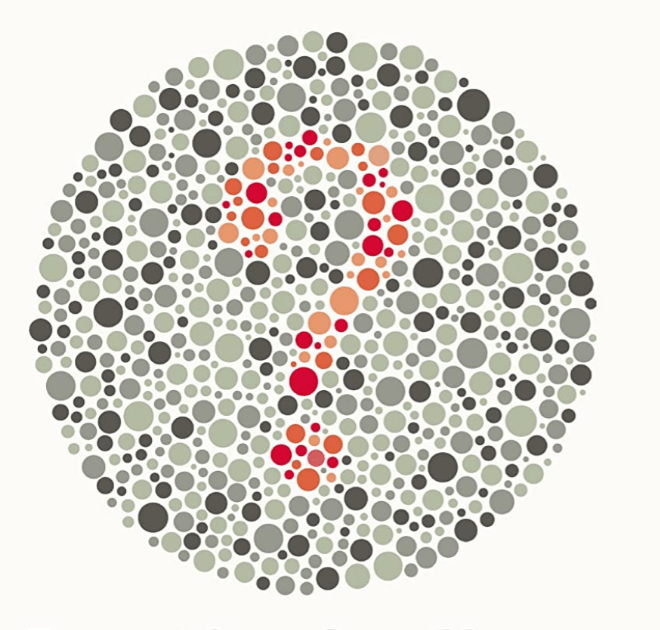
Is that a color-blindness test at the top? Does anybody see something different from a big question mark?
For the original Hulk there were severe enough changes physically that we can’t write it off as a purely mental / psychological phenomenon. Here her body seems mostly unchanged (the hair is probably just flying wild, not physically replaced), altho her costume is [shown as] physically replaced.
Sure, it doesn’t logically make sense, but that’s part of the joke.
I agree with Winter Wallaby. This is a cartoon, you know. It’s not supposed to make real-world sense.
On the other hand, there is some physical change. “It” has a forked tongue and pointy fingernails. And it’s … dressed differently.
Sure, it doesn't logically make sense, but that's part of the joke.
Yeah, and our griping about the logic is our way of appreciating the joke.
I was trying to figure out if “Shella Na Gigs” was an anagram, and stumbled on the Wiki article for “sheela na gig,” which is apparently a carving of a woman showing off her lady bits, found on multiple European churches.
Yes, and what’s even funnier to me is that her husband(?) goes along with it (I thought she was married to the guy in the football helmet), and knows how to bring him [Hulk] out of her, as tho it’s perfectly normal.
When I saw this one, my thought was that Trudeau was ripping off Rose Is Rose‘s schtik, only even less comprehensibly…
BD hasn’t worn a helmet since he lost his leg to an IED.
Is Hunk-Ra male or female? In panel 7 it looks like female clothing, and she’s referring to herself as a princess. But in panel 5 he’s called “him.”
Hunk-Ra has always been shown as very male. The princess to which Hunk is referring in panel 7 is his mother, who was just dissed (deliberately) by B.D. in panel 6. Not sure why the female clothing, though. I suppose maybe Boopsie can channel Hunk’s mother under certain circumstances, though I don’t think she’s every displayed that power before. (And notice that the nurse says “Got him” anyway. Confusing.)
Oh, right, it’s in response to “your mama”.
“Sorry for the delay in the post appearing this morning. I messed up AM and PM in the scheduler. ==mitch”
24-hour clocks for the win!
I was sad when I moved back to Canada. It’s difficult to find clock radios that are in 24-hour format. I have been tripped up by AM/PM confusion too many times. And I mean proper clock radios, made by company’s like Sony and such (though there are fewer of these available as time passes), not those ones that just beep or want to Bluetooth your phone.
That said, as big a fan of the 24-hour clock as I am, I do not think I would like using an analogue 24-hour clock.
@ Dysfunctional – Sheelanagig is also the name a stompy instrumental folk outfit from my part of the world (SW England) – https://sheelanagig.co.uk/
On a detective show I was watching, the lead detective is getting a briefing from the CCTV tech. The screen shows an entry for 18:00 and the tech says “and here we see him leaving, six o’clock on the dot..”.
I’m conversant in both, but that does seem silly. I guess it was because they thought “the audience won’t understand!”‘
I just really like not having confusion over AM/PM. Especially when having to do things like read train timetables or schedule meetings and phone calls. Time zones are bad enough. :) Most of the people I work with are in Europe (mostly in one time zone), so any discussion that includes a time must be made absolutely clear.
Hunk-Ra’s appearance is fairly consistent with past appearances. Here’s one that, in spite of the GoComics date, is originally from 1990:
SingBill, with an actual clock-radio, there can be the additional complication that besides the AM and PM indicators lighting up, there may be AM and FM indicators as well. Then you see that AM and have to reason out which one it must be.
Oh, that sounds bad! My current one has an AM/FM switch on the side and no indication on the display. What describe is just so hostile to the user experience.
A long time ago I visited Montreal or Montréal, a city where both French speakers and English speakers can feel that they are out of place. English speakers do AM/PM and French speakers do 24-hour. Many shows are put on with English and French versions alternating, so you’ll see something like this:
English: 6 and 8 p.m.
Français: 19.00 et 21.00 h.
Montreal seemed nice when I visited. I could imagine living there. It would certainly improve my French. And it is, unlike much of Quebec, rather bilingual (though I understand the degree varies from area to area). I was able to function in English without difficulty during my visit. I was amazed how shop clerks seemed to be able to immediately pick up on which client preferred which language and greeted them appropriately.
I had a friend that traveled to Montreal, and he said that the convention for those that were bilingual was to say something like, “Hello Bonjour” and the other would respond in the preferred language.
re: ” I was amazed how shop clerks seemed to be able to immediately pick up on which client preferred which language and greeted them appropriately.”
I had three years of French (one in HS and two in college) and, in later life, have used it in speaking (as opposed to reading) situations for only one word, and that failure, in a Francophone booksstore in Vancouver BC forty years or so ago. I found a book I wanted but didn’t see a price; took it to the clerk, asked my one word — “Combien?” — and the clerk looked at me, recognized my pathetic accent, and answered me in English.
I had a comparable experience a few years before in Melbourne trying to order something in my “best Australian accent.” Spotted for a Yank poseur right away.
As for reality, Doonesbury is also the strip in which Zonker could talk to his plants. And they’d answer. Aloud. In English. Which Mike could also hear.
re: “I was amazed how shop clerks seemed to be able to immediately pick up on which client preferred which language and greeted them appropriately.”
I remember being in the Friday outdoor market in Riberac in the Dordogne, an area of France that has plenty of English visitors and residents. One market stallholder was gamely trying to converse with a couple of middle-aged female customers in English – “‘Ow ar yeu enjoing yor steh?” or something like that. They stared at him in blank incomprehension, so he tried again. This time understanding blossomed on their faces like the rising sun and one of them said “Ah, non, nous sommes français!”
I was only a visitor, though sometimes for months at a time. I had one French photographer friend who lived there who was not a local but originally from Paris. One day, also at the market, she confided to me that she found it a lot easier to understand what the English were saying than the locals speaking their local dialect.
I prefer 24h time , but can understand AM/PM with one exception, I find it totally absurd that 12AM is midnight and 12PM is noon.
If I hadn’t been reading Doonesbury Classics for the last few years, I’d have had no idea who Hunk-Ra was. I don’t think he’s appeared in new strips since I started reading regularly back around the turn of the century.
GiP says: I find it totally absurd that 12AM is midnight and 12PM is noon.
I think any convention using AM or PM for noon and midnight (in either match-up) is bound for confusion and objection. That’s why you can see some people or organizations schedule things for an 11:59 or a 12:01 time.
When I worked at a hospital — and often on an overnight shift — at the (Inpatient and IV) Pharmacy we got copies of doctors’ orders forms that had meds. There was a standard in our handbooks, but most commonly you would see “12 N” or just “N” for noon, and “12 MN” or just “MN” for midnight.
Personally I’m a fan of the etymological approach. AM stands for {“ante meri-diem” or “before middle-day” or before noon; and PM stands for “post meri-diem” or “after middle-day” that is, after noon. So noon itself is the “meridiem” — and could be abbreviated M. Yes, really, that would give you 11:59 AM, then 12:00 M, then 12:01 PM. I don’t know what midnight would be, but probably 12 PM.
There is some practical-use sense to the modern most common convention (perhaps official in some circles) that GiP decries. We can arrive at that by asking what the number “12:00” is more like, “11:59” or “12:01”. Arguably, it’s much more like “12:01”, and from that we are supposed to agree that 12:00 a minute before 12:01 AM (so, midnight) outght to be 12:00 AM, and the 12:00 leading to 12:01 PM (thus, noon) ought to be 12:00 PM.
Another take is that things are fine with PM, where two interpretations of “after” coincide on the same practical arrangement — say (A) 8 PM is the 8th hour mark WITHIN THE PORTION OF THE DAY AFTER NOON or (B) 8 PM is the hour mark that COMES 8 HOURS LATER THAN NOON. Both of these work out to the time we call 8PM or 20.00h on the 24 hr clock. (The minutes of the hour between noon and 1PM do not work out at all. We should be calling them 00:01 PM etc)
Now try those on for AM. (A) 8 AM is the 8th hour mark WITHIN THE PORTION OF THE DAY BEFORE NOON . Check, that works. Can we also say (B) 8 AM is the hour mark that COMES 8 HOURS EARLIER THAN NOON? No, not at all. That would describe the time we call 4 AM.
This may explain why the AM/PM system is so counterintuitive in the first place. We’re not going to have a countdown-to-noon system for the AM hours, but a part of us hears it that way. But also it contains an argument that midnight should be 12:00 PM.
Shrug: your French speaking adventure was not a failure, communication was achieved, the clerk understood you, you got the information you asked for. Was the clerk a rude jerk? I leave that as an exercise for the reader.
The clerk was not, as I recall, rude at all. But I described it as a “failure” because I had arguably spent three years learning a language only to find that the one and only time I “used” it — and then only a single word — it turned out to be unneeded.
(Yeah, I know that’s not quite the case, since I have used my reading knowledge of French many times, including passing one of the foreign language requirements in my PhD program — though I never finished the program. But at the time it felt that way.)
What’s weird about AM/PM is that the ancients had a 12-hour day, based on the sundial. In the Bible you will read about “the first hour” or “the eleventh hour”, the latter meaning “at the last minute.” The first hour started at sunrise. There were only hours during daylight. At night, the sundial was useless, so no hours.
There is no 12 A.M. or 12 P.M. There is only Noon and Midnight. The idea that it must fit the pattern is an artifact of the digital age, which can accommodate no exception.
Though, of course, they can if the people making them really want to. When I worked at a bank, they were clear that there were to be no apostrophes in any addresses anywhere in all of Canada. Except St. John’s. That had an apostrophe. Because they knew they couldn’t get away with omitting it.
To Mark in Boston on sundial dependence…
Of course there were eventually timekeeping systems that did not depend on daytime sunlight. Such as waterwheel clocks and sand hourglasses. Even during the time of Phillip of Macedon, his royal heir was given to inventions (famously under the tutelage of Aristotle), and devised a way of estimating the passage of time by rate of evaporation of water from a strip of old cloth you tied around your wrist, and allowed to dry (and change color) while you went about your normal business.
This was called Alexander’s rag time-band.
There is no 12 A.M. or 12 P.M. There is only Noon and Midnight. The idea that it must fit the pattern is an artifact of the digital age, which can accommodate no exception.
An d as I mentioned in passing earlier, one solution for contexts where the format must be obeyed but the errors around straight-up noon and midnight are rife, some sources take to scheduling things for 11:59 PM and so on.
BTW did we miss mentioning the additional downfall of the semi-standard convention (12:00 AM for midnight, 12:00 PM for noon) is what day midnight is part of. If you hear “they set a deadline of Midnight of Tuesday for bids” I think it be understood to mean a minute after 11:59 PM Tuesday, thus a minute before 12:01 AM Wednesday. Yet the convention of calling midnight 12:00 AM was based on it being contiguous with 12:01 AM would seem to put it as part of the following day.
deety – I saw the question mark also.
Several decades ago Robert and I went to Quebec and Montreal. We each took Spanish in high school, so French – only common words. We quickly learned that people seemed to say some things twice – starting in their language – such as we would say please/porfavor while a French speaking person would say porfavor/please.
The movie theater across the street from the hotel in Montreal was showing “le fre mas futer du Sherlock Holmes” (I am sure I have spelled the French wrong, my apologies). We were watching the Muppet show on TV – they all spoke French and when Miss Piggy should be speaking French (while the others spoke English) she spoke Italian instead.
Meryl – When I have closed-captioning on, to follow the mostly-English dialogue of something on television, they have in general a rather minimal way of handling a phrase from another language dropped into the dialogue: the captioning will just say “[foreign language phrase]”. I can understand that they don’t want to require their transcribers to recognize a number of languages and be able to transcribe brief phrases from them — the job is to hear the English accurately and capture it in text.
Still, if the goal is to help deaf viewers have an experience close to what a hearing member of the audience would have, it wouldn’t be a huge stretch to at least allow them to try — since a largely-monolingual English-speaking audience member is not going to be baffled when a character says, for instance, “Hola amigo”, and the captioning could try not to be baffled either. no, I don’t mean that the CC should be saying “Hi, pal” but more like “[Greeting in Spanish]” or “[Spanish phrase]” or even “Hola amigo” — still not taking on translation duties but giving the deaf CC reader the same experience a hearing audience member gets, which is receiving the dialogue in the language it is uttered in, and leaving it up to them to understand it.
OTOH I think they do a very good job, when there is extended translation going on, of tossing in an “[In English]” when the spoken dialogue drops back to English, and hearing audience members would catch of course.
I wish more movies would pay attention to language and the fact that different languages can be spoken, and whether you, and the characters in the story, understand the language, or not, has important ramifications on the story. I just saw the movie about the capture of Eichmann, and I would have liked to know, when the Israeli agents approached him, were they talking Spanish? German? English? Later when they’ve captured him, what language are they speaking? (Yes, they made passing attempts in both cases, starting with actual Spanish for the approach, but then quickly switching to English — was that “English” supposed to be continued Spanish, German, Actual English? It makes a difference! And yes, when questioned, he spoke some Hebrew, but again, when it petered out, did he return to… Spanish? German? English? …Yiddish?)
The absolute worst is when characters speaking their native language speak English with stupid accents — why? They are speaking natively, why should we hear them as speaking in a hobbled “accent”? Chokolat is the poster child for this abuse; more recently, The Zookeeper’s Wife needlessly engaged in it, too. Sgt. Schulz did an excellent job, on the other hand — when he was narrating, he spoke flawless, flowing English; when he was on the ground as a spy in England, his English was good, but subtly German-accented. Actual German was used for brief things when the actual content of what was being said wouldn’t matter, but when German’s were talking German to each other, they used flawless native English; these same characters, when speaking actual English, would have the subtle (or not so subtle) German accented English. Basically, it used the outrageous convention from Allo, Allo, without it seeming an outrageous convention. (In Allo, Allo, the characters spoke accented English to represent foreign languages, the accent changing with the language being represented, often to hilarious effect.)
Of course books face some of the same language issues, but the pain of doing it wrong is probably stiffer in the case of film and tv, as you may have an actor uttering something completely implausible.
A case of doing it right in a book can be found in Call It Sleep, Henry Roth’s 1934 novel of immigrant life. The six-year old narrator is in the first generation born in the U.S. His immigrant mother is not very secure in her English, and the text reflects this. But when she is speaking Yiddish, the text gives her dialog in perfect English. And when she starts to be an activist, her speeches and leadership to neighbors and co-workers, which we know she is using Yiddish for, is in brilliant oratorical moving English.
Um, isn’t that pretty much standard operating procedure in most books and plays and so on? Marc Anthony is no doubt speaking fluent Latin in Shakespeare’s JULIUS CAESAR, but what the audience hears/reads is fluent English, to name but one of tens of thousands of cases. (Julie himself lapses into Latin with “Et tu, Brute” of course, but he was under a lot of stress at the time.)
Anthony Burgess has a story in his autobiography. He learned to read very early in life, back when the movies were silent, and he got to see a lot of movies for free because he was the only one among his friends who could read. They would pay his way and he would read the subtitles to them. But one time the main character in the comedy did something to infuriate a Hasidic character who said something nasty in return — subtitled in Hebrew! Young Anthony was baffled, never having seen non-English writing, especially as the few adults in the theater laughed at what must have been a hilarious joke. (The joke being not what he said but the fact that it was subtitled in Hebrew.) The other kids were like “What did he say? What did he say?” “I don’t know!” The kids were muttering “Huh! Thought you said he could read.” It was quite embarrassing for the future author.
The old TV show “Combat!” used to do a pretty good job with languages. Sometimes the Germans spoke English, but only to Americans or sometimes to French people that didn’t speak German. One of the important members of the company was “Caje” a Cajun guy who could sort of converse with French locals.
Shrug, yes on your point that we olften or generally get most of the dialog or narration in English (or the language of the book or movie or play we’re experiencing) — as also detailed (with notes of problems) by larK in his post. But what I was pointing out in the case of Call It Sleep was that this pattern coexists with the one where we get “broken” English for a character trying hard to speak English but having trouble. And breaking the association with the intellectual or educational advancement of a character we meet that way.
Mark in Boston, oddly enough I was thinking about Anthony Burgess earlier this week. One of these “on this date in the past” blogs or radio bits I follow made a note that it was the anniversary of first publication of Shakespeare’s Sonnets; and they (oh, it was WFMT classical music radio) were going to play two settings of “probably the best-known or most popular of Shakespeare’s Sonnets”. Well, that turned out to be Shall I compare thee to a summer’s day? but the first one that jumped into my mind was (My mistress’ eyes are nothing like the sun — the one most familiar to me because it provided Burgess with a title for his fictional bio of Shakespeare.
Burgess often enjoyed talking about language and linguistics, as you must know. One particular I think I did not see him discuss but others suggested, is that he must be familiar with Malayan after his colonial service there (as reflected in his Malay Trilogy later given the name The Long Day Wanes). So he would know orang- as the root in that language for “man” or “human”, as reflected in our name for the ape “orang-outan” or “man dwelling in the woods”. Okay, now with orang having the buried echo of man, can we insert that into our understanding of the title A Clockwork Orange?
This morning I was confronted again by the clock on the microwave, which insisted it was 9:35 PM; there is no similar AM designator, and I have never bothered to figure out how to set it properly. Random brief power outages are enough to have me need to reset it, and they occur often enough that I figure that one of these days, by sheer happenstance, I would set it in the way that I usually do, and it would for once correspond to the proper position of the sun ante or post the median, but this has apparently never happened, which I find unlikely to the point that I suspect malicious intent on the part of the microwave — it’s doing it deliberately. Just exactly why the clock on the microwave should care one way or the other if it is AM or PM I have never quite figured out, especially since it doesn’t really care enough to unambiguously state one is AM, one is PM, it just sort of half-assedly marks only one of them, leaving the other as an exercise for the reader.
The oven clock, which is right below the microwave, and usually needs to be reset about as often as the microwave, but not quite, being on a separate circuit, does not have any sort of am/pm indicator at all, at least none that I have ever noticed, so the makers of regular ovens don’t seem to think you really need to care one way or the other if it is morning or night, at least not as far as your baking needs are concerned. (The two analog clocks in the kitchen also don’t seem to think they need to tell you explicitly whether it is morning or night, assuming you have enough basic intelligence to figure it out on your own, and for those few cases either self-inflicted or otherwise where you might truly get it wrong, I think they must enjoy the spectacle of watching you go about exactly 12 hours out of sync with the day, and see how long it takes you to slowly realize it.)
If you are going to only bother to indicate one of the possible meridian positions, which one is the more logical to have as the assumed default, especially for a microwave? Should AM be explicitly stated for those who are bleary-eyed and confused until they have their first cup of possibly microwaved coffee who might otherwise assume it is 7 PM unless told explicitly? Is the assumption that a microwave is more likely to be used in the morning than in the evening, so that if you stumble to the microwave at 6 in the evening, it is assuming more likely you have overslept the whole day and need to be explicitly reminded that it is now in fact 6 PM? Or are they afraid that if they had chosen instead to only indicate AM, you might assumed that when it’s not AM, it must be FM?
Mitch4: The book is “Little Wilson and Big God” by Anthony Burgess, or John Anthony Burgess Wilson to use his full given name. It’s well worth reading, and not just because he’s a great writer. It’s a self-portrait of a young Catholic boy in Manchester, England, learning to draw and play the piano. He also writes about his military service during the war, and his teaching career in Malaya.
larK: My microwave has no AM/PM indicator. It assumes 12-hour days. But I don’t bother to set the clock at all because it appears to make no difference when cooking something. I don’t know if it has a programmable timer like an oven. It probably does, but when do you need a timer to start dinner at 5:50 so you can eat at 6:00? If you’re not home to push the button at 5:50, you’re likely to still be stuck in traffic when it’s time to take it out at 6:00.
I quit resetting the microwave clock for similar reasons to MiB.
Hunk-Ra sounds a lot like Ramtha, an ancient warrior who fought the Atlanteans over 35,000 years ago.
According to the Wikipedia page on “J. Z. Knight”:
“‘Ramtha’ is the name of a reputed entity whom Knight says she channels. According to Knight, Ramtha was a Lemurian warrior who fought the Atlanteans over 35,000 years ago. Knight claims Ramtha speaks of leading an army over 2.5 million strong for 63 years, and conquering three-fourths of the known world. According to Knight, Ramtha led the army for 10 years until he was betrayed and almost killed.”
Regardless of whether you think Ramtha/Hunk-Ra is real, some people think he’s real, and some people think he should be vaccinated, even if he is reluctant.
Switching channels on TV one night I came across a movie on the Jewish Broadcasting Service channel which caught my eye. It was a black and white movie in Yiddish called Tevye – made in 1939 in NYC. (First foreign language film to be considered culturally important enough to go into US National Film Registry of the Library of Congress.) It was subtitled – but subtitles were in Hebrew. Between knowing the basic story (only part of what it is in “Fiddler on the Roof”) and the few words of Yiddish I know and watching what was going on it was easy to follow the story and interesting to see.
(I have watched this channel many times as it helps greatly when one cannot attend Jewish religious services for the High Holy days as they do not belong to a congregation or dealing with saying Kaddish on anniversary of my father’s death when dealing going to the synagogue when services is same as time as dinner – they rerun later in the evening. They run Orthodox, Conservative and Reform Jewish religious services at different times.)
Meryl, do you mean the subtitles were actually in the (Modern) Hebrew language, or that they were captions for the Yiddish spoken dialogue, written in Yiddish but using the Hebrew alphabet, as was traditional for a long time?
Mitch4 – from what I read about it the subtitles were Hebrew, my assumption would be modern Hebrew, and they were talking in Yiddish both based on the info about it and what I was hearing with the limited Yiddish I know. (In the same way Robert’s family did not teach him Italian, my family did not teach me Yiddish so they could talk to each other in front of me when I was young and I would not know what they were saying.)
These were the references I used about it – there are others online. It went into Library of Congress in 1991 if you want to look for info about it there. It seems to be available to be watched online.

 Comics I Don't Understand
You know, I read this comic on Sunday and never thought o’ that . . . you’re right. You can’t vaccinate a ‘personality’, just the body it’s in. Imagine vaccinating someone with even more than two personalities.
Makes for an amusing comic, tho.
Sorry for the delay in the post appearing this morning. I messed up AM and PM in the scheduler. ==mitch
I thought the same thing, but decided to assume the nurse faked it.
We’re trying to apply logic to Hunk-Ra? That whole storyline has always seemed very weak to me.
But then, I’ve never met anyone who claimed to channel anyone. My friends have different curious spiritual beliefs. :)
In addition to giving someone two doses, the health care “professional” is also not wearing gloves. I’m not sure she’s the right person for this job.
Sorry for the double post, but now I’m distracted by how her watch/bracelet thing keeps switching from one wrist to the other.
Right, we don’t know the metaphysical ground rules for “channelling”. But why would they differ from better-studied DID (formerly called MPD)?
Is that a color-blindness test at the top? Does anybody see something different from a big question mark?
For the original Hulk there were severe enough changes physically that we can’t write it off as a purely mental / psychological phenomenon. Here her body seems mostly unchanged (the hair is probably just flying wild, not physically replaced), altho her costume is [shown as] physically replaced.
Sure, it doesn’t logically make sense, but that’s part of the joke.
I agree with Winter Wallaby. This is a cartoon, you know. It’s not supposed to make real-world sense.
On the other hand, there is some physical change. “It” has a forked tongue and pointy fingernails. And it’s … dressed differently.
Sure, it doesn't logically make sense, but that's part of the joke.Yeah, and our griping about the logic is our way of appreciating the joke.
I was trying to figure out if “Shella Na Gigs” was an anagram, and stumbled on the Wiki article for “sheela na gig,” which is apparently a carving of a woman showing off her lady bits, found on multiple European churches.
https://en.wikipedia.org/wiki/Sheela_na_gig
Yes, and what’s even funnier to me is that her husband(?) goes along with it (I thought she was married to the guy in the football helmet), and knows how to bring him [Hulk] out of her, as tho it’s perfectly normal.
When I saw this one, my thought was that Trudeau was ripping off Rose Is Rose‘s schtik, only even less comprehensibly…
BD hasn’t worn a helmet since he lost his leg to an IED.
Is Hunk-Ra male or female? In panel 7 it looks like female clothing, and she’s referring to herself as a princess. But in panel 5 he’s called “him.”
Hunk-Ra has always been shown as very male. The princess to which Hunk is referring in panel 7 is his mother, who was just dissed (deliberately) by B.D. in panel 6. Not sure why the female clothing, though. I suppose maybe Boopsie can channel Hunk’s mother under certain circumstances, though I don’t think she’s every displayed that power before. (And notice that the nurse says “Got him” anyway. Confusing.)
Oh, right, it’s in response to “your mama”.
“Sorry for the delay in the post appearing this morning. I messed up AM and PM in the scheduler. ==mitch”
24-hour clocks for the win!
I was sad when I moved back to Canada. It’s difficult to find clock radios that are in 24-hour format. I have been tripped up by AM/PM confusion too many times. And I mean proper clock radios, made by company’s like Sony and such (though there are fewer of these available as time passes), not those ones that just beep or want to Bluetooth your phone.
That said, as big a fan of the 24-hour clock as I am, I do not think I would like using an analogue 24-hour clock.
@ Dysfunctional – Sheelanagig is also the name a stompy instrumental folk outfit from my part of the world (SW England) – https://sheelanagig.co.uk/
On a detective show I was watching, the lead detective is getting a briefing from the CCTV tech. The screen shows an entry for 18:00 and the tech says “and here we see him leaving, six o’clock on the dot..”.
I’m conversant in both, but that does seem silly. I guess it was because they thought “the audience won’t understand!”‘
I just really like not having confusion over AM/PM. Especially when having to do things like read train timetables or schedule meetings and phone calls. Time zones are bad enough. :) Most of the people I work with are in Europe (mostly in one time zone), so any discussion that includes a time must be made absolutely clear.
Hunk-Ra’s appearance is fairly consistent with past appearances. Here’s one that, in spite of the GoComics date, is originally from 1990:
https://www.gocomics.com/doonesbury/2018/06/01
SingBill, with an actual clock-radio, there can be the additional complication that besides the AM and PM indicators lighting up, there may be AM and FM indicators as well. Then you see that AM and have to reason out which one it must be.
Oh, that sounds bad! My current one has an AM/FM switch on the side and no indication on the display. What describe is just so hostile to the user experience.
A long time ago I visited Montreal or Montréal, a city where both French speakers and English speakers can feel that they are out of place. English speakers do AM/PM and French speakers do 24-hour. Many shows are put on with English and French versions alternating, so you’ll see something like this:
English: 6 and 8 p.m.
Français: 19.00 et 21.00 h.
Montreal seemed nice when I visited. I could imagine living there. It would certainly improve my French. And it is, unlike much of Quebec, rather bilingual (though I understand the degree varies from area to area). I was able to function in English without difficulty during my visit. I was amazed how shop clerks seemed to be able to immediately pick up on which client preferred which language and greeted them appropriately.
I had a friend that traveled to Montreal, and he said that the convention for those that were bilingual was to say something like, “Hello Bonjour” and the other would respond in the preferred language.
re: ” I was amazed how shop clerks seemed to be able to immediately pick up on which client preferred which language and greeted them appropriately.”
I had three years of French (one in HS and two in college) and, in later life, have used it in speaking (as opposed to reading) situations for only one word, and that failure, in a Francophone booksstore in Vancouver BC forty years or so ago. I found a book I wanted but didn’t see a price; took it to the clerk, asked my one word — “Combien?” — and the clerk looked at me, recognized my pathetic accent, and answered me in English.
I had a comparable experience a few years before in Melbourne trying to order something in my “best Australian accent.” Spotted for a Yank poseur right away.
As for reality, Doonesbury is also the strip in which Zonker could talk to his plants. And they’d answer. Aloud. In English. Which Mike could also hear.
re: “I was amazed how shop clerks seemed to be able to immediately pick up on which client preferred which language and greeted them appropriately.”
I remember being in the Friday outdoor market in Riberac in the Dordogne, an area of France that has plenty of English visitors and residents. One market stallholder was gamely trying to converse with a couple of middle-aged female customers in English – “‘Ow ar yeu enjoing yor steh?” or something like that. They stared at him in blank incomprehension, so he tried again. This time understanding blossomed on their faces like the rising sun and one of them said “Ah, non, nous sommes français!”
I was only a visitor, though sometimes for months at a time. I had one French photographer friend who lived there who was not a local but originally from Paris. One day, also at the market, she confided to me that she found it a lot easier to understand what the English were saying than the locals speaking their local dialect.
I prefer 24h time , but can understand AM/PM with one exception, I find it totally absurd that 12AM is midnight and 12PM is noon.
If I hadn’t been reading Doonesbury Classics for the last few years, I’d have had no idea who Hunk-Ra was. I don’t think he’s appeared in new strips since I started reading regularly back around the turn of the century.
GiP says:
I find it totally absurd that 12AM is midnight and 12PM is noon.I think any convention using AM or PM for noon and midnight (in either match-up) is bound for confusion and objection. That’s why you can see some people or organizations schedule things for an 11:59 or a 12:01 time.
When I worked at a hospital — and often on an overnight shift — at the (Inpatient and IV) Pharmacy we got copies of doctors’ orders forms that had meds. There was a standard in our handbooks, but most commonly you would see “12 N” or just “N” for noon, and “12 MN” or just “MN” for midnight.
Personally I’m a fan of the etymological approach. AM stands for {“ante meri-diem” or “before middle-day” or before noon; and PM stands for “post meri-diem” or “after middle-day” that is, after noon. So noon itself is the “meridiem” — and could be abbreviated M. Yes, really, that would give you 11:59 AM, then 12:00 M, then 12:01 PM. I don’t know what midnight would be, but probably 12 PM.
There is some practical-use sense to the modern most common convention (perhaps official in some circles) that GiP decries. We can arrive at that by asking what the number “12:00” is more like, “11:59” or “12:01”. Arguably, it’s much more like “12:01”, and from that we are supposed to agree that 12:00 a minute before 12:01 AM (so, midnight) outght to be 12:00 AM, and the 12:00 leading to 12:01 PM (thus, noon) ought to be 12:00 PM.
Another take is that things are fine with PM, where two interpretations of “after” coincide on the same practical arrangement — say (A) 8 PM is the 8th hour mark WITHIN THE PORTION OF THE DAY AFTER NOON or (B) 8 PM is the hour mark that COMES 8 HOURS LATER THAN NOON. Both of these work out to the time we call 8PM or 20.00h on the 24 hr clock. (The minutes of the hour between noon and 1PM do not work out at all. We should be calling them 00:01 PM etc)
Now try those on for AM. (A) 8 AM is the 8th hour mark WITHIN THE PORTION OF THE DAY BEFORE NOON . Check, that works. Can we also say (B) 8 AM is the hour mark that COMES 8 HOURS EARLIER THAN NOON? No, not at all. That would describe the time we call 4 AM.
This may explain why the AM/PM system is so counterintuitive in the first place. We’re not going to have a countdown-to-noon system for the AM hours, but a part of us hears it that way. But also it contains an argument that midnight should be 12:00 PM.
Shrug: your French speaking adventure was not a failure, communication was achieved, the clerk understood you, you got the information you asked for. Was the clerk a rude jerk? I leave that as an exercise for the reader.
The clerk was not, as I recall, rude at all. But I described it as a “failure” because I had arguably spent three years learning a language only to find that the one and only time I “used” it — and then only a single word — it turned out to be unneeded.
(Yeah, I know that’s not quite the case, since I have used my reading knowledge of French many times, including passing one of the foreign language requirements in my PhD program — though I never finished the program. But at the time it felt that way.)
What’s weird about AM/PM is that the ancients had a 12-hour day, based on the sundial. In the Bible you will read about “the first hour” or “the eleventh hour”, the latter meaning “at the last minute.” The first hour started at sunrise. There were only hours during daylight. At night, the sundial was useless, so no hours.
There is no 12 A.M. or 12 P.M. There is only Noon and Midnight. The idea that it must fit the pattern is an artifact of the digital age, which can accommodate no exception.
Though, of course, they can if the people making them really want to. When I worked at a bank, they were clear that there were to be no apostrophes in any addresses anywhere in all of Canada. Except St. John’s. That had an apostrophe. Because they knew they couldn’t get away with omitting it.
To Mark in Boston on sundial dependence…
Of course there were eventually timekeeping systems that did not depend on daytime sunlight. Such as waterwheel clocks and sand hourglasses. Even during the time of Phillip of Macedon, his royal heir was given to inventions (famously under the tutelage of Aristotle), and devised a way of estimating the passage of time by rate of evaporation of water from a strip of old cloth you tied around your wrist, and allowed to dry (and change color) while you went about your normal business.
This was called Alexander’s rag time-band.
There is no 12 A.M. or 12 P.M. There is only Noon and Midnight. The idea that it must fit the pattern is an artifact of the digital age, which can accommodate no exception.An d as I mentioned in passing earlier, one solution for contexts where the format must be obeyed but the errors around straight-up noon and midnight are rife, some sources take to scheduling things for 11:59 PM and so on.
BTW did we miss mentioning the additional downfall of the semi-standard convention (12:00 AM for midnight, 12:00 PM for noon) is what day midnight is part of. If you hear “they set a deadline of Midnight of Tuesday for bids” I think it be understood to mean a minute after 11:59 PM Tuesday, thus a minute before 12:01 AM Wednesday. Yet the convention of calling midnight 12:00 AM was based on it being contiguous with 12:01 AM would seem to put it as part of the following day.
deety – I saw the question mark also.
Several decades ago Robert and I went to Quebec and Montreal. We each took Spanish in high school, so French – only common words. We quickly learned that people seemed to say some things twice – starting in their language – such as we would say please/porfavor while a French speaking person would say porfavor/please.
The movie theater across the street from the hotel in Montreal was showing “le fre mas futer du Sherlock Holmes” (I am sure I have spelled the French wrong, my apologies). We were watching the Muppet show on TV – they all spoke French and when Miss Piggy should be speaking French (while the others spoke English) she spoke Italian instead.
Meryl – When I have closed-captioning on, to follow the mostly-English dialogue of something on television, they have in general a rather minimal way of handling a phrase from another language dropped into the dialogue: the captioning will just say “[foreign language phrase]”. I can understand that they don’t want to require their transcribers to recognize a number of languages and be able to transcribe brief phrases from them — the job is to hear the English accurately and capture it in text.
Still, if the goal is to help deaf viewers have an experience close to what a hearing member of the audience would have, it wouldn’t be a huge stretch to at least allow them to try — since a largely-monolingual English-speaking audience member is not going to be baffled when a character says, for instance, “Hola amigo”, and the captioning could try not to be baffled either. no, I don’t mean that the CC should be saying “Hi, pal” but more like “[Greeting in Spanish]” or “[Spanish phrase]” or even “Hola amigo” — still not taking on translation duties but giving the deaf CC reader the same experience a hearing audience member gets, which is receiving the dialogue in the language it is uttered in, and leaving it up to them to understand it.
OTOH I think they do a very good job, when there is extended translation going on, of tossing in an “[In English]” when the spoken dialogue drops back to English, and hearing audience members would catch of course.
I wish more movies would pay attention to language and the fact that different languages can be spoken, and whether you, and the characters in the story, understand the language, or not, has important ramifications on the story. I just saw the movie about the capture of Eichmann, and I would have liked to know, when the Israeli agents approached him, were they talking Spanish? German? English? Later when they’ve captured him, what language are they speaking? (Yes, they made passing attempts in both cases, starting with actual Spanish for the approach, but then quickly switching to English — was that “English” supposed to be continued Spanish, German, Actual English? It makes a difference! And yes, when questioned, he spoke some Hebrew, but again, when it petered out, did he return to… Spanish? German? English? …Yiddish?)
The absolute worst is when characters speaking their native language speak English with stupid accents — why? They are speaking natively, why should we hear them as speaking in a hobbled “accent”? Chokolat is the poster child for this abuse; more recently, The Zookeeper’s Wife needlessly engaged in it, too.
Sgt. Schulz did an excellent job, on the other hand — when he was narrating, he spoke flawless, flowing English; when he was on the ground as a spy in England, his English was good, but subtly German-accented. Actual German was used for brief things when the actual content of what was being said wouldn’t matter, but when German’s were talking German to each other, they used flawless native English; these same characters, when speaking actual English, would have the subtle (or not so subtle) German accented English. Basically, it used the outrageous convention from Allo, Allo, without it seeming an outrageous convention. (In Allo, Allo, the characters spoke accented English to represent foreign languages, the accent changing with the language being represented, often to hilarious effect.)
Of course books face some of the same language issues, but the pain of doing it wrong is probably stiffer in the case of film and tv, as you may have an actor uttering something completely implausible.
A case of doing it right in a book can be found in Call It Sleep, Henry Roth’s 1934 novel of immigrant life. The six-year old narrator is in the first generation born in the U.S. His immigrant mother is not very secure in her English, and the text reflects this. But when she is speaking Yiddish, the text gives her dialog in perfect English. And when she starts to be an activist, her speeches and leadership to neighbors and co-workers, which we know she is using Yiddish for, is in brilliant oratorical moving English.
Um, isn’t that pretty much standard operating procedure in most books and plays and so on? Marc Anthony is no doubt speaking fluent Latin in Shakespeare’s JULIUS CAESAR, but what the audience hears/reads is fluent English, to name but one of tens of thousands of cases. (Julie himself lapses into Latin with “Et tu, Brute” of course, but he was under a lot of stress at the time.)
Anthony Burgess has a story in his autobiography. He learned to read very early in life, back when the movies were silent, and he got to see a lot of movies for free because he was the only one among his friends who could read. They would pay his way and he would read the subtitles to them. But one time the main character in the comedy did something to infuriate a Hasidic character who said something nasty in return — subtitled in Hebrew! Young Anthony was baffled, never having seen non-English writing, especially as the few adults in the theater laughed at what must have been a hilarious joke. (The joke being not what he said but the fact that it was subtitled in Hebrew.) The other kids were like “What did he say? What did he say?” “I don’t know!” The kids were muttering “Huh! Thought you said he could read.” It was quite embarrassing for the future author.
The old TV show “Combat!” used to do a pretty good job with languages. Sometimes the Germans spoke English, but only to Americans or sometimes to French people that didn’t speak German. One of the important members of the company was “Caje” a Cajun guy who could sort of converse with French locals.
Shrug, yes on your point that we olften or generally get most of the dialog or narration in English (or the language of the book or movie or play we’re experiencing) — as also detailed (with notes of problems) by larK in his post. But what I was pointing out in the case of Call It Sleep was that this pattern coexists with the one where we get “broken” English for a character trying hard to speak English but having trouble. And breaking the association with the intellectual or educational advancement of a character we meet that way.
Mark in Boston, oddly enough I was thinking about Anthony Burgess earlier this week. One of these “on this date in the past” blogs or radio bits I follow made a note that it was the anniversary of first publication of Shakespeare’s Sonnets; and they (oh, it was WFMT classical music radio) were going to play two settings of “probably the best-known or most popular of Shakespeare’s Sonnets”. Well, that turned out to be Shall I compare thee to a summer’s day? but the first one that jumped into my mind was (My mistress’ eyes are nothing like the sun — the one most familiar to me because it provided Burgess with a title for his fictional bio of Shakespeare.
Burgess often enjoyed talking about language and linguistics, as you must know. One particular I think I did not see him discuss but others suggested, is that he must be familiar with Malayan after his colonial service there (as reflected in his Malay Trilogy later given the name The Long Day Wanes). So he would know orang- as the root in that language for “man” or “human”, as reflected in our name for the ape “orang-outan” or “man dwelling in the woods”. Okay, now with orang having the buried echo of man, can we insert that into our understanding of the title A Clockwork Orange?
This morning I was confronted again by the clock on the microwave, which insisted it was 9:35 PM; there is no similar AM designator, and I have never bothered to figure out how to set it properly. Random brief power outages are enough to have me need to reset it, and they occur often enough that I figure that one of these days, by sheer happenstance, I would set it in the way that I usually do, and it would for once correspond to the proper position of the sun ante or post the median, but this has apparently never happened, which I find unlikely to the point that I suspect malicious intent on the part of the microwave — it’s doing it deliberately. Just exactly why the clock on the microwave should care one way or the other if it is AM or PM I have never quite figured out, especially since it doesn’t really care enough to unambiguously state one is AM, one is PM, it just sort of half-assedly marks only one of them, leaving the other as an exercise for the reader.
The oven clock, which is right below the microwave, and usually needs to be reset about as often as the microwave, but not quite, being on a separate circuit, does not have any sort of am/pm indicator at all, at least none that I have ever noticed, so the makers of regular ovens don’t seem to think you really need to care one way or the other if it is morning or night, at least not as far as your baking needs are concerned. (The two analog clocks in the kitchen also don’t seem to think they need to tell you explicitly whether it is morning or night, assuming you have enough basic intelligence to figure it out on your own, and for those few cases either self-inflicted or otherwise where you might truly get it wrong, I think they must enjoy the spectacle of watching you go about exactly 12 hours out of sync with the day, and see how long it takes you to slowly realize it.)
If you are going to only bother to indicate one of the possible meridian positions, which one is the more logical to have as the assumed default, especially for a microwave? Should AM be explicitly stated for those who are bleary-eyed and confused until they have their first cup of possibly microwaved coffee who might otherwise assume it is 7 PM unless told explicitly? Is the assumption that a microwave is more likely to be used in the morning than in the evening, so that if you stumble to the microwave at 6 in the evening, it is assuming more likely you have overslept the whole day and need to be explicitly reminded that it is now in fact 6 PM? Or are they afraid that if they had chosen instead to only indicate AM, you might assumed that when it’s not AM, it must be FM?
Mitch4: The book is “Little Wilson and Big God” by Anthony Burgess, or John Anthony Burgess Wilson to use his full given name. It’s well worth reading, and not just because he’s a great writer. It’s a self-portrait of a young Catholic boy in Manchester, England, learning to draw and play the piano. He also writes about his military service during the war, and his teaching career in Malaya.
larK: My microwave has no AM/PM indicator. It assumes 12-hour days. But I don’t bother to set the clock at all because it appears to make no difference when cooking something. I don’t know if it has a programmable timer like an oven. It probably does, but when do you need a timer to start dinner at 5:50 so you can eat at 6:00? If you’re not home to push the button at 5:50, you’re likely to still be stuck in traffic when it’s time to take it out at 6:00.
I quit resetting the microwave clock for similar reasons to MiB.
Hunk-Ra sounds a lot like Ramtha, an ancient warrior who fought the Atlanteans over 35,000 years ago.
According to the Wikipedia page on “J. Z. Knight”:
“‘Ramtha’ is the name of a reputed entity whom Knight says she channels. According to Knight, Ramtha was a Lemurian warrior who fought the Atlanteans over 35,000 years ago. Knight claims Ramtha speaks of leading an army over 2.5 million strong for 63 years, and conquering three-fourths of the known world. According to Knight, Ramtha led the army for 10 years until he was betrayed and almost killed.”
Regardless of whether you think Ramtha/Hunk-Ra is real, some people think he’s real, and some people think he should be vaccinated, even if he is reluctant.
Switching channels on TV one night I came across a movie on the Jewish Broadcasting Service channel which caught my eye. It was a black and white movie in Yiddish called Tevye – made in 1939 in NYC. (First foreign language film to be considered culturally important enough to go into US National Film Registry of the Library of Congress.) It was subtitled – but subtitles were in Hebrew. Between knowing the basic story (only part of what it is in “Fiddler on the Roof”) and the few words of Yiddish I know and watching what was going on it was easy to follow the story and interesting to see.
(I have watched this channel many times as it helps greatly when one cannot attend Jewish religious services for the High Holy days as they do not belong to a congregation or dealing with saying Kaddish on anniversary of my father’s death when dealing going to the synagogue when services is same as time as dinner – they rerun later in the evening. They run Orthodox, Conservative and Reform Jewish religious services at different times.)
Meryl, do you mean the subtitles were actually in the (Modern) Hebrew language, or that they were captions for the Yiddish spoken dialogue, written in Yiddish but using the Hebrew alphabet, as was traditional for a long time?
Mitch4 – from what I read about it the subtitles were Hebrew, my assumption would be modern Hebrew, and they were talking in Yiddish both based on the info about it and what I was hearing with the limited Yiddish I know. (In the same way Robert’s family did not teach him Italian, my family did not teach me Yiddish so they could talk to each other in front of me when I was young and I would not know what they were saying.)
https://www.filmpreservation.org/preserved-films/screening-room/tevye-1939
https://en.wikipedia.org/wiki/Tevya_(film)
https://www.imdb.com/title/tt0032012/
These were the references I used about it – there are others online. It went into Library of Congress in 1991 if you want to look for info about it there. It seems to be available to be watched online.