Didn’t take long to get started: Saturday, Nathan sent me this Mr. Lovenstein strip (which seems to be designed to make copying the comic impossible; if this becomes a trend, we might be out of business).
So Death drew first blood.
And then Sunday:
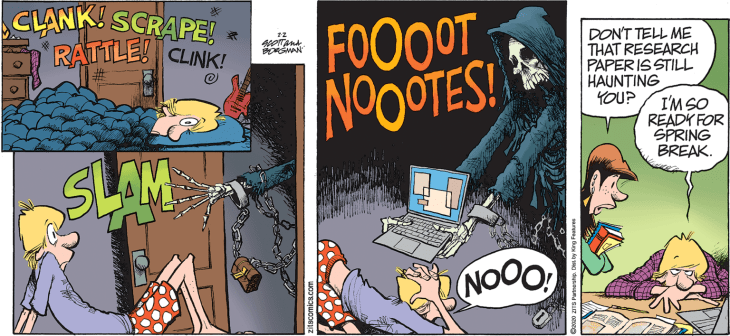
Clown Cars would have been on the board if we saw through the window a tiny parked car:

And maybe we should have let Pinocchio compete:
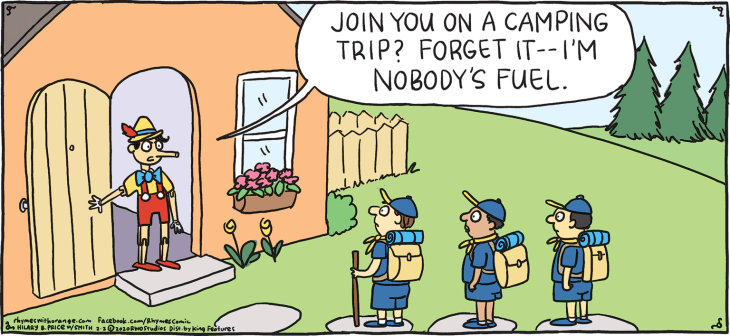
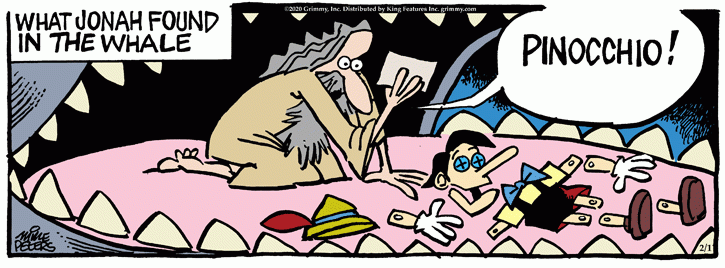
And okay, while we’re here, let’s hit the second one, the Mother Goose and Grimm, with a CIDU tag. Yes, Jonah and Pinocchio both ended up inside whales (though Jonah a few thousand years earlier, but whatever), but why is Jonah holding a sheet of paper (?) and why is Pinocchio disassembled? Is the whale actually an Ikea popup?
Anyway, after the first weekend, it’s Death 2, Russian Clown Gesundheit 0.
(If you have no idea what I’m talking about, click here)
 Comics I Don't Understand
The Zits isn’t about Death. It’s a “Christmas Carol” reference, that’s the Ghost of Research Papers Past.
I agree with Carl Fink and think it should be removed from contention.
Actually, wasn’t the Ghost of Christmas FUTURE a skeletal figure? Methinks Jeremy has been procrastinating.
So we have a consensus thay the Ghost of Christmas Future IS NOT synonymous with Death?
If there are no opposing arguments, I will remove the point.
Who knew this would create such a conundrum?
For pages like Mr. Lovenstein’s that disable the context menu on comics: Using Firefox, right-click in a background area and select “View page info.” This opens a new page; go to the Media tab, find the image you want (in this case it’s the first PNG), select Save As. Can be tedious when there are many images.
Or, this might show the Lowenstein comic:

I didn’t want to jinx myself by saying it before it worked, but it’s dead simple if, like me, you run with scripting turned off.
Mark, that’s basically how I save GoComics comics; but last night, right-clicking (using Firefox and Opera) gave me no menu at all.
@Arthur – however that is not the whole comic – you miss out the aftercomic or punchline or payoff or whatever it is, where you see that Death’s work is not scything through the residents of the retirement home, as the colour panels suggest, but is an actual menial job washing floors.
Andréa, where’s the fun if there AREN’T conundrii?
” . . . but is an actual menial job washing floors.”
I saw that panel and didn’t make the connection; thanks for pointing it out – adds another level of funny.
I believe Jonah is reading a name tag or something similar; otherwise, how would he know Pinocchio’s name?
As to the time discrepancy, isn’t it more bothersome that Pinocchio escaped from the whale intact if not alive (yet)? Would it be funnier if Pinocchio (and Gepetto) found Jonah’s remains instead (even though Jonah also escaped intact)?
Or maybe it’s a different Pinocchio; the remains of a puppet boy named Pinocchio would be exactly what you might expect to find in any whale.
I think Pinocchio is dissassembled because that’s like his skeleton. Not a brilliant concept.
As for copying, there’s always screen-capturing.
The Jonah one is a real CIDU. The “nobody’s fuel” one was funny.
“As for copying, there’s always screen-capturing.”
But that gets you a poor quality picture that has to be cropped in some other program.
I happened to come across this yesterday . . .
. . . certainly is a different ‘take’ on Pinocchio.
Another example of ‘time discrepancy’ . . .

The comic was too big for screen capture.
On my screen, at least.
Mark Jackson: even easier, when you find the right graphic, right-click and Copy, then paste that into the address bar and you’ll be viewing just the graphic.
The Ghost of Christmas Future showed Scrooge his grave, so I think you can say the character is at least an aspect of Death, if not Death itself.
Also, the image is so clearly the image of Death in popular culture that it immediately brings the character to mind regardless of what you call it. Calling an image of the Grim Reaper “Steve” wouldn’t change the visual impact, for example.
That’s a good point, and one I was thinking of myself, after my posts above. Can we give this one-half of a point? ‘-)
Re: CIDU Bill
On a PC you can use Ctrl-[minus] and Ctrl-[plus] to make the size of the screen image smaller and larger, respectively. [Ctrl-0 resets the screen to the default size.]
This one is iffy (I might need a panel of judges):
So to keep things neat, I’ll take Andréa’s suggestion and give half a point to the Zits, and then half a point to today’s Lio, restoring the score to Death 2, Russian Clown Gesundheit 0
I suppose that the Mother Goose and Grimm strip imagines a universe in which Pinocchio failed to escape from Monstro and, as one would expect in such a circumstance, died in the normal course (whereupon he was found by Jonah thousands of years earlier – as Bill noted, there is an issue with the timeline). Then apparently the acids of Monstro’s stomach somehow cause Pinocchio’s joints to disintegrate, while the principal body parts are damaged but remain. While that is not how it would work, the picture is obviously intended to suggest the effect that there would be on a human corpse, where the tendons connecting the bones are gone long before the bones themselves are. And somehow Pinocchio’s nametag (or something) is still around, so Jonah was able to identify him.
My question is: Why is Jonah calling out Pinocchio’s name? It looks like a cry of recognition, but there is no story in which Jonah and Pinocchio have previously met. And if they had previously met, Jonah would have been able to recognize Pinocchio (as we can) without reading his nametag.
The Lio had a number of comments regarding the game being referenced. It was not familiar to me, but many had heard of it either by that name or some others. Most agreed that it would be unlikely to be formally played at a school these days.
https://en.wikipedia.org/wiki/Street_football_(American)#Variations
The Baader-Meinhoff phenomenon strikes again!
‘One such game, known variously as “Smear the Queer”, . . .’
(sorry, the political INcorrectness is NOT mine)
We had a get-together here on Saturday (10 dogs, 7 people, NO politics), and a friend who was raised in Georgia mentioned (I don’t remember the context) this name of a street game she played when she was a child; we (the humans) were aghast, and thought it was maybe something HER friends had made up; turns out to have been widespread enough to be mentioned in WikiPedia, in the article linked above.
I’m surprised that no one has yet been That Guy who points that, while Pinocchio was indeed swallowed by a whale, Jonah is said to have been swallowed by a “giant fish” (or somesuch depending on translation), and of course a whale is not a fish. Thus, Even Further Fail.
So I guess I’m self-appointed to be That Guy this time. But I’m happy to see someone else run with the quibble next time, O.K.?
I’m skeptical that we know that Jonah was not swallowed by a “whale.” A “whale” is indeed not a “fish,” since the modern meaning of “fish” excludes mammals. But Jonah was swallowed not by a “fish” nor a “whale,” but a דג. I doubt that we know Biblical Hebrew usage well enough to know that the meaning of דג excluded mammals that lived in the sea.
BTW, we already had this Jonah whale conversation at least once before here. . .
Over the course of 24 years, I gave a feeling we’ve had it MANY times.
Bill: time to start assigning numbers…
I’m of the opinion of a whale shark, myself; neither whale, nor shark, but the largest species of fish still extant.
Ah, but Pinocchio was swallowed by the Terrible Dogfish, also not a whale, so no inconsistency.
Whale sharks are sharks.
You’re right; I misspoke. They ARE fish, tho. (And please don’t tell Hubby I said they weren’t sharks; he’s swam/swum with them and would be appalled I said that.)
A millennium or two ago, when the legend was created, they considered whales to be fish.
Arthur (FEBRUARY 3, 2020 AT 12:54 AM): If you have a Mac, just use Shift-Command-4 and select the area you want to capture. Sorry if Windoze can’t do that.
Shrug, as The Other Guy, I could point out that a book of fairy tales written by people who live in a desert is unlikely to be the best marine biology text.
Within the mythology of the story (sorry if that offends anyone) the great fish could be exactly that, a creature created by God for the purpose.
@ Boise Ed & Arthur – Thanks to your comments, I finally looked it up and discovered why I was never able to remember the correct modifier keys (Ctrl, Alt, etc.) to use with “PrtScr” in Windows(*): the idiots in Redmond seem to have changed the combinations in progressive versions. So try “PrtScr“, “Ctrl+PrtScr“, “Alt+PrtScr“, (etc.) until you find what works for the version you have. (This only gives a single window or the whole desktop, respectively.)
P.S. For free-form rectangular captures, a “Snipping Tool” is available in Windows 10 (and possibly as early as Windows 7, but given Windows’ susceptibility to viruses, I wouldn’t recommend connecting anything below Windows 10 to the Internet).
P.P.S. (*) – “Windoze” translates into German as “Windoof“, the adjective “doof” means “silly” or “stupid”.
The Windows 10 snipping tool is my go-to tool for saving GoComics comics.
@ CIDU Bill – Does that mean that when I send you the actual .GIF file from GoComics as an attachment, you do a screen capture from the e-mail instead of just using the attachment?
Kilby, when you send an attachment, I usually use Snipping Tool rather than downloading it, because it allows me to name he comic. The results are identical, of course.
in Win10 PrtSc works for me the same as it always has. PrtSc by itself captures the entire screen, and Alt+ gets the active window.
Boise Ed: “A millennium or two ago, when the legend was created, they considered whales to be fish.”
Do you have a reference for this? (Not a challenge, this sounds right to me; I’m just curious.)
Whether whales are fish or not depends on your definition of “fish”. Whales, birds, fish, insects and humans are all animals. There are other animals, and the word for one of those other animals is “beast”. Samuel Johnson’s dictionary (published 1755) defines “beast” as “An animal distinguished from birds, insects, fishes, and man.” A lizard is a beast that is not a mammal, and a man is a mammal that is not a beast.
In Genesis Chapter 1, on the fifth day of creation God said (KJV) “‘Let the waters bring forth abundantly the moving creature that hath life, and foul that may fly about the earth in the open firmament of heaven.’ And God created great whales, and every living creature that moveth, which the waters brought forth abundantly, after their kind, and every winged fowl after his kind: and God saw that it was good.”
On the sixth day, God said “‘Let the earth bring forth the living creature after his kind, cattle, and creeping thing, and beast of the earth after his kind:’ and it was so. And God made the beast of the earth after his kind, and cattle after their kind, and every thing that creepeth upon the earth after his kind: and God saw that it was good.”
The KJV and most other translations do not use the word “fish” at this point, but in Genesis 1:28 got creates male and female humans and tells them “Have dominion over the fish of the sea, and over the fowl of the air, and over every living thing that moveth upon the earth.”
Johnson’s Dictionary defines “whale” as “The largest of fish; the largest of the animals that inhabit this globe.”
The word “mammal” was not used in English until half a century after Johnson, and it was borrowed from Latin usage.
So to Johnson and the KJV translators, if it’s one of us it’s a man, else if it looks like an insect it’s an insect, else if it flies it’s a bird, else if it swims it’s a fish, else it’s a beast. Breasts are not used for this classification. Fish and whales on the fifth day, beasts on the sixth.
The book of Jonah doesn’t say “whale”. It says “fish”.
But in Matthew 12:40: “But as Jonas was three days and three nights in the whale’s belly; so shall the Son of man be three days and three nights in the heart of the earth.” Meaning of course the night from Good Friday to Holy Saturday, the night from Holy Saturday to Easter Sunday, and the night from Easter Sunday to … hey, wait a minute …
JPS translates it differently: “And God created the great sea-monsters, and every living creature that creepeth, wherewith the waters swarmed, after its kind, and every winged fowl after its kind; and God saw that it was good.”
@ Bill – The results are only the same if your e-mail program has enough screen space to display the attachment at full resolution. It also means I’ve been wasting my time carefully renaming every attachment to (strip’s name)+(publication date).
P.S. @ Brian in StL – Thanks for the feedback. When I looked it up, one of the references cited the “Windows” key as the necessary modifier, but I didn’t bother to test that, because I almost always use the Snipping Tool. I’ll have to try both combinations sometime and compare the results.
Personally, I think discussing the “whale vs. fish” issue based on third-party (goy) translations is silly. The fundamental difference is that fish are kosher, and whales (presumably) are not. I have no idea how many stomachs a whale has, but I seriously doubt that they “chew their cud”, and it is definitely certain that they don’t have cloven (or any other sort of) hooves. This of course leads to the inescapable conclusion that the reason the fish spit Jonah back out was that humans are not fit for kosher consumption.
@Kilby, not all fish are kosher. Specifically, even fish as defined by modern biology which are scaleless (such as eels and sharks) are treif. Whales are treif, even if they’re fish.
Nuts, nobody is ever going to page back to that fiftieth comment unless I link to it here on page two.
@ Carl Fink – Perhaps biologists feel that way, but I just can’t think of either one (eels or sharks) as “fish”.
P.S. One interesting difference between English and German is the way the two languages divide up the animal kingdom. In German, the word “Tier” (“animal”) applies to virtually any non-human (land-based) creature, including (for instance) both birds and insects (I’m not sure whether it would extend to ocean fish). In English, if you asked a kid to name an “animal”, you generally would not expect birds or bugs in the reply, they count as a different class.
P.S. Bill must just have fetched Arthur’s comment from moderation: my comment that is #51 now was #50 when I submitted the comment that is now #53. This also proves that the “recent comments” list will pick up a de-moderated comment (as long as there are not more than 14 newer comment when the comment in question is released).
My mind went right to Doctor Pangloss’s biology lesson.
“Pray classify: pigeons and camels.”
“Pigeons can fly, camels are mammals.”
Which of course is irrelevant to everything previously discussed here.
Kilby: The rules based on “chewing their cud” and having “cloven hooves” are explicitly stated to be rules for land mammals. As Carl Fink alluded the rules for sea animals, but to be explicit: they must have scales and fins.
I’m also not sure if you were joking? Whales are not kosher, but I don’t see that gives us much of a hint as to what swallowed Jonah.
I assure you that eels and sharks qualify as fish, to the extent that the term means anything. In modern taxonomy, an eel is more closely related to a human being than to a shark, but “fish” is not a formal taxonomic term these days. I have never met anyone who didn’t think birds and insects were animals in the classical “animal, vegentable, mineral” system. Certainly everyone thinks whales and shrimp and starfish are animals. If tier translates as “land animal” then it is not linguistically the same as English “animal”.
Catfish are not kosher because they have no scales.
Even more technically, the scales on a kosher fish must be easily removed without tearing the skin. So some fish, like sturgeon, are not kosher even though they have scales.
Glad I could help, Kilby, albeit indirectly.
@ WW – My premise that the original author would prefer to have Jonah swallowed by a kosher creature was definitely not serious, although I have read some amusing stories about equally silly theoretical and/or theological arguments, supposedly coming from the Talmud & other similar sources.
P.S. @ Carl Fink – The dividing lines between the respective kingdoms or genera depends on context, of course. The rules for “20 Questions”(*) allow for only those three groups (Animal, Vegetable, Mineral), but in general descriptive text it is different. In German, it would be normal to see both “pigeons” and “ants” described as “schöne Tiere“ (beautiful animals), but the same passage in English would more likely call them beautiful “birds” or “insects”, rather than “animals”. One could say that the word “Tier” should be more accurately translated as “creature”, but if you need a common German word for “animal”, there just isn’t anything else available.
P.P.S. (*) – When playing “20 Questions” with my kids, we’ve tripped over the “fish” vs. “cetacean” problem a number of times, such as when one kid included “killer whale” in the category “fish”, whereas the other kid knew that it should count as a “mammal without feet”.
You know, if God created all the animals… instead of issuing these arcane rules that people would still be trying to interpret thousands of years later, why didn’t He just give Moses a printout: HERE’S STUFF YOU CAN EAT, and HERE’S STUFF YOU CANT EAT.
“Ein Mensch ist kein Tier!” — Bertolt Brecht
Bill, better yet, have “kosher” or “tref” imprinted on their skins or fur.
Dad had a theory that it was easier to say “G-d said not to eat that” than explain that undercooked pork (for example) could kill you. Same as mom’s come up with odd reasons why one should not do something.
On the other hand, the rules do deal with animals that those who wrote the Old Testament would never had seen, so somehow the rules were broad enough to cover animals that might be a health problem on other continents and who would have known to include them in the rules?
Basically none of those things are true. The rules aren’t about health, Maimonides got that wrong. They don’t cover animals or plants that the Hebrews hadn’t at least heard of. Right now, rabbis don’t agree on what’s kosher. For instance, can you have maize in the house during Passover? Answer: who is your rabbi? Some Jews require kosher foods to be (historically) found in the Land of Israel for this very reason–they don’t want to apply the Law to things the Law doesn’t talk about.
Kilby, in general in English – not just when playing “20 Questions” – I would expect kids (and adults) to consider birds and bugs as “animals.” e.g. if I said “what was the most interesting animal at the zoo today?,” I wouldn’t be surprised to hear “shrimp” or “parrot” as the answer.
Yet it sounds very odd whenever my (non-native speaker) mother goes on about some “animal” that got into the house, when she means some bug, or that she was bitten by an “animal”, when again she means some bug. It’s one thing to be presented with the question is an insect an animal, it’s quite another to actually use it colloquially, and as a native speaker, it is distinctly odd to use “animal” when referring to a bug (though not quite wrong enough that you feel justified in correcting it, because you end up asking yourself, is not a bug an animal, and when you go, yeah, then you go, so why can’t you say what she just said?
Our intuition about terms like this can be very odd. A mouse is an animal no matter what size it is. I would also have no trouble referring to a lobster or crab as an animal – it seems completely colloquial to me as a native English speaker. On the other hand, some insects are microscopic (e.g., some wasps are amoeba-sized). While microscopic insects are technically animals, I would never expect them to be referred to that way in colloquial usage.
While historically fish and sometimes even birds were not necessarily considered animals, I would say that today all vertebrates are automatically animals. But, in colloquial usage, arthropods’ status as animals seems much more conditional.
Re: Carl Funk
As you may know, maize (i.e., corn) is a problem on Passover for some Ashkenazic Jews because it is unclear whether the rabbinical ban on kitnoyos, (certain foods that can be made into flour that can be mistaken for grain flour that can become leavened) extends to foods the European rabbis never saw, like potatoes (which had not been brought over to Europe from the New World at the time of the kitniyos ban). There is a disagreement as to whether maize (or an variation) existed in the Old World at the time the ban was set in place, and if it was therefore included in the ban, or not).
This is a nonissue for Sephardic Jews since they did not live in the same countries (and sometimes in the same continent) as the countries that were under the “jurisdiction” of tne Ashkenazic rabbis, and they therefore never accepted the ban on themeselves. Sephardic Jews eat all kotniyos (or as they pronounce it, “kitnoyot”) on Passover.
Carl *Fink*, I apologize profusely for the typo of your name. (I hate typing on my phone because there are million “fat finger” mistakes. It took forever to fix all the rest of the typos, and I missed that one and, I see now, also the “kotniyos” (s/b “kitniyos”) in the last sentence.)
@Carl Fink: Once I’m here again, I add another comment on your post. The only “animals” that require a tradition in order to be considered kosher are birds, since the forbidden ones are listed by name in the Torah. And since, for many of them, it has since become unclear what nonkosher bird is being specified, only (species of) birds that have a tradition of being considered kosher are eaten.
lark/UsualJohn: Yeah, I agree. I think for most English-speakers (although apparently not for Kilby) birds and fish are clearly “animals” [*]. But insects are more borderline, particularly as they get smaller.
[*] Although I was unaware that this was historically not the case, so perhaps I’m overestimating the level of usage consensus on this.
@Pinny: I promise, after having the name “Fink” for so long, it’s hard to offend me with my name. :-)
There’s also controversy about other things due to lost or drifted vocabulary. For instance, some people think “locust” (which it’s legal to eat) means the insects, the grasshoppers. Others think it’s the name of a plant.
And what is a “beast”?
“Ein Mensch ist kein Tier!” — Bertolt Brecht
That’s a great song. Because of the “treading upon” parts, when I used to have functional playlists, that was on one for “spite and malice” songs, along with for instance “Positively 4th Street”.
@ Winter Wallaby – Put it this way: say a kid reports to you, “I went for a walk down to the pier, and I saw an animal swimming in the water!“, would you expect the creature the kid observed to be a:
a) jellyfish?
b) dog?
c) salmon?
d) tadpole?
e) otter?
f) human?
g) spider?
Among native English speakers, most people would expect the answer to be “dog” or “otter”, and not “salmon” or “spider”.
@Kilby, is it worth mentioning that both the Wallaby and myself are, in fact, native English speakers? I would rule out dogs, humans and spiders because we aren’t aquatic (and spiders can’t in general swim, though there are water-walking spiders). If a kid saw a dog in the water she’d would probably say, “A dog.” Normal language would be to only say, “an animal,” if one could not identify it.
I’d also not expect jellyfish, again because they aren’t usually spoken of as swimming.
@ Carl Fink – That “native speaker” was in reference to larK’s mother, not to you or WW. And whenever I’ve seen dogs walking along the beach, they were almost always soaking wet.
Mitch4, I hope you follow it in your playlist with the ending of Dreigroschenoper, to the tune of Mack the Knife:
For the ones live in the darkness,
and the others in the light,
and we see the ones in brightness,
those in darkness drop from sight.
Much better in German of course.
P.S. Alternatively, if the kid says, “Mom, the cat just brought an ‘animal’ into the living room!“, it would be more natural to expect a mouse or chipmunk, rather than a spider or sparrow. For the latter two cases, the kid would be more likely to report a “bug” or “bird”, respectively.
Kilby: In your swimming example, I wouldn’t be surprised if it was a salmon or a tadpole. Actually, I would expect those over dog because, as Carl said, when the kid says “animal” I expect it to be an animal that they have trouble identifying.
Similarly, if the cat brings a bird in the house, I expect the kid to say “bird,” not because they don’t think of birds as animals, but because it’s easy to tell that it’s a bird, and so I expect them to be use the more specific term. I would be surprised if my kid said that they met their friend’s “sibling” today, rather than “brother” or “sister,” but that doesn’t go to show that “brothers” and “sisters” aren’t specific types of siblings.
More generally though, I do agree there are many situations in which, when we hear the word “animal,” we’re more likely to think of mammals and vertebrates. But the fact that mammals and vertebrates are the “canonical” cases people are likely to think of, doesn’t show that they think of that as part of the definition. If you ask native English speakers to picture a nurse, they most likely picture a woman – but no one would say that being a woman is part of the definition of nurse.
Carl Fink – Bears, there are no bears in middle east (as I understand it) and bears are not kosher, well not kosher to eat. (I don’t know if any in my little bear village eat in kosher manner since though they don’t eat meat, I know most of them like a good lobster for a holiday dinner.)
My dad told me many things when I was a child – I have learned in life that not all of them are true.
Apparently in the Ashkenazi areas all grains were kept mixed together including maize (which I am not sure how they had same back then) with “corn” being a term for general grain. Therefore one could not maize separate from other Passover forbidden grains. In the Sephardic areas the different grains were stored separately, hence allowing for one to eat corn for same without eating the grains forbidden for Passover. (Okay, this idea of the separate storage of grains comes from Robert who has read about same.) Since the changes to allow corn during Passover, I have not been able to bring myself to do and still do not eat it then. I do little enough to respect the holiday so I continue to avoid corn during it.
I have learned from doing crossword puzzles that an eel is a fish – I never considered it to be same, but found that it fit the letters and spaces – several times. I mentioned this to Robert and he said to me “of course an eel is a fish – did you think it a snake?” Well, yeah, I sort of did. I did not know it had gills (which he claims) as I have never been near either one – and don’t plan to be.
Eel I’ve swum with . . . altho these aren’t the kind one eats.

What’s that gleam in a da reef?
With the bright shiny teef?
That’s a moray.
I learned about ‘corn’ as “predominant local grain” while getting an explanation of the beautiful lines from Ruth (in probably KJV) about “laboring in the alien corn”.
(Or also studying Middlemarch with no prior knowledge of British Political Economy history and trying to understand who were the good guys or bad guys for riding hard to get to Parliament to vote for or against the Reform Laws and Corn Laws.)
@Meryl, grain and corn were originally the same word. Corn took on the meaning of “The locally-dominant grain.”
rain
“Like all other fish, moray eel breathe using the gills. They are located behind the head, in the form of the two circular openings. Moray eel keeps its mouth open (not because they are ready to bite any second, but) because it needs to provide constant circulation of the water toward the gills.”
I was once at a class session given by a (computer) graphics guy, who was talking about backgrounds and textures. He mentioned Moiré patterns and misinformed the class that they were called that from resemblance to the skin of a Moray Eel.
I had a grudge against this guy and was going to interrupt and haughtily correct him. Good thing I didn’t get the opportunity, as my “correction” would have been equally wrong. I thought it was from a personal name, some Monsieur Moiré or Dr. Moiré.
Later when I went to look up his first name and backstory, I found out it was just a common noun or adjective, with a middling-interesting history (including a relationship to English “mohair”). https://en.wikipedia.org/wiki/Moir%C3%A9_pattern
Just to add two more data points for the expansive definition of “animal”, here are two articles about the recent discovery of a specific creature does not need oxygen to live.
The first article has the headline:
“Scientists discover the first-known animal that doesn’t need oxygen to survive”
Reading the article one finds out that said “animal” is the (presumably microscopic) “parasite Henneguya salminicola,”
https://www.usatoday.com/story/news/nation/2020/02/25/scientists-discover-first-animal-doesnt-breathe-hsalminicola/4866954002/
The 2nd article has a headline that describes these creatures as a “Microscopic parasite” and the first sentence of the article describes this creature as an “animal” [twice!]:
“Henneguya salminicola: Microscopic parasite has no mitochondrial DNA
An international team of researchers has found a multicellular animal with no mitochondrial DNA, making it the only known animal to exist without the need to breathe oxygen.”
https://phys.org/news/2020-02-henneguya-salminicola-microscopic-parasite-mitochondrial.html