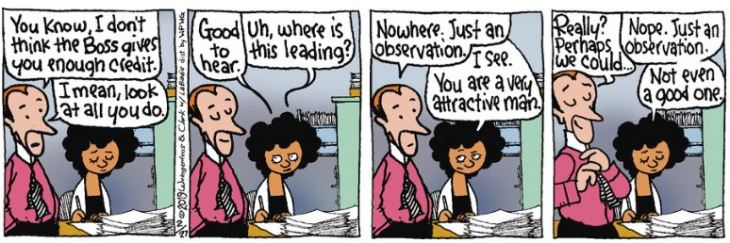
She knows the flattery is leading up to some request, but he doesn’t want to admit it. So she flatters back, and he feels that it implies more than just a comment. She says it *is* just an observation (his phrasing). Then she basically said she lied about his being handsome.
I think the joke is his obliviousness. He thinks she won’t see through his flattery to his hidden agenda. He also misses her ploy of flattering back to show how unnatural such unprompted comments are.
It helps to know the history of the strip. I’ve been reading since it started.
The guy (Duane) and the woman (Ms Foxx) are friends. Duane is attracted to Ms Foxx and would like to pursue a romantic relationship. Ms Foxx is happy to be friends, but doesn’t have any romantic feelings.
Duane compliments Ms Foxx in a clumsy attempt to woo her. Ms Foxx returns a compliment, then just as he thinks he’s getting somewhere she shoots him down, reminding him there is no possibility of romance. She like to tease him.
But I wouldn’t say the joke is (entirely) his obliviousness. I’d say she’s simply pointing out how obvious it is that a compliment is almost never given without a ulterior motive. If she is expected to believe this isn’t leading anyway, then he has to concede that her compliment doesn’t have to be leading anywhere either. And it’s impossible for him to imagine that.
He’s complimenting the quality of her work and her professionalism. Being an insecure woman, she can’t believe that he doesn’t want to **** her. Therefore, she sexually harasses him to try to elicit attention from him. When he tries to suggest that they could go discuss the matter with HR, she interrupts him and tries to pretend she didn’t just sexually harass him.
woozy: I have to disagree. I often give compliments when somebody does something good. People are very quick to speak negatively and criticize, I like to put out some positive energy into the world.
“I’d say she’s simply pointing out how obvious it is that a compliment is almost never given without a ulterior motive.”
Is that true? I’m sure things can be misconstrued from time to time, but I often give my co-workers compliments if they do something good or useful to me with no ulterior motive other than to acknowledge that I appreciate what they’ve done. Am I alone?
(That’s not the case here, obviously, as Pete pointed out the dynamics of the characters in this strip.)
She can tell the shy guy is trying to make a timid advance. So instead of simply shooting him down easy, she decides to mess with him to be a little bit mean about it.
I work with a younger woman with a (fortunately) good sense of humor. Early on I warned her that anyone who came to her desk being nice to her was going to make ridiculous requests. Now every time I go to her desk, I always start with, “Is that a new outfit? Wow, your hair looks great, did you style it yourself?” Gotta be careful with that schtick, of course.
I’m not sure about who disagrees or not with whom here.
Woozy said “almost” and I used “include”, leaving room for extreme cases.
Apart from that, I think SOME altruists just want to feel good about themselves, that MOST altruists ALSO want to feel good about themselves, and that true altruism is rare.
Perhaps I should point out these compliments are 1) at the workplace and 2) from Duanne. She strongly suspects there is an ulterior motive (not necessarily sexual). And she’s probably right.
Obviously there are situations (with different people) where compliments are just compliments. But not in this strip, in this work environment, with these coworkers.
“He’s complimenting the quality of her work and her professionalism. Being an insecure woman, she can’t believe that he doesn’t want to **** her. Therefore, she sexually harasses him to try to elicit attention from him. When he tries to suggest that they could go discuss the matter with HR, she interrupts him and tries to pretend she didn’t just sexually harass him.”
That’s a very creative reinterpretation. But given what we know of these characters (or at least the authors interpretation of them) a purely fanciful one.
Stan and SingaporeBill, I’m going to assume you are decent human beings and not Duane-like pompous assets.
” I often give my co-workers compliments if they do something good or useful to me with no ulterior motive other than to acknowledge that I appreciate what they’ve done.”
If you’ve always done this, it isn’t a surprise for the pattern to continue. If, however, this is NOT your usual practice, then having it suddenly start up suggests that something is up. I gather that this is NOT the usual pattern for this character.
Olivier, if “ulterior motive” includes, “I’ve generally been conditioned to be nice to other people, in part because that leads people to be nice to me,” then I guess I have an ulterior motive for most compliments, but that seems too broad a definition of “ulterior motive” to me. I would say an “ulterior motive” requires me to at the time be consciously thinking what I’m going to get out of the compliment.
Similarly, I don’t think it makes sense to say that it’s not “true altruism” if the person’s altruism is motivated by the how their altruistic behavior makes them feel. Someone who kicks kittens because they like seeing animals in pain, and someone who helps other people because they like other people happy are both motivated by what they like, but that’s doesn’t make them equivalent.
Stan & SingaporeBill: A compliment is often given for a specific good job. It is much more rare to say “The boss doesn’t appreciate all you do around here” – that seems much more like an attempt to manipulate by feeding feelings of persecution.
“I gather that this is NOT the usual pattern for this character.”
Yea, Pete pointed that out earlier. I was just reacting to Woozy’s overall statement that comment that “a compliment is almost never given without a ulterior motive”. However, it was all straightened out by those concerned. Thanks for the input.
WW: I think our difference is only a matter of degree. I agree with you that altruism is FIRST about helping others, so kicking kittens will never qualify. But, for me, altruism is an absolute: it has to be completely selfless (that is super-human, hence rare); otherwise, it’s “just” plain, human, charity (but just as admirable).
I agree with your definition of “ulterior motive” concerning charity, because being conscious of what you get for your charity is not charity but, inferior, pharisaism.
Kicking rabid kittens away from people who are deathly allergic is altruism. Especially given that it may even hurt your reputation with some, you are putting the needs of others ahead of your own.
@SingaporeBill: “Kicking rabid kittens away from people who are deathly allergic is altruism.”
Only if you assume people are more important than kittens.
I would agree with that some of the time, and maybe even most of the time, but first I’d want to know how the ‘people’ are. I can think of many candidates for whom rabid kittens are Too Good For Them.
Shrug, I have to disagree with “Only if you assume people are more important than kittens”: This only applies if you’re kicking the kittens out of a thirty-story window. Otherwise, you’re comparing discomfort or injury to a kitten with the death of a person.


She knows the flattery is leading up to some request, but he doesn’t want to admit it. So she flatters back, and he feels that it implies more than just a comment. She says it *is* just an observation (his phrasing). Then she basically said she lied about his being handsome.
I think the joke is his obliviousness. He thinks she won’t see through his flattery to his hidden agenda. He also misses her ploy of flattering back to show how unnatural such unprompted comments are.
LikeLike
It helps to know the history of the strip. I’ve been reading since it started.
The guy (Duane) and the woman (Ms Foxx) are friends. Duane is attracted to Ms Foxx and would like to pursue a romantic relationship. Ms Foxx is happy to be friends, but doesn’t have any romantic feelings.
Duane compliments Ms Foxx in a clumsy attempt to woo her. Ms Foxx returns a compliment, then just as he thinks he’s getting somewhere she shoots him down, reminding him there is no possibility of romance. She like to tease him.
LikeLike
Arthur has it.
But I wouldn’t say the joke is (entirely) his obliviousness. I’d say she’s simply pointing out how obvious it is that a compliment is almost never given without a ulterior motive. If she is expected to believe this isn’t leading anyway, then he has to concede that her compliment doesn’t have to be leading anywhere either. And it’s impossible for him to imagine that.
LikeLike
He’s complimenting the quality of her work and her professionalism. Being an insecure woman, she can’t believe that he doesn’t want to **** her. Therefore, she sexually harasses him to try to elicit attention from him. When he tries to suggest that they could go discuss the matter with HR, she interrupts him and tries to pretend she didn’t just sexually harass him.
woozy: I have to disagree. I often give compliments when somebody does something good. People are very quick to speak negatively and criticize, I like to put out some positive energy into the world.
LikeLike
“I’d say she’s simply pointing out how obvious it is that a compliment is almost never given without a ulterior motive.”
Is that true? I’m sure things can be misconstrued from time to time, but I often give my co-workers compliments if they do something good or useful to me with no ulterior motive other than to acknowledge that I appreciate what they’ve done. Am I alone?
(That’s not the case here, obviously, as Pete pointed out the dynamics of the characters in this strip.)
LikeLike
Doesn’t “ulterior motive” include reciprocity, even unconscious? You know: “Do unto others, etc.”
LikeLike
She can tell the shy guy is trying to make a timid advance. So instead of simply shooting him down easy, she decides to mess with him to be a little bit mean about it.
LikeLike
Olivier, that’s like saying altruism doesn’t exist because ultimately altruists just want to feel good about themselves.
LikeLike
I work with a younger woman with a (fortunately) good sense of humor. Early on I warned her that anyone who came to her desk being nice to her was going to make ridiculous requests. Now every time I go to her desk, I always start with, “Is that a new outfit? Wow, your hair looks great, did you style it yourself?” Gotta be careful with that schtick, of course.
LikeLike
I’m not sure about who disagrees or not with whom here.
Woozy said “almost” and I used “include”, leaving room for extreme cases.
Apart from that, I think SOME altruists just want to feel good about themselves, that MOST altruists ALSO want to feel good about themselves, and that true altruism is rare.
LikeLike
Perhaps I should point out these compliments are 1) at the workplace and 2) from Duanne. She strongly suspects there is an ulterior motive (not necessarily sexual). And she’s probably right.
Obviously there are situations (with different people) where compliments are just compliments. But not in this strip, in this work environment, with these coworkers.
“He’s complimenting the quality of her work and her professionalism. Being an insecure woman, she can’t believe that he doesn’t want to **** her. Therefore, she sexually harasses him to try to elicit attention from him. When he tries to suggest that they could go discuss the matter with HR, she interrupts him and tries to pretend she didn’t just sexually harass him.”
That’s a very creative reinterpretation. But given what we know of these characters (or at least the authors interpretation of them) a purely fanciful one.
Stan and SingaporeBill, I’m going to assume you are decent human beings and not Duane-like pompous assets.
LikeLike
” I often give my co-workers compliments if they do something good or useful to me with no ulterior motive other than to acknowledge that I appreciate what they’ve done.”
If you’ve always done this, it isn’t a surprise for the pattern to continue. If, however, this is NOT your usual practice, then having it suddenly start up suggests that something is up. I gather that this is NOT the usual pattern for this character.
The leopard, his spots, etc.
LikeLike
Olivier, if “ulterior motive” includes, “I’ve generally been conditioned to be nice to other people, in part because that leads people to be nice to me,” then I guess I have an ulterior motive for most compliments, but that seems too broad a definition of “ulterior motive” to me. I would say an “ulterior motive” requires me to at the time be consciously thinking what I’m going to get out of the compliment.
Similarly, I don’t think it makes sense to say that it’s not “true altruism” if the person’s altruism is motivated by the how their altruistic behavior makes them feel. Someone who kicks kittens because they like seeing animals in pain, and someone who helps other people because they like other people happy are both motivated by what they like, but that’s doesn’t make them equivalent.
LikeLike
Stan & SingaporeBill: A compliment is often given for a specific good job. It is much more rare to say “The boss doesn’t appreciate all you do around here” – that seems much more like an attempt to manipulate by feeding feelings of persecution.
LikeLike
People who want to feel good about themselves help serve food at the food kitchen on Christmas and Thanksgiving.
True altruists help serve food at the food kitchen on some day when they need the help.
LikeLike
“I gather that this is NOT the usual pattern for this character.”
Yea, Pete pointed that out earlier. I was just reacting to Woozy’s overall statement that comment that “a compliment is almost never given without a ulterior motive”. However, it was all straightened out by those concerned. Thanks for the input.
LikeLike
WW: I think our difference is only a matter of degree. I agree with you that altruism is FIRST about helping others, so kicking kittens will never qualify. But, for me, altruism is an absolute: it has to be completely selfless (that is super-human, hence rare); otherwise, it’s “just” plain, human, charity (but just as admirable).
I agree with your definition of “ulterior motive” concerning charity, because being conscious of what you get for your charity is not charity but, inferior, pharisaism.
LikeLike
Kicking rabid kittens away from people who are deathly allergic is altruism. Especially given that it may even hurt your reputation with some, you are putting the needs of others ahead of your own.
LikeLike
@SingaporeBill: “Kicking rabid kittens away from people who are deathly allergic is altruism.”
Only if you assume people are more important than kittens.
I would agree with that some of the time, and maybe even most of the time, but first I’d want to know how the ‘people’ are. I can think of many candidates for whom rabid kittens are Too Good For Them.
LikeLike
And that is why you fail altruism, you monster!
LikeLike
Shrug, I have to disagree with “Only if you assume people are more important than kittens”: This only applies if you’re kicking the kittens out of a thirty-story window. Otherwise, you’re comparing discomfort or injury to a kitten with the death of a person.
LikeLike
“Thou shalt not kill, but need not strive,
Officiously to keep alive.”
LikeLike