Is That is Priceless in newspapers at all? Maybe the three-week thing only applies to print comics, even if you’re working through GoComics or another syndicate?
By all logic, I think, in 2019 comic strip artists should have the option of being as timely as editorial cartoonists: it’s not as if they have to put the physical drawing in an envelope and mail it in.
 Comics I Don't Understand
I don’t think this comic appears in papers. A lot don’t use color for their daily comics and wouldn’t want to print some of the strips where the work of art is potentially NSFW. Both Skin-Horse and Two Party Opera run at GoComics without a delay. The new run of Bloom County lags about a week behind Breathed’s posting on Facebook. So the rules are clearly different for webcomics. I think the lead time for syndicated comics these days have more to do with syndicate editors having time to find objectionable things, otherwise you’re right about the long lead times no longer making sense.
This was actually a CIDU for me. I had no idea who Felicity Huffman is and had to do some Googling to figure it out.
Well, since the “cartoonist” here doesn’t even have to do artwork of his own, he can presumably post very quickly.
If this were printed in a newspaper, I think the comic would be compromised. Shrunk in size, details would be lost I’d think.
This post gave me a sense of deja vu. I recall asking about the lead time of web comics some time ago.
Grawlix, the amount of time it takes to physically draw the comic isn’t really a huge factor (unless you’re doing Prince Valient).
Good point, DemetriosX: the newspapers would need to have their own Arlo Pages.
(though… I guess if Britain’s Sun can have its Page 3…)
By the way, I have no idea why it’s legal to spend 7 figures to build an auditorium to guarantee your kid gets into into a school, yet illegal — and the whole world gets their collective panties in a twist — when somebody pays a 5-figure bribe to get his kid into the school.
CIDU Bill: I had pretty much the same reaction. I actually read an article where someone used that comparison to condemn the bribers, saying “This isn’t like a case where someone donates a wing to make sure their kid gets in, this was an illegal bribe.” They seemed to think it was self-evident that the cases were different.
One difference I can think of is that when you build the auditorium, there’s probably no explicit quid pro quo agreement.
I haven’t read about this in detail. Why is it illegal to bribe your way into a private university anyway?
https://claytoonz.com/2019/03/13/lottascamma-u/
Paying with an implicit hope is not the same as paying to have test results altered or lying about being about on a certain athletic team or other of the “tactics” used by this scheme. The first is not honorable, but it’s hard to prove the quid pro quo for a crime; the second are a slam dunk.
If you have your own comics website, the lead time would be as long as it took to make the comic and upload it. In this case, finding the right artwork and making up a caption, plus maybe two minutes to upload. I know I can change anything on my websites within minutes.
However, if you are on GoComics or ArcaMax or ???, I don’t know if you upload your own comics, or if they have to go thru another person before they are uploaded.
“By all logic, I think, in 2019 comic strip artists should have the option of being as timely as editorial cartoonists: it’s not as if they have to put the physical drawing in an envelope and mail it in.”
Still needs time to go through editorial, to make sure it won’t twist the undergarments of the customers (that is, the newspapers that still buy comic strips). Plus, of course, a three-week lead time means that the syndicate has something in the pipeline if they have problems (or somebody at the syndicate takes a two-week vacation).
If you scroll down on that Claytoonz page that Andréa posted, there’s a video of the complete process of drawing, shading, and coloring the single-panel comic electronically. He does a lot of undo’s when he’s starting up. I did start skipping through it; still, I found it to be a real treat.
Back before Breaking Cat News was in newspapers there was a couple of months were Georgia Dunn was posting comics on her own site the same day they posted on GoComics, so non-newspaper strips on GoComics can contain references to current events that are still current.
Clay Jones has had videos of each comic being drawn for about the past six months.
The celebs allegedly involved are charged with wire-fraud and/or mail-fraud, among other things.
The applications willfully misrepresented the students.
This all seems like a big deal to me.
When EvilCorp donates $5 million to a senator’s campaign, there’s no explicit agreement that the senator will vote in favor of the upcoming bill that will give EvilCorp a billion dollars in tax breaks; but seriously…
The difference is that when a rich person donates a large sum to the school, the school and all of its students benefit. When a rich person gives money to a school official or coach and presents them with falsified credentials for her kids, that’s a bribe and fraud. The school receives no benefit.
“By the way, I have no idea why it’s legal to spend 7 figures to build an auditorium to guarantee your kid gets into into a school, yet illegal — and the whole world gets their collective panties in a twist — when somebody pays a 5-figure bribe to get his kid into the school.”
Bill, I think you understand this perfectly well. Legally, this case is not about the unfairness of college admissions. It’s about the bribery of coaches and SAT proctors to violate their duty to their employers.
“The celebs allegedly involved are charged with wire-fraud and/or mail-fraud, among other things.”
That’s because the federal government ordinarily has no jurisdiction over fraud.
“When EvilCorp donates $5 million to a senator’s campaign, there’s no explicit agreement that the senator will vote in favor of the upcoming bill that will give EvilCorp a billion dollars in tax breaks”
No, but the $5 million does get you (or your lobbyist) the opportunity to explain your concerns about pending legislation. That’s why EvilCorp donated to both candidates.
“Legally, this case is not about the unfairness of college admissions. It’s about the bribery of coaches and SAT proctors to violate their duty to their employers.”
Normally, I would expect employees who violate their duty to their employers to be dealt with by their employers, either by firing them, or with civil suits. If the employees committed crimes in the course of violating their duty to their employees, I would generally only expect state criminal charges if the employers referred the matter to the police, and would virtually never expect federal charges.
Winter Wallaby: Yes, the employers would certainly have preferred to deal with the employees by firing them and covering it up. But somehow this came to the attention of the U.S. Department of Justice (I don’t think we know how just yet.) And unfortunately for the defendants, DOJ had less interest in perpetrating a cover-up. There were serious crimes involves, there was federal jurisdiction, state law enforcement would probably have had difficulty dealing with this multi-state criminality, and enforcement was likely to result in favorable publicity. It must have been an easy call.
In contrast, whatever you think of the plutocrat who buys admission with a large contribution (which generally needs to be much larger than the amounts involved here), it is not illegal. Universities can admit who they want, as long as they do not engage in actionable discrimination.
Legally, this case is not about the unfairness of college admissions. It’s about the bribery of coaches and SAT proctors to violate their duty to their employers.
Okay, this part makes sense to me: focus on the conspiracy angle.
the $5 million does get you (or your lobbyist) the opportunity to explain your concerns about pending legislation. That’s why EvilCorp donated to both candidates.
They’re still getting a direct quid pro quo for their quid, no?
I forget the legal term I came across, but the illegality has to do with (as quoted from one report), “For every student admitted through fraud, an honest, hard-working student was rejected.”
By getting in while unqualified, you’re keeping out someone who is qualified, and thereby causing them harm.
I’m not sure I’m in favor of that being illegal, but it currently is.
“They’re still getting a direct quid pro quo for their quid, no?”
They’re definitely buying something of value for their money, or they wouldn’t do it. But they aren’t necessarily getting what they want.
“For every student admitted through fraud, an honest, hard-working student was rejected.”
Strictly speaking, you don’t know this. They may have created an additional slot for the bought-his-way-in student. After all, if they don’t really belong in the school, how long will they stay with it?
One of the commentators was saying that this would likely be beyond just embarrassing for the parents. He expected actual prison time for some. Of course it’s likely a delight for the top legal firms around.
I saw a so-what-else-is-new comment that asked something like, ‘How do you think Dubya got into law school with a 2.35 GPA?’ I do not vouch for the accuracy of this accusation.
Usual John: What I’m saying is that it’s strange for you to frame this case as about employees violating their duty to their employers, because then the injured parties are the employers, and the injuries that they sustained are not of a nature that is normally seen as requiring federal criminal charges. If you are correct to say that the employers would have preferred to “cover it up,” then that makes doubly strange for you to frame it as a case where the employers are the victims.
Arthur: But if the injured party is the student who would have gotten in, doesn’t that require that they had some right to get in under a “correct” admissions process? It’s not obvious to me that an applicant, at least to a private university, has a right to be judged on their qualifications. They have rights to not be discriminated on based on certain specific legally defined categories, but my inclination is to think that that probably private universities are otherwise free to set their admissions procedures by whatever criteria they wish. I don’t know if there’s any governing law on this, though, would be happy to learn of it.
Winter Wallaby: There is a public interest in preventing a punishing bribery, even when the employer of the person bribed might prefer that no criminal action be brought.
Here is an interesting article on the legal issues involved, comparing the case to insider trading, https://www.bloomberg.com/opinion/articles/2019-03-13/you-have-to-pay-the-right-person.
Also, among the schools targeted by the cheating ring was UCLA.
My initial inclination on hearing about this was to wonder if it should be a criminal case of fraud (handled in the criminal court system), or just a case of academic fraud (handled in the institution(s) affected.) I was thinking just of the parents/”students”, because I didn’t realize that the ring had bribed test proctors to look the other way while the cheating was happening. So, the test proctors who violated their duties might be criminally liable, because they got paid by the testing service to make sure there was no cheating, and then they knowingly allowed cheating.
“How do you think Dubya got into law school with a 2.35 GPA?’”
I don’t think you should take advice from someone who thinks W went to law school.
(He went to Yale as an undergraduate, and Harvard Business School.)
Current 1600 Pennsylvania Ave occupant went to Wharton. I, for one, and not convinced he actually learned anything while there.
The federal government has the standing to enter this matter as the universities in question receive taxpayer funds in excess of $10,000. A low bar, but that gets the fed camel’s nose under the tent flap.
“There is a public interest in preventing a punishing bribery, even when the employer of the person bribed might prefer that no criminal action be brought. ”
This sounds like a conclusion… but it’s stated like a premise.
If you start by assuming your conclusion is true, your logic will always lead you to believe your conclusion is true… but the logic won’t be sound.
Throw a conditional in there… there may be a public interest in preventing and punishing bribery, even when the employer might prefer that no charges be brought.
” A low bar, but that gets the fed camel’s nose under the tent flap.”
The feds get in because mail fraud is inherently a federal matter.
I think it’s the same difference as that between bribery and campaign contribution. It’s illegal to say, “I’ll give you $100,000 if you make sure I get that contract” but perfectly fine to say, “Here’s a $100,000 campaign contribution, and while I’m here, I’d like to talk about that contract.”
Ideally, Chak, this whole brouhaha will get people talking about whether there actually is a difference.
My first comment to Robert when the news broke was “who is going to run the cafe on “When calls the Heart” when they fire Lori Laughlin? ” He said that would not fire her over it. I said they would. Meryl right again.
But is she fired-fired, or James-Gunn-fired?
And why wasn’t William H. Macy included in this scandal? The one and only article I read on this stated explicitly that he was NOT ‘part of the scandal’ . . . she did it without him knowing??
Andréa: Do you tell your husband about all the crimes you commit? ;)
Hmmmm . . . I’d have to think on that. Seriously, tho, how embarrassing for her to face him, no?
According to the government filing, https://www.justice.gov/usao-ma/press-release/file/1142951/download, William H. Macy knew about and was involved in the scheme. However, the government has Felicity Huffman on tape discussing it. Apparently there is only hearsay evidence against Macy. With no admissible evidence against Macy, and no way to get any (testimony from Huffman would have been barred by the spousal privilege), the government had no basis to indict Macy.
Spousal privilege doesn’t BAN her testmony, it just means it has to be voluntary.
If you have your own comics website, the lead time would be as long as it took to make the comic and upload it.
I remember one time when a web comic strip referenced a news story so quickly, it hadn’t even been widely reported yet.
Bill, you’re thinking of the spousal testimonial privilege. The spouse communications privilege, which is involved if a spouse is asked to testify about marital communications, can be invoked by either spouse. Huffman wouldn’t have been able to testify about what Macy said to her if he objected (as, presumably, he would). And it seems that there would be no way to proceed against Macy without evidence of what he said to Huffman.
That said, it is possible that the feds could have found an exception to the spousal privilege, or ignored it just to put additional pressure. I think it shows good judgment that they did not seek to destroy the Macy-Huffman marriage that way.
Usual John: I was about to make the same comment as you, but then I saw this.
https://en.wikipedia.org/wiki/Spousal_privilege#Communications_privilege :
“…further scenarios defeat the spousal communications privilege: if the confidential communication was made in order to plan or commit a crime or fraud, or . . . In these five situations, a court will not allow either spouse to assert the privilege to block the testimony.”
(My knowledge of spousal privilege is admittedly based on TV and this wikipedia page, though.)
Winter Wallaby, as explained in this case (which is controlling law here), https://casetext.com/case/us-v-bey-19, the government must produce evidence of a spouse’s complicity in the underlying, on-going criminal activity before the district court may admit testimony regarding confidential communications between the defendant and the spouse, although the spouse’s involvement in the criminal activity need not be particularly substantial to obviate the privilege. So possibly the government could have come up with something here.
There are a number of tactical reasons why that probably would not have been a good idea. It depends on Huffman flipping, and you’ve got nothing without that. And what do you offer Huffman anyway, to make that happen? It enormously complicates what is currently an open-and-shut case. It risks very bad publicity, for very little contribution to the public good. It risks destroying a marriage, and there is no evidence that these are people who really shouldn’t be married. Having his wife convicted, and he himself being convicted in the court of public opinion, is probably punishment enough for Macy, under these circumstances.
Usual John: How is your first paragraph different than what I (or rather Wikipedia) said?
Winter Wallaby, the difference is that the government must produce evidence of complicity before the court will even admit the testimony.
The nature of the spousal privilege (even its existence) varies from jurisdiction to jurisdiction. I’m sure you’ve been assuming that California law would apply, but it’s possible that relevant communications happened outside California, bringing a choice-of-law question into it. Better to take the bird in hand, I would think.
Another possible issue that hasn’t been addressed above yet: There’s the part where if they have any kids left at home, putting both parents away at the same time is a burden on the state.
Plus, there’s the fact that the hearsay would have to fall under one or more of the hearsay exceptions.
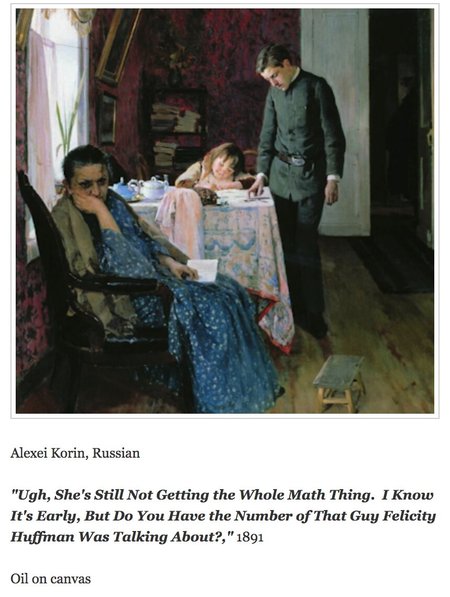
On a completely different thing: Is it a swipe at Ms. Huffman that she’s allegedly referred to in a painting from 1891?
James Pollock: The case is brought in federal court, specifically the U.S. District Court for the District of Massachusetts. The controlling precedent is that from the U.S. Court of Appeals for the First Circuit (and the Supreme Court, of course). The First Circuit recognizes the spousal privilege in the form discussed above.
While that’s a good point about kids at home, I believe that Macy and Huffman have only the two college-age daughters.
Usual John: Do you mean that they need to produce evidence of complicity independently of the spousal testimony? That wasn’t clear to me from the case you sent. (Although the opposite wasn’t clear either, I’ll take your word for it if you’re saying it is.)
Winter Wallaby: That was the way I read it, but frankly, I’m not completely sure either. However, the general rule is that a confession alone is insufficient to support a conviction; there must be some kind of corroborative evidence to show the trustworthiness of the confession (although this standard, known as the corpus delicti rule, is an easy standard to meet). So I’m inclined to think that there must be some evidence of complicity beyond just the testimony. However, I have not researched this.
” The controlling precedent is that from the U.S. Court of Appeals for the First Circuit (and the Supreme Court, of course).”
You still have choice-of-law problems if the allegedly incriminating statements were made in a different Circuit. And if the state law and the federal law diverges significantly, you might be generating grounds for an appeal.
Under Federal Rule of Evidence 501, the privilege is governed by federal common law (although state law can still be important on some issues, such as whether there is a marriage). As for a Circuit deferring to another Circuit, I’ll believe it when I see it.
Of course, if there’s a change of venue, that’s a different matter. Macy and Huffman would probably rather be tried in the District of Colorado, where they live, rather than the District of Massachusetts, where the case was brought. I suspect that the argument for a change of venue is weak, but don’t know enough about criminal procedure to say.
“Under Federal Rule of Evidence 501, the privilege is governed by federal common law”
Yet under Erie (304 U.S. 64 (1938)), there is no such thing as federal common law, only the common law of the states. (Yes, I know. That applies to substantive law and not to procedural, and evidence is procedural. But there’s an argument to be made that privilege should not fall under, or not solely under, “procedural” as a category.
I’m assuming that the District of Massachusetts was selected because the school that was allegedly defrauded is there, and therefore the criminal act(s) alleged took place there. But without having facts, It’s impossible to say. (if this is one of the cases where the “consultant” paid off the test proctor to alter test scores, it’s possible that wherever the kid(s) took the entrance exam is the most proper venue. If it’s one where they paid off a sports coach to tab the student despite not actually wanting the kid on the team, then it’s wherever that coach is employed.)
I didn’t take criminal law at all… I studied up on it for the six weeks before taking the bar exam, but don’t really have much interest in criminal law. I graduated in December, 2010, into the teeth of the biggest legal recession since the Great Depression.
Andréa – That was my question also. When I first heard I told Robert “the wood turner’s wife is one of those arrested. They haven’t mentioned him – maybe he didn’t know?” He looked terribly upset (which I understand) when they stopped when he was going into some building – not sure if where he was going was related.
James Pollack – Don’t know who James Gunn is or how he was fired, but she is gone. They were canceling the show and enough people complained so that it has been pulled and will be redone. She is the town mayor and ows a cafe in the show with the sheriff as partners. In the recent episodes he was going to buy the local bar/tavern (not sure which it is called) and did not not have enough money to buy and she could not buy him out and the former mayor (since turned criminal and back to good guy again – it is Hallmark after all) also wanted to buy it and did not have enough money and they decided to go halves on it – but someone else – from outside the town – bought it out from under them. So her partner could take over the cafe on his own. I guess the former mayor might end up being so again. I admit to liking it – a rarity for Hallmark’s shows made for the channel – but it is the type of show where the two main characters finally marry – and he gets killed while she is pregnant with their first child.
On the other hand, the people at “Fuller House” came out after the Hallmark firing and said she was fired, but I think they reversed themselves.
Ah, realized I should have mentioned – I had watched the Hallmark TV movie of the show due to its plot of a eastern, educated woman heading to the west to be a teacher (and not knowing at the time it was in Canada) -which did not have the same cast and was actually better than this series which followed.
Winter Wallaby – yes, I tell Robert everything. Since he is with me almost all the time there is not much to tell him that he does not know – together so much that he no longer can have surprise Christmas or birthday gifts. In my case nothing criminal to tell. (I had a client leave me once as I was too honest an accountant for him.) I swear I was not driving on the section of a road that I was supposedly photographed by a red light camera as running a red light on. I drive so rarely that I know the exact route I drove that day to meet a client and return and I was not on that section of that road. But how does one prove that – pay the $80! And yes he has heard much about that ticket.
“I swear I was not driving on the section of a road that I was supposedly photographed by a red light camera as running a red light on.”
Was there a PICTURE of your car doing this? In FL, you can drive thru the tollbooth and a pic is taken and sent to you along with the toll bill.
. . . and isn’t it THEIR legal duty to prove it, rather than YOUR legal duty to DISprove it??
I once did an ‘Alice’s Restaurant’ routine – I was given a speeding ticket; I went to court and proved with drawings and circles and arrows that this particular road did NOT have a speed limit sign on it to tell drivers coming off one road that the speed limit was changed.
I still had to pay the fine, BUT points were not taken off my license, which was my goal. And within a week or so, a speed limit sign was put up where it should’ve been in the first place.
“Don’t know who James Gunn is or how he was fired”
Mr. Gunn is a director. Tweets from his past resurfaced that were incompatible with the Disney company’s public image, so he was fired. Then, several months later, somebody remembered that he was the main creative force behind a pair of movies which made the Disney company several hundreds of millions of dollars, and he was re-hired to make a third (many of the production crew and cast apparently signaled to management that they would not return to make the third movie with a different director, and some of them did so publicly.)
While he was unemployed, Disney’s rival company immediately snatched him up to revive THEIR comic-book movie project.
Andréa – They did send a photo of the car going through a red light. Based on the photo it is a main road to the south of us. We are not often in that area and I was not there that day so we don’t know how there is a photo of the car there. How does one prove that there were not on that road in that location (I was on that road that day in a different community and I really don’t think I ran a light on the section of the road I was on.)
Since i drive the car so rarely and I know from my calendar what I did that day – It just makes no sense – but they somehow have a photo of the car going through the light.
In the past I have fought tickets and won, but how does one fight a photo that should not/cannot exist but does.
I also learned in the past that in NYC if one gets a parking ticket, the fact that the car was in Pennsylvania that day in the middle of a multi- day trip (hotel bill with car listed) does not prove it was it was not parked in NYC that day.
” How does one prove that there were not on that road in that location”
You prove that you WERE somewhere else at that time. (Note that this is different from a parking ticket, because a parking ticket is an ongoing infraction whereas running a red light is an instantaneous violation.)
A defense that you could not have committed a crime because you were somewhere else at the time is sufficiently common that it has its own name: it’s an alibi.
It works better for some crimes than for others. In The Hunting of the Snark, it is suggested that the crime of desertion could not be proved because of an alibi.
UNLESS your car is unique, picture of a car proves nothing. Does the picture show a license plate? Must have, or how else did they get your address? A real puzzler . . .
Photo-red-light and photo-radar systems identify the license plate numbers, or they don’t issue a ticket. However, they don’t always get the license correct. Mythbusters did an episode where they tried out various methods of obscuring the license plates to beat a photo-radar. I don’t think any of them worked, but the machines do make mistakes.
Somehow, I can’t imagine Meryl taking the time to rub mud on her license plate to beat a photo-radar, but one never knows . . . ‘-)
Mud on the license plate is a tool used to fool human beings (and also doesn’t work). Mythbusters had weird prismatic covers for the license plate, and stuff like that.
Even if mud on the license plate worked, it’s still a loser’s game: you can get ticketed for having an obscure license plate even if you don’t commit any other infraction.
About a decade or so ago a rumor went around in Germany that you could avoid a traffic camera ticket by hanging a CD from the rear view mirror (shiny side forward). The idea was that the mirrored flash would overexpose the negative, making it impossible for police to prove who was driving (which is a prerequisite for issuing a German ticket, since the points go to the actual driver, rather than the vehicle owner). It’s even possible that the trick could have obscured the plate number (making it impossible to identify the owner). However, the police quickly made improvements to their flash and film development technology, enabling them to resolve sufficient infomation from low-quality images.
P.S. Germany has had radar and red light cameras for more than 20 years. The standard (fixed location) design with a box on top of a pole flashed yellow, the newer “cylindrical column” and all mobile devices (in unmarked police hatchbacks) flash in red. There are also special models that flash in infrared (for use in tunnels), so you never know about it until the ticket arrives in the mail. Unlike in France, which also uses cameras, but where it is illegal to camouflage them, the German police can (and often do) disguise their units to make them very hard to see in advance.
In Oregon, photo radar units had a big sign that warned drivers that photo radar was in use on that particular roadway. Then, the photo-radar gear was always in an identical van parked on the side of the road. They still got a surprising number of offenders. The photo-red-light gear, on the other hand, was built into the traffic-signalling system on specific intersections whose location was not a secret. Yet you’d still see stupid people who didn’t get the memo.
They got around the identity-of-the-driver by sending the ticket to the registered owner; the driver was presumptively the registered owner unless the owner swore, under oath, that the driver was actually somebody else… and also provided the name and address of the driver.
@ JP – The Oregon system is just about identical to the German one.
It was described as about the opposite… Oregon doesn’t do anything to hide photo radar, and puts out clearly visible signs that you can clearly see as you approach. That isn’t at all “just about identical” to ” the German police can (and often do) disguise their units to make them very hard to see in advance.”
@ JP – Stop being intentionally difficult. I was talking about the process of sending tickets and identifying the driver.
Yes, they did have a photo of the back of the car with license plate. How this got put together on their end or why I don’t know. I had driven on the road in question up to a certain point about a 3/4 of a mile before where I was suppose to be – and then turned onto a large “limited access road” and went north, never arriving at the point shown in the photo and mentioned in the ticket. I can’t prove where I was as I was elsewhere driving in the car – not even a witness I know. At least it was “only $80 back then.
You know the old joke – “Pay the $2?”, well we decided to treat it that way.