A {Gentile) friend who had picked up a little shared-culture Yiddish apparently mixed up “schlep” with, maybe, “schtup”. So would say things like “Oh, he’s definitely schlepping her!”.
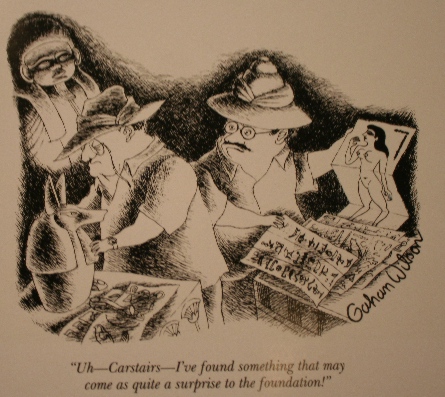
“Surprise” because it’s more realistic than most Egyptian art, or surprise because it’s mildly titillating? Wait a second, there’s something weird going on with the legs of that woman. And why is she wearing sunglasses, or a sleep mask? OK, I’m lost.
That she’s depicted as a Playboy-style centrefold is the surprise. Nudity per se is not so surprising to people dealing in ancient art in general (though I don’t think the Egyptians specifically went for it much).
The Egyptians had papyrus, so technically they could have had a centerfold. That sure looks like paper, though.
The woman’s legs look weird because Wilson did the perspective correctly, oddly enough. The paper fold is at the level of her knees, but makes them appear to bend backwards.
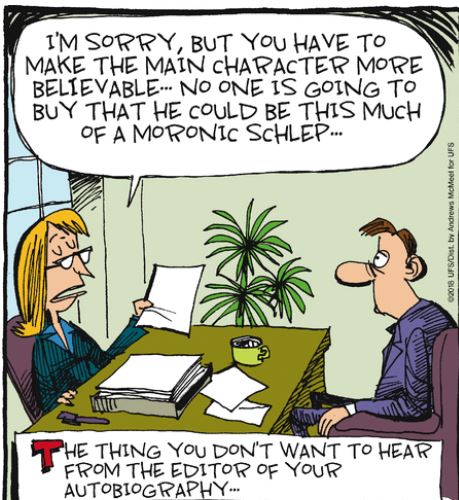
Checking whether the squirrel had been clipped off at the bottom revealed that the panel is a recycled comic. Whamond used exactly the same gag (but with different criticism, and including the squirrel) on 16-Aug-2013.
In response to Ranedeer, the weirdness with the legs is a fold in the “paper” or whatever surface to resemble an opened magazine. And I took the “sunglasses” effect as a reference to a style of dark eyeliner depicted on ancient Egyptian burial masks and hieroglyphics
v.
“to carry or drag,” 1922 (in Joyce’s “Ulysses”), from Yiddish shlepen “to drag,” from Middle High German sleppen, related to Old High German sleifen “to drag,” and slifan “to slide, slip” (cf. Middle English slippen; see slip (v.)). Related: Schlepped; schlepping.
n.
“stupid person, loser,” 1939, short for schlepper “person of little worth” (1934), in Yiddish, “fool, beggar, scrounger,” from schlep (v.) “to carry or drag” (for sense evolution, cf. drag (n.) “annoying dull person”).
When a moronic schlep writes an autobiography, generally the main character is not a moronic schlep.
Autobiography subjects usually achieve far greater things than their authors ever did. That’s either why you read biographies instead of autobiographies, or why you read autobiographies instead of biographies, depending on what you’re looking for.
So nice that people on this group know what schlep means. I go crazy on one of my embroidery groups which is mostly filled with nice, middle Americans who have no idea of same and another with two British ladies who we translate so many things back and forth when we post.


 Comics I Don't Understand
Last one makes no sense. Yiddish “schlep” means “haul”. Someone apparently thinks all Yiddish adjectives are some sort of insult.
LikeLike
A {Gentile) friend who had picked up a little shared-culture Yiddish apparently mixed up “schlep” with, maybe, “schtup”. So would say things like “Oh, he’s definitely schlepping her!”.
LikeLike
“Putz” would have worked.
LikeLike
It may not be correct Yiddish, but I have heard “schlep” used as a noun in the sense indicated above (not necessarily by “native” speakers ;-) ).
LikeLike
I’ve heard “schlep” as a noun (embedded in English), but related to its verb sense — like “That’s quite a long schlep to do every day!”
LikeLike
I would guess that the cartoonist mixed up “schlep” and “schlemiel”.
LikeLike
“Surprise” because it’s more realistic than most Egyptian art, or surprise because it’s mildly titillating? Wait a second, there’s something weird going on with the legs of that woman. And why is she wearing sunglasses, or a sleep mask? OK, I’m lost.
LikeLike
That she’s depicted as a Playboy-style centrefold is the surprise. Nudity per se is not so surprising to people dealing in ancient art in general (though I don’t think the Egyptians specifically went for it much).
LikeLike
The Egyptians had papyrus, so technically they could have had a centerfold. That sure looks like paper, though.
The woman’s legs look weird because Wilson did the perspective correctly, oddly enough. The paper fold is at the level of her knees, but makes them appear to bend backwards.
LikeLike
I think Whamond meant “schlub”. At least there’s no squirrel.
LikeLike
Checking whether the squirrel had been clipped off at the bottom revealed that the panel is a recycled comic. Whamond used exactly the same gag (but with different criticism, and including the squirrel) on 16-Aug-2013.
LikeLike
In response to Ranedeer, the weirdness with the legs is a fold in the “paper” or whatever surface to resemble an opened magazine. And I took the “sunglasses” effect as a reference to a style of dark eyeliner depicted on ancient Egyptian burial masks and hieroglyphics
LikeLike
Yes, I gave the panel a sqirrelectomy: since I was giving this an LOL tag, it made sense to remove an element that worked against it.
LikeLike
v.
“to carry or drag,” 1922 (in Joyce’s “Ulysses”), from Yiddish shlepen “to drag,” from Middle High German sleppen, related to Old High German sleifen “to drag,” and slifan “to slide, slip” (cf. Middle English slippen; see slip (v.)). Related: Schlepped; schlepping.
n.
“stupid person, loser,” 1939, short for schlepper “person of little worth” (1934), in Yiddish, “fool, beggar, scrounger,” from schlep (v.) “to carry or drag” (for sense evolution, cf. drag (n.) “annoying dull person”).
LikeLike
When a moronic schlep writes an autobiography, generally the main character is not a moronic schlep.
Autobiography subjects usually achieve far greater things than their authors ever did. That’s either why you read biographies instead of autobiographies, or why you read autobiographies instead of biographies, depending on what you’re looking for.
LikeLike
Of course the main requirement for becoming a judge is white hair that curls at the ends.
LikeLike
Thanks, Kevin.
And since everything’s better with music (“Once I was a schlepper, now I’m Miss Mazeppa”):
LikeLike
Anybody else reminded of Laverne and Shirley?
https://www.huffingtonpost.com/barry-kibrick/schlemiel-schlimazel-hase_b_8512356.html
LikeLike
Definitely have heard of someone being a schlep. Also they could be schlepy.
LikeLike
So nice that people on this group know what schlep means. I go crazy on one of my embroidery groups which is mostly filled with nice, middle Americans who have no idea of same and another with two British ladies who we translate so many things back and forth when we post.
LikeLike