Election Day

Having survived many months of an extremely arduous campaign, many CIDU readers may feel the same way as Drabble’s dad did (above). Nevertheless, there is a lot at stake today, so I would prefer to quote Walt Kelly’s famous exhortation, as expressed by Pogo:


Heinlein expressed a similar sentiment in “Double Star“: “Take sides! Always take sides! You will sometimes be wrong — but the [person] who refuses to take sides must always be wrong! Heaven save us from poltroons who fear to make a choice. Let us stand up and be counted.


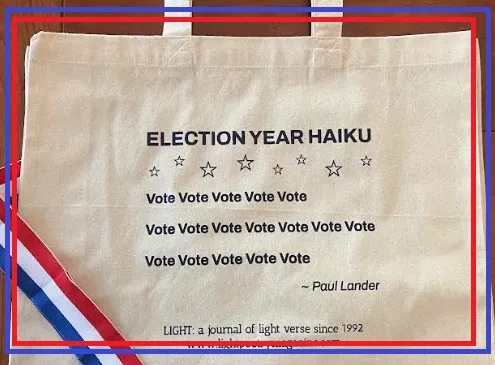
The prize offered for Week 92 of the Invitational was a tote bag, featuring an election year haiku, written by Paul Lander in the journal “Light“:

P.S. Since CIDU has always avoided overtly political discussions, comments are disabled. Please use whatever time you would have spent on composing an elaborate opinion to go to the polls and cast your ballot.


P.P.S. The following option is neither rational, nor legitimate, even if some people may think it is funny:


Bonus post: train of association

This is actually a long-running plot thread in Safe Havens: The boy called here “Leo” is also, in his other time and place, going to be Leonardo da Vinci. His education in science and technology as a youth in the modern world will underlie his great talents in the 15th and 16th Centuries.

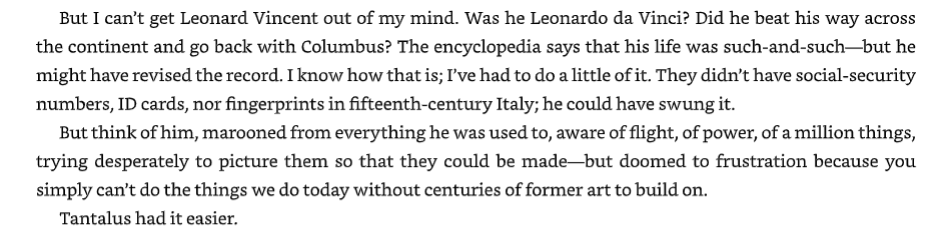
Does anyone else here look at that and think, “Oh yeah, I remember that speculation coming up in The Door Into Summer!“? That 1956/7 novel by R.A. Heinlein involved quite a bit of plot interactions in different time periods, mostly by means of cold sleep, but with a smidgen of actual time-machine travel. The narrator tracks down an eccentric inventor in his hermitage, and learns about his device. When loaded with equal masses on its two pans, it can send them into other times, one to the past and one to the future by equal time-intervals. He extracts this recollection from the inventor:

The narrator does manage to get sent back from 2001 to 1970 (both of which, I remind you, were part of the unclear future when the book was published). After some plot-heavy manipulations, towards the end of the story he reflects: