Marrose sends:
She asks:
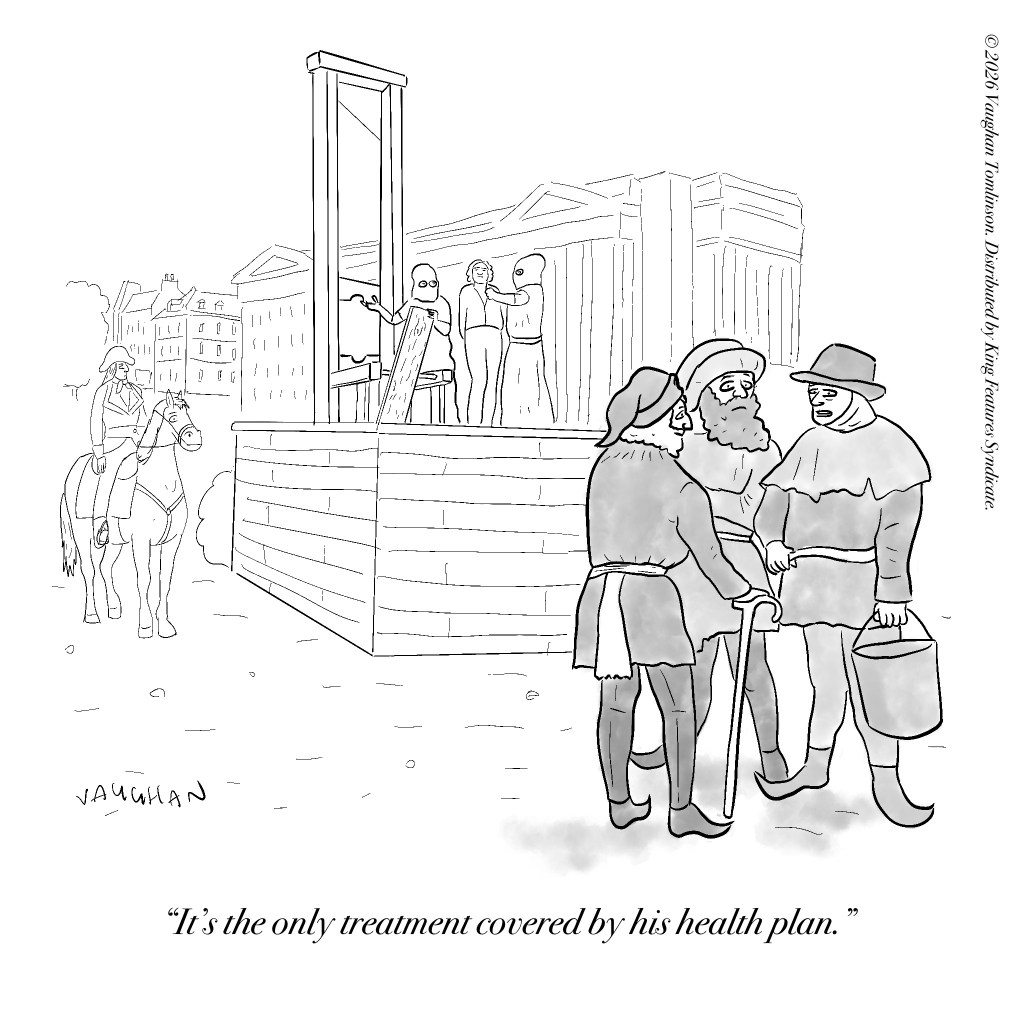
Why are there medieval peasants (circa 1300) talking about the French Revolution ( 1789-1802)? I get the comment was supposed to be wryly funny, but I can’t get past the characters.
I guess the cartoonist is fuzzy about how revolting French people would have dressed? Maybe AI involved, “Draw me some people from long ago”. Srsly, it’s an excellent question, and an unnecessary distraction from the point of the cartoon!
Tomlinson is from South Africa, but I don’t think that gets him a bye on this detail.


Also: treatment for what?
LikeLiked by 1 person
Powers – Dandruff? Head lice? Actually that treatment will put an end to most any medical problem.
LikeLiked by 1 person
As a person with extremely low knowledge of history and different ways of dress, the joke is fine for me. However, if someone is going to nitpick the different styles, why not complain about the hoods? Apparently those were rare.
Philip – This treatment will certainly make the executee not care about any medical problem, but it won’t end many of them. Even worse, it could cause the spread of their medical problem to others, exacerbating it, not ending it.
LikeLike
I don’t see anything in the cartoon to indicate that it is supposed to be c. 1300.
LikeLike
The peasants feel like they were cribbed from a painting.
LikeLike
Usual John, they’re right. I’m no expert but there’s a lot online about historical clothing. These guys are wearing gowns, hose, and curly shoes, which would have been perfect for the 14th-century French peasant going to town. By the early 18th century, they’d have breeches, chemise-style shirts, and shoes with square toes.
Anyway, googling “3 peasants talking” gives me the image that was clearly used for reference so that’s the why of it.
LikeLike
I didn’t think to look for the source painting. It’s Three Peasants in Conversation, by Albrecht Dürer, c. 1497. But the architecture seems characteristic of the 18th and 19th centuries, and the equestrian is wearing a bicorne, which is associated with the Napoleonic period. And of course that is a guillotine, which was not put in use until 1792.
I don’t think we have a well-researched historical setting here. I would have thought that the French Revolution was intended, but the guillotine is so associated with the Reign of Terror that it’s hard to see humor in the punchline.
LikeLike
Maybe those three wandered over from the Renaissance Faire a couple of blocks away.
LikeLiked by 1 person
@beckoningchasm star Like (I’d have done it for real, but I don’t want to get involved in signing up with WordPress)
LikeLike
Picky, picky, picky!
LikeLike
Is “Honest, we’re not aiming to be curmudgeons, it’s just hard to ignore the problems here” one of our categories now?
LikeLiked by 1 person
As an American 1770s reenactor – they are definitely dressed wrong for the general 18th century European/American colonist whether French, Spanish, Dutch, English… (which includes those on the American continent). I would presume those living in Europe in general would be dressed similarly to those living here. (Yes, even then style mattered and pictures (drawings) of the latest fashions in the home country of a colony would be sent to the colony and circulated about same, supposedly the colonies were only a few months behind in fashion from the mother country.)
I will say that my clothing for reenactment is far from fashionable – I wear work outfits – for my shift (sort of A-line white dress) which is basic undergarment for women, petticoat (skirt), jacket (as would be now, but closes down the front with straight pins, no safety pins then) – to match my 18th self – Anne Stewart (Mrs. Alexander Stewart), a housewife of the “middling sort”, as due to my 20th/21st century limited sewing skills. She would wear more fashionable clothing when going out in public. She is however with her husband’s militia unit so would dressed simply.
I also made husband’s clothing, but his is much more fashionable than my work clothes – since as a man he would out in public and judged by his appearance, while I would be at home unless something public was going on which I was attending (and in period would have dressed much fancier than I am if I went to same). He generally wears at events, which are drills by the town’s men to practice in case of attack by French, Dutch, natives, battle reenactments, or so in 1775 & until end of the Revolution, his “hunting frock” – a much simpler and much dressy work shirt of a sort – beige with trim, and wears his “frock coat” – suit jacket – when conducting business with other gentlemen or at parties and such, either with breeches and thigh high stockings with a white shirt which goes down to his thighs.
In the comic they are dressed earlier in time than same.
LikeLike
Boise Ed asks: Is “Honest, we’re not aiming to be curmudgeons, it’s just hard to ignore the problems here” one of our categories now?
Yes, it at least technically is one of the (wait for it) 346 categories listed … . And it seems to have been used 5 times!
LikeLike