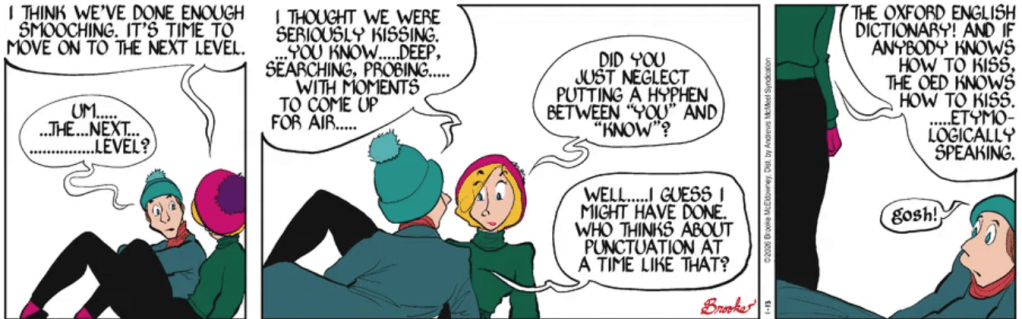
Jack Applin sends this in: “A hyphen between “you” and “know”? As in “you-know”? What sense does that make? If she will criticize his punctuation, then she should also condemn the excessive and random number of dots in his ellipses, though she is no better with her five-dot ellipsis.”
So she’s able to read thought balloons clearly enough to discern hyphens?
 Comics I Don't Understand
McEldowney does that a lot. His characters love to be pretentious about grammar but he personally struggles with it. He gets subjective and objective case wrong, punctuates like it’s decorative, and loses track of subject-verb agreement regularly. I’ve wondered for years if he just enjoys rage-baiting grammarians, legitimately believes he’s right, or is trying to write “informed pedantry” where the reader is expected to accept that the character is right for the sake of the story (as an example of an informed trait, think of Tony Stark – the audience accepts that he’s a genius engineer even though the actual things he says about science on screen are nonsense).
Those are good points, Andrew. I’m guessing “informed pedantry”.
There’s a few Spider-Man comics where he complains that someone pronounced it “Spider Man” instead of “Spider-Man.”
Thank you for reminding me once again why I stopped reading this strip years ago.
If anything other than straightforward separate words, I will sometimes try y’know.
Here’s a weird synchronicity: Minutes after reading this cartoon and discussion, I went to Wikipedia to look up “live oak” and discovered that Walt Whitman spelled that with a hyphen. The article says “Walt Whitman writes in his poem “I saw in Louisiana a live-oak growing”” Searching the web for the poem seems to confirm that he spelled it that way. I expect some people will accept that as the correct spelling, citing Walt as an authority!
Moreover, my speech recognition program wants to spell that “Live Oak”, thinking it’s a place name. I find that my speech recognition program frequently adds superfluous hyphens. Like some humans, it has difficulty recognizing that phrases frequently used as adjectives are not always used as adjectives: during the Cold War, versus a Cold-War crisis. A live-oak grove, with a dozen live oaks.
Another way that computers give us extra hyphens is when copying text (typesetting): where a word was hyphenated because it was spanning two lines in the original copy, the hyphen gets retained in subsequent copies where the word no longer spans two lines.
All that being said about the error itself, perhaps the joke is that this character is one of those people who frequently makes mistakes and is confident that they are correct, to the point that they mistakenly “correct” other people’s “mistakes”.
The other joke here I think is a form of breaking the fourth wall: she is reading his speech bubble rather than hearing him.
I have been trying to think of any instance where there might possibly correctly be a hyphen placed between you and know. So far the only possibilities I can see are you-know-who and you-know-what, both phrases being defined on the Merriam-Webster webpage.
“Someone pronounced it Spider Man instead of Spider-Man?” I see one of his superpowers must be the ability to read speech balloons.
I would have thought that the hyphenated version was wrong, but I see it is spelled that way on the covers of the comics. I suppose Spider-Man can spell-his-name any-way he likes-to.
Dr JayKay, how about “you-know-who”, frequently used in my home as one the more polite synonyms of POTUS.
Let’s make that “one of”.
The hearable alternative spelling of “Spider-Man” I thought might be in question would be to print it solid, Spiderman. Which likely would get spoken as a dactyl, with reduced vowel in the final syllable — parallel to Sugarman [or the less-Anglicized Zuckerman].
DrJayKay, yep, it’s always been “Spider-Man”, though of course it’s often written incorrectly.
Reminds me of “Mastercard”, which people want to be camelcase, “MasterCard”, but isn’t. Or “Visa”: friends who work there tell me that writing it in all caps is practically a firing offense! The card brands are VERY protective of their names.
@Phil, another oft-mistaken camel-case is PetSmart (a smart place to shop for your pet-related products, I guess) — often mistakenly written (by me, anyway) as PetsMart (a marketplace for pet products). The PetSmart styling is in their written materials, in running text at least. Signage on the stores is in all-caps, but you can still tell how it is divided as they use red for the PET and blue for the SMART. (It’s decorated with some odd blue plumage and a red dot erupting between the T and the S, but that doesn’t contradict the division.)
Thank you! — to the ones who gave me several ideas to look up today. It’s interesting to learn the names for concepts not previously known. Camel case is a delightful term, “a word with a hump in the middle”. Not a package for shipping a camel.
I see Visa is a curious company name, being derived from an acronym but not typed in all capitals like an acronym. It’s something like some words which were formed from acronyms, but the capitalization has been dropped over time: SCUBA, RADAR, LASER…
Amn’t Brooke pretentious?
Sorry, Brian, “amn’t” needs to be used in the first person: “Amn’t I pretentious”, something Brooke would almost certainly never say.
I first encountered the term “camel case” in programming, where we use the capital letters to separate the words in variable names.
Mark-If Brooke thinks ‘you know’ is hyphenated, then he’d probably also misuse ‘amn’t’.
If you read the subsequent strips, you-know is a euphemism for sex (explained in the next strip, engaged in in the following one – with his usual visual euphemism of entwined hands).
https://featureassets.gocomics.com/assets/9d351480cc93013ebadd005056a9545d
https://featureassets.gocomics.com/assets/9f92c820cc93013ebadd005056a9545d
Mitch4, we have an internal system called Idea Exchange. When it was being introduced, people kept calling it Ideas Exchange. I started referring to “Idea Sexchange”, which worked surprisingly well to get folks to remember the correct name!
DrJayKay, I don’t think Visa is from an acronym. I’d never heard that, and searching did not find anything to support it. Just sayin’.
As for “amn’t”, that takes me back over a half century to summer camp, where a cabin-mate was being harassed about something and finally came back with, “I amn’t stupid!”
Since none of us were Irish, that utterance did NOT improve his standing, I’m afraid.
Uh huh, that was how you got your cow orkers to notice the spelling subtlety…
Let’s face it, all 9 Chickweed Lane comics are CIDUs,
There’s an old joke referring to Spider-Man and Superman, et al as folk of Jewish descent. I recall the pronunciation of the final “A” being unstressed, as often happened with surnames.
Possibly Whitman did that to disambiguate between the nondeciduous oak variety and a living oak tree of nonspecific variety.
Grawlix: Of course the creators of both characters were Jewish, so that’s not entirely unlikely…!
jjmcgaffey: It looks like you’re right.
phsiii: I am seeing references to Visa International Service Association. I am confused about whether that was the source of an acronym or whether it was just a different name.
Perhaps you would like to run a search on Visa International Service Association. Visa could be a shortened form of that and not be an acronym.
It does seem as if it’s unlikely that the name of a banking organization would have any humor in it, such as a recursive acronym. I suspect many bankers would disapprove of humorous names.
Verrrry interesting. Since Visa International Service Association was created while the card was still Bank Americard, I resist the idea that the brand was ana acronym. I think it’s more likely that the plan was to rebrand as Visa and so the Association was created in anticipation of that event.
But I will try to find out for sure!
Hmm…
The Visa logo is all caps, but employees couldn’t write it that way?
BankAmericard was camel case, sort of.
Wikipedia says the name “Visa” was chosen for its connotations, not as an acronym. And anyway, if it was an acronym for Visa International Service Association, that wouldn’t resolve the issue.
I have always thought from when “VIsa” credit cards first came out was that it’s name was intended to make one think of traveling – as when one needs a “visa” to go to another country.
(Husband would tell you that it is my overly logical mind telling me this.)
Meryl, that was also my guess about the Visa name around the time it was introduced.