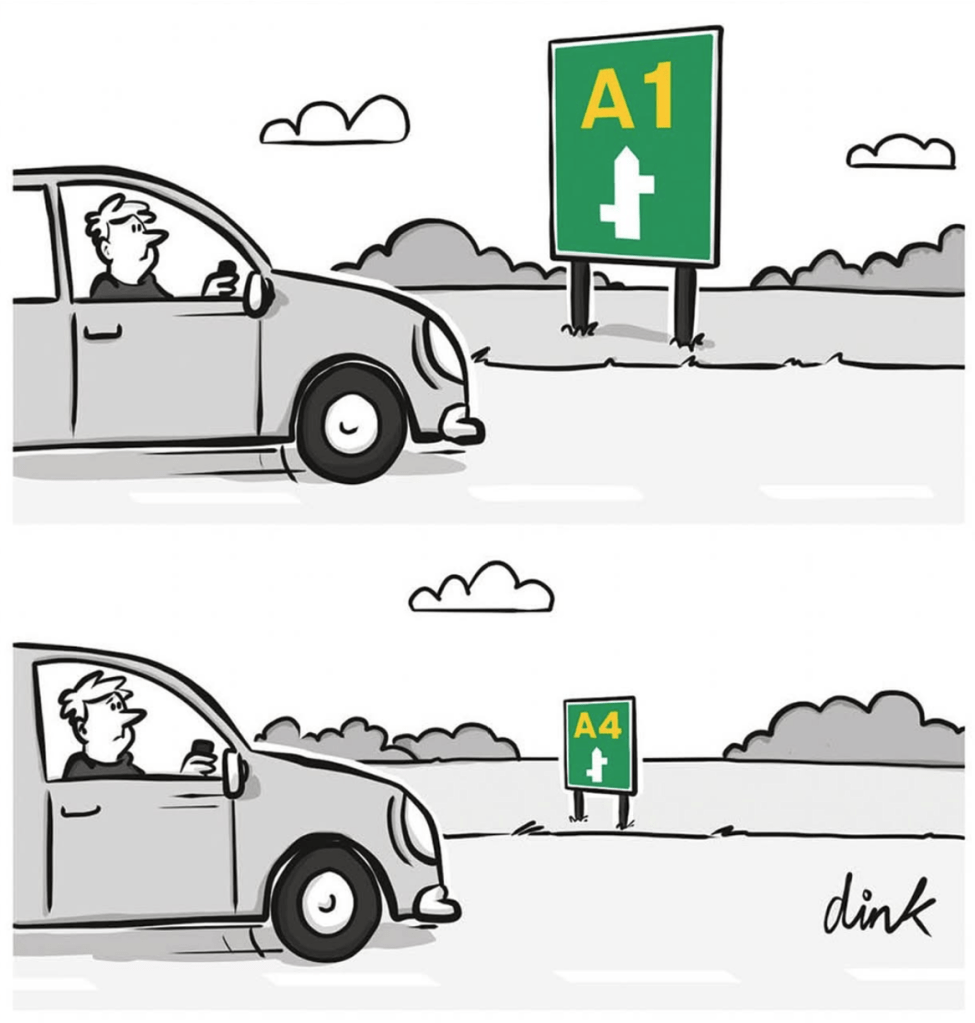
I think the joke here is about paper sizes. The ISO A1 (23.4″ × 33.1″) paper is 8 times the size (in area) of ISO A4 (8.3″ × 11.7″).
For people used to the ANSI paper sizes (AKA Americans), this translates to ANSI D (22″x34″, usually only used for blueprints) and ANSI A (8.5″x11″, standard Letter)
Gnoman has it
Also, A1 and A4 follow the naming convention of British roadways, and they use the paper sizes Gnoman explained.
The A1 in Britain runs from London to Edinburgh. (410 miles)
The A4 is shorter, and runs from London to Avonmouth (128 miles). The road signs likely aren’t smaller, though.
I’m an American that understood the paper size reference, although at my work my large prints are in ARCH
@Voodoo Chicken
I do most of my printing work in ARCH sizes as well, but it is very handy to be able to recognize that something is in an ISO format and isn’t just a scan with cruft on the margins.
I didn’t interpret the signs as different sizes. I just thought the second one was farther away.
 Comics I Don't Understand
I think the joke here is about paper sizes. The ISO A1 (23.4″ × 33.1″) paper is 8 times the size (in area) of ISO A4 (8.3″ × 11.7″).
For people used to the ANSI paper sizes (AKA Americans), this translates to ANSI D (22″x34″, usually only used for blueprints) and ANSI A (8.5″x11″, standard Letter)
Gnoman has it
Also, A1 and A4 follow the naming convention of British roadways, and they use the paper sizes Gnoman explained.
The A1 in Britain runs from London to Edinburgh. (410 miles)
The A4 is shorter, and runs from London to Avonmouth (128 miles). The road signs likely aren’t smaller, though.
I’m an American that understood the paper size reference, although at my work my large prints are in ARCH
@Voodoo Chicken
I do most of my printing work in ARCH sizes as well, but it is very handy to be able to recognize that something is in an ISO format and isn’t just a scan with cruft on the margins.
I didn’t interpret the signs as different sizes. I just thought the second one was farther away.