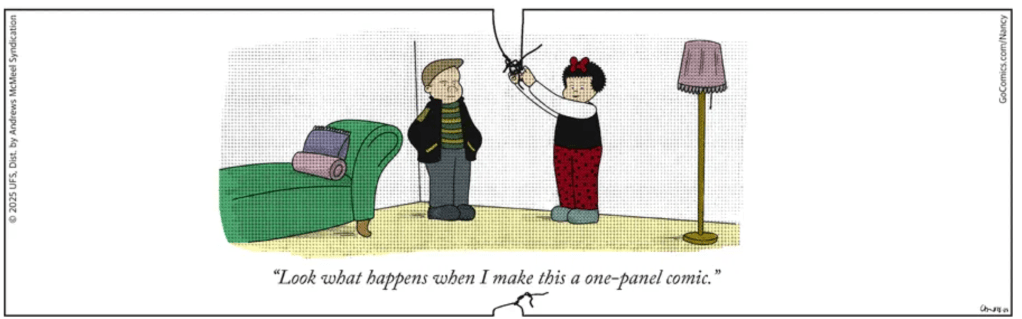
??? Is there a joke either in the two panel version or the one panel version? Why does the comic only fill up the middle of the space? Why is there a dotted background, which doesn’t occur in this strip generally? What’s Jaimes trying to say here?
Related
4 Comments
I don’t know what you mean by “two-panel version.” Nancy cut, and is tying off, the borders between panels. This caused the comic to shrink so it bridges the former gap between panels and leaves room below for dialogue. I think the pointillist effect is a result of the art actually being shrunk, not part of the joke exactly.
The joke is the panels merging and the dialogue moving to the bottom, in the style of many single-panel comics.
If we knock down this wall see how it opens up all this space making the place brighter and more airy.
Are Nancy and Sluggo teens now? I haven’t read this strip since I was a teen.
When Nancy converts the two-panel strip into a one-panel cartoon, the entire art style changes to look like it belongs in the New Yorker.
This probably works better in black & white, the colors are fighting with the shading here
 Comics I Don't Understand
I don’t know what you mean by “two-panel version.” Nancy cut, and is tying off, the borders between panels. This caused the comic to shrink so it bridges the former gap between panels and leaves room below for dialogue. I think the pointillist effect is a result of the art actually being shrunk, not part of the joke exactly.
The joke is the panels merging and the dialogue moving to the bottom, in the style of many single-panel comics.
If we knock down this wall see how it opens up all this space making the place brighter and more airy.
Are Nancy and Sluggo teens now? I haven’t read this strip since I was a teen.
When Nancy converts the two-panel strip into a one-panel cartoon, the entire art style changes to look like it belongs in the New Yorker.
This probably works better in black & white, the colors are fighting with the shading here