JMcAndrew sends this in: “I’m not buying that Uncle Sam would be endorsing a food of German origin as his favorite meat.
Samuel Wilson was a meat packer from Troy, New York, who supplied barrels of beef to the U.S. Army during the War of 1812.
If anything this should be an anthropomorphic barrel of beef or pork.”
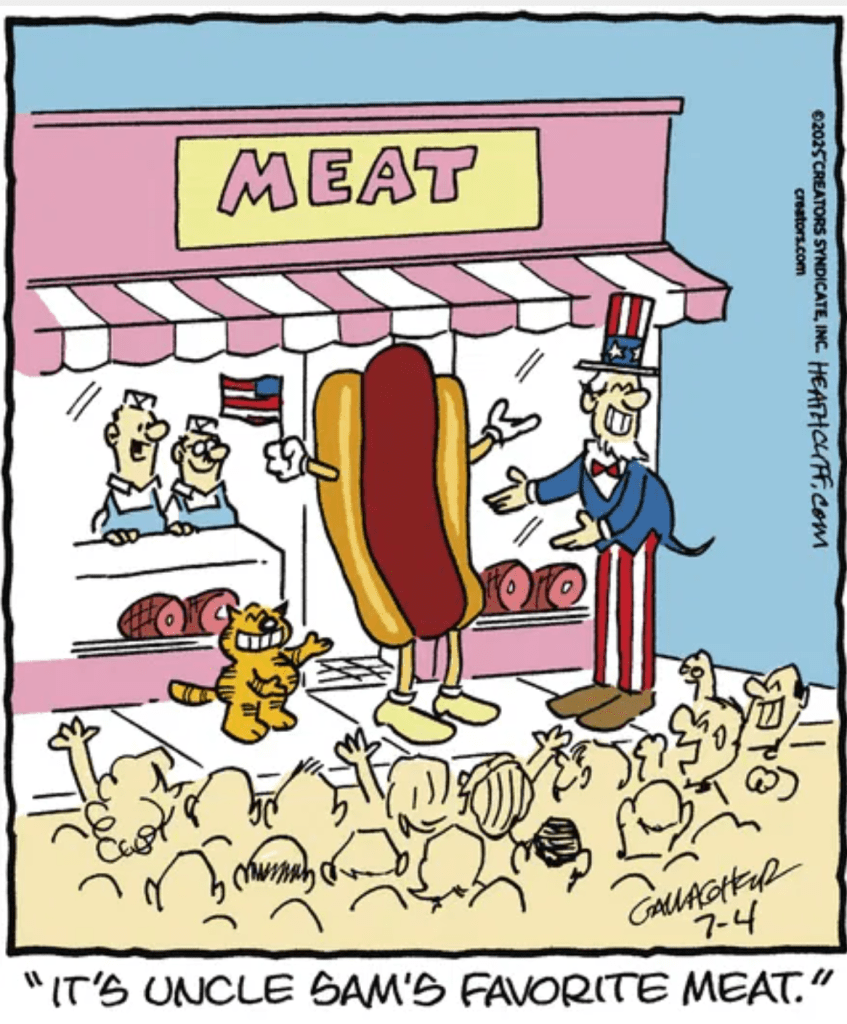
This hearkens back to that old GM ad slogan: “Baseball, hot dogs, apple pie, and Chevrolet”, all of which have become less common than when that slogan was introduced in 1974.
Still, the hot dog is iconic, and certainly easier to make anthropormorphic:

 Comics I Don't Understand
I accidentally posted this “immediately”, before it was really finished, rather than scheduling it for later. But it’s already out there for people receiving email notices of these posts, so there’s no sense trying to put toothpaste back in the tube. So this is today’s bonus post.
LikeLike
I did geocaching for a while. There was supposed to be one by the Sam Wilson statue in Arlington. It’s in a very small park where the Minuteman Bike Trail crosses Mass Ave, easy to get to from where I lived, but we never found it.
LikeLike
It would more in keeping with the ‘modern tradition’ of ‘Heathcliff’ to use an anthropomorphic can of ‘HAM’, but that isn’t considered ‘traditional’ 4th of July fare.
LikeLike
“And here to MEET him is Joey Chesnut!”
But seriously, isn’t the cat committed to ham?
LikeLike
The frankfurter sandwich, aka the hot dog, was long considered America’s favorite (casual, savory) food, although it has largely been supplanted by the hamburger. It may seem an odd choice; not only is it a usually pork sausage of German origin, but the very name “hot dog” suggests that the meat is of dubious source, implying that the vendor may have used stray dogs rather than domestic pigs in concocting the sausage. Indeed, uncertainty as to the meat used continues today, although contemporary concerns are more focused on the possibly low quality of the pork. But it was not for nothing that President Roosevelt served hot dogs to King George VI in 1939. The gesture helped to build relations between the countries on the eve of the war.
LikeLike
Sausage of German origin, but it was the Americans who put it in a bun so you could hold it without getting your hands greasy or wearing special gloves. A story has it that sausage vendors gave out gloves with their sausages just for that purpose.
Dogs being made into sausages was a common fear in the 19th century. In fact the well-known song “Where Oh Where Has My Little Dog Gone” has a verse where the owner fears his dog met exactly such a fate. But the sausage vendor who offered “Hot Dachshunds” must have been referring to the shape; otherwise, who would eat them? But cartoonist Tad Dorgan couldn’t spell “Dachshund”, and the rest is, well, legend, if not history. American legend or American history, whatever.
Now, Indian pudding — THERE is a truly and undeniably American dish. I love that stuff. But nobody else I know can stand to eat it.
LikeLike
@bensondonald (3): Maybe it’s a Jewish cat.
@Usual John (4): Were hot dogs that exotic in 1939?
LikeLike
I’ll have to try Indian pudding.
My wife, for her birthday, requested flan. She likes flan, but doesn’t favor Mexican food in general, so seldom has it. I’d never made flan, or creme brule, but it turned out to be no harder than baking her a cake, and was a big hit. So now I’m inspired to try other baked puddings.
LikeLike
Boise Ed: In America, hot dogs in 1939 were pretty much the least exotic thing possible. But they were exotic to British royalty.
Mark in Boston: The Tad Dorgan story has been floating around a long time, but is completely untrue. Hot dogs, including their name, predate Tad.
LikeLike
Pretty unlikely that Sam Wilson was the inspiration for Uncle Sam. The term was already in use before Wilson started working for the Army, and nobody drew a connection between Wilson and Uncle Sam until decades later. Most likely Uncle Sam was just a playful take on “U.S.” that caught on.
Anyway, Uncle Sam is famously against eating meat – at least domestically during wartime. He recommends eating fish and lots of veggies, saving the meat for the boys overseas.
LikeLike
I’m guessing it is Uncle Sam’s favorite meet because it is pork. I think the meet in the window are a clue to that as well.
No one talked about that aspect and this isn’t marked as a CIDU, so maybe everyone already understood that part of it.
LikeLike
I misspelled meet/meat not once, but twice. Wow. I really want and edit function!
LikeLike
Is this a Heathcliff comic?
I rarely find him funny.
LikeLike
“I misspelled meet/meat not once, but twice. Wow. I really want and edit function!”
Inevitable.
LikeLike
In the back of my head somewhere it seems to me Uncle Sam was the result of saying that picture of him looked like their uncle – but that must be an unrelated story about someone else.
However, having nothing else to do – Robert is writing down data for an a/c we hope to buy tomorrow or day after so we can work in our office again after not being able to do so since a heat wave started last week or the week before (days all run together due to getting very little work done – only what can be done on laptop while working in the kitchen) – I looked up Uncle Sam online.
Apparently he was a meat purveyor to the US Army during the War of 1812.
LikeLike
You can find many stories online. From Wikipedia (usual caveats) entry on the Sam Wilson legend:
Doubts have been raised as to the authenticity of this story, as the claim did not appear in print until 1842. Additionally, the earliest known mention definitely referring to the metaphorical Uncle Sam is from 1810, predating Wilson’s contract with the government.
LikeLike
Legend or not, Troy, New York is very much into Uncle Sam Wilson, with a statue of Sam Wilson in Uncle Sam Park, near the Uncle Sam Bikeway, not far from Uncle Sam Lanes, Uncle Sam Flooring LLC, Uncle Sam Swim Team, Uncle Sam Athletics, and Uncle Sam’s Good & Natural Products.
LikeLike