Danny Boy sends this in: “Not entirely true of *this* Danny”.
Related
15 Comments
Danny looked at the sign. “This way to the egress,” it said, an arrow indicating the door. Others passed by – sometimes with expressions of annoyance as they maneuvered around him – but he remained still. He had paid good money to be here. He would savor this.
I recall the “This way to the egress” sign as part of a joke story about carnival sideshows or the like. The sign would be displayed as though leading to another exhibit. But of course it (accurately) led to the exit, and was part of getting the crowd to move on through more quickly.
Nice detail on the name of the tavern
@mitch P. T. Barnum famously had “This Way to the Egress” signs posted in order to reduce lingering crowds
Bill’s Buffalo Wings + … what?
Powers, I’d reckon it’s “Tavern.”
@Chipchristian thanks for providing the source of that bit, and informing us that it was real!
@3 I was just about to mention that. Nice little reference.
“Bill’s Buffalo Wings” — if you know, you know, as they say.
The last one could have been a psyco-path.
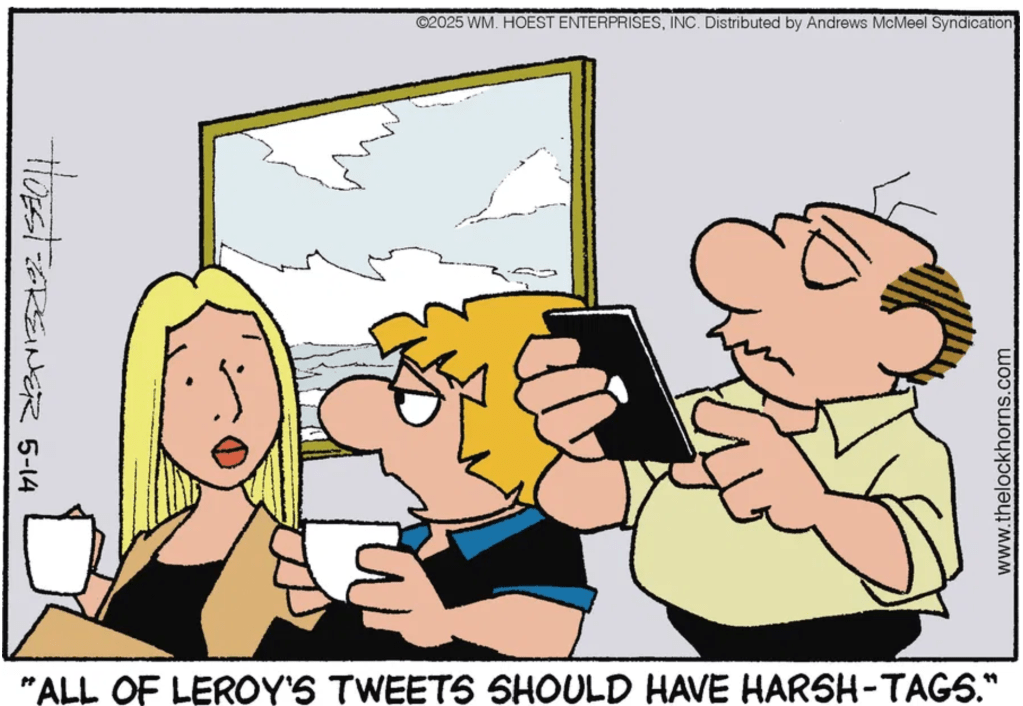
Grawlix: The following was tweeted by one Paul Watson on October 4, 2024:
Man sits by me on train.
Man: Loads of psychopaths around here.
Me: Really?
Man: Loads mate.
Me: How’d you know?
Man: There’s signs aren’t there?
Me: I guess?
Man: I love them
(47 minutes of awkward silence.)
Man leaves train, he has a bike. I realise he was saying ‘cycle paths’.
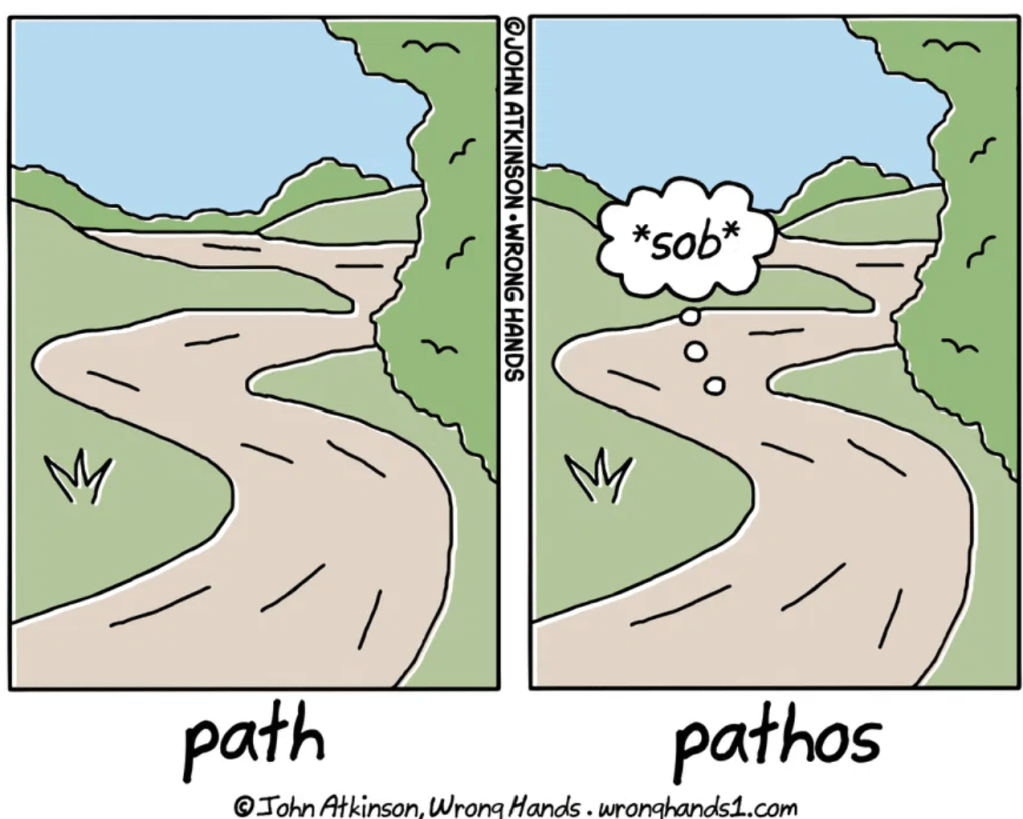
MiB, this fits exactly with a classic Bizarro panel, which Piraro recently reprinted in his blog or memoir-blog. Also I’ve seen it paired with the Wrong Hands panel about paths, which is in this Saturday Morning OYs collection.
So pathology isn’t the study of paths?
@Mark in Boston: Pathology derives from Greek pathos “suffering”, which would also describe how you might feel after a long hike on a path.
But, oddly enough, path has a different derivation:
“Old English paþ, pæþ “narrow passageway or route across land, a track worn by the feet of people or animals treading it,” from West Germanic *patha- (source also of Old Frisian path, Middle Dutch pat, Dutch pad, Old High German pfad, German Pfad “path”), a word of uncertain origin, not attested in Old Norse or Gothic.
“The original initial -p- in a Germanic word is an etymological puzzle. Don Ringe (“From Proto-Indo-European to Proto-Germanic,” Oxford 2006), reflecting an old theory, describes it as “An obvious loan from Iranian …, clearly borrowed after Grimm’s Law had run its course.” Watkins says the word is “probably borrowed (? via Scythian) from Iranian *path-,” from PIE root *pent- “to tread, go, pass” (source of Avestan patha “way;” see find (v.)), but this is too much of a stretch for OED and others.”


 Comics I Don't Understand
Danny looked at the sign. “This way to the egress,” it said, an arrow indicating the door. Others passed by – sometimes with expressions of annoyance as they maneuvered around him – but he remained still. He had paid good money to be here. He would savor this.
I recall the “This way to the egress” sign as part of a joke story about carnival sideshows or the like. The sign would be displayed as though leading to another exhibit. But of course it (accurately) led to the exit, and was part of getting the crowd to move on through more quickly.
Nice detail on the name of the tavern
@mitch P. T. Barnum famously had “This Way to the Egress” signs posted in order to reduce lingering crowds
Bill’s Buffalo Wings + … what?
Powers, I’d reckon it’s “Tavern.”
@Chipchristian thanks for providing the source of that bit, and informing us that it was real!
@3 I was just about to mention that. Nice little reference.
“Bill’s Buffalo Wings” — if you know, you know, as they say.
The last one could have been a psyco-path.
Grawlix: The following was tweeted by one Paul Watson on October 4, 2024:
Man sits by me on train.
Man: Loads of psychopaths around here.
Me: Really?
Man: Loads mate.
Me: How’d you know?
Man: There’s signs aren’t there?
Me: I guess?
Man: I love them
(47 minutes of awkward silence.)
Man leaves train, he has a bike. I realise he was saying ‘cycle paths’.
MiB, this fits exactly with a classic Bizarro panel, which Piraro recently reprinted in his blog or memoir-blog. Also I’ve seen it paired with the Wrong Hands panel about paths, which is in this Saturday Morning OYs collection.
So pathology isn’t the study of paths?
@Mark in Boston: Pathology derives from Greek pathos “suffering”, which would also describe how you might feel after a long hike on a path.
But, oddly enough, path has a different derivation:
“Old English paþ, pæþ “narrow passageway or route across land, a track worn by the feet of people or animals treading it,” from West Germanic *patha- (source also of Old Frisian path, Middle Dutch pat, Dutch pad, Old High German pfad, German Pfad “path”), a word of uncertain origin, not attested in Old Norse or Gothic.
“The original initial -p- in a Germanic word is an etymological puzzle. Don Ringe (“From Proto-Indo-European to Proto-Germanic,” Oxford 2006), reflecting an old theory, describes it as “An obvious loan from Iranian …, clearly borrowed after Grimm’s Law had run its course.” Watkins says the word is “probably borrowed (? via Scythian) from Iranian *path-,” from PIE root *pent- “to tread, go, pass” (source of Avestan patha “way;” see find (v.)), but this is too much of a stretch for OED and others.”
https://www.etymonline.com/search?q=path