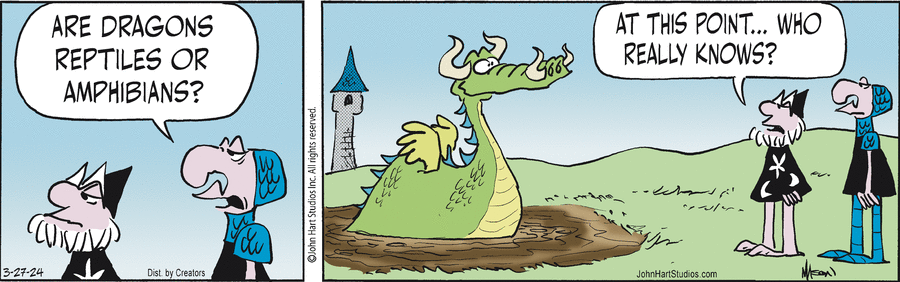
Tim Harrod submitted this Wizard of Id as a CIDU promptly on the day that it was published, exactly eight months ago today. As Tim put it: “Just a straight-up, no-analysis-possible I Do Not Get It“:
…
I can’t give a definite answer to Rodney’s question, either, but it probably depends on which cultural tradition the Dragon came from.
P.S. One reason that I did not like the Disney movie “Raya and the Last Dragon” is that the dragons were furry (rather than scaly).
 Comics I Don't Understand
A dragon sitting in a mud puddle is perhaps slightly amusing.
My dog sits in puddles all the time when it is hot, but that wouldn’t make him amphibian.
This seems like a reference to the modern debate about dinosaurs.
Dragons with fur are less common, but certainly not unheard of. I’m not even sure there is a good argument to be made about the true representation of a mythical creature.
Amphibian is just about the one thing dragons can’t be in any tradition because amphibians necessarily have smooth skin without scales.
I have no clue about the joke. I imagine Mastroianni may have a child studying taxonomy in grade school who asked him that question and he said, “That would be an equally funny question from the writer of a major syndicated legacy strip as it was from a child, let’s do this.”
I wonder if the idea is that dragons are mythical creatures, and thus don’t have to conform to any taxonomy. Since they don’t exist, they can be either, both, or none.
@Andrew Millar: warning, zoology major!
Actually, one major group of amphibians are (slightly) scaled: https://en.wikipedia.org/wiki/Caecilian
Perhaps –
At the time of the Wizard of Id – neither amphibian nor reptile existed as terms. So no one knows which a dragon is as no one knows what the words mean or what either an amphibian nor a reptile is?