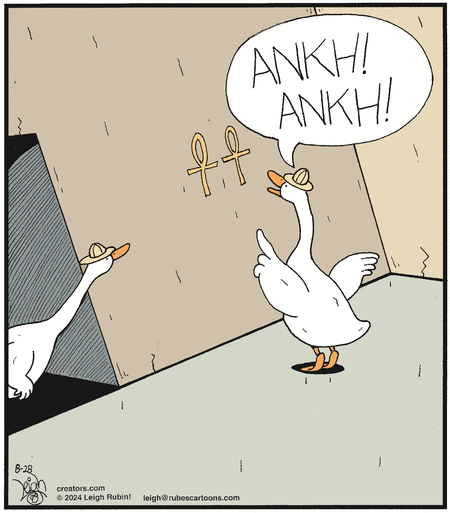
I have no idea what Leigh Rubin intended with this cartoon:
… The symbols on the wall are indeed a pair of ankhs, but why is it supposed to be funny when a goose says that?
Related
14 Comments
Because it’s a good approximation of the sound geese make.
I didn’t get it because I’ve always pronounced it wrong.
(“AYNK” [a as in “hay”] instead of the correct “AHNK” [a as in “father”] or “ANK” [a as in “bad”])
I don’t think I’ve heard actual goose calls, or not enough to discuss what that sounds like. However, the very standard description, or naming, of that is to say “the geese were honking”. And then in a next step, it seems reasonable that ‘Ankh’ could be a spelling for a honk.
@ Dana (3) – I have to admit that I had (briefly) considered a relationship to the more traditional goose call (“honk, honk”), but I didn’t think the orthographic nor audible similarity was close enough to make that the answer.
P.S. Wikipedia has a list of animal sounds (including typical transcriptions), but “honk” (or “hiss”) doesn’t come remotely close to any of the sounds in the audio clip for geese. Then again, neither “cock-a-doodle-doo” nor the German equivalent “kikeriki” sounds anything like a rooster crowing.
Actually, the Wikipedia sounds for goose could easily be transcribed “ankh”… closer than “honk” (though “honk” as an onomatopoeic transcription is much closer than the sound of a car horn that most people think of when you say “honk”). And I can say “cock-a-doodle-doo” to sound very like a rooster crowing – it’s entirely throat sounds, not pronounced with full round vowels. The German is even easier. They’re all approximations…
Note that ANKH is the middle sound of Tutankhamen, and his name written in hieroglyphs contains an ankh. If you’ve heard his name spoken, you know how to say ankh.
“You say we have rien, but I say we have tout en commun“
Mitch4: For that, you get to go to your sarcophagus without any supper!!!
Almost no English speakers pronounce ankh or Tutankhamen with the unvoiced fricative “kh” sound, they just say a “k” (glottal stop) instead. Thus endeth the nitpicking. For now.
The song “King Tut” was performed by “Steve Martin and the Toot Uncommons.”
Carl, I’m getting warmed up to start putting out there an aspirated /t/ midword rather than a theta for the orthographic “th”s in “Zarathustra” and “Neanderthals”.
@ L.F. (10) – I thought that was just a wisecrack, but I looked it up, and he really did use that name on the cover of the single:
@ Mitch (11) – The “T” sound would be correct in “Neanderthal” (“Thal” was the archaic German spelling of “Tal”, meaning “valley”), but the “th” in “Zarathustra” really was a theta, from the language Avestan.
P.S. There is an anecdote that during the first German spelling reform (at the beginning of the 20th century), Kaiser Wilhelm specifically requested that the H in “der Thron” (engl. “throne”) should be preserved, but in fact the “th” spelling is still used in German for all “foreign” words that originally had a Greek theta.
P.P.S. During the second (21st century) reform, several more “th” spellings were simplified to “t”, including reducing “der Thunfisch” to “Tunfisch”, which was controversial enough that the “h” was made “optional”, but it still appears on most cans of tuna in Germany.
Kilby – And if you have not seen Steve Martin perform it – in period costume and dance – it is rather funny. He did same on Saturday Night Live – https://www.youtube.com/watch?v=FYbavuReVF4
 Comics I Don't Understand
Because it’s a good approximation of the sound geese make.
I didn’t get it because I’ve always pronounced it wrong.
(“AYNK” [a as in “hay”] instead of the correct “AHNK” [a as in “father”] or “ANK” [a as in “bad”])
I don’t think I’ve heard actual goose calls, or not enough to discuss what that sounds like. However, the very standard description, or naming, of that is to say “the geese were honking”. And then in a next step, it seems reasonable that ‘Ankh’ could be a spelling for a honk.
@ Dana (3) – I have to admit that I had (briefly) considered a relationship to the more traditional goose call (“honk, honk”), but I didn’t think the orthographic nor audible similarity was close enough to make that the answer.
P.S. Wikipedia has a list of animal sounds (including typical transcriptions), but “honk” (or “hiss”) doesn’t come remotely close to any of the sounds in the audio clip for geese. Then again, neither “cock-a-doodle-doo” nor the German equivalent “kikeriki” sounds anything like a rooster crowing.
Actually, the Wikipedia sounds for goose could easily be transcribed “ankh”… closer than “honk” (though “honk” as an onomatopoeic transcription is much closer than the sound of a car horn that most people think of when you say “honk”). And I can say “cock-a-doodle-doo” to sound very like a rooster crowing – it’s entirely throat sounds, not pronounced with full round vowels. The German is even easier. They’re all approximations…
Note that ANKH is the middle sound of Tutankhamen, and his name written in hieroglyphs contains an ankh. If you’ve heard his name spoken, you know how to say ankh.
“You say we have rien, but I say we have tout en commun“
Mitch4: For that, you get to go to your sarcophagus without any supper!!!
Almost no English speakers pronounce ankh or Tutankhamen with the unvoiced fricative “kh” sound, they just say a “k” (glottal stop) instead. Thus endeth the nitpicking. For now.
The song “King Tut” was performed by “Steve Martin and the Toot Uncommons.”
Carl, I’m getting warmed up to start putting out there an aspirated /t/ midword rather than a theta for the orthographic “th”s in “Zarathustra” and “Neanderthals”.
@ L.F. (10) – I thought that was just a wisecrack, but I looked it up, and he really did use that name on the cover of the single:
@ Mitch (11) – The “T” sound would be correct in “Neanderthal” (“Thal” was the archaic German spelling of “Tal”, meaning “valley”), but the “th” in “Zarathustra” really was a theta, from the language Avestan.
P.S. There is an anecdote that during the first German spelling reform (at the beginning of the 20th century), Kaiser Wilhelm specifically requested that the H in “der Thron” (engl. “throne”) should be preserved, but in fact the “th” spelling is still used in German for all “foreign” words that originally had a Greek theta.
P.P.S. During the second (21st century) reform, several more “th” spellings were simplified to “t”, including reducing “der Thunfisch” to “Tunfisch”, which was controversial enough that the “h” was made “optional”, but it still appears on most cans of tuna in Germany.
Kilby – And if you have not seen Steve Martin perform it – in period costume and dance – it is rather funny. He did same on Saturday Night Live – https://www.youtube.com/watch?v=FYbavuReVF4