As we have asked before with Baldo, does the joke depend on language, and does it work in both the Spanish and the English versions of the strip?
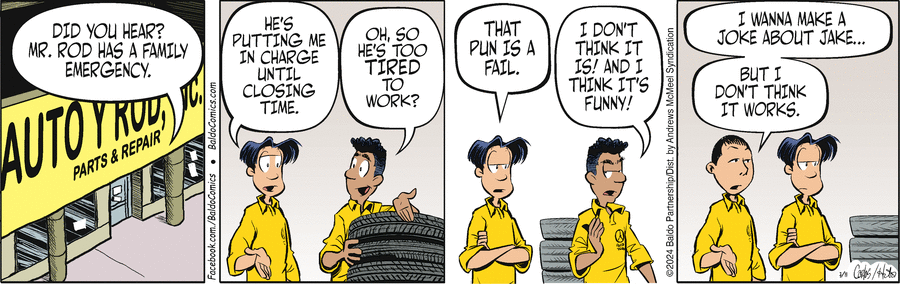

Here there are two loci for our standard questions: In panel 2, the dialog from the second character (who I think must be Jake); and in panel 4, the second part of the dialog from the speaking character.
My take on those two, in short summary: The panel 2 pun works fine in English, and the Spanish also has something of a pun, by substituting a different statement instead of a translation. In panel 4, in the Spanish there seems to be an amusing equivocation, by virtue of a grammatical ambiguity; which does not carry over into English.
In some detail:
PANEL 2
In the English, notice the emphasis given in the lettering to the word TIRED. And while Jake says that, he is all over a stack of TIRES; even seemingly pointing to them as though in a sort of illustration.
In the Spanish, Jake’s line translates according to Google as “Oh, so you roll out of here early?” (and I think the “you” is not the only choice — it’s more of an impersonal, and might amount to “we”). So it no longer mentions tires or tiredness, but with the mention of rolling still manages to indirectly bring in the tires and roughly complete a pun. (And as a noun instead of verb, rueda is rendered first off as wheel.)
PANEL 4
OK, a bit of background. English (like, say, French) in simple sentences, in at least semi-formal speech or writing, requires an overt subject, even if a person and number could be inferred. Spanish (like many other European languages) allows skipping a subject pronoun if the verb form is enough to determine person and number. You can see this in both of Jake’s sentences in panel 3 — creo is 1st-person singular, but the sentence does not need to say yo creo; same for pienso not needing yo pienso.
Then in panel 4, the third character’s line Pero no creo que trabaje could be But I don’t think it works [it = the potential joke], or But I don’t think he works [he = Jake]. Which is a fairly good joke, or anyway language-amusement. [My point about not requiring overt subject pronoun turns out not crucial here, since if this sentence did use a subject pronoun, él for he or it would still be indeterminate.] But in English we get But I don’t think it works, and no secondary dig at lazy Jake.
 Comics I Don't Understand
Confirming that you can’t expect a pun to translate.
In panel 4, the pun still works in English as long as you know the character of Jake, who is known for never doing anything useful at the shop. (Or maybe it becomes just a joke and not a pun. Either way it’s funny.) A similar joke is “I want to get my watch fixed but I don’t have the time.”
“I wanna make a joke about Jake, but I don’t think it works” — just like Jake doesn’t work.
In panel 2, the pun in English doesn’t necessarily rely on the stack of tires, as Auto Y Rod is a car repair shop, but I guess it helps illustrate it.
I only read Baldo when it shows up here at CIDU, and since “Jake” only appears once, and not until the fourth panel, I had no idea that it was the character’s name. Instead, it reminded me of a slang expression from the early 20th century, which was resurrected into the script of “The Sting”.
Even though the term “jake” was completely unknown in the 1970s, when Robert Redford’s character said that something was “jake”, it was clear from the context that he meant that it was “good”. Since this would be far too obscure for the strip above, the statement that the joke would not work almost made sense.
P.S. There is one additional minor difference between the two strips in the third panel. In English, Jake’s responses are in the present tense, whereas in Spanish, he replies in past tense and/or subjunctive.
Yes, I know “So are we jake?” after repairing a dispute.
But even more iconic there’s – “Forget it, Jake. It’s Chinatown.”
Btw, trabaje in the last bit of dialect is a subjunctive!
From https://ellaverbs.com/spanish-verbs/trabajar-conjugation/
Subjunctive Tenses of Trabajar
Trabajar in the Subjunctive Present
The Subjunctive Present is used to talk about situations of uncertainty, or emotions such as wishes, desires and hopes. It differs from the indicative mood due to the uncertainty of the events which are being spoken about. For example, “trabaje”, meaning “I work”.
In Spanish, the Subjunctive Present is known as “El Presente de Subjuntivo”.
PRONOUN SPANISH ENGLISH
Yo trabaje I work
Tú trabajes you work
Ella / Él / Usted trabaje s/he works, you (formal) work
Nosotras / Nosotros trabajemos we work
Vosotras / Vosotros trabajéis you (plural) work
Ellas / Ellos / Ustedes trabajen they work, you (plural formal) work
I’ve been reading Baldo for a long time. In the past, there was a lazy and rather stupid character named Omar. He was also the nephew of the owner, Mr. Rod. At some point, we stopped seeing Omar and started seeing Jake. I don’t recall if they overlapped. It seems to me that Jake wasn’t originally lazy, and that he took on that role later, but I might be mistaken.
Anyway, the similar roles have caused confusion in the Comments, as some now think that Jake is Mr. Rod’s nephew. That hasn’t ever been shown, but I would say that it won’t at some point. We have seen Jake sucking up to Mr. Rod.
Another continuity development was Sergio buying tires (and presumably wheels and suspension parts) for Baldo’s vintage Impala. The artist has relied on a set of stock drawings made years ago for the car, so we’ll see if the next appearance there are new ones with wheels and tires all around. At least it temporarily quited those in Comments who moaned about the car being on concrete blocks, and ones oriented in unsafe fashion.
I was initially wondering how the name Jake was pronounced in various languages – Jaike or Jack and if the latter whether it involved car jacks. But I guess not.
On Tyres and Rolling, I was driving through France with a friend and we had a dodgy spare wheel, so we pulled into a garage and asked the garagiste if he had an err… ummm… ahh… and we settled on a “roulade”.
This caused him some mirth, as is turns out a roulade is not a wheel or tyre but is a form of food, sweet and cakey like a Swiss roll or savoury and made of meat.
https://en.wikipedia.org/wiki/Roulade
And in Shakespeare and other sources from his time, “a jakes” was an outhouse or latrine.
And your story of the roulade reminds me of the witness description of the robbers wearing baklavas over their heads.
The follow-up strip again plays on knowledge of Jake’s laziness for its fourth-panel pun:
https://www.gocomics.com/baldo/2024/07/12
Er, punchline, I should say. No pun in the fourth panel. Apologies.
Thanks! Here’s an embed of the followup strip Powers provided a link to.
And same one in Spanish.
(Both this and the previous day have “play on words” where the English version has “pun” as single word.)
The decoration on their T-shirts looks suspiciously similar to the Mercedes Benz “trident-star” logo, but such an upscale brand seems highly out of place, considering Baldo’s close association with broken down jalopies.
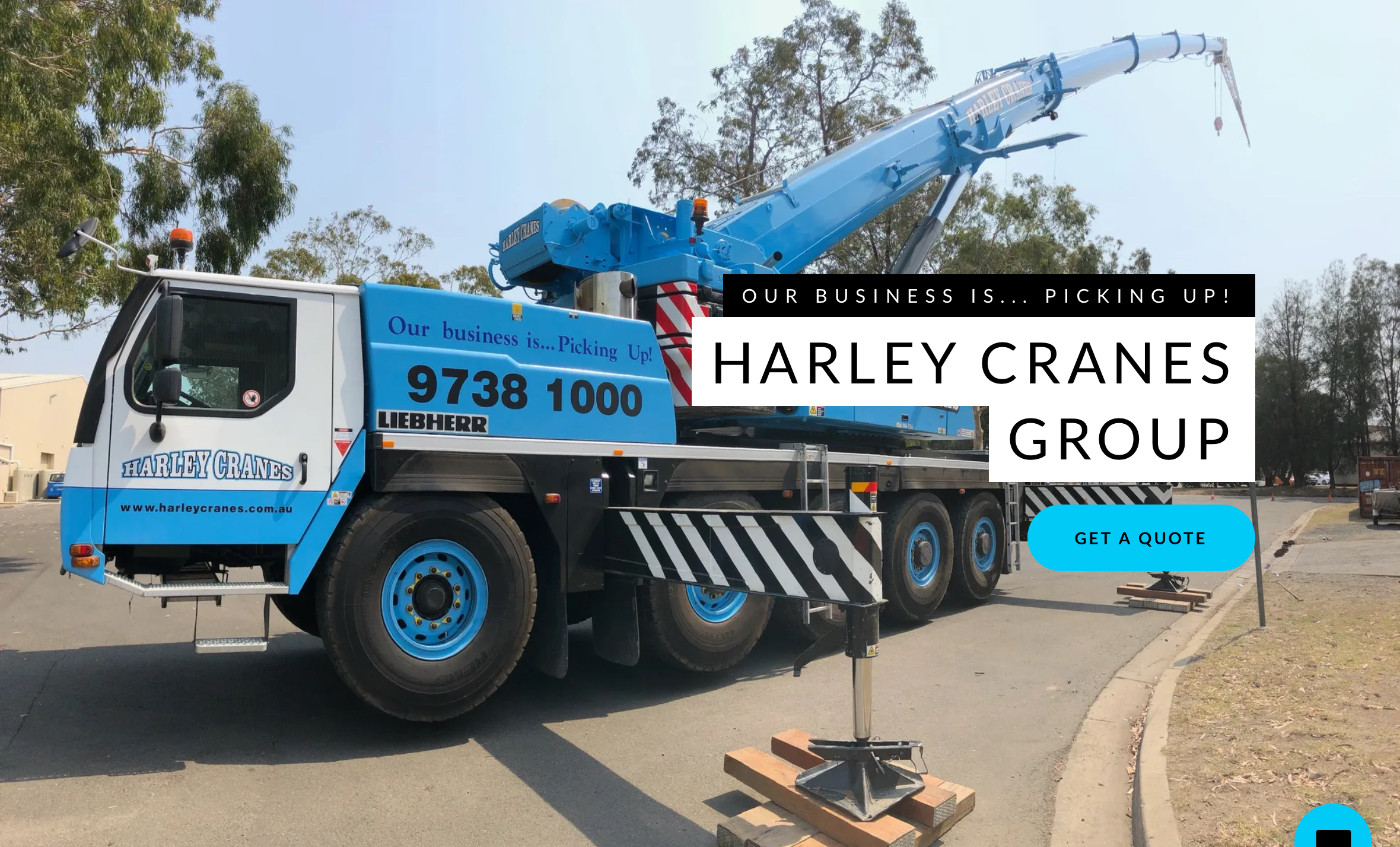
Hmm, now what would be a good motto for a crane company?
.
.
.
.
.

.
.
.
.
The auto parts store is Auto Y Rod. I think the symbol is supposed to be a stylized A.
@ Brian (16) – GoComics wasn‘t working when I commented @14, so I wasn‘t able to find any other examples. Now that GC is back online, the decoration on the shirt turns out to be an old-style steering wheel, back from before airbags became standard equipment:
P.S. All of the legible examples that I could find were at least 10 years old. Later strips seems to be rendered less carefully, leaving the logo in doubt. Unfortunately, all of the earlier examples also featured the boorish and incredibly annoying owner of the shop. This strip was the least unfunny one that I discovered.
Excellent detective work. I might have been more help if I were working from my PC. I have the backup PC at the fancy new apartment, but don’t have internet there yet. That’s something I need to get on.
Right now I have the phone connected to the PC via USB, and using the program scrcpy to mirror the phone display. It’s not bad, and you can use the keyboard and mouse and all, but sometime the images aren’t super sharp.
I can and do sometimes run the PC off hotspot from the phone, but the data available from that is relatively limited.
It has been over 45 years since I took Spanish in high school and I was never very good at it – and it was high school Spanish.
However I seem to remember being taught to use “Yo” at the start of a sentence in which I was saying that I did something, I wanted something, etc. This may have just been something that the teachers and the text books did to emphasize that this is “I am doing this”, but due to same on the rare occasions I (attempt to) speak Spanish I put “Yo” at the start of the sentence as in “Yo quiro” for “I want” and so on. (And as bad as my Spanish is – it is worlds better than my Hebrew.)
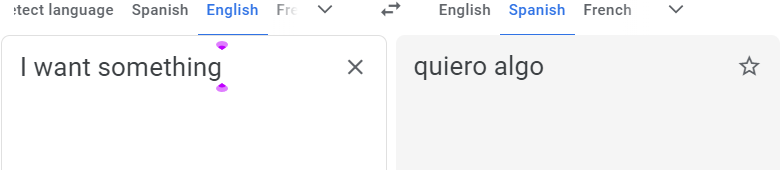
Yes, “yo” is the 1st-person singular pronoun, nominative (subject) form; so “Yo quiero algo” would be the completely full form for saying “I want something”. But also it is quite acceptable to leave off the “yo” and just say “Quiero algo”. I was just checking this in Google Translate, and when you click the “reverse the languages” arrows, the “yo” disappears.

First
Then
The guys are still hanging out, trying on puns, as of the following Wednesday (When does work get done at that place?
Trying to see with authorities whether repuesto , meaning spare in general contexts, would also be the term in bowling. From https://www.microsiervos.com/archivo/mundoreal/bolos-faq.html it looks like the answer is No.
And at https://forum.wordreference.com/threads/strike-spare-pin-bowling.125092/ someone reporting on usage in Mexico says “strike=chuza
Spare=en mexico lo decimos spare, porque no hay un termino que lo defina adecuadamente, hay quien dice semi chuza, porque derribas los diez pinos en 2 intentos. ” “In Mexico we call it spare, because there is no term that adequately defines it,..”
Jake is still trying …
.. very trying!
Does the pun work in Spanish? I’d guess not, as the translation seems to be along the lines of “functional”. I’m not sure what the typical words/phrases for exercising are in Spanish.