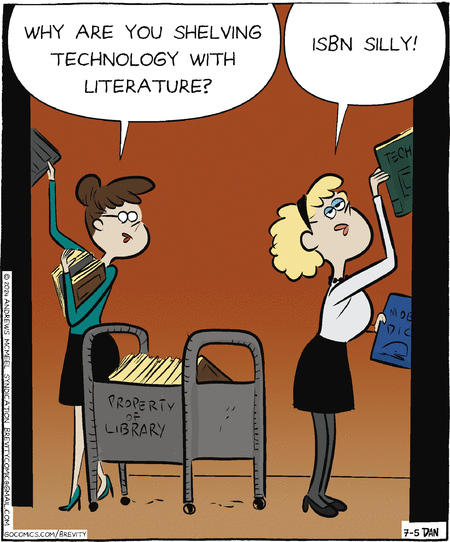
Instead of “Moby Dick” and some random technical tome, that librarian should have been shelving “CDB!” (with “Shrek” thrown in for good measure).
ISBNs have no relationship to the contents of the book. And different editions of a book will have different ISBNs.
It’s probably meant to be read:
I = I
S = is
B = be
N = ing
So, “I is being silly”
Ah, so the joke is that “ISBN” sounds like “I was being”?
Joel D! I think you’ve got it!
We have no reason, besides “she’s being playful” (and the needs of the joke), why the 2nd librarian uses the “invariant IS” form. But there is no reason she can’t be, and I’d say Powers goes a step too far in moving her to standard dialect with “was” replacing “is”.
And my first reaction was along the lines Mark H suggests. The first librarian expects books with related subject matter to be shelved in some relation to each other, suggesting they shelve according to Dewey Decimal or that LC-derived system ; but the 2nd librarian could be going wild today and shelving by ISBN, which was never a shelving scheme and wouldn’t work.
Joel’s explanation @3 was much easier to understand than my cryptic reference to William Steig’s CDB! – I thought the book was a well-known classic, but perhaps that was just because it was an often quoted favorite in my extended family.
@Kilby — I kind of remember Steig’s book. Although I recall clearly only one of the entries–“NME LEN” with a hostile UFO occupant.
The backwards mouths are creepy.
@ BeckoningChasm (7) – I can’t quote directly from the book, because I don’t own a copy (yet); this is my approximate memory of quotes passed around by family members:
C.D.B.?
L.M.N.A.B.!
O.S.A.R.A.B. — U.C.?
O.I.C. – S.A.B.!
It could be taking to mean either she is declaring herself to being silly (I’s bein’ silly) or she is commenting that ISBN is a silly system. Thus, the pun.
I don’t think it is from the same source, but the same operating principle lies behind the Breakfast Dialogue that starts from F U N E M?
While it’s true that ISBNs have no relationship to the contents of the book, I use a database (“Book Collector”) that uses ISBN to fetch lots of information about each book. If a reference library stored its books by ISBN, it would be easy to fetch any specified book quickly. (Of course, that would be impractical for a browsing library; one would have to do one’s browsing in the database.) If I ever have to move again, I might just sort the books by ISBN in boxes, then not shelve them in my new digs.
Yes, a system of MARC records can hold all the info about books that would be on the old paper catalogue cards, plus info about (say) what branch of your library system has which copy of that title, plus circulation info, etc — and the ISBN field could be an index field of course. But this doesn’t help with the issue that different editions or physical formats get entirely new ISBNs, so that shelving by ISBN could mean that different copies of the very same title would not be in the same place, let alone other titles with “the same topic”.
And what did you have for breakfast? “MNX”. That and CUA O are the only two I remember
More fully:
F U N E X?
S, V F X
F U N E M?
S, V F M
F U N E MNX?
S, V F MNX….
I forget where it goes from there
The punchlines in Brevity are almost always puns, so I think the explanation from Joel D. fits best.
I don’t know if this is in the book, but my dad told it to me and it probably comes from long before the book. We assume that one of the two speakers is named “Abie.”
ABCD puppies?
LMNO puppies!
OSAR puppies! CMPN?
A couple I remember from the book:
A boy in an elevator says I M N D L F 8 R.
A boy looks askance at his breakfast while his mother says M N X R L T 4 U!
F.U.N.E.X. comes from The Two Ronnies, big cheeses on BBC TV in the 1970s (18 million+ audience at their peak, which is about a third of the entire British population at the time). “Swedish Made Simple”.
This YouTube, if it loads properly (I’m getting an endlessly spinning progress circle where the URL should be) is the longer version with a preamble explaining the setup and with some 70s-style in-your-face-uendo – “comedy which reflects the broadcast standards, language and attitudes of its time”, as the BBC puts as a trigger warning on ancient repeated material. The clip is 3m50 but the F.U.N. restaurant scene starts around 1m50.
Thanks, narmitaj, it’s good to see that whole sketch.
No, no, you can have an 8-digit silly or an 11-digit silly, but not 9 or 13.
(A pretty obscure joke, so I’ll explain here of all places: The US telephone network uses location codes called CLLI, or “silly codes,” often just called “sillies.”)
Back in junior high, long before the accounting bug bit me, I planned to be a librarian. My mom was getting a master’s degree in library science and all of my (extensive for a child) collection of books had been organized as if in a library. So I volunteered in the school library.
Fiction books were organized by author’s last name (followed by the first name if more than one author with same last name) and non-fiction was organized by the Dewey Decimal System.
So, literature would never be with technology other than a fictional book about same.
As far as I know (it has been some time since I have been in a library other than our own at home *) this system of filing books – fictional by author’s last name and non-fiction by Dewey Decimal still exists.
(*Have not been in a library since we had bedbugs as they are a major possibility for where we got same. Either from items borrowed from the library and taken home or at the time we both having just about monthly exhibitions of our work – his silhouettes and scherenchnitten pieces and his wood turned pieces and the dolls I had made were in exhibition in various local libraries in our county and the next county in “revolving” exhibitions.)
 Comics I Don't Understand
Instead of “Moby Dick” and some random technical tome, that librarian should have been shelving “CDB!” (with “Shrek” thrown in for good measure).
ISBNs have no relationship to the contents of the book. And different editions of a book will have different ISBNs.
It’s probably meant to be read:
I = I
S = is
B = be
N = ing
So, “I is being silly”
Ah, so the joke is that “ISBN” sounds like “I was being”?
Joel D! I think you’ve got it!
We have no reason, besides “she’s being playful” (and the needs of the joke), why the 2nd librarian uses the “invariant IS” form. But there is no reason she can’t be, and I’d say Powers goes a step too far in moving her to standard dialect with “was” replacing “is”.
And my first reaction was along the lines Mark H suggests. The first librarian expects books with related subject matter to be shelved in some relation to each other, suggesting they shelve according to Dewey Decimal or that LC-derived system ; but the 2nd librarian could be going wild today and shelving by ISBN, which was never a shelving scheme and wouldn’t work.
Joel’s explanation @3 was much easier to understand than my cryptic reference to William Steig’s CDB! – I thought the book was a well-known classic, but perhaps that was just because it was an often quoted favorite in my extended family.
@Kilby — I kind of remember Steig’s book. Although I recall clearly only one of the entries–“NME LEN” with a hostile UFO occupant.
The backwards mouths are creepy.
@ BeckoningChasm (7) – I can’t quote directly from the book, because I don’t own a copy (yet); this is my approximate memory of quotes passed around by family members:
C.D.B.?
L.M.N.A.B.!
O.S.A.R.A.B. — U.C.?
O.I.C. – S.A.B.!
It could be taking to mean either she is declaring herself to being silly (I’s bein’ silly) or she is commenting that ISBN is a silly system. Thus, the pun.
I don’t think it is from the same source, but the same operating principle lies behind the Breakfast Dialogue that starts from F U N E M?
While it’s true that ISBNs have no relationship to the contents of the book, I use a database (“Book Collector”) that uses ISBN to fetch lots of information about each book. If a reference library stored its books by ISBN, it would be easy to fetch any specified book quickly. (Of course, that would be impractical for a browsing library; one would have to do one’s browsing in the database.) If I ever have to move again, I might just sort the books by ISBN in boxes, then not shelve them in my new digs.
Yes, a system of MARC records can hold all the info about books that would be on the old paper catalogue cards, plus info about (say) what branch of your library system has which copy of that title, plus circulation info, etc — and the ISBN field could be an index field of course. But this doesn’t help with the issue that different editions or physical formats get entirely new ISBNs, so that shelving by ISBN could mean that different copies of the very same title would not be in the same place, let alone other titles with “the same topic”.
And what did you have for breakfast? “MNX”. That and CUA O are the only two I remember
More fully:
F U N E X?
S, V F X
F U N E M?
S, V F M
F U N E MNX?
S, V F MNX….
I forget where it goes from there
The punchlines in Brevity are almost always puns, so I think the explanation from Joel D. fits best.
I don’t know if this is in the book, but my dad told it to me and it probably comes from long before the book. We assume that one of the two speakers is named “Abie.”
ABCD puppies?
LMNO puppies!
OSAR puppies! CMPN?
A couple I remember from the book:
A boy in an elevator says I M N D L F 8 R.
A boy looks askance at his breakfast while his mother says M N X R L T 4 U!
F.U.N.E.X. comes from The Two Ronnies, big cheeses on BBC TV in the 1970s (18 million+ audience at their peak, which is about a third of the entire British population at the time). “Swedish Made Simple”.
This YouTube, if it loads properly (I’m getting an endlessly spinning progress circle where the URL should be) is the longer version with a preamble explaining the setup and with some 70s-style in-your-face-uendo – “comedy which reflects the broadcast standards, language and attitudes of its time”, as the BBC puts as a trigger warning on ancient repeated material. The clip is 3m50 but the F.U.N. restaurant scene starts around 1m50.
Thanks, narmitaj, it’s good to see that whole sketch.
No, no, you can have an 8-digit silly or an 11-digit silly, but not 9 or 13.
(A pretty obscure joke, so I’ll explain here of all places: The US telephone network uses location codes called CLLI, or “silly codes,” often just called “sillies.”)
Back in junior high, long before the accounting bug bit me, I planned to be a librarian. My mom was getting a master’s degree in library science and all of my (extensive for a child) collection of books had been organized as if in a library. So I volunteered in the school library.
Fiction books were organized by author’s last name (followed by the first name if more than one author with same last name) and non-fiction was organized by the Dewey Decimal System.
So, literature would never be with technology other than a fictional book about same.
As far as I know (it has been some time since I have been in a library other than our own at home *) this system of filing books – fictional by author’s last name and non-fiction by Dewey Decimal still exists.
(*Have not been in a library since we had bedbugs as they are a major possibility for where we got same. Either from items borrowed from the library and taken home or at the time we both having just about monthly exhibitions of our work – his silhouettes and scherenchnitten pieces and his wood turned pieces and the dolls I had made were in exhibition in various local libraries in our county and the next county in “revolving” exhibitions.)