I recall a memoirish article by someone who had been a simultaneous-translation officer at the UN. They recounted most proudly the occasion when they were doing the key Russian-to-English translation for a top Soviet official, who made a point using a very familiar (to Russians) quoted phrase from Pushkin [I’m guessing at this memory], and our protagonist came up with a Shakespeare phrase covering much the same idea, which they substituted! On the fly! [Or maybe they saw a written text just before going on?] Gosh, I hope it wasn’t That one may smile, and smile, and be a villain.
Well, whatever issues that sort of thing may present for literalist fans, there is no problem if an artist or writer is doing their own translation; or, indeed, preparing versions in different languages without picking out an “original” and a “translation”. And since these paired Macanudo strips give the sources for the quotations, this is a fine thing.

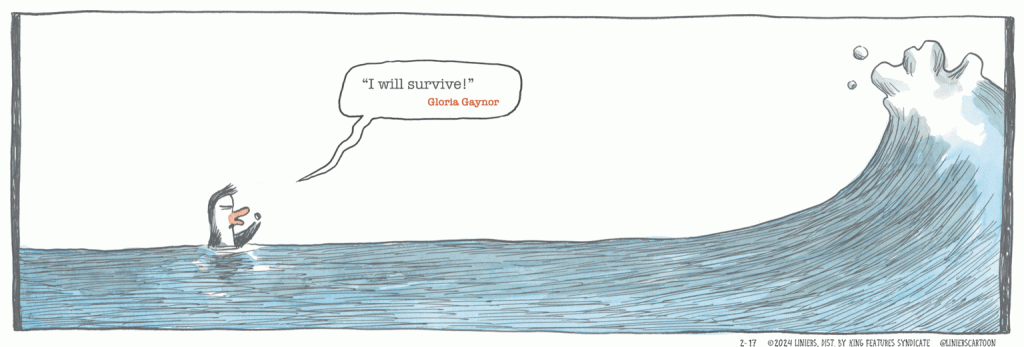
I didn’t know anything about Charly García, but here’s Wikipedia to the rescue.
Oh, and with some help from Google Translate, the Charly García line put in English could be “This is endurance”, and the Gloria Gaynor line put in Spanish could be “[Yo] Sobreviviré”.
CIDU QUEUE REMINDER
As always — but it needs saying explicitly again now and then — we like to think of this as a reader-participation site, and not just for your invaluable (or anyhow amusing) comments, but for suggestions of comics to run and discuss.
Please share your specific suggestions of panels or strips, in CIDU, LOL, and OY categories, either by direct email to

(that’s “CIDU.Submissions” at gmail dot com), or by using the handy-dandy Suggest A CIDU form page!
 Comics I Don't Understand
Translation is not a science, it’s an art,† and perfection is extremely difficult to achieve. Most of the translated books and movies that I have read and/or seen have been perfectly adequate, but only occasionally significantly better than that. Whenever I have the option (in choosing between English and German), I always prefer the language in which the work was originally composed.
The Macanudo strips shown above were part of a week-long arc of literary quotes. I’m sure that the material on all the other days was just as fitting in either language, but I didn’t really like any of the strips all week. I would much rather see a cartoonist write his own material for one of his own characters, rather than using the artwork as a frame for someone else’s words. (Mutts is another strip that occasionally falls prey to the “literary quote disease”.)
P.S. (†) – During my nearly three decades in Germany, I have done a fair amount of translation work, but virtually all of has been on paper. The skill and mental flexibility to do a synchronous verbal translation of unscripted material is beyond me.
Erm, yes but.
The earlier quotations, from Emerson, García Márquez, Cézanne, Voltaire, and Borges, were matched in the two versions of the Macanudo. So it does seem to make sense that this post decided to deal with the only one where the sources and content differed, and make that difference the subject of the post.
I agree that situating it as part of a week of quotations might have been helpful; but otoh leaving that out doesn’t seem distorting. It might have focussed a question about why quit on translating for this one case when the five previous ones all used it quite successfully. (And from texts originating variously in English, Spanish, and French.)
One thing to add about the pair featured here is that though the quotes are different, their tenor or “message” are quite similar.
BTW, I thought over the course of the week, the artist did a great job of keeping the drawings to the constant setting and general situation, but varying the specific action to very nicely fit the progress of the quotations.
I remember reading the Asterix comics in English when I was younger, and one of my friends that knew French said that the English translations were pun-for-pun, not word-for-word, since puns depend strongly on the target language.
I was once viewing one of my favorite YouTube channels, 3B District Court in Michigan. It’s different than most of the livestream court channels, where the camera is just there recording. In this case, Judge Middleton runs it as a channel. He talks to the viewers to respond to their chat messages that he allows before starting court, he’ll explain things about the proceedings to us, etc.
There are fair number of Spanish-speaking people in the county. They often need a translator. The usual one is Vivian, who does translation work by Zoom in many of the courts. Sometimes when she’s not available, or it’s something short, he has one of the court employees, Priscilla do it. He explained once why he doesn’t have her do it all the time and save the money by stating that it isn’t her job and she has other things to do.
One time they were doing something where neither was available. They had a translator in the courtroom. When they started up, he was doing simultaneous translation. The judge had to stop him and explain that doing that is bad for the record, which is recorded. They have to do it by one person speaking, then a translation, back and forth.
PS: If LarK is reading, no comments from today are showing on the scrape site.
@ Mark H. (4) – I never ran into the English versions of “Asteríx” until I had already read (and enjoyed) all the books in German, but my experience, the English versions were simply inferior: the dialog sounded awkward and unnatural in comparison to the German versions, which sounded more “native”.
There was a report several years ago in The Daily Cartoonist that a new publisher had licensed Asteríx for the American market, and was planning to re-work (or replace) the translations with Americanized versions, but I doubt that this will significantly improve their popularity. Goscinny died in 1977; the books that Uderzo wrote after that were tolerable, but not even nearly of the same quality, and the later writers have been even worse.
The primarily problem is that Asteríx was originally written for a Gallocentric, xenophobic readership. Racist and misogynist humor that played perfectly well in France in the 60s and 70s looks and sounds antiquated today.
P.S. @ larK & Brian (5) – The problem with the comment scraper began on Sunday before noon, the last scraped comment is dated 18-Feb. @ 11:14 am.
re: cidu scraper
Yeah, one of the DNS servers was down, naturally over a long weekend, and I was chasing IMAP not working, and only this morning cottoned on to the fact that indeed many other things too weren’t working, which quickly lead us to the actual culprit, instead of mucking about with the (working) mail server…
It’s all back working now.
Thanks very much, larK!
As always, thanks to LarK for his efforts.