Thanks to Usual John for sending this in.
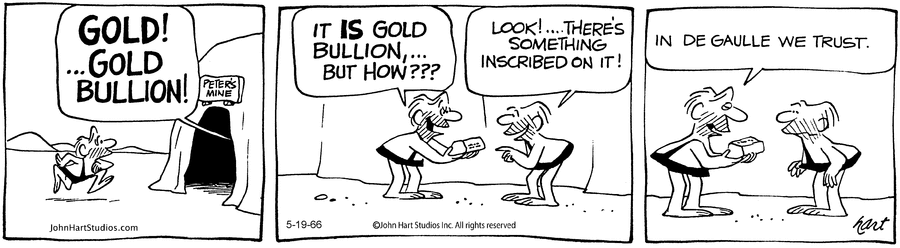
John points out “Some commenters on GoComics suggested that this strip refers to Charles de Gaulle’s practice, at this time, of exchanging U.S. dollar reserves for gold. While the timing works for this 1966 strip, I don’t see how it leads to a joke.”
My question back then was, always if you can buy bouillon cubes at the supermarket in chicken or beef, why not gold?
 Comics I Don't Understand
There is a difference in how they’re spelled, if that means they are just different words for different things.
The gag is twofold: The first part is the growing doubt in the 1960’s about the dollar as a reliable financial reserve (hence B.C. and Peter’s excitement about finding gold, rather than “money”), which is then topped by altering the American fiscal motto “In
Godde Gaulle We Trust” (to refer to a well-known proponent of gold reserves: France began converting dollar reserves in February 1965, effectively purchasing metal from Fort Knox at the standard fixed rate.)P.S. @ deety (1) – I often have trouble spelling both Bouillon (soup) and Bullion (metal), and generally have to look them up to make sure I am referring to the correct thing.
I understand that the words bouillon and bullion are both related etymologically to the verb to boil, and all came to English through Norman French. Gold was formerly refined by using mercury to extract the gold from ore, then boiling off the mercury. My thanks to Professors Google and Wikipedia.
Perhaps this song about the person in question would be useful.
Especially the line, “this old man thinks he’s Ste. Joan”
Also, DeGaulle tended to regard himself as pretty close to godlike; I think there’s maybe a joke there about his ego.
boiling off the mercury
I’m sure that made for a healthy occupation.
” if you can buy bouillon cubes at the supermarket in chicken or beef, why not gold?”
Chicken boullion cubes are often wrapped in gold-colored foil.
And, also, you can buy Bitcoin at the Jewel supermarket near me. The modern version of gambling on commodities.
Mark Twain wrote about using mercury to extract silver in Life on the Mississippi.
Chicken boullion cubes are often wrapped in gold-colored foil.
And the beef ones were red. Those were a fixture of my childhood, but I haven’t bought them in a long time. Some soup base products are highly rated, which I have yet to try.
I have no idea whether German bouillon cubes are color coded, because we always buy the stuff as powder in a jar, which makes it much easier to make small adjustments when cooking soups and sauces. There are two major brands here: Knorr and Maggi; I usually prefer Knorr for ready-made powdered soup mixes, but for straight bouillon Maggi has (or had) a better flavor. Unfortunately, Maggi recently “improved” their recipe (adding the idiotic claim “with natural ingredients” to the label), but the “natural” stuff now produces a slightly unpleasant odor when it is dropped into the boiling water.
Kilby_ I tend to buy it loose in jars also – much easier to adjust the amounts when using it in cooking. I remember when all that could be found was the cubes and trying to get them to dissolve completely as they were rather heavily “packed” together.
The cubes my family had were individually wrapped, but then tumbled or packed in bottles or cannisters.
But yes I’m familiar with the treatment you describe, with unwrapped cubes packed in the jar, and tended to melt together
@ mitch (13) – I think Meryl meant the extreme density of each single pressed cube, rather than the way they might fuse together because of hydroscopic effects. Getting one of those miniature bricks to dissolve could take a very long time.
When we had our African exchange student, we discovered that Maggi cubes are the base of all African cooking. She was an excellent cook, and I took her to the local African store, which sold the nearly impossible to find Maggi cubes in big Costco sized lots. (We had bought beef stock in a tetrapak liter container because that was all the regular supermarkets had, and she made do fine with that, but her heart longed for the expensive Maggi cubes, and eventually she gave into temptation and bought us a life-time’s supply, which she probably would have used up in a month were she cooking everyday (we were tempted to let her do all the cooking, but felt bad about the child labor…).)
It seems Hart had ongoing concerns about DeGaulle around this time. Here is a slightly later B.C strip, showing up on Gomics “Back to B.C.” today:
@ mitch (16) – That francophobic attitude was also reflected in a sardonic comment made by Tom Lehrer in the early 1960s: “…including our current friends, like France, and our traditional friends, like Germany…”