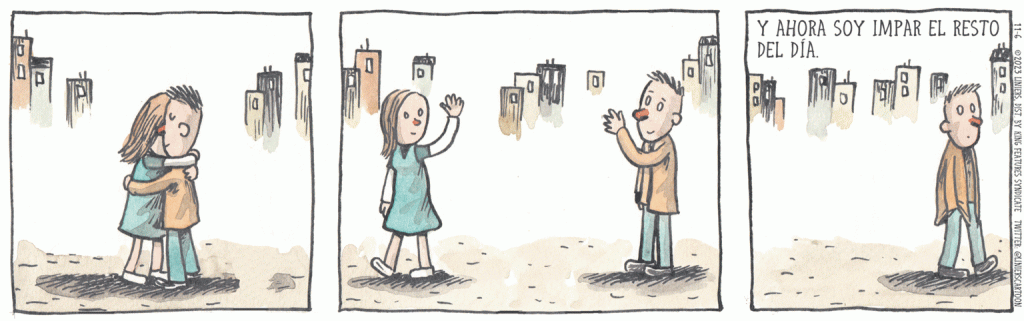
Here’s the Spanish version (thanks, Mitch), in case that helps.
Related
8 Comments
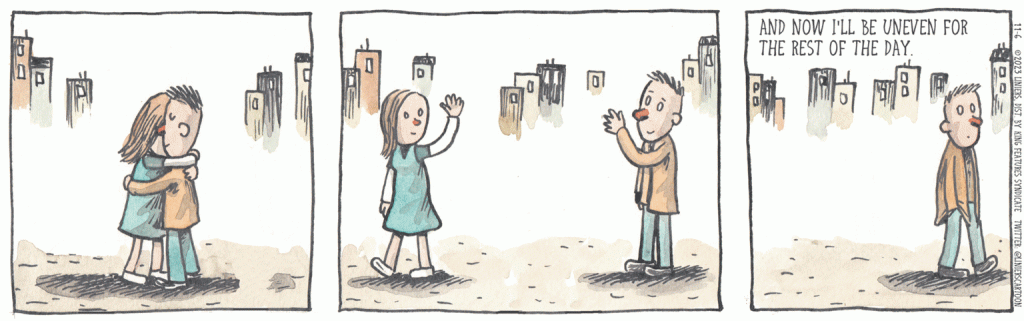
The man in the comic is left “uneven” because one is the first “odd” number. As written and sung by Harry Nilsson (and later covered by Three Dog Night): “One is the loneliest number that you’ll ever do…”
P.S. The Spanish word “impar” (for “odd”) has a nearly identical cognate in the French word “impair”, which is also known in English because of its traditional use in Roulette.
P.P.S. After thinking about a bit, I’ve decided that the accuracy of the translation is a question of taste. In ordinary (and mathematical) terms, the “normal” translation for “impar” would be “odd”, but that has negative connotations when applied to a person. Although overly literal, the word “uneven” appears to be a precise hit, capturing both the mathematical sense of the term, as well as his emotional uncertainty.
When first looking at this with Zbicyclist, I wanted the uneven to mean something about the first panel — like, he has received a hug but not yet given a matching hug (and here reading-in some principle that they should be paired). Or, has been in a left-handed hug but not yet a matching right-handed hug. (Though the one in the first panel seems centered.) On this latter idea, consider if they had included cheek-kissing but had only completed one side — that could certainly leave a person feeling uneven.
@ mitch (3) – A few years ago there was a fascinating piece in “Karambolage” about the French custom of greeting people with alternating cheek kisses. Apparently the traditional number of kisses depends on the kisser’s city of origin, and can vary (typically between two and four), and then there was the question about which cheek to start with. This could easily lead to embarassing situations, if two people from different cities (with variant customs) attempt to greet each other in this fashion. Cherchez les baisers!
I think what it’s going for is “unpaired”, which I believe the Spanish for “odd” can be understood as (in Portuguese, at least “um par” means “a pair”, and odd is “ímpar”). So I think the word play is not only literally that he will be unpaired for the rest of the day, but also that it is odd or weird or unbalanced for him to be so.
“In Vegas, I got into a long argument with the man at the roulette wheel over what I considered to be an odd number.”
-Steven Wright (attrib.)
I don’t know, but I’d always considered the numeral 8 to be rather peculiar looking myself.
@ Grawlix (6) – That Reddit link worked fine on this desktop Mac, but on my iPad it resulted in WordPress embedding it, which made it impossible to get to the thread of jokes. The moral of the story is: be careful with Reddit links, they may not work as expected.
What did the set of all integers n such that n = 2 * m + 1 where m is an integer say to the set N of all integers? “I can’t even.”
 Comics I Don't Understand
The man in the comic is left “uneven” because one is the first “odd” number. As written and sung by Harry Nilsson (and later covered by Three Dog Night): “One is the loneliest number that you’ll ever do…”
P.S. The Spanish word “impar” (for “odd”) has a nearly identical cognate in the French word “impair”, which is also known in English because of its traditional use in Roulette.
P.P.S. After thinking about a bit, I’ve decided that the accuracy of the translation is a question of taste. In ordinary (and mathematical) terms, the “normal” translation for “impar” would be “odd”, but that has negative connotations when applied to a person. Although overly literal, the word “uneven” appears to be a precise hit, capturing both the mathematical sense of the term, as well as his emotional uncertainty.
When first looking at this with Zbicyclist, I wanted the uneven to mean something about the first panel — like, he has received a hug but not yet given a matching hug (and here reading-in some principle that they should be paired). Or, has been in a left-handed hug but not yet a matching right-handed hug. (Though the one in the first panel seems centered.) On this latter idea, consider if they had included cheek-kissing but had only completed one side — that could certainly leave a person feeling uneven.
@ mitch (3) – A few years ago there was a fascinating piece in “Karambolage” about the French custom of greeting people with alternating cheek kisses. Apparently the traditional number of kisses depends on the kisser’s city of origin, and can vary (typically between two and four), and then there was the question about which cheek to start with. This could easily lead to embarassing situations, if two people from different cities (with variant customs) attempt to greet each other in this fashion. Cherchez les baisers!
I think what it’s going for is “unpaired”, which I believe the Spanish for “odd” can be understood as (in Portuguese, at least “um par” means “a pair”, and odd is “ímpar”). So I think the word play is not only literally that he will be unpaired for the rest of the day, but also that it is odd or weird or unbalanced for him to be so.
“In Vegas, I got into a long argument with the man at the roulette wheel over what I considered to be an odd number.”
-Steven Wright (attrib.)
I don’t know, but I’d always considered the numeral 8 to be rather peculiar looking myself.
More numerical silliness here…
@ Grawlix (6) – That Reddit link worked fine on this desktop Mac, but on my iPad it resulted in WordPress embedding it, which made it impossible to get to the thread of jokes. The moral of the story is: be careful with Reddit links, they may not work as expected.
What did the set of all integers n such that n = 2 * m + 1 where m is an integer say to the set N of all integers? “I can’t even.”