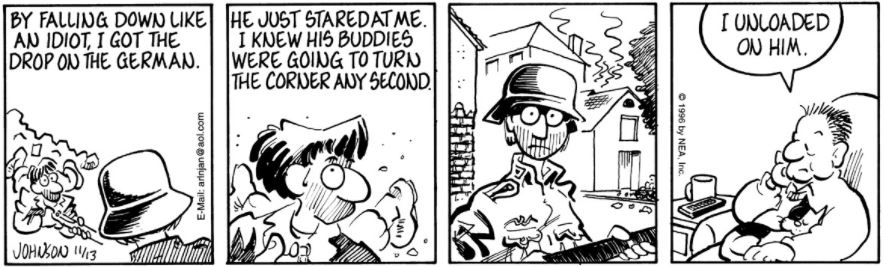
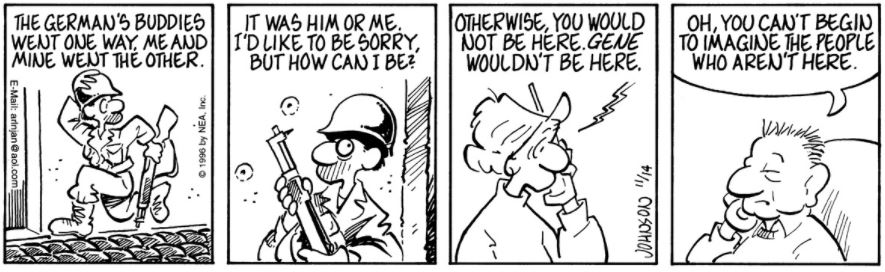
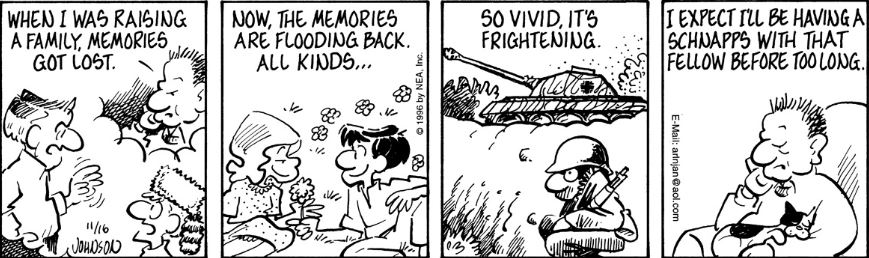
[Bill’s note from first postings on this site] This is something I made sure to rescue from the old site: after the first time I posted the 1996 sequence with Arlo’s father, somebody asked me to re-post it every year.
Unfortunately most of your comments are gone, but the 47 you posted in 2018 and 2019 are below.
[Note for 2022 — Reposting to continue Bill’s tradition. 2020 and 2021 comments also preserved.]
[Note for 2023 — Reposting, as per tradition. Past and 2022 comments preserved. Add-on comics for Veterans Day / Armistice Day will appear in another post in about an hour.]



From 2003:

From 1985:

 Comics I Don't Understand
I don’t recall noticing before that the Dad also has a cat. A different sort of cuddly than Ludwig.
LikeLike
As far as I know, none of my immediate relatives served overseas. My dad was too young for the Korean war, and was out of the navy before Vietnam started. However, I remember getting some insight into WWII from an old high school gym teacher who served in the Pacific. The most vivid detail was when somebody (most likely me) asked him whether he had killed anyone, and he held up three fingers. He went into a little detail after that (which I’ve long since forgotten), but when he held up those fingers, I got the impression that he felt very much like Arlo’s father in the sequence above.
LikeLike
It’s not surprising that Arlo’s dad has a cat. As I recall, Ludwig’s name has something to do with experiences Jimmy Johnson’s father had in WWII and I think a cat they had when JJ was a kid.
Like Kilby, my family has mostly missed armed conflicts, always being too young or too old. My father came within a few hours of going to Viet Nam. He was in the Naval Reserve and had been out of work for several months. He was going to put in his activation papers and probably would have served as a medic with a Marine unit. But he got a job offer while on the way to the reserve station. My mother had to call him there and tell him not to do it.
LikeLike
Even if we had someone who was wizard enough to distill the comments from the old thread out of the Wayback Machine, it probably would involve too much effort to import them into the new template. Therefore, it seems proper to strike a word from the old quote: in this case, “bis repetita
nonplacent“.LikeLike
Thanks for sharing this, Bill. It was a deliberate act to remember; that’s more than I can say for most people. But then, what do I know? “War is good business. Invest your sons.”
LikeLike
, , , and your daughters.
LikeLike
Correct, Kilby, comments would have to be moved over individually; and there were a lot of them.
LikeLike
Lately, when i think about the fourth comic. it’s been resonating with me in another way:
I am the child of a (Class of ’39) refugee. If my father’s family hadn’t won what amounted to another sort of lottery, I wouldn’t be here. My brothers wouldn’t be here, and my sons, nieces and nephews wouldn’t be here.
And I know I’m far from alone
LikeLike
My father was in the Air Force during the Korean conflict. He helped keep Thule Greenland safe from the Commie Menace. I was a bit too young for Vietnam, in fact I was of the first that never had to register for the draft.
LikeLike
I remember sitting in the tv lounge at college, watching the lottery and thinking, “Now I’m going to find out if my brother is going to die in Vietnam.” I felt so guilty when I realized he wasn’t, because I cheered.
LikeLike
Chak, no reason for guilt: in my dorm, we certainly cheered our own good fortunes.
LikeLike
In the 2003 strip, is that Janis in the third panel?
LikeLike
No, it’s their son, Gene.
LikeLike
Today’s A&J is pretty sobering, too.
https://www.gocomics.com/arloandjanis/2018/11/11
LikeLike
Thanks for resurrecting this from the ashes that godaddy left you.
LikeLike
You are, of course, correct, Andrea. And I apologize. I was using the slogan as it existed during the Vietnam War. But daughters died then, as well.
LikeLike
2003 resonates for me. I was one of the lucky ones to win the lottery too. I was 127 and they stopped at 95. Don’t ever tell me I’m not lucky.
LikeLike
I’m glad to see this here. That series of strips says so very much. I find it a relief from what seems to a glamorization of war that has been going on for the last 15 or 16 years.
LikeLike
I think I mentioned in a recent post that Robert’s grandfather was in Mexico in WWI under General Pershing. His dad was in WWII in India.
As far as I know,neither of my grandfathers was in WWI. Dad was on the young end for WWII and was in some sort of special engineering training program when the war ended. I have been researching what seems to be the program online, but it seems to end a year or so too early, so it may be the wrong one. He was sent to Fordham University (in the Bronx). The same program existed in other places and Mel Brooks was sent to VMI under what seems to be the same program (they brag about it on the tour of VMI which is how I know about it. So dad went a camp in North Carolina for basic training and then was sent back to NYC for this program.
LikeLike
My father was in the Pacific theater during WWll. They were gearing up to invade the Home Islands when they dropped the two big firecrackers. Kinda makes you think.
LikeLike
My grandfather on my father’s side was a serious Quaker and conscientious objector in the Great War. As basically all men were considered to have enlisted willy-nilly, he was court-martialed in May 1917 and was imprisoned (as were his cousins) with hard labour. He was released on medical grounds in September 1918, though most of the 6000 jailed conchies were kept in prison a year after the war ended so as not to compete with returning demobbed soldiers in the job market. He may well have failed the army entry medical as he had a weak heart and indeed died in 1929 at the age of 43.
His kids were 11 (my father – he must have been conceived a month or so before his father went into prison, so that was lucky), 8 and 5 when he died and so 21, 18 and 15 when the next war started. Although none of them were militaristic types and varyingly supportive of Quaker pacific principles, they all joined up during WW2, first having to write an explanatory letter to their Quaker mother. My father had an army year in the Somerset Light Infantry, the outfit that court-martialed his father, then transferred to the RAF in 1941. He was sent to Canada to learn to fly and then had a relatively privation-free war as he stayed there until summer 1944 as a flight instructor.
In 1944 he was posted back to the UK to a Liberator squadron (547 – see http://www.nawaller.com/wol/liblge.jpg ) flying anti-submarine patrols with Coastal Command. He stayed on for a year after flying converted Liberators with Transport Command, bringing service people back from the Far East 26 at a time in week-long missions. He resented having had to join the military as, apart from considerations of global turmoil and misery, it basically buggered up his his twenties (22 to 28, anyway) . On the other hand it eventually gave him a career as – after a period helping his mother run a hotel in York until she died in 1952 – he took up civil flying as an airline pilot, retiring on Boeing 707s in 1974.
Him leaving the RAF to help run the hotel turned out to be essential to my existence, as in summer 1946 a 19-yo woman turned up to stay there while working in York, and in 1947 they got married and stayed together until my father died in 2004. My mother is still alive. I think her father served in the Great War but I never met him and she doesn’t know any details.
LikeLike
I can identify with the Lottery cartoon. The year the draft ended my number was 50.
LikeLike
My grandfather enlisted in the Newfoundland Regiment in the Great War in 1914. He was one of the “First 500”, also known as Blue Puttees because they ran out of khaki puttees and hsd to make substitutes out of blue broadcloth. Lied about his age: he was only 16. Fought in Gallipoli in 1915; survived that, and was shipped to France in 1916 to take part in the Somme Offensive. Somehow survived *that* — his Regiment suffered 91% casualties (almost 800 went “over the top”; 710 were killed/wounded), a figure exceeded only by the Essex Regiment, who happened to be on the Nfld Regt’s flank.
Grandpa was finally wounded in Belgium by a exploding shell in 1917 and eventually demobilised home to Newfoundland. He hardly ever talked about the war, according to my dad. He also never took part in any of the reunions after the war: he had lost too many friends. In retrospect, he suffered from PTSD: they called it “shell shock” in those days. He opposed any of his sons ever enlisting.
LikeLike
There’s another one that probably belongs with these. It’s on Mr. Johnson’s webpage.
LikeLike
Recently I’ve been learning about my grandfather’s part in WW1 in bits and pieces (after always assuming he was way too young to have fought, which technically he was).
Five years ago I found out he did fight (on “the other side,” which kind of changed my perspective on the book about WW1 I was coincidentally reading at the time).
I subsequently found out he’d been living in Poland at the time, not yet Austria-Hungary, so why was he fighting in the A-H Army?
Wait, here’s a photo indicating he was living in The Ukraine.
My cousins and I finally pieced together (just last month) that his Ukranian village was part of A-H when he was a teenager and lied about his age to fight, then was part of the USSR, then Poland before my grandparents moved to Vienna, making them Austrians again (and making my grandfather, sort-of-retroactively) an Austrian veteran again.
The irony is, they moved to Vienna, a dozen years before Anschluss, because they thought Austria would be the most hospitable place for Jews to live.
LikeLike
“He hardly ever talked about the war, according to my dad. . . . In retrospect, he suffered from PTSD: they called it “shell shock” in those days.”
I have no war stories, as my family lived in Amsterdam during the Nazi occupation of Holland. (Ironically, I’m just finishing the book, ’17 Carnations: The Royals, the Nazis, and the Biggest Cover-Up in History’, and I’m just now to the part where Hitler invades The Netherlands.) My father was taken off the streets of A’dam two times and put into slave labor camp, from which he escaped.
He, too, rarely talked about those days, especially not with a daughter (both Hubbies heard more from him than I ever did). The other members of the families had some stories, but I never knew – and never will know – how many were apocryphal and how many not.
Those who ‘just suffered’ but didn’t fight have no reunions, and he’d never have gone to any . . . he was a classic example of untreated PTSD, for which everyone in the family suffered.
OTOH, his older brother was a Nazi, so we have both POV, altho he was imprisoned after the War, rightfully so. I’m sure this added to my father’s PTSD, because this was the ‘favored son’.
LikeLike
“and your daughters”
The difference, Andréa — and this was a huge difference during Viet Nam — was that men were drafted and women weren’t.
LikeLike
Point taken.
First Hubby’s parents bought him an RV and car so he could go to Canada; I was to follow when he was established there (we weren’t married but what the heck).
He was in an accident, flipped over both the car and trailer, he and his brother and a friend all surviving. He came back to USA, enlisted and spent his entire time in the Army as an MP at Fort Monmouth, NJ.
To this day, I am gobsmacked about how that turned out.
LikeLike
My grandfather was only briefly arrested; but even though he never ended up in one of the camps, he never really discussed the experience.
Which is why we’re tracking down details 80 years later (and are faced with a ton of contradictory information we’ll probably never resolve).
LikeLike
(But I fear I’m straying a bit from the “veterans” topic)
LikeLike
My dad was in the Navy for World War II and the Korean war.
During World War II he was stationed on a ship that was stationed in San Francisco Bay. There was only one time the ship left the bay. It pulled out of the bay just barely into the ocean, turned around and went right back into the bay. And that’s how Dad got sea-duty pay.
During the Korean War he was on a ship, the USS Hyman, that went out to sea. It was never in any battles, but at one point it was a certain distance from a combat zone with a battle in progress, and a stray enemy rocket hit the rear end of the ship and caused some damage although nobody was hurt. And that’s how Dad got combat pay.
(Wikipedia says the USS Hyman actually was engaged in a gunnery duel, not just a bystander, so I guess the combat pay was earned.)
LikeLike
I was doing research, too, and as with the genealogy searches, I finally thought, “Why am I doing this? There’s no one to pass it to, and do I really care anymore?”
LikeLike
Mark in Boston: I assume you deliberately refrained from telling it as: he was a combat virgin until the Hyman was damaged?
LikeLike
My father exists because of the Great War–my grandfather married and knocked up Granny quick to avoid the draft. Dad was born in August of 1918.
Irv Fink, son of Jewish refugees from Europe, ended up going back there as part of the US Fifth Armored Division to fight the Nazis. He always claimed he and his driver were the first Allied troops to enter occupied Luxembourg. By accident. They got lost. When they ran into a Wehrmacht private directing traffic, they turned right around and left as fast as possible.
My brother took an advanced degree to avoid the Vietnam draft. I was too young to worry.
LikeLike
I think this story line is archetypal. (is that the right word?)
Although my own dad was a little on the old side to fight in WWII, he did his part in the oil fields and shipyards in California. My husband’s dad, however was in the Navy, a 19 year old radioman on the Liscome Bay built in the Kaiser shipyards in Vancouver, WA. Briefly, they got torpedoed, and he was one of the 272 that survived, out of over 900 crewmen.
My husband says he always refused to talk about his experiences, so everyone was surprised when 50 years after the end of the war, that he called the family together, and for the first time told everyone honestly about those nightmarish hours.
I was amazed that we have other friends with WWII vet parents that did this same thing.
Shortly after this, he was diagnosed with Alzheimer’s. Rest in peace, Dad B., we remember you and miss you.
LikeLike
Robert’s Dad served during WWII in India. The story Robert was told is that there was line of the soldiers being assigned to different places. The line cut in front of his dad – the soldiers ahead of the cut went to D-Day, those after it went to India. Unfortunately there was a family secret he was not told until his sister found out after their dad died and told him, so much of the stories he was told about his dad, WWII and his mom make no sense and had to be lies, so other than knowing that he served in India, we are not sure what is true. (We know that he did serve in India as we have seen photos.)
LikeLike
@Meryl A – your line “the stories he was told about his dad, WWII and his mom make no sense and had to be lies” reminded me of the story of Ruth Wilson’s grandparents. Wilson is currently Mrs Coulter in the BBC/HBO adaptation of Philip Pullman’s book His Dark Materials, but recently she also starred in Mrs Wilson as her own grandmother (and during the series gives birth to her own mother!). Her grandfather Alex was a WWI soldier, an author, an academic, a theatre-troupe runner, a WW2 and Cold War intelligence officer but perhaps also a serial fantasist and certainly a liar and four-time bigamist, Ruth Wilson being a descendant of his third “marriage”. The second marriage resulted in a young boy being told by his abandoned mother that his father had been killed in Egypt in 1942; it was six decades before he found out the truth that his father actually died in 1963 and there were all these other wives and semi-siblings. In fact, Alex apparently kept his secrets from each and all of his wives until after his death. Presumably Roberts’ dad’s story is not quite so elaborate! But wartime turmoil seems a good time for reinventing yourself in various ways, and leaving the past behind.
https://www.radiotimes.com/news/tv/2019-07-29/what-is-the-real-life-story-behind-ruth-wilsons-new-bbc-drama-mrs-wilson/ goes into some (confusing) detail.
LikeLike
“and during the series gives birth to her own mother!” – actually, father (hence the Wilson name continuity).
LikeLike
This is beautiful, thanks. More things to never forget.
LikeLike
larK: Well, it wasn’t actually his Hyman, as it belonged to the U.S. Navy. And he was married by the time he went off to Korea so he wasn’t a combat virgin.
Dad also told me about how the armed forces started using penicillin. It was very expensive at the time, and the military bought and administered large quantities of it. Dad was in the infirmary in a ward full of patients who got penicillin shots every four hours. It’s painful because it’s granular and a big needle has to be used. The guys hated one particular nurse who did not seem to care how much pain she inflicted.
It wasn’t until recently that I found out exactly what disease the Navy was using penicillin to treat. That’s my Dad! I wonder how many brothers and sisters I have that I don’t know about.
LikeLike
The comic on Johnson’s blog originally appeared in 2009 (I couldn’t find a version without the color):
LikeLike
“After Engagement, US Hyman Still Intact”
LikeLike
“It wasn’t until recently that I found out exactly what disease the Navy was using penicillin to treat.”
Do you suppose the nurse “who did not seem to care how much pain she inflicted.” was exactly a revenge of sorts?
LikeLike
EXACTING, not exactly. Altho I guess that works, too.
LikeLike
Any nurse with a sense of justice would know that the sailors had already gotten what they deserved.
LikeLike
@larK: that’s a groaner if I ever saw one.
LikeLike
narmitaj –
I know the story you mean. We watched the TV show of it when it was on in the US.
How can I explain this without giving out the family secret, hmm, okay – story was always that his mom was waiting for his dad to come back from the war and marry her – they did not actually met until after the war ended – details missing here to protect the guilty obviously – so how did he send stuff back to her during the war?
LikeLike
(2020) Today’s Zack Hill is quietly respectful.
LikeLiked by 2 people
The “last WWI veteran” mentioned in the first panel of the Arlo and Janis strip (see 12-Nov-19, 10:23 pm) died about 15 months after that strip was published in 2009.
LikeLike
The very last one died May 5, 2011.
Every French family has lost members to WWI, there are monuments to the dead in every city, however small.
Some of my uncles were in the war in Algeria (ended in 1962), but none of them want to talk about it, which is all I need to know about war.
LikeLiked by 2 people
The only strip in my regular lineup was, perhaps surprisingly, Breaking Cat News:
LikeLiked by 2 people
I noticed this one too, and was interested if she’s going to give us something of those hero cat stories.
LikeLiked by 2 people
I remember stories about pigeons being recognized for superlative service. In delivering messages across combat lines, and the like.
LikeLiked by 2 people
I noticed this one too, and was interested if she’s going to give us something of those hero cat stories.
Doesn’t appear that she will at this time.
LikeLiked by 1 person
We have the Dickin Medal in the UK for military gallantry by animals… mostly pigeons, horses and dogs, but one cat, Simon. https://en.wikipedia.org/wiki/Dickin_Medal . “The Dickin Medal has been awarded 71 times, plus one honorary award made in 2014 to all the animals that served in the First World War.”
Simon was “HMS Amethyst’s ship’s cat, awarded for “gallantry under fire” and for the disposal of many rats despite shrapnel injuries during the Yangtze Incident in 1949″
LikeLiked by 2 people
Thanks for the link, narmitaj. “We also serve..” .. who only stand and wait, on all fours!
LikeLiked by 1 person
The only strip in my regular lineup was, perhaps surprisingly, Breaking Cat News:
I did not notice until the next day that there was also a Veterans Day comic for Wednesday’s Six Chix, on Susan Camilleri Konar’s turn. I won’t work to link it here, but notable is taking an international step and noting “Remembrance Day” as well.
Oh I guess I have to put it in if I want to ask whether that flower is a poppy.
LikeLiked by 1 person
@ Mitch4 – Yes, that flower is most definitely a “Flanders poppy“.
LikeLike
Is the name Armistice Day still used anywhere?
LikeLiked by 1 person
… with the mention of “eleventh hour of the eleventh day of the eleventh month” ..
LikeLiked by 1 person
On the firemen’s calendar in my kitchen, November 11th is ‘Armistice 1918’.
LikeLiked by 1 person
In the US, 11/11 is Veteran’s Day and celebrates all who served. Memorial Day is in the spring and is supposed to remember those who lost their lives (although mostly it kicks off the summer season).
LikeLiked by 2 people
Kurt Vonnegut once wrote “Armistice Day has become Veterans’ Day. Armistice Day was sacred. Veterans’ Day is not. So I will throw Veterans’ Day over my shoulder. Armistice Day I will keep. I don’t want to throw away any sacred things. ”
P.S. As documented in the linked article, Vonnegut was born on November 11th, so he had more than one reason to cherish the date.
LikeLike
2021 Reposting
LikeLike
Quite a story.
Do you repost it every year?
LikeLike
That’s the plan, Dana.
LikeLike
Too bad Dana’s question hadn’t been asked by Dan, or Stan, so that Lost in A^2’s answer would fit the traditional rhyming banter “That’s the plan, Stan”.
LikeLike
The change from Armistice Day to Veteran’s Day was to change the day to honor all of our Veteran’s from all of our wars, while Armistice Day referred only to those from World War I.
Similarly originally Decoration Day only applied to those who died in the US Civil War as it came from decorating the graves of those who died in same. (I had originally read that Decoration Day started in the south, but this year I read that it started in the North.) By changing the name to Memorial Day it became a day to honor all of those who died in all of our wars.
In other countries it is still Armistice Day.
When I was young I had a book which had a story for each day of the year (not sure about leap year day) and the story for Nov 11 was about Armistice Day. The children are in school (so they did not get the day off) and have to stand at their desks at 11:11 in remembrance. First time I remember hearing about 11:11 on 11/11 and the reason for the date of the holiday. As I recall in some countries it is called Remembrance Day, but when I looked which countries online – did not find mention of same.
LikeLike
Meryl, this Wikipedia article suggests that Remembrance Day is the term in much of the Commonwealth.
https://en.m.wikipedia.org/wiki/Remembrance Day
LikeLike
Mitch 4 –
Thank you.
LikeLiked by 1 person
I was hoping to post a thoughtful, relevant comic for the occasion, but since we are only three days past the midterm elections, none of the comics that I follow (not even the political cartoonists) has taken any notice of Armistice a.k.a. Veteran’s Day. So, even though it is slightly less than reverent, here’s a strip about unfortunate event proximities:
LikeLiked by 1 person
Baldo, Snuffy Smith, Beetle Bailey (de rigor)
LikeLike
@ Whitey – Of those three, the only one I liked was Beetle Bailey:
LikeLike
Of course, if the search isn’t limited to “today”, there are many excellent tributes worth posting, such as this Liō:
LikeLike
P.S. Or this Doonesbury:
LikeLike
(Posted by Grawlix to Random Comments, cross-posting copy here. ==mitch)
I found this post on The Daily Cartoonist looking for strips relating to Veterans Day.
I’ve been trying to find the year of publishing of the Alley Oop strip roughly halfway down the page. I’m curious about the apparent story arc.
https://www.dailycartoonist.com/index.php/2021/11/11/csotd-armistice-day-in-the-midst-of-war/
LikeLike
A big thank-you and best-wishes to all the Veterans and Armistices who may be out there!
LikeLike
Here’s today’s Arlo and Janis strip on 2023-11-11:
LikeLike