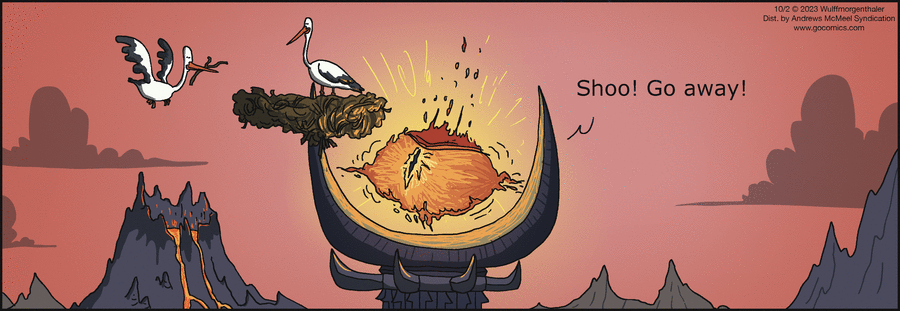
@Sheep has it. It is the Eye of Sauron with some storks (?) roosting on it. The Eye could see almost everything and inspired great fear, so its inability to dissuade birds from nesting is amusing. To me, at least.
I agree with Targuman that the incongruity is quite amusing, but to add one minor nitpick, this is the “Eye of Sauron” as visualized and animated onto film by Peter Jackson. As far as I can remember, there is not one word in the books that supports the physical appearance of an eyeball on top of a tower. Frodo and Gandalf do perceive the Eye, but they are both subject to the influence of their respective Rings. In addition, Sauron possessed the Palantir of Minas Ithil, which was effectively a Deus ex Machina telescope, but did not telegraph its presence or usage in any externally observable fashion.
As I recall, Sauron never directly appears in any of the books. I think there’s a bit where one of the Hobbits touches a palantir and a voice pops into his head, saying something like “Oh, and who are you?”
@ B.C. (4) – It did start with a touch (when Pippin saved the Palantir from falling into a pool of water at Isengard), but later that night, his curiosity led him to swipe the Palantir from Gandalf and look deep into it, getting caught by Sauron in the process. Afterwards, Gandalf forced Pippin to relate the whole encounter, and the exchange began just like you said (“He didn’t say anything, he just looked at me, and I understood: ‘Who are you?’, and I answered, ‘A hobbit.’”), but it continued on for a couple more sentences.
The only other characters who ever have “direct” encounters with Sauron are Aragorn (when he wrests control of the Palantir from Sauron), Gollum (before Sauron releases him from Mordor), and Denethor (via the Palantir of Minas Tirith), but Aragorn’s is the only one that is described at all, and that was only very briefly.
Very good point RE the depiction of the “Eye of Sauron.” @beckoningchasm – I think that is true about LOTR (and the Hobbit, of course, where he is not referenced at all). But what about the Silmarillion? I confess, I never got very far in the rest of the lore…
@Targuman: I think the only time Sauron appears directly in the Silmarillion is when he tries to kill Luthien (one of the main characters) and Huan (hound of the gods). He sends a bunch of wolves to kill them, and when they die, he transforms into the biggest werewolf he can to kill them himself.
Huan beats him and he has to flee.
Apparently Sauron was really good at transforming himself, but in the Lord of the Rings he mostly stays back and sends armies to do the work instead.
@ Brian R (12) – Emphasis on the “was” (in “…was good at transforming…” – After transferring a large portion of his power into the One Ring, and then being caught bodily by the destruction of Númenor, Sauron “…was never again able to assume a fair appearance…”
P.S. I forgot one instance in which the Eye (or at least a representation of it) is described in the books: the “Lidless Eye” was used as a heraldric device (on banners and/or shields) by the armies and servants of Mordor.
P.P.S. @ MiB (11) – That would explain why the lost Palantir of Osgiliath was never found again. (It has to be that one, because the Witch’s crystal ball is much too large to be one of the “normal” ones; Pippin would never have been able to lift it.)
P.P.P.S. I really wish that I could remember as much of the real-world chemistry and physics that I learned in school as I can dredge up of Tolkien’s invented legendarium.
@Kilby: Maybe chemistry and physics books need to be written like Tolkien stories. “Celeborn continued: ‘The first attempt to forge the Ring used silver, atomic number 47, symbol Ag. This precious metal resists corrosion but is prone to tarnish in the presence of sulfur. For a second attempt, Sauron tried titanium, atomic number 22, symbol Ti. This metal is lightweight but very difficult to work into a ring.'”
My co-workers contribute this:
Those storks could only be nesting there after the the battle of Morannon, before the Nazgul and fell beast did a great job of keeping birds (like eagles) out of Mordor.
 Comics I Don't Understand
That’s the Eye of Sauron from the Lord of the Rings.
LikeLike
@Sheep has it. It is the Eye of Sauron with some storks (?) roosting on it. The Eye could see almost everything and inspired great fear, so its inability to dissuade birds from nesting is amusing. To me, at least.
LikeLike
I agree with Targuman that the incongruity is quite amusing, but to add one minor nitpick, this is the “Eye of Sauron” as visualized and animated onto film by Peter Jackson. As far as I can remember, there is not one word in the books that supports the physical appearance of an eyeball on top of a tower. Frodo and Gandalf do perceive the Eye, but they are both subject to the influence of their respective Rings. In addition, Sauron possessed the Palantir of Minas Ithil, which was effectively a Deus ex Machina telescope, but did not telegraph its presence or usage in any externally observable fashion.
LikeLike
As I recall, Sauron never directly appears in any of the books. I think there’s a bit where one of the Hobbits touches a palantir and a voice pops into his head, saying something like “Oh, and who are you?”
LikeLike
Lord of the Rings reference? That’s all I got.
LikeLike
@ B.C. (4) – It did start with a touch (when Pippin saved the Palantir from falling into a pool of water at Isengard), but later that night, his curiosity led him to swipe the Palantir from Gandalf and look deep into it, getting caught by Sauron in the process. Afterwards, Gandalf forced Pippin to relate the whole encounter, and the exchange began just like you said (“He didn’t say anything, he just looked at me, and I understood: ‘Who are you?’, and I answered, ‘A hobbit.’”), but it continued on for a couple more sentences.
The only other characters who ever have “direct” encounters with Sauron are Aragorn (when he wrests control of the Palantir from Sauron), Gollum (before Sauron releases him from Mordor), and Denethor (via the Palantir of Minas Tirith), but Aragorn’s is the only one that is described at all, and that was only very briefly.
LikeLike
@beckoningchasm:
Yeah, that’s the problem with novelizations, they often deviate from the source movie…
LikeLiked by 1 person
Oh, thank you. I’ve only read the books, and I was completely lost
LikeLike
By the way, APOD has a much better image of Sauron here:
https://apod.nasa.gov/apod/ap231003.html
LikeLike
Very good point RE the depiction of the “Eye of Sauron.” @beckoningchasm – I think that is true about LOTR (and the Hobbit, of course, where he is not referenced at all). But what about the Silmarillion? I confess, I never got very far in the rest of the lore…
LikeLike
Did the Wicked Witch of the West have a Palantir in the 1939 Wizard of Oz movie?
LikeLike
@Targuman: I think the only time Sauron appears directly in the Silmarillion is when he tries to kill Luthien (one of the main characters) and Huan (hound of the gods). He sends a bunch of wolves to kill them, and when they die, he transforms into the biggest werewolf he can to kill them himself.
Huan beats him and he has to flee.
Apparently Sauron was really good at transforming himself, but in the Lord of the Rings he mostly stays back and sends armies to do the work instead.
LikeLike
@ Brian R (12) – Emphasis on the “was” (in “…was good at transforming…” – After transferring a large portion of his power into the One Ring, and then being caught bodily by the destruction of Númenor, Sauron “…was never again able to assume a fair appearance…”
P.S. I forgot one instance in which the Eye (or at least a representation of it) is described in the books: the “Lidless Eye” was used as a heraldric device (on banners and/or shields) by the armies and servants of Mordor.
LikeLike
P.P.S. @ MiB (11) – That would explain why the lost Palantir of Osgiliath was never found again. (It has to be that one, because the Witch’s crystal ball is much too large to be one of the “normal” ones; Pippin would never have been able to lift it.)
LikeLike
P.P.P.S. I really wish that I could remember as much of the real-world chemistry and physics that I learned in school as I can dredge up of Tolkien’s invented legendarium.
LikeLike
@Kilby: Maybe chemistry and physics books need to be written like Tolkien stories. “Celeborn continued: ‘The first attempt to forge the Ring used silver, atomic number 47, symbol Ag. This precious metal resists corrosion but is prone to tarnish in the presence of sulfur. For a second attempt, Sauron tried titanium, atomic number 22, symbol Ti. This metal is lightweight but very difficult to work into a ring.'”
LikeLike
My co-workers contribute this:
Those storks could only be nesting there after the the battle of Morannon, before the Nazgul and fell beast did a great job of keeping birds (like eagles) out of Mordor.
Did I mention that I work with a lot of nerds?
LikeLike