
Okay, I only read Rae sporadically, and could not list many characters for you. But this still leaves a whole lot that cannot be explained without spending a few years in immersion learning of anime. What the after-all is going on, anybody!
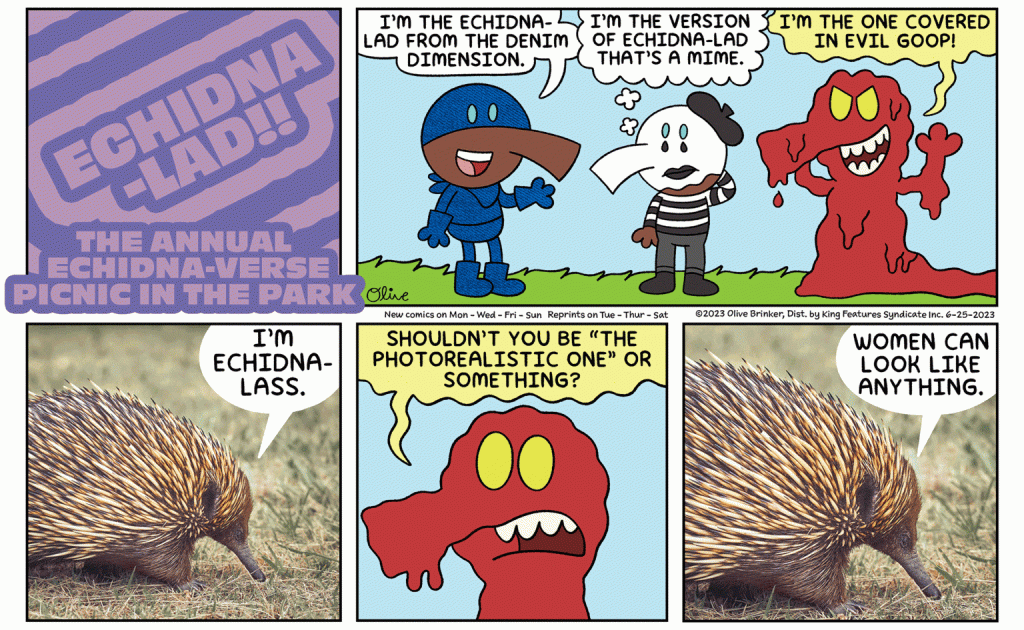
In case it you think it would help to consult other recent Sunday “Echidna-Lad!!” episodes, here are a couple:
/
 Comics I Don't Understand
As with the movie The Fly (and unlike the “Beam me up” in Star Trek), matter transmission is far from foolproof. Echidna-Lad has arrived at HQ without three important things: his clothing, his skin, and the peanut ■&■’s.
The “teleporter” device in the first strip is more like a variation on the Star Trek “Transporter” device. Instead of sending the traveller (and the contents of his pockets) all at once, it builds everything up from the inside out: first the peanuts, then the chocolate, then the candy coating, and after that the bones, muscles, and presumably also the skin and clothes, but that hasn’t happened yet in the final panel. I would have tagged that strip “Ewww!”
OK then, I’m just not hip enough. And never will be.
P.S. Why did wordpress squeeze the first strip horizontally, but not the other two?
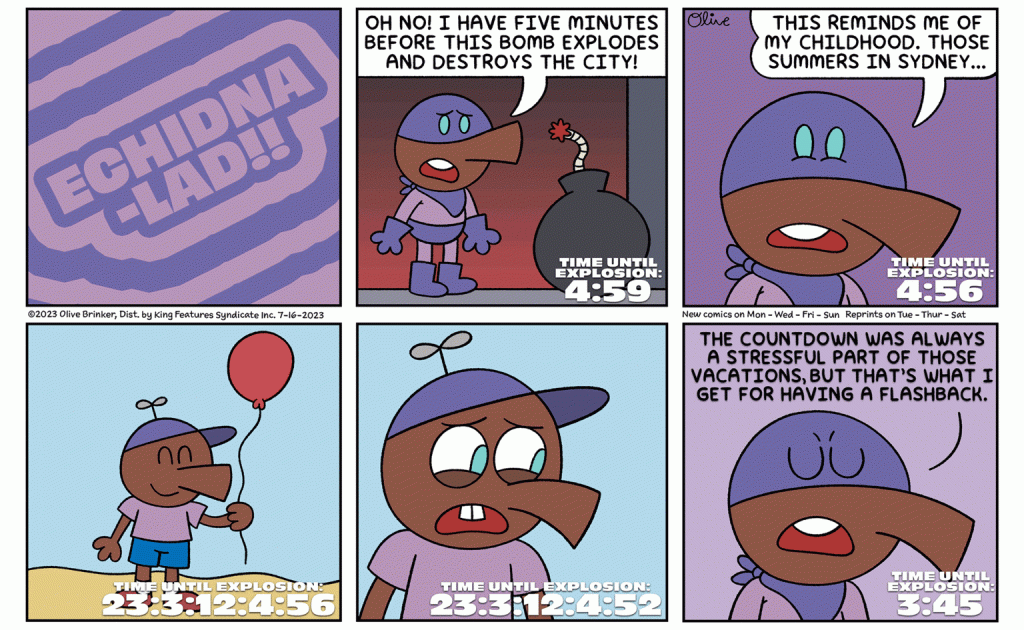
P.P.S. I think the clock format in the 4th & 5th panels of the last strip is probably YY:DD:HH:MM:SS, but I’m not sure. Does anyone else have a better idea?
The transporter sequence also shows that there will be no snacking on the candy – they’re already eaten.
I keep trying to make some sense out of the fact that M&Ms have a “skin” and the dude in the last panel doesn’t, but can’t quite get there.
The Trek transporter wasn’t foolproof. They had the episode of Voyager where two characters were merged and there was moral debate about reversing it as it would destroy this new person.
Brian in STL: And don’t forget Mirror, Mirror with the evil Spock!
And the one where Kirk gets split into two characters. (Original Series “The Enemy Within”, I think).
The ST:TNG where Riker was duplicated but they didn’t find out for a long time.
@ Phil (6) – The reason that he doesn’t have his skin is because the device is still running in the last panel; it’s not finished with him (yet).
P.S. Film techniques in the 1960s only permitted the original (TOS) transporter to work on static (immobile) figures, but improved special effects allowed later incarnations to process moving (and even speaking) actors.
P.P.S. When the crew first tested the transporter in “Galaxy Quest”, the animal arrived “inside out”, and then it exploded.
@Kilby, none of the images are squeezed for me. Firefox on Debian GNU/Linux.
@ Carl (12) – Thanks for checking. The effect is definitely caused by the frames in the wordpress “theme”, which are restricted by the fixed window dimensions on mobile devices. If I open the image in a separate tab, his head goes back to round again. At the moment I don’t have access to a desktop system for comparison, but I’m sure that Firefox on my trusty old Mac would not show any problems.
@Kilby (12): yeah, the ST:TOS transporter was done by stopping the camera, stepping away, then dropping some glitter through the light beam and overlaying the images. Low-tech but it worked.
And the transporter was a particular bit of genius in that it allowed the show to move faster–they didn’t spend half of each episode getting to and from the planet.
This makes me think of all the inventions that appeared in a certain science fiction story and are now in all the science fiction stories. A better historian than I am would have to locate the origin of each one. There’s “The Time Machine” by H.G. Wells, allowing controlled time travel (rather than haphazard like Mark Twain’s Connecticut Yankee). Faster-than-light travel so you can get to another galaxy before everyone on the ship dies of old age. Artificial gravity on the space ship, which would certainly be a benefit for our own space program. Babelfish or whatever so that wherever you go, you hear people speaking in English. Or just that everyone in every galaxy already speaks English as their native language (seems like it could just as easily have been Russian or Chinese). Ray guns, which predate the real-world invention of the laser.
@ MiB – Your comment happened to reveal an astounding featur that I have never observed before in any computer font: consider the three words: “dish, fish, & wish”. Something in the kerning algorithm has managed to eliminate the dot over the “i”, without turning the “fi” into a fused ligature. Yes, I know that 99.44% of the CIDU readership will say “Who cares!”, but I still thought it was unusual and impressive.
Can it do the ffl thing in “waffle”?
At least for me, the dot is over the “i” is still there, it’s just that the “f” has a top stroke that allows the “i” dot to align right where the top stroke ends, so it can look like it isn’t there, but the top stroke of the “f” appears longer; or you can see the “i” dot leaning right against the end of the “f” top stroke. The “fl” has a similar effect, though, because of the short stroke, “ff” doesn’t really work.
Mark in Boston – I have always figured that putting some “invention” in a publication or a movie just gives someone the idea to actually invent it.
Meryl A: The idea of a countdown before a rocket launch came from science fiction. I forget who invented it, but that author is said to have put it into the story to build up suspense. I watched the televised launches in the 1960’s when astronauts were sent into space, and there was always that “5 … 4 … 3 … 2 … 1 … Liftoff!”
Mark, and Meryl – And that “liftoff” seemed so calm and professionalized, to those of us who had gotten used to the version common to much of the fiction or movies, “blast off!”