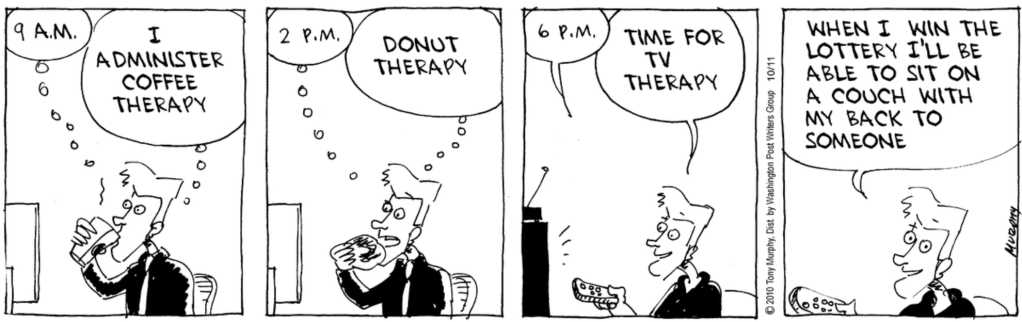
This strip has only appeared once before at CIDU. At GoComics it is just one month shy of cycling into the sixth iteration of its original 35-month run (from Jan 2008 to Nov 2010). I suppose that there must be some fans, GoComics shows 12400 followers, but among the five appearances of this strip so far, I have only discovered one comment (attached to the original appearance on 11-Oct-2010), which I think is rather revealing: “Ha! Ha! Ha! Ha! Ha! (I don’t get it either.)“
I think the final frame is a reference to standard psychiatric therapy, where the counselee lies on a couch with the therapist behind them. So the punchline refers only to the third frame.
Thanks Mark – that explains it. The seemingly incongruous comment about “winning the lottery” is merely an explanation of how he plans to pay for the “real” therapy.
I thought it meant the guy thought he was like Wild Bill Hickok & would be shot if he didn’t have a wall behind him & a clear view of anyone approaching. Therapy was to get over this before he got rich.
Oh, to heck with it. Keeping my delusion.
@Downpuppy, yeah I have a friend who jokes “I’ll take the gunfighter seat!” but then really does prefer to take the one with back to a wall leaving you the one with back to the room (and the door).
I often wondered why the standard psychoanalytic setup was a couch with the patient facing away from the doctor. The doctor couldn’t see the patient’s face that way, and might miss cues. But I have come to think that it’s so the patient can’t see the looks of shock, disgust or boredom on the doctor’s face.
I looked at a couple sources to check on my impression that the couch is used more in analysis than in most other forms of talk therapy. (Sources differ on that) Here is a bit of quote on the reasons,from an article by an analyst —
“The physical arrangement of analysis also can be helpful for the analyst. Freud admitted that he first came up with the idea because he could not put up with being stared at by other people for eight hours a day—a very practical consideration! But there are deeper reasons, too. The use of the couch changes the pace of the interaction. There is less pressure to keep up with the ordinary to-and-fro of a more social, conversational interaction. In addition to making room for the patient to say more, there is room for the analyst to think more—and analysts need a lot of freedom and space to think in order to do their job well”
Another source I glanced at, from a non-analytic therapist, said facing the client or patient away (But not necessarily reclining) could be useful to the process, emphasizing practical aspects like avoiding social niceties and catching up.
The arrangement with the patient on the couch facing away from the doctor is also handy for the cartoonist, who is then able to draw both faces full-on or three-quarter rather than having to draw the back of someone’s head.
The usual client here (who is the lead character in the comic) generally sits on the couch, upright and roughly facing the therapist. I wonder if the presence of a couch in such contexts is meant to offer an option of reclining; or just some flexible seating choices.
I take it this panel was meant to take place during “the holidays”, and the client was too busy to get there in person so they arranged an online session. (But what holidays, eh?) I guess the therapist’s dialogue is meant to tell the client that getting over the hump of tech difficulties is worth it.
 Comics I Don't Understand
When he’s rich, he’ll be able to afford an actual therapist.
LikeLike
This strip has only appeared once before at CIDU. At GoComics it is just one month shy of cycling into the sixth iteration of its original 35-month run (from Jan 2008 to Nov 2010). I suppose that there must be some fans, GoComics shows 12400 followers, but among the five appearances of this strip so far, I have only discovered one comment (attached to the original appearance on 11-Oct-2010), which I think is rather revealing: “Ha! Ha! Ha! Ha! Ha! (I don’t get it either.)“
LikeLike
I think the final frame is a reference to standard psychiatric therapy, where the counselee lies on a couch with the therapist behind them. So the punchline refers only to the third frame.
LikeLike
Thanks Mark – that explains it. The seemingly incongruous comment about “winning the lottery” is merely an explanation of how he plans to pay for the “real” therapy.
LikeLike
P.S. Fuzzmaster got it @1, of course, but his comment was hidden in moderation while Mark and I were writing 2, 3, and 4.
LikeLike
I thought it meant the guy thought he was like Wild Bill Hickok & would be shot if he didn’t have a wall behind him & a clear view of anyone approaching. Therapy was to get over this before he got rich.
Oh, to heck with it. Keeping my delusion.
LikeLike
@Downpuppy, yeah I have a friend who jokes “I’ll take the gunfighter seat!” but then really does prefer to take the one with back to a wall leaving you the one with back to the room (and the door).
LikeLiked by 1 person
I have not been to therapy (I know, big surprise!) but my understanding is that the couch method never was very common and almost unknown these days.
LikeLike
I thought the couch was mostly associated with psychoanalytic treatment.
LikeLike
I often wondered why the standard psychoanalytic setup was a couch with the patient facing away from the doctor. The doctor couldn’t see the patient’s face that way, and might miss cues. But I have come to think that it’s so the patient can’t see the looks of shock, disgust or boredom on the doctor’s face.
LikeLike
I looked at a couple sources to check on my impression that the couch is used more in analysis than in most other forms of talk therapy. (Sources differ on that) Here is a bit of quote on the reasons,from an article by an analyst —
“The physical arrangement of analysis also can be helpful for the analyst. Freud admitted that he first came up with the idea because he could not put up with being stared at by other people for eight hours a day—a very practical consideration! But there are deeper reasons, too. The use of the couch changes the pace of the interaction. There is less pressure to keep up with the ordinary to-and-fro of a more social, conversational interaction. In addition to making room for the patient to say more, there is room for the analyst to think more—and analysts need a lot of freedom and space to think in order to do their job well”
From https://www.psychologytoday.com/us/blog/headshrinkers-guide-the-galaxy/201404/whats-the-couch-got-do-it
Another source I glanced at, from a non-analytic therapist, said facing the client or patient away (But not necessarily reclining) could be useful to the process, emphasizing practical aspects like avoiding social niceties and catching up.
LikeLike
The arrangement with the patient on the couch facing away from the doctor is also handy for the cartoonist, who is then able to draw both faces full-on or three-quarter rather than having to draw the back of someone’s head.
LikeLike
The usual client here (who is the lead character in the comic) generally sits on the couch, upright and roughly facing the therapist. I wonder if the presence of a couch in such contexts is meant to offer an option of reclining; or just some flexible seating choices.
I take it this panel was meant to take place during “the holidays”, and the client was too busy to get there in person so they arranged an online session. (But what holidays, eh?) I guess the therapist’s dialogue is meant to tell the client that getting over the hump of tech difficulties is worth it.
LikeLike
A forward-facing couch would make sense if the therapist also does couples counseling.
LikeLike