In some places, such as desert areas without a lot of leaves (and no doubt loads of others), one would use a hand (and then, one hopes, wash/clean the hand). In Arab culture, for instance, traditionally this would have been the left hand, which is why you greet people and eat with the right hand. In other places and times no doubt either hand was used for ablutionary purposes and no taboo attached to using the dirty hand.
For those who didn’t use geese, there were sponges. In ancient Rome, sponges on sticks were provided in rest rooms. Also “sponge” was also a word used as an insult for a very obnoxious person. We have a related term for such a person.
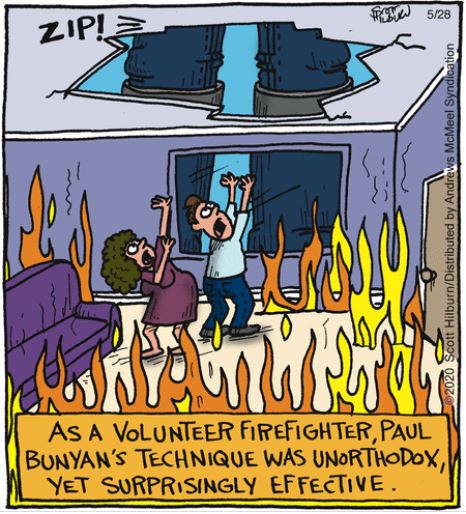
 Comics I Don't Understand
Paul B: Hey, Lem, that was a really p1ss-poor idea.
LikeLike
Why is this labeled Arlo, but not actually on the Arlo page?
LikeLike
Lem G: But Paul, normally you only work on forest fires, and those areas always grew back faster when you were part of the crew.
P.S. @ Carl Fink – “Arlo” is only in the eye of the beholder. In this case, Paul is holding his well out of sight.
LikeLike
Gargantua did it long before Gulliver.
Freud’s interpretation is Arlo-tag-worthy.
LikeLike
Gargantua had interesting uses for geese, did he not?
LikeLike
lazarusjohn, that passage in Gargantua left me wondering forever just what premodern people used for that purpose, in fact.
LikeLike
Probably why people hoard TP: they’d rather not have to find out.
LikeLike
In some places, such as desert areas without a lot of leaves (and no doubt loads of others), one would use a hand (and then, one hopes, wash/clean the hand). In Arab culture, for instance, traditionally this would have been the left hand, which is why you greet people and eat with the right hand. In other places and times no doubt either hand was used for ablutionary purposes and no taboo attached to using the dirty hand.
View at Medium.com
LikeLike
For those who didn’t use geese, there were sponges. In ancient Rome, sponges on sticks were provided in rest rooms. Also “sponge” was also a word used as an insult for a very obnoxious person. We have a related term for such a person.
LikeLike
Ah, yes, Gargantua. I can’t think of Rabelais without also thinking of “Pick-a-Little, Talk-a-Little” in The Music Man.
LikeLike
Didn’t remember the song title, but can’t forget “Chaucer …. Rabelais …. Ballllzac!” .
LikeLike
Given that Paul B. was a famous woodsman, could this have been the origin of the expression “morning w…“?
[…scuffle, sounds of a struggle, and a door slamming…]
[new voice]: NO!
LikeLike
And from another song in the same show, “Even if you can quote Balzac and Shakespeare and all them other high-falutin’ Greeks!”
LikeLike
They act so hoity-toity because they’re part of the high polloi!
LikeLike