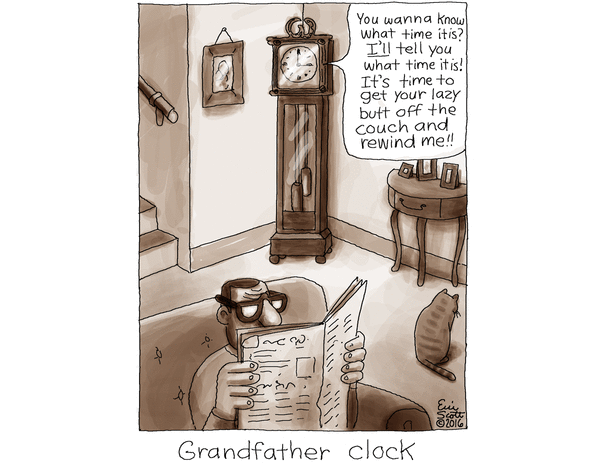
And is there significance to this being a grandfather clock, other than the fact that it has to be (re)wound?
And as an aside… do/did grandfather clocks have to be manually wound? My grandfather had one (appropriately enough), but I don’t remember ever having seen him to it.
 Comics I Don't Understand
As to your aside: winding a grandfather clock: key wind or chain wind, but, yes, winding required. https://www.wikihow.com/Wind-a-Grandfather-Clock
Yes to both. We had one growing up. It had to be wound. Mom got it retrofitted years later with an electric motor.
I think. Now I’m doubting myself. I know for sure the player piano was retrofitted.
I think the cartoonist has the impression that grandfathers are crotchety old guys who nag and belittle you and makes demands.
… which says more about him then others, I think.
To my mind every winding of a clock after the first is a rewinding.
I guess the connection is that the mutterings of this clock are in a style that stereotypical old and cranky Grandfathers make. Also, couldn’t you wind a mechanical clock only once, the first time, and then all after are rewinds?
the clearly visible weights kept the mechanism going. On a typical eight-day clock, once a week the other ends of the cables had to be pulled to lift the weights back to maximum height.
Since, they have to be wound. Bill, was your grandfather’s clock right twice a day? Sometimes they can get unbalanced, stop all the time, so you just give up.
Remember from Tristram Shandy that the narrator’s parents took “This is the day to remember to wind the clock” to mean “Let’s have sex tonight!”?
(I studied Tristram Shandy in a class where everybody had picked up from the professor the habit of referring to the narrator’s father, and the narrator’s Uncle Toby, as respectively “My Father” and “My Uncle Toby” as though these were their names. I had missed that bit of instruction, and for a couple minutes was bewildered by the apparent personal revelations of the class members. I did not inflict that form of speech upon you above, however.)
Scott, the clock kept perfect time. What I remember most about it is that it was loud. TICK! TICK! TICK!
“were my exertions this morning sufficient to wind you?” he asked
“minute man, you wound me!” replied the watch
My parents have a grandmother clock (it hangs on the wall, rather than standing, but is otherwise similar to a grandfather clock – weight and pendulum) which is an eight-day clock – it needs winding once a week so it doesn’t stop.
It got crooked on the wall and was stopping all the time, but we got it cleaned and then put a screw through the hole in the back of the cabinet after using a level to get it in the right position, and now it runs beautifully.
And I agree – after the first winding, “wind” and “rewind” are synonyms in this context.
The cat appears to have been shamed.
CIDU Bill, what source of energy did you think kept an 18th century clock going? Perpetual motion? Water power? Sheer fear of your grandfather?
By the way, they are called “grandfather clocks” not because they are tall but because of an old song.
@Mark in Boston, I used to have that song on a record when I was a kid and listened to it all the time.
Mark in Boston. “CIDU Bill, what source of energy did you think kept an 18th century clock going?”
Well…. the the prominent pendulum is a reasonable guess… A wrong guess but a reasonable one. Another guess would be weights.
Actually, I’m not entirely how spring mechanisms would encourage a pendulum. I do know as a child I was always disappointed when I tried to set my grandmothers broken clock in motion the pendulum would swing three of four times then stop.
How do the reset the Foucaults Pendulums in museums? Does the janitor at midnight give it a push?
There was a Twilight Zone episode “Ninety Years Without Slumbering” where a man believed he would die if his grandfather clock stopped. How it was taken down the stairs without stopping was unclear to me. He sang a song in the episode about his grandfather’s clock; I would guess that’s the song referenced above.
Traditionally all clocks had to be wound. Today there are grandfather clocks that have to be wound and ones that work on that work with that miracle of the modern age – a battery. The spot to wind the clock in the face of it.
Thomas Jefferson had a clock (not a grandfather) that also marked the days of the week – unfortunately it was not measured out correctly and holes had to be cut in the floor on each side of the room for the weights to continue into the basement – so the end days of the week were marked in the basement. It still works and if you go to Monticello and see it, be sure to look in the basement for the days that are marked in same.
Clocks originally had one hand – hours only.
And if you want to upset someone, explain about how other than day, month and year and somewhat weeks, time within a day is arbitrary. Also the time that one is reading now on watch or clock is not the correct time for where one is unless one happens to be in the spot of the time zone where it is that time. Time would vary in earlier periods by where one was as it was set to the sun overhead at noon. Over, say, the US eastern time zone, the time should actually vary over an hour (at western end it is later than at earlier end) as to help make the train schedules in the 1800s the time zones were invented and the center time of the time zone is used across the entire zone.
“But it stopped short, never to start again when the old man died.” I think “My Grandfather’s Clock” is a really creepy song, but maybe that’s just me.
If I recall, Tristram Shandy believed that he knew the date of his conception because of a family tale (from Uncle Toby?) of his mother asking his father “Did you remember to wind the clock?” when they were in the middle of sex.
“My Grandfather’s Clock” is a really creepy song, but maybe that’s just me.”
Not just you.
I prefer this parody:
My grandmother’s cat grew too fat for his shelf
So he slept every night on a bed.
He was almost as big as my Grandma herself
‘Cause three times a day he was fed.
He was fed tuna scraps as he sat on Grandma’s lap
On his back with a big napkin tied,
He ate as much as he could hold
Until he got too wide.
Hadn’t heard of the song before. The song is really only creepy in a modern context, where we seek to distance ourselves from death. The song, and the metaphor of the clock representing his life, is about how we all have a measure of time in which to live. It documents the events of his life. But those all end when we reach the end and die. Therefore, make the most of your time. I think a healthy awareness of the value of time is important to getting the most from life. I can understand how in modern times people would consider this concept too traumatizing for little Jordan and Madison
I did hear this pop song by The Moody Blues 30-some-odd years ago when it came out and thought it was pretty good. Similar theme. Make the most of your time. Only thing is that 22,000 days is only a bit more than 60 years, which seems a little short, but I guess it scans better than other options.
Alicia Keys rather blatantly derived from that for her piece 28 Thousand Days.
Grandfather clocks did need to be wound. Today they may run on batteries. This video explains and demonstrates it well and also shows this rare night clock. When you needed to tell the time in the old days.
“Winding” my dad’s Gclock required pulling the chains on the weights (heavy metal pine cones) til the cones were back at the top of the case. Over the course of a day or so, the cones would drop to the bottom and require you to pull them back up.
woozy: the spring (or weights) power the clock, not the pendulum. The pendulum and the escapement behind it are there to keep the clock running at a fixed rate rather than varying with the spring tension.
Meryl: these days it’s seconds that are the real point of reference and days that are arbitrary.
If you think time is absolute, here are questions for you: What time is it right now at the North Pole? What is the difference between civil time and sun time at your location? What is the difference between civil time and sun time at the north pole? What time is it right now on the moon? On the sun?
The Foucault Pendulum at the Museum of Science in Boston has a ring-shaped electromagnetic device around the rope that is designed to exert a force with every swing that is enough to make up for the lost energy. It is designed so that the force on the swing does not interfere with the rotation of the pendulum’s swing.
The musical posts reminded me of this gem:
Now with regards to absolute vs. relative time, just how do starships from different worlds meet up in space? How are time coordinates figured? I don’t recall Star Trek explaining how rendezvous-ing worked.
The first Sir Terry [Pratchett] book I read was ‘Thief of Time’.
the spring (or weights) power the clock, not the pendulum. The pendulum and the escapement behind it are there to keep the clock running at a fixed rate rather than varying with the spring tension.
The weights power both the clock and the pendulum. (After all, the pendulum is also not a perpetual motion machine.) The pendulum regulates the rate of the fall of the weights via the escapement, and each tick of the escapement gives a kick to the pendulum to keep it swinging.
Also the time that one is reading now on watch or clock is not the correct time for where one is unless one happens to be in the spot of the time zone where it is that time.
Of course, even if you are on the time zone meridian, a clock set to civil time right now in the US will not give mean local solar time, since the US is currently on Daylight Saving Time. (Assuming mean local solar time is what you mean by “correct” time.)
Grawlix: Presumably those ships carry a chronometer which is synced to some reference signal or to time “back home”. Of course, time dilation would make that more complicated, but it could be explained away in a sentence or two. “So, you see, it’s similar in principle, though quite different in mechanism, to Harrison’s marine chronometer.” See?
I always wondered how Federation ships can rendezvous with ships from “the alien planet of the week” when time standards may not be understood between cultures.
Next question: Are there any Sci-Fi movies that portray ships rendezvous-ing at random angles and not all “right side up” to the camera? :-)
If your clock twitches, does that mean it has a nervous tick?
Why would ships rendevousing in space at a time be an issue? At least any more an issue than rendevousing in space at a place? Presumably with faster than light travel and instantaneous communication there is a universal frame or reference and they have a handwaving workaround to relativity. (I’m pretty sure it must have been mentioned in one show or another.) Why would anyone assume that time has to be set to any local measure?
@ Grawlix – “…Sci-Fi movies that portray ships rendezvous-ing at random angles…”
In Star Trek, the ships were designed to look (and fly, and even sound) like futuristic planes (whooosh!), and the navigational tactics were (at best) on par with WWII marine battles. That’s what the audience understood then, and it’s all that an audience can be relied on to understand now, which is why things still haven’t improved a whole lot ever since. When it comes down to it, if they thought those ships were really going to fight in three dimensions, they would have designed more of the armament to point in every possible direction.
There was a nice (but minor) exception near the end of “The Wrath of Khan“: Spock tells Kirk that Khan is very intelligent, but lacks experience, and has been demonstrating “two dimensional” tactics. Kirk understands the hint, stops the Enterprise in the interstellar cloud, and sinks her down (along the “Z” axis), only to rise again after Khan’s ship has passed overhead, so that the Enterprise can stage a surprise attack from behind.
Even in the more recent Star Wars films, the space battles are fundamentally two dimensional, with an “up” and a “down”. The worst of it is that “disabled” ships occasionally “sink” out of orbit, as if losing power would change the way that gravity interacts with the ship’s mass. Another dreadful mistake occurs at the beginning of Episode 8: a fleet of resistance “bombers” is supposed to “drop” their bombs on an enormous “dreadnought” battleship. It was scripted just like a WWII mission to bomb Berlin or Tokyo, but nobody bothered to tell the scriptwriters that those bombs would never fall out of the bay in orbit, because there just isn’t any gravity in free fall.
“Another dreadful mistake occurs with the existence of Episode 8”
There you go. Fixed that for you.
“Presumably those ships carry a chronometer which is synced to some reference signal or to time “back home”. ”
See “the Counter-Clock Incident”. Star Trek’s original series offered three distinct methods for time travel, and the animated series added yet another. Whatever the plot requires…
” Presumably with faster than light travel and instantaneous communication”
The Federation does NOT have instantaneous communication. The exact scope of the delay varied from script to script, but they DID face delays (which allowed Kirk to act independently, because Starfleet couldn’t be contacted in time.)
” if they thought those ships were really going to fight in three dimensions, they would have designed more of the armament to point in every possible direction.”
Current generation fighter planes fight in three dimensions, but the armament for doing so is ALL pointed forward.
Fighting in three dimensions was a major plot point in Star Trek II, with Khan limited to two-dimensional thinking because of his upbringing back in the 1980’s, when airplane dogfighting hadn’t been invented yet.
“Even in the more recent Star Wars films, the space battles are fundamentally two dimensional, with an “up” and a “down”.”
The space battles that are near a planet have an objective “up” and “down” Up is away from the center of mass of the planet, and “down” is toward the center of mass of the planet.
“The worst of it is that “disabled” ships occasionally “sink” out of orbit, as if losing power would change the way that gravity interacts with the ship’s mass.”
A vessel under (sufficient) power can orbit at any height and speed. An unpowered vessel can orbit at only one height at a given speed, and only one speed (at a given height). Take a powered vessel, turn off the power, and it can no longer maintain its position. Its orbit will rise (or fall) to match the current speed.
“nobody bothered to tell the scriptwriters that those bombs would never fall out of the bay in orbit, because there just isn’t any gravity in free fall.”
There is gravity in free fall.
Since the 1950’s, bomb racks in combat aircraft have included something called an “ejector foot” that forcibly separates the ordnance from the rack. They also have these for external fuel tanks. When an armed aircraft, or just one with an extra fuel tank lands, these have to be disabled out at the end of the runway, before the aircraft taxis in..
Length of day is completely different on every planet. People from different planets will have a horrible time with their circadian rhythms.
“People from different planets will have a horrible time with their circadian rhythms.”
If they have circadian rhythms. Blind people already sometimes suffer from this, since it’s always dark for them…
>The Federation does NOT have instantaneous communication. The exact scope of the delay varied from script to script, but they DID face delays (which allowed Kirk to act independently, because Starfleet couldn’t be contacted in time.)
Waaay too many scenes with Picard nattering with Admiral so-and-on on the com-screen for me to accept this. The exact nature of the communication (I’ll grant you I’m not sure if the were able to communicate while in warp speeds but the com-screen was just too common a device to say they didn’t have instantaneous communication.
Kilby: Re: The Wrath of Khan and 3D maneuvers. That part of the Wrath of Khan actually always bothered me much more than the design of the ships. The battle was even, or the the Enterprise even a little behind until that point, so Kirk was also maneuvering purely in two dimensions until he made a conscious decision to move along the z-axis. That seems like an amazingly bad oversight for someone who’s supposedly highly skilled in starship warfare.
woozy, is this really a contradiction? Maybe there was a communications breakthrough between Kirk’s time and Picard’s.
The “ejector foot” has nothing to do with the absence (or presence) of gravity. The purpose of the mechanism is to make sure that the dropped object leaves the vicinity of the wing fast enough, before any turbulence effects might cause the object to tumble and perhaps collide with the wing and/or fuselage. Ejection seats in fighter aircraft are rocket powered for the same reason. Warships in space do not need to worry about turbulence.
“Maybe there was a communications breakthrough between Kirk’s time and Picard’s.”
Which was then lost again by Janeway’s time?
“The purpose of the mechanism is to make sure that the dropped object leaves the vicinity of the wing fast enough”
Almost. At hypersonic speeds, A vacuum forms around the aircraft. Dropped munitions would fall only about a half-inch, then ride on the air-pressure shockwave, which would hold the munition in place. When we place the munitions on the plane, we expect the pilot to deliver them to target, not bring them back.
“Ejection seats in fighter aircraft are rocket powered for the same reason.”
Again, almost. Sometimes the pilot might want to eject from the aircraft while it is motionless on the ground. He (or she) needs to get high enough for the parachute to deploy, or ejecting is just a different way to die. The rocket motors in ejector seats provide enough thrust to lift the pilot to a minimum altitude for the parachute to deploy. For this reason, people who are not pilots are taught how to check to see that the ejector mechanism is disabled, so they can get in the cockpit without having to worry about being elevated to a safe distance for a parachute to deploy, while not wearing a parachute.
” Warships in space do not need to worry about turbulence.”
True enough, unless they can also operate near the surface of a planet, where they might find an atmosphere, which might be turbulent. Star Wars X-Wings have wings because… they fly in atmosphere. Y-Wings and TIE fighters are also shown operating near planets, in atmosphere.
“That part of the Wrath of Khan actually always bothered me much more than the design of the ships. ”
Besides the fact that the premise is fatally flawed. (Khan didn’t think with 3D tactics because his 20th century experience didn’t give him an opportunity to think in 3D, despite the fact that aerial dogfighting was quite well-known in the 20th century. Oops.)
Kirk was fighting with an untrained crew of cadets with a cadre of seasoned officers… in a badly-damaged warship that was due to be decommissioned. He’s lucky he had any weapons at all, and had crewmen who could carry out orders for complex maneuvering.
Kirk (i.e., the filmmakers) did a poor job of using the third dimension tactically but it looked good. What would have looked better would have been if the Enterprise had not just retreated in the z-axis but also executed a 1/4 turn on the Y axis. So the Enterprise was below the Reliant but also pointed right at her as the Reliant passed overhead. Fire all the weapons as Reliant passes instead of waiting for Reliant to pass, and then slowly climbed in the z axis. My alternative is something a fighter from the 20th century can’t do, which makes it fit the screenwriter’s premise of Khan’s fatal flaw, and would have looked good on screen, too. But, um, Kirk couldn’t do it because the crew was green, or maybe the Enterprise was too damaged. Yeah, that must be it.
“woozy, is this really a contradiction? Maybe there was a communications breakthrough between Kirk’s time and Picard’s.”
Who said we were talking only about the original series or even just Star Trek? The question was about ships knowing what time it is in space and two ships being able to agree upon it. It seems to me the only issues would be 1) lack of local time; No sun to set their watch to. This seems to be how the question came up but it seems rather bizarrely naive as it’d obvious they’d use a universal time i.e. Stardate. 2) Mechanical. Timepieces are unreliable and run down and need to be reset. This seems rather archaic for a science fiction show. 3)Relativistic time dilation. This is a very real problem. But nearly every science fiction show simply ignores this. We have faster than light travel and stardates…. and most have instantaneous communications. I’m fairly sure there were some communications between ship and star fleet in TOS, certainly ship to ship, but no I can’t pinpoint a specific one. But even if they didn’t have instantaneous communication it seems more about lack of a permanent channel than an inability to have a universal objective time. At any event they *DID* have it in Star Trek TNG, which certainly counts as “The Federation” and “Star Trek”.
So other than relativity concerns (which in reality is everything) I still don’t see why two ships meeting at a specified time should be problematic (if we ignore relativity– which every show with faster than light travel does).
What is this “Star Trek Terms of Service” of which you speak?
woozy: I also definitely recall instantaneous communications between distant planets. But I also remember cases where ships in TNG were too far away to get answers quickly, and so were “on their own.” Without looking up specific cases, I’m going to go out on a limb and guess that the writing was not consistent about this, even within each series. At any rate, I agree with you that it’s only relativity that causes problems with setting a universal time – if you ignore relativity, slow communication is only a practical problem, not a fundamental one.
In “Cause and Effect” in TNG, the Enterprise is caught in a time loop. When they get out, they discover that they check some Starfleet beacon, realize that they’ve “lost” 17 days, and reset the ship’s chronometer to “standard time” (or something like that).
Mitch4: I’m guessing you’re joking, but just in case you’re not, ToS = “The Original Series”
Yes, I was just perpetrating an attempt at faux-ignorance humor. But thank you for kindly just offering the answer.
“But I also remember cases where ships in TNG were too far away to get answers quickly, and so were “on their own.””
I view that more as bureaucratic inefficiency of communications more than anything else.
I figure the science and consistency of ToS was so naive that it would never have occurred to them there *would* be any problem with instantaneous communication. However they certainly didn’t have the comscreen as frequently in ToS and TNG (but I always assumed they thought that would confuse the viewer who would have thought of the screen as a high tech window). However I can’t say with certainty the y*did* have instantaneous communication. But they *certainly* did by TNG. And TNG is *certainly* Star Trek.
Well, to be fair, Janeway was a LOT further away.
woozy: The cases I (vaguely) recall weren’t bureaucratic inefficiency, but about how long it would take the signal to reach. For example, searching around a little, in “Where No One Has Gone Before (TNG),” Data states that they are so far from Starfleet that their message to Starfleet would take over 51 years. (Interesting that the issue is stated as the length of time the message would take, rather than the power the message would require.) And, of course, Voyager was out of contact from Starfleet for most of the series.
“I view that more as bureaucratic inefficiency of communications more than anything else.”
[…]
” they *certainly* did by TNG.”
You start by conceding that they didn’t, and then end by insisting that they did. You have the same lack of consistency as Star Trek.
Depending on the demands of the week’s plotline, they either did or did not have instantaneous communication.
“And TNG is *certainly* Star Trek.”
… is an opinion. Another opinion is that Star Trek is Star Trek, and TNG is TNG, and the two overlap in a couple of guest-starring roles and interlocking “Naked” episodes. They’re clearly different… one has green-skin Klingons, and one has head-bump Klingons.
Moving on:
Relativistic time dilation is only meaningful if they’re traveling at relativistic speeds. In Star Trek, they do not. They either travel at orbital speeds, which don’t produce significant relativistic effects, or they travel at warp speed, which is outside the range of relativistic effects.
My favorite SF story about instantaneous communication is James Blish’s “Beep”.
James, they did explain the Klingon thing. The explanation seemed kind of iffy, but it is canon.
woozy: Joe Haldeman’s The Forever War addresses the effect of relativity and time dilation as humans conduct an interstellar war with a race of aliens. Ships do still rendezvous, but I recall at least one case where one ship was newer than the other. It’s a good read.
“they did explain the Klingon thing. The explanation seemed kind of iffy, but it is canon.”
Depends on your definition of “canon”, I guess.
Winter Wallaby. In that episode, like Voyager, they were they were beyond the practical realms. The explanation as to how instantaneous commication worked and what range it had was never made clear but they could clearly communicate instantly with nearly on charted space.
It is curious as to why it would take 51 years when they were thousand of light years away.
James, I conceded that maybe they didn’t have it in ToS, although I am sure they did, I just can not cite an episode with certainty. But in TNG they absolutely did and I am unwavering in my commitment to that.
Of course, I was right.
https://memory-alpha.fandom.com/wiki/Subspace_communication
Subspace communication was near instantaneous and existed in ToS. It does require amplification, antenas and/or relays. Apparently it would even allow for communication between quadrants if relays had been established. and they did use it more in TNG by technology and policy.
woozy: What in that link do you believe shows you were correct? I see nothing there that supports your claim that Star Trek has consistently had instantaneous communication.
I don’t know what you mean by “beyond the practical realms.” “Instantaneous” means “instantaneous.” If communication is possible, but takes 51 years, it’s not instantaneous. To change it to “near instantaneous, under certain conditions” is to move the goalposts beyond all recognition.
Kinda the same as everybody else’s, James: that which is true in the context of the fictional property, according to the people who own said fictional property.
You can choose to personally reject it — the explanation of the Klingons’ altered appearance is really stupid — but that’s what the word means.
WW: No communication is instantaneous. Face to face speech isn’t instantaneous. Telephone calls aren’t instantaneous. However, for all intents and purposes, they are and would be said to be so by any reasonable English speaker. The problem with ST of all flavours is that it made up stuff as it went along. If an episode goes easier with instantaneous communication, they have it. If they want the crew to (yet again) violate the PD, they give them a 51-year lag or an ion storm or some such. The problem is when we try to make it all be…logical *raises eyebrow*
CIDU Bill: I believe James is suffering from the condition known in fandom as “head canon.” This is believing something that is not supported by the original source material or set as canon by the official sources. https://fanlore.org/wiki/Headcanon
For example, some may use Wesley Crusher’s rainbow shirt to craft a head canon that he is gay, which then informs all other interpretations of the work.
https://www.google.com/imgres?imgurl=https%3A%2F%2Fi.imgur.com%2FwsTDsoL.png&imgrefurl=https%3A%2F%2Fimgur.com%2Fgallery%2FvyEnw&docid=1EcckrVHj_PzYM&tbnid=MrRcy8_ikTcxqM%3A&vet=1&w=408&h=624&bih=742&biw=1344&ved=2ahUKEwj_47nfnKXlAhVhw1kKHbyUCPsQxiAoCXoECAEQKQ&iact=c&ictx=1
“James, I conceded that maybe they didn’t have it in ToS, although I am sure they did, I just can not cite an episode with certainty. But in TNG they absolutely did and I am unwavering in my commitment to that.”
Sometimes they had instantaneous communication, and sometimes they didn’t. Whether they had it varied from episode to episode, depending on the needs of the story-of-the-week. They lacked communication of any kind in at least the first season of Voyager. OTHER ENTITIES had it… notably, the Q and the Travellers could travel physically at a nearly instantaneous rate. But if the plot required the Enterprise to be cut off, then cut off they were.
This will remain true regardless of what you unwaveringly believe.
“Of course, I was right.
https://memory-alpha.fandom.com/wiki/Subspace_communication”
The source you cite states multiple times that subspace communication is not instantaneous.
“What in that link do you believe shows you were correct?”
Uh. Everything….
“I see nothing there that supports your claim that Star Trek has consistently had instantaneous communication.”
If you can speak face to face in real time that is instantaneous, isn’t it?
“To change it to “near instantaneous, under certain conditions” is to move the goalposts beyond all recognition.”
That’s like saying “changing a ‘tennis ball bounces’ to ‘bounces on certain surfaces, if it is initially propelled’ is to move the goalposts beyond all recognition– if it gets stuck in muddy cow field, it’s not bouncing”.
“If you can speak face to face in real time that is instantaneous, isn’t it?”
And if you can’t, then it is not instantaneous, is it?
“I believe James is suffering from the condition known in fandom as ‘head canon.'”
You believe incorrectly.
And yes, real grandfather clocks needed to be wound! I have my grandfather’s, and remember fondly the big production about winding it once a week. That’s why the case is so tall: winding comprises winding the weights all the way up to the top of that case, so it will run for a week without winding.
‘ “I believe James is suffering from the condition known in fandom as ‘head canon.” ‘
“You believe incorrectly.”
Yep, that’s head canon for you…
““If you can speak face to face in real time that is instantaneous, isn’t it?”
And if you can’t, then it is not instantaneous, is it?”
And if Moby Dick were a pregnant guppy, he wouldn’t be a white whale, would he?
And if Star Trek was written by Jane Austen in the 18th century they wouldn’t have faster than light travel, would they?
Since they can and frequently did speak face to face in real time, there’s no point in speculating what it’d be if they couldn’t. Because they could.
Aw jeez…
The question I asked was tongue in cheek.
[” This seems to be how the question came up but it seems rather bizarrely naive as it’d obvious they’d use a universal time i.e. Stardate.”]
Pardon me if I don’t take Sci-Fi as seriously as some folk do. I was looking at things from a different angle. I was imagining here that the aliens worlds in question weren’t aware of the Stardate standard.
[“Why would anyone assume that time has to be set to any local measure?”]
I was presuming (again, tongue in cheek) that each world would have its own concept of time and standards of measure, and outside of a Federation or Empire-imposed foreign standard, you might not know when to meet up at a certain point in space.
Roddenberry had a marketable idea that could be turned into a series, and managed to like up just enough financing to get it into production (for a whopping $180K per episode, albeit in 1960’s dollars). He then hired dozens (later perhaps hundreds) of writers to produce material that could be filmed. Some of these writers shared his cosmic vision, others were just hacks looking for a quick paycheck.
Nevertheless, no matter what the source was, all of the material that made it onto the screen became the Gospel of Star Trek Canon, and was revered by true fans everywhere. Then, when the network refused to satisfy the cult’s wish for more material to worship, the fans created the hallowed Convention, and other arcane practices that culminated in Shatner’s famous pronouncement: “Get A Life!”
Based on the fertile soil of a large body of cult members, the entertainment saw the light (glinting from the silver they hoped to earn), and created movies, and sequels, and sequels of sequels, each of which added another layer to the Holy Canon. When the layers became too dense, J.J. Abrams came with his magic Sword of Rebooting to cut the Canon’s Knot, and restarted it all from the beginning, but different. The True Fans saw that it was different, and they howled, “How could you betray us so?”
Hogwash. When all is said and done, it is worth remembering that Leonard Nimoy not only approved of what Abrams was doing, he underlined this commitment by appearing in not just one, but two of the new movies. There is some eminent value in what Shatner said; after all, it was just a TV show.
> I was imagining here that the aliens worlds in question weren’t aware of the Stardate standard.
Then… they *wouldn’t* be able to. What’s to wonder about? That’s like asking How would you shout “Look out for the Cat” to someone who doesn’t know English. You wouldn’t.
>I was presuming (again, tongue in cheek) that each world would have its own concept of time and standards of measure, and outside of a Federation or Empire-imposed foreign standard, you might not know when to meet up at a certain point in space.
But…. why is that even a question? They’d find out what the other cultures of time was, and communicate and agree on a time and place. What’s to wonder about? You ask what time is it for you. What’s your basic unit of time. Tell me when a unit passes after this point….now. Okay, meet us at so many time units after this time. Oh, and watch out for that cat!
I figured you were wondering, how in space, with no frame of reference could time be agreed upon. That’s an honest and real question. And the answer is it *can’t* be. Two people would have to have a frame of reference to each other and agree on something. But in sci-fi shows with magic handwaving of faster than light travel and some magic face to face real time communication the issue is moot.
” how in space, with no frame of reference could time be agreed upon. ”
Half-lives of decay of radioactive materials. H. Beam Piper thought of this about 5 decades ago. (A slightly different variant… two cultures which have absolutely nothing in common… how do you translate from one language to another? You have no basis to assign meaning to any simbols used. The answer comes when the archaeology team finds a periodic table. There’s intrinsic meaning there, which gives them their start in deciphering the alien language.
“Since they can and frequently did speak face to face in real time, there’s no point in speculating what it’d be if they couldn’t.”
Since they frequently couldn’t speak face to face in real time, insisting that they always could doesn’t make much sense, either. But there you are.
“Yep, that’s head canon for you”
In your head it is. If only there were some term for that…
woozy, your insistence that because you saw face-to-face instantaneous communication means that all the communication was instantaneous falls apart under simple scrutiny.
People who are in the same room can speak to each other in real-time. This does not imply that either one of them can speak instantaneously to anyone else. The Star Trek producers didn’t decide whether or not Federation starships had instantaneous communication before they starting having writers produce scripts. This meant that some of the writers wrote scripts where they had it, and some of the writers wrote scripts where they didn’t, and then as they went on they had to try to retcon the two together, but ultimately what they came up with is that the Federation has nearly-instantaneous communication… except when they didn’t.
(Dramatically, they often wanted to put the show on the frontier, beyond the known expanses of space, so they could encounter new people and new civilizations. This effect is severely blunted if starfleet captains are supposed to stop and phone home for instructions every time they encounter something new. The historical models used are A) sailing ships during the age of exploration. The British admiralty didn’t control ships that were over the horizon; the ship’s captains were expected to represent the Crown to whoever and whatever they encountered on their missions, and B) the American frontier, pre-railroad. The settlers who chose to venture westward went beyond the reach of civilization and created outposts, which had little communication with or direction from back east. Lewis and Clark spent years between leaving for and returning from the Pacific Ocean, and during that time they had an exploration/mapping mission but no communication with the capital. Some writers even went back as far as C) the Roman Expeditionary Legions as historical models. You get dramatic weight when the ship’s captain must make a decision that could affect the entire future of interaction with this new planet we’ve just discovered. There isn’t much, if any, if the captain gets stuck and can just phone home for advice and instructions.
I don’t see a contradiction: Sometimes there’s an elaborate series of relay stations between Starfleet and wherever the ship is, making communication instantaneous, and sometimes there isn’t, so signals are delayed until they find relay stations.
Technobabblewise, this is no worse than countless other rules we’re willing to accept.
“Gavagai” and points to rabbit sitting on ground.
Clearly, “gavagai” in their language is the word for “ extended finger”.
“I don’t see a contradiction”
When the shows were made, they were highly inconsistent about how (and whether) communication with home base worked. Later, they made up an excuse for why it was inconsistent and applied it. This is a retcon, a retroactive change to the continuity.
No big deal, really. Some people like finding plot holes, and some people like making up complex explanations for why it isn’t really a plot hole after all, and mass-market fandoms usually have plenty of both types in them. The whole thing is captured quite well in a Simpsons episode. Somebody, probably Comic-Book-Guy, asks Lucy Lawless a question about a Xena episode, hoping to expose a plot hole. But Lucy Lawless explains the answer as “a wizard did it”. Every time you notice something that looks inconsistent, the answer is “a wizard did it”. Star Trek fandom was prone to similar solutions, except that they’d be filled with technobabble, like “they just trans-reverse the ion thrust emitters”, which boil down to “a wizard did it”. Because the writers of the Trek TV shows were so diverse, and worked under different interpretations of what was possible and what wasn’t possible under the show’s premise, there are a LOT of inconsistencies to iron out. Mostly, the complaint is that in any episode, they never re-use solutions that were invented just in the nick of time to save the day the week before. For example, they used the transporters to reverse the effects of aging, then never use this technique again. When they needed to time-travel, they kept inventing new methods and techniques to do so. (The only exception to this rule that I can think of off the top of my head was the excellent “Yesteryear” episode of the animated series.) Making up, debating, and challenging such theories as to why a seeming inconsistency isn’t really inconsistent is fun and entertaining… whether you’re doing it to explain away the inconsistencies in the Sherlock Holmes stories, or Star Trek, or Marvel comics, all of which have plenty of inconsistencies to pick at.
But if, instead, you insist that there was never an inconsistency in the first place… that they always had (x), and (x) was always the solution….
“When all is said and done, it is worth remembering that Leonard Nimoy not only approved of what Abrams was doing, he underlined this commitment by appearing in not just one, but two of the new movies.”
You might recall that Nimoy was deeply conflicted on the Trek fandom… he wrote “I am not Spock” in 1975, before coming around and writing “I am Spock” in 1996.
” J.J. Abrams came with his magic Sword of Rebooting to cut the Canon’s Knot, and restarted it all”
Yeah. Disney let him cut loose all the old continuity that had developed for Star Wars, too. Almost as if it were too much to ask that he actually learn the continuity of the project he was developing.
1 – In past times sometimes clocks were stopped at the time that head of the household died. It is claimed that when General Stonewall Jackson died (after being accidentally shot by his own men at night) the clock in the room stopped on its own.
2 – I am going to come to CIDU from my desktop computer to try to print out the discussion on Star Trek and time and give it to husband as he is online with Wil Wheaton and see what Wil makes it of it all. (Don’t be impressed – he found him, I presume on Facebook, but they have private conversations on same.)
Unfortunately it will not be soon – juggling too many things – such as 90 year old mom and her 2 cardiologists as if they don’t replace her pacemaker within a month and a week (based on the 2 months we were told 3 weeks ago), well, there is no plug in alternative to keep it going. Also our continuing breakdown of vehicles (we need our to schelp mom around – she can’t climb into the van) – at one point recently none of the 3 were completely working.
Wil Wheaton played possibly the least popular Star Trek character of all time, with a substantial portion of the fanbase calling for his character to be killed off, the sooner the better. It wasn’t a failure on the actor’s part, but rather of the writers. “Shut Up, Wesley!” remains a popular Star Trek meme to this day.
Meryl A: I’m going to guess that nerds arguing about inconsistencies in the Star Trek universe is extremely uninteresting to Wil Wheaton at this point. He’s probably just going to say “a Wizard did it.”
My understanding is that Wheaton is a huge Trek fanboy.
Wesley was always intended to be a key piece in the storyline. In retrospect things that happened that did not seem to be when watching it in the original real time, lead towards his leaving with the being (okay, I admit it I did not really pay attention to who anyone beyond the main characters were when I watched it) that was in the first episode and takes him away at the end of the series is part of an arc of events that continue over the entire series and was always intended to be such.