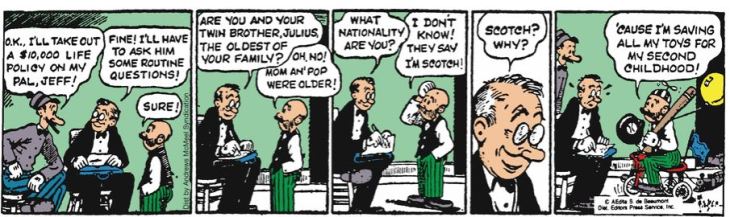
@ tygalilee – The final panel plays on the ancient stereotype that the Scots were notoriously frugal. Another example is the old joke:
“I don’t get it”
In old jokes, pre political correctness, Scotish people are very thrifty and try to save money. This guy is keeping all his childhood toys for all his life so that he won’t have to buy new ones when he reaches senility.
Q: “What caused the Grand Canyon?”
A: “A [insert racial epithet] dropped a penny down a gopher hole!”
Was Mutt and Jeff ever funny?
What does dropping a penny down a gopher hole mean?? LOL The comic deserves a geezer tag and a RIDU tag.
I had never heard of that stereotype, so it didn’t make sense to me either. That said, is reverting back to childhood and wanting to play with toys in one’s old age a thing?
There is a cash advance franchise in FL called AmScot, and I wonder if it’s short for American/Scottish and supposed to impart a sense of frugality, working on that stereotype.
Nor other reruns, either . . .
I too had never heard of this stereotype – though in hindsight I now realize that’s probably why Scrooge McDuck was such a skinflint.
More hilariously, when I checked Dictionary.com to make sure “skinflint” wasn’t a racist term, I see that “Scrooge” is listed as a synonym (how Dickensian!)
@Mark M: Per Wilipedia, “Second childhood is an informal phrase used to describe adults whose declining mental capabilities mean they need care similar to that of children. It is an unscientific term, similar in meaning to the old terms dotage or senility. The current scientific term is senile dementia.”
I think that it was stereotyped as old folks reverting to childhood by playing with toys.
As a humourous BTW, “senile” and “Senator” come from the same Latin root.
Not that I’m saying anything.
I’ve seen it both asserted and disputed that the brand name “Scotch Tape” was originally based in the frugality stereotype.
Mitch4, remember when the Scotch brand coolers had a tartan cover? We had one of those.
Ah, nostalgia
Scotch describes a kind of whiskey, not people. People are Scottish descent are “Scots”, not “scotch”. This bugaboo bothers some of them way more than it does others.
I’ve heard that the origins of “Scotch Tape” as a brand name came from field testing of a prototype product which had adhesive along the edges only. A customer’s comment was something to the effect of “this could be a great tape, just tell those Scottish [stingy] bosses of yours to stop being so cheap with the adhesive”,
@ tygalilee – The bit with the gopher hole was supposed to imply that the person was so stingy that he would dig up the coin, no matter how deep it was, producing the Grand Canyon as a side effect.
P.S. Here’s another example of extreme measures without the racist baggage:
>I had never heard of that stereotype, so it didn’t make sense to me either. That said, is reverting back to childhood and wanting to play with toys in one’s old age a thing?
Bless your heart.
“Second Childhood” is a phrase I heard frequently although I’ve heard it to mean either senility or retirement/midlife crisis. The frugality of Scotts is very long lived and pervasive stereotype. In Nova Scotia they used to joke about the old farmer who refused to buy matches because he’d be damned if he would spend good money on something he’s just going to burn.
Now I’m reminded of “The regiment took a vote, we’ll buy a new one.”
There’s a legend similar to the Grand Canyon joke about how the Duomo in Florence, Italy, was built.
The Duomo, designed by Brunelleschi, was the biggest dome in the world at the time is was created, and was an engineering marvel. After its construction, a joke circulated that the dome was built by building a solid dome of dirt, and just constructing the dome over the dirt. How did they get the dirt out? Simple: they hid a gold coin somewhere in the pile, and then announced its presence to the notoriously greedy citizens of Florence (e.g. the Medici banking family) , who dug it all out within a day.
In the “finding these sort of references offensive can go overboard category,” the father of an ex-girlfriend forbade the use of Dutch treat [I could kind of go along with that one, since it bothered him] and brought up his daughters to think that it was racist to say that it was “nippy” outside [no, Marc, you’re effing crazy]. My family uses Scots frugality as a running joke, but that’s how the ancestors emigrated from Ayrshire and made their way to North Carolina and then to Missouri and then to Oregon. Not gonna give up the jokes around the Thanksgiving table.
There’s a difference, of course: “Dutch treat” does reference a group of people, while “nippy” just sounds like sounds like something else
“Dutch treat” clearly has a bigoted origin, similar to “getting jewed,” “getting gypped,” “Chinese fire drill,” etc . . . But in all the cases, the person saying them may not have any bigoted intent, and may not even be conscious that what they’re saying has any relationship with any ethnic group or stereotype. (I’m not saying that makes it OK to use all these terms.) This seems particularly likely in the case of “Dutch treat,” since I’ve never met, or indirectly heard of, anyone who genuinely thought that Dutch people were cheap. I’ve heard of the stereotype before, but it seems like some weird old-timey stereotype that only exists in jokes. Dunno if it’s more active in Europe.
B.A.: If saying something bigoted and then pretending that it’s not is synchronicity, then we’ll have synchronicities every day.
Winter, I guess it seemed like synchronicity because I happened to have CIDU and the Newsweek article in adjacent windows.
I have to disagree with you on “Jew down,” though: I can’t imagine how it can be used WITHOUT knowingly referring to Jews.
“Chinese fire drill”… I’d never heard this term until I was taking driving lessons, and when it was time to switch drivers, the instructor said “Chinese fire drill!” I did ask him where that came from, and he told me “Nobody knows.” Which probably isn’t true. I didn’t think it was an ethnic slur, but I was also glad the driving class wasn’t taking place in Chinatown.
B.A. I agree people who say “jew down,” know it refers to Jews. What I meant is that the person saying “jew down” may not be consciously thinking “I’m using ‘jew’ in this way to communicate bad things about jews.”
My wife (who is Jewish) worked for someone who would talk about people trying to “jew” him. At one point he said to my wife “Barbara keeps telling me I should stop saying ‘jew’ in that way, but I don’t think it’s offensive, do you? I just means to be cheated.” My wife did tell him she thought it was offensive. But she also thought he honestly was not trying to be anti-Semitic. Obviously, it’s still a bigoted term, and I’m not saying it was OK for him to use it.
Similarly, I’m sure your instructor knew that the “Chinese” in “Chinese fire drill” referred to a particular ethnic group. (And it only takes a few second thought to see that calling an inept fire drill a “Chinese fire drill” is insulting to Chinese people.) But he might not have been consciously intending to insult the Chinese.
I am 1/4 Scottish. Some of my siblings joke about our innate thrifty ways. None of them are as thrifty as I am though.
That said, is reverting back to childhood and wanting to play with toys in one’s old age a thing?
One of my goals now that I’m no longer a productive member of society is to get my old HO slot car system back in operation.
One of my brothers bought the family house from my mother years back. I was reminiscing about the car set once and said I wished I’d kept it. He replied, “Mom kept all that in a box in the basement. I’ll get it for you.” Now the box is in my house, waiting on resurrection.
I grew up in a small Minnesota town which had no Jews, no black people, and only one Asian, so the folks I knew mostly had to make do with making fun of Catholics, which was pretty lame. (O.K., and Indians.) This led to a somewhat skewed view early on as to *who* I was supposed to be entitlted to feel superior to, so I finally decided to just go with “people who don’t read books.” That worked out fairly well for me.
But if my own tribe (Norwegian-Americans) couldn’t use and make fun of the stereotypes against ourselves — see: Ole and Lena jokes; Lake Woebegon; etc. — we wouldn’t have any foundation for humor at all, and thus would not be the famed wits that we are. (Well, that’s at least half true.)
Winter, he certainly knew the name came from a small and obscure country in Asia, but not why that combination of words indicated a bunch of teenagers running laps around a car.
In other words, no more an ethnic slur than Chinese checkers.
People never fail to astound me.
I’m not talking about bigots, it’s their job to say ignorant things, but…
A few years ago, I was chatting with the father of my son’s college roommate — perfectly nice guy — who suddenly mentioned that his office manager probably knew the boys’ landlord, because “they” all know one another.
A secular Baltimore Jew and an Orthodox recent immigrant from Israel.
I told him the only thing the two men had in common was that they were missing part of their penises.
(Yes, I could have been more polite about it, but then I also could have been more IMpolite).
This was 2011, in a large East Coast city with a significant Jewish population.
B.A. He may not have known the details of the history, but surely it’s obvious that a “fire drill” where everyone ends up where they started is an inept fire drill, and that the adjective used to describe it is thus not complimentary?
Bill, I knew someone from India who said when he was in NJ, he regularly got asked “Do you know [other random Indian]?” Worldwide, there are about 100x as many Indians as Jews, so by my calculations, that’s 100x as stupid. ;)
When I was in Minnesota some years back, somebody asked me whether I knew a particular person living in New York City.
I don’t even know what to attribute that to.
Honestly, I didn’t think of it even as a variation on “fire drill,” let alone a slur on the Chinese. I can’t speak for him of course. But since the term’s been around since at least the 1950s, it’s possible he was just repeating a phrase used by his driving instructor, who was repeating a phrase used by HIS driving instructor, who was repeating a phrase used by HIS driving instructor.
(Turtles all the way down).
CIDUB, I assume from his use of “they” that your Baltimore pal had no idea you were Jewish.
I knew somebody from India in New Jersey; I was there when he asked the attendant at a gas station, “So, what part of India are you from?” and got the answer, through clenched teeth, “Pakistan…”
“Mom kept all that in a box in the basement. I’ll get it for you.”
Wow! Congratulations!
One thing I learned from my year in New Jersey was that “Indian” gas station attendants are virtually always Pakistani.
Nothing weird about that: just the normal pattern of first- and second-generation immigrants working for businesses family members and people from their town/city/county started up or bought into.
Related to all this: I’ve heard people referring to candidates in presidential primaries attacking one another as “a Polish firing squad.”
Though “circular firing squad” has become the preferred term, not surprisingly.
” if my own tribe (Norwegian-Americans) couldn’t use and make fun of the stereotypes against ourselves — see: Ole and Lena jokes; Lake Woebegon; etc. — we wouldn’t have any foundation for humor at all”
B.A. I’m not sure if we disagree about anything? I did say at the start “…he might not have been consciously intending to insult the Chinese.” I can make that stronger and say “he most likely wasn’t,” if you prefer.
I’m saying “Chinese fire drill” and “jew down” are both ethnic slurs, but that in both cases, people (e.g. my wife’s boss, your driving instructor) using those phrases may not intend them as such. It’s obvious that they’re slurs if you sit down and think about them, but people use a lot of words and phrases without sitting down and thinking about them.
Similarly, I used the word “gypped” frequently, until someone pointed out it was an ethnic slur. It was obvious once he pointed it out, but I didn’t make the connection until then.
Now I have to wonder about all those afternoons I played Chinese handball…
Back to the comic: the evidence has shown (repeatedly) that Mutt & Jeff is
1) Poorly edited;
2) Only rarely (if ever) funny;
3) Very often irritating, if not blatantly offensive.
The question is why anyone should waste time following this strip, or bother submitting it to CIDU. I can think of only two logical answers:
1) Hopeless nostalgia;
2) Pathological masochism.
No, B.A., he apparently had no idea. Though I can’t believe he didn’t just assume that everybody with a New York accent is Jewish (and yeah, my accent isn’t what it once was, but nobody’s going to miss the fact that I’m from New York).
‘“nippy” just sounds like sounds like something else’
Reminds me of the people who were fired for using “niggardly”.
I wonder if the same has happened because of “renege”.
Arthur, I remember that: it happened in Washington DC, and it convinced me that we’d officially established a moronocracy where facts can no longer be counted on as a defense against ignorance.
The thing about “niggardly” is that it’s close enough to make people feel genuinely uncomfortable when they hear it. Even if they’re aware it’s from a completely different root.
As such, since the discomfort is real, even if the etymology is spurious, it makes sense to avoid using it, so as not to cause useless pain.
As far as whether someone can use “Jew down” innocently — there was a discussion of that elsewhere among people I know, who suggested that, growing up in places where they had never encountered Jews, they thought the phrase was probably spelled something like “gewed down”, and never even associated it with the word “Jew”. Same way that people might entirely miss that “gyp” is related to “Gypsy”, and think it was spelled “jip.”
So, yeah. People can miss real etymologies which are offensive; people can know that etymologies are false but nonetheless have emotional reactions which are painful; in general, not hurting people when you don’t have to is a good idea.
Believe it or not, back in the ’50s there was an American automobile named Scotsman, a stripped-down low-cost model.
“Niggardly” might make people feel uncomfortable, and should probably be avoided when possible, but using the word shouldn’t have been a firing offense. Not in a universe where dictionaries exist.
Bill: If you’re thinking of this story, then no one was fired. The man who said “niggardly” resigned on his own. The DC mayor accepted his resignation, was widely criticized for accepting it (including by black leaders), and then the resignation was withdrawn.
It shouldn’t have happened in the first place, but it hardly seems like a sign of a moronocracy where facts can’t be used to defend against ignorance.
If you want to argue we live in a moronocracy, there are much better recent examples. Why just earlier this week, Presi…[remainder of comment censored].
Arthur: Interestingly, at least from the brief descriptions on that page, several of the uses of “niggardly” on that page do appear to me to be intended to be racist: the Obama one, the B. Curry one, and likely the Broward County one.
Back in the early days of Mutt & Jeff, ethnic humor was the norm and nobody gave it a second thought. Entertainers exaggerated the stereotypes of their own ethnicity, whether they were Black (Bert Williams), Jewish (Max Davidson), Scots (Sir Harry Lauder) or whatever.The very word “racism” was unknown.
WW, I agree with you about the Broward case; I don’t have enough information on the Obama one to form an opinion. Note that the section after the Broward case suggests that racist usage of it might increase.
Arthur; Those predictions are all from the years after the Howard case in 1999, though.
Incidentally, none of the examples in the Wikipedia article resulted in firings. The only one I see with formal consequences are the Wilmington teacher, and the Broward case.
WW, my remembrance of the Howard case was that there was pressure on him to resign.
Winter, I didn’t realize the resignation had been withdrawn: the media isn’t big on follow-ups.
That said, I don’t recognize a practical difference between being pressured to resign and being fired.
And I do stand by my feeling that this was a big step toward the post-fact society we live in today. To my mind, anyway.
Of course, decades earlier we had a politician who was defeated because his opponent said he practiced monogamy and his sister was a thespian, so it’s not as if anything’s new.
I can believe she didn’t know “Jew down” was derogatory; she also doesn’t seem to know the definitions of other words she uses, like “privy” and “hypothetical”.
And, yes, I think it counts as synchronicity.
“The very word ‘racism’ was unknown.”
Well technically, the word came into English-language use no later than 1902 (though the French “racisme” appeared decades earlier, and it really didn’t take a genius to “coin” “racism” when “racisme” already existed), and Mutt and Jeff didn’t appear until 1907; but the word didn’t become widespread in the English language until the 1930s.
Aren’t you sorry you brought it up, Mark?
There are some words with folk etymology that give racist connotation where none exists. One is “picnic”, where supposedly whites would get together, have an outdoor party, then to cap it off “pick a . . . ” well a victim for a lynching. Completely bogus of course, but some believe it.
Winter Wallaby“Dutch treat” clearly has a bigoted origin … I’ve never met, or indirectly heard of, anyone who genuinely thought that Dutch people were cheap.
I’m not sure if it is bigoted. The earliest use I can find of the phrase, and possibly it’s origin, is in an 1875 book Europe Viewed Through American Spectacles. The author speaks of the practice with respect and suggests that America should adopt it. He doesn’t imply that it’s “cheap”.
There seems to be an assumption that if a people or group are mentioned in a phrase, the phrase is therefore a slur. But it might not be.
In my (very small) circle of friends, Dutch Treat means *I* pay.
There are a number of English idioms (most of which have fallen out of use) that use the word “Dutch:”
Going Dutch / Dutch treat
Double Dutch (gibberish, also a jump rope game)
Dutch uncle (a harsh/stern/frank person, pretty much the opposite of “avuncular”)
Dutch courage (courage obtained by the consumption of hard liquor)
Dutch wife/widow (a prostitute)
Dutch gold (a gold-appearing metal that is relatively worthless)
Dutch comfort (solace taken from the fact things could be worse)
Dutch oven (A large metal cooking pot with a heavy or tight-fitting lid)
What most of these terms have in common is that something Dutch is a cheap substitute or an inferior version of the real thing. While it may be true that there are no written references of “Dutch treat” before the 1880s, most of these other terms have earlier written references, and probably entered usage during the Anglo-Dutch wars of the 17th century. While it is possible that a couple of these terms might have more innocent origins, it is pretty clear that the majority were intended to be pejorative.
Incidentally, I’ve heard the “each man pay his own bar tab” story as the source for “Dutch treat” before in reference to the Pennsylvania Dutch. However, it’s hard for me to imagine enough that many Amish, Mennonites, and Moravians were hanging out in 19th century bars.
I don’t think you’ll find much negative about “Dutch doors”.
Perhaps there is nothing to look askance at either about “Dutch husband” — a cushion you put between your knees while sleeping (on your side), either to allow cooling airflow in hot climates, or perhaps for positioning for those with joint pain.
When my brother moved to California, a couple years after college, his first housing arrangement was apartment-sharing, found thru a network of friends from Chicago. He didn’t really know the people who were to be his flatmates, as he was taking over the slot of his actual friend.
So, not really knowing them, he was unsure what to make of it when they would refer to the landlords of their privately-held building as “The Jews”. Thus for instance, “The pipes are leaking in the downstairs bath, has anyone reported it to the Jews?” and “Whose turn is it to write the rent check and take it to the Jews?” But we hadn’t been brought up to quickly jump to suspecting anti-semitism, so he didn’t ask pointed questions about their choice of term — but he did notice it and think it a little odd.
After a couple of months, it was his turn to front the rent check, and deliver it in person. He met the owners, in their home around the corner — a Chinese-American couple, Mr. and Mrs. Jew.
As Pete indicated above, the “Dutch” in “Pennsylvania Dutch” is a corrupted form of “Deutsch“, meaning “German”. For what it’s worth, when settling the bill in a German restaurant, it’s extremely common that the server will first ask “Zusammen oder getrennt“, meaning “(pay) together, or separately?” If the latter, each person reports all of the items he or she had, and pays (and tips) just for that portion. It’s cumbersome, but it usually works out OK. This custom may very well be the origin of “Dutch treat”.
Arthur: Pressure from the Mayor, or due to bad feeling from colleagues? In the article I linked to he says that he made the decision purely on his own. But in any event, I would say a story where the bad decision (to accept the resignation) was reversed due to outside pressure is not a good illustration of how facts can’t defend against ignorance – quite the opposite, actually.
Incidentally, I think the last time I encountered the “Dutch are cheap” stereotype was ~20 years ago, on a postcard showing what the “ideal European” would look like in the new, common currency EU: As hard-working as a Spaniard, as efficient as an Italian, as generous as a Dutch person, the sense of humor of a German, etc. . .
Kilby, over here we call that ‘separate Czechs’ and need to tell the server about it in advance of ordering.
So let me see if I understand this: When in Hungry, you need to to bring two Czechs with you and present them before the Finnish?
Brian in STLj, I didn’t know HO applied to slot cars, too. Does it match up with the gauge for model trains, or is it just a coincidence.
“The very word “racism” was unknown.”
But “racialism” was.
My point being nothing more, and nothing less, than racism has always existed whether we referred to it by that term or not.
…..
But just having a term doesn’t necessarily mean slur. And having the origin of a now ubiquitous term be offensive doesn’t mean it still is (I am never going to call my “dutch oven” or my “scotch tape” anything else). But on the other hand that doesn’t mean all terms are inoffensive (Say “he jewed me” or “Indian giver” in my presence and… I’ll nod politely but secretly wish I had the guts to punch you in the nose). I realize the language of “identity politics” is slap-dash and overly simplistic, but there is something to the idea that slurs against powered are different than slurs against the powerless (yes, that’s way oversimplified and pat) and no-one of scott or dutch descent is significantly harmed by stereotypes (which isn’t to say they aren’t offensive) but bet your *** jews, blacks, american indians are.
Anyway, nothing is a simply yes,, I’m always right and you are always wrong situation. So I *know* there are cases where what I wrote above is bollocks.
Brian in STLj, I didn’t know HO applied to slot cars, too. Does it match up with the gauge for model trains, or is it just a coincidence.
It’s similar but not exact as I recall. The HO cars are 1:64 scale and about three inches in length. The tracks had two wires embedded on either side of the slot that carried the current. The cars had spring-loaded pickup shoes that made contact with the wires.
There were many variations and generations. I had a Aurora Model Motoring set.
Interestingly, when I read that site I linked again, it states that the HO cars weren’t, but were 1:76 scale or British OO gauge.
Woozy, “racialism” is not much older than “racism”. There is a citation from the 19th century, but “racism” does not appear in the first edition of the Oxford English Dictionary or the early printings (around 1934) of the Second Edition of Webster’s New International Dictionary. It appears in later printings of each of these in the “new words” section.
Yes, racism has always been with us, but so has nuclear fusion in the form of energy from the sun, and we didn’t have a word for that either until the early 20th century.
I wonder what other terrible things we are doing right now that we don’t have a word for yet?
Hey a lot of adults run slot cars, and also model trains. :-) Funny the H0 slot car article mentions “foreign 00 gauge” trains. While British 00 scale is known today, Lionel offered their own line in that size prior to WWII. Note that Lionel’s track gauge was wider than that of H0, but British practice used H0 track. (When H0 scale was developed, motors were too big to fit the dainty British steam locos so the scale was fudged while keeping the gauge for convenience.) Also note that the terms H0 and 0 gauge the “0” should actually be a zero. 0 was part of a 19th century toy train cataloging system. #1 gauge was a step larger, #2 (rarely seen) larger still along with #3 and #4, while 00 was smaller. As the article states H0 was literally half of 0.
Not that anybody here asked…
:-)
Hey, good to know.
Now could you please help us understand the A series and B series of paper sheet sizes, of which A4 is the most familiar everyday instance?
@ Grawlix – In English, I have never heard anyone refer to the “H0” scale as anything other than “aitsch oh“, but that didn’t help me in German, in which the scale is universally known as “ha null” (meaning “H zero”).
P.S. @ Mitch4 – I have zero knowledge about the intricacies of model trains, but metric paper sizes are logical, and easy to use, once you understand the system. The basis (which is only rarely if ever used) is “A0” format (note the zero, just like the one in “H0”).
An A0 sheet measures one square meter in size, but it is not square: instead, it has an aspect ratio equal to the “golden ratio“. The trick is that if you cut that sheet in half, each of the halves has exactly the same aspect ratio, thus producing “A1” format(*). Cutting A1 in half produces A2, and two more cuts results in the (most) popular A4 format (21 cm wide, 29,7 cm tall). A5 is a popular notebook page size, and some business cards are printed in A8 format, although “credit card” format is more popular.
P.P.S. You could lay out sixteen A4 sheets of paper to form the shape of an A0 sheet (see the diagram). If you weigh those 16 pages of A4 paper, the result (in grams) is the “grade” of the paper (80 gram paper is the usual standard).
Kilby, you got the paper description correct except that the aspect ration is 1 by sqrt(2), not 1 by phi.
@ Arthur – Ooops. Thanks for the correction. I checked, and you are right: 21*sqrt(2)=29.7
P.S. The trick with the golden ratio is different: removing a square the size of the short dimension leaves a smaller strip that is still in the same aspect ratio.
I had sort of figured that the use of Dutch meant fake – a Dutch treat is not a treat, a Dutch uncle is not an uncle, a Dutch door is two parts of a door – not a “real” door – but that was just something I guessed at and am probably wrong based on what was said here.
The house our reenactment unit interprets for the Christmas candlelight event was owned by a family which had come from Holland when same owned the colony. The doors to the outside (all 3 of them, but one should no longer be there and should be a window base on info a member of the unit found about the history of the house) are Dutch doors. One of the reason that none of us portray the family who the house belongs to is that it would make no sense to say “see our Dutch doors” if one was one was Dutch and considered it normal – or see our cabinet/box bed if one thought it normal. So when discussing (never gossiping which would get one into trouble) about my friends whose home it is, when talking about the differences between the house and that of an English family (of the same economic level) I will point out the various differences including the doors and say “We call them Dutch doors, the Dutch of course just call them doors. They are a most wonderful idea – on a nice day one opens the top and it lets in the light and air and (pause) it keeps out the small children and animals.” Also said about the family – but not necessarily because they are Dutch, just logical “The family is of the gentry class and very wealthy. They have been here since it were (accent for was) a Dutch colony. Each generation accumulated wealth and left it to the next, which accumulated more wealth and left it to the next, and so on.” This is not intended as Dutch thing, but rather to point out the logic that since they were in the colony longer than “we” British they have had more time to accumulate wealth for the family and more time for that wealth to increase.
The Pennsylvania Dutch is definitely from the German work for German – Deutsch. It includes a much larger assortment of groups than the traditionally dressed and commonly known Amish and Mennonites. The Goshenhoppen event we go to in the summer includes the other groups and those volunteering at the event are in German 18th century or 19th century (depending on the area they are working in) clothing, which in general is the same as English ditto, with small variations. The other religious groups included – Dunkards, Moravians, Lutherans, Reformed, and some others that I cannot remember right now.
(The house we interpret is one of three houses that belonged to the extended family that still exist in museums. The owner of the house was one of the men who decided to separate the north part of the township of Hempstead before the American Revolution from the main part of Hempstead – resulting in the current two separate townships of Hempstead and North Hempstead. This was out of political diffrences as the Hempstead part leaned towards loyalty to the British crown, while North Hempstead leaned towards breaking away – the north part was more heavily Dutch (and the Dutch remained in same remained Theodore Roosevelt living in North Hempstead) and the south part more heavily English. The son, who is a year old in 1775 for our event, becomes more important than his father when grown and serves as a judge when is grown.)
My uncle – a Spanish teacher in his earlier years and having worked in export in his later years thought Gitano a strange name for jeans – it meant gypsy in Spanish. (If incorrect – his error not mine.)
At some point between when I first learned about them as a child and more recently “a Jew harp” became “a jaw harp”.
Lastly, even rudder than using racist terms in English is using them also in Yiddish. I will not list them. I have mentioned before and been corrected by (I think Bill) that the phrase does not mean what I thought it did –
There is a phrase in Yiddish “hocking a chine ick” (not sure of the spelling – chine rhymes with spine). I had grown up with my dad saying that it meant “sounding like a chinaman” – meaning how the Chinese language sounds to the English ear. I was at an embroidery meeting and was speaking to a friend who would know the phrase and said it about someone not at the meeting and totally unrelated to same. I then realized a good friend who is Chinese was standing to side of me. I think I literally turned red when I thought about it and have not used the phrase or it’s short version “hocking” since. When I posted here before though I was told it meant sounding like a tea kettle. I guess both could be right. My point being that words and phrases we grew up hearing are ingrained in us and can be said with no intent to insult anyone or insinuate anything, but might offend someone today.
 Comics I Don't Understand
I don’t get it…
@ tygalilee – The final panel plays on the ancient stereotype that the Scots were notoriously frugal. Another example is the old joke:
“I don’t get it”
In old jokes, pre political correctness, Scotish people are very thrifty and try to save money. This guy is keeping all his childhood toys for all his life so that he won’t have to buy new ones when he reaches senility.
Q: “What caused the Grand Canyon?”
A: “A [insert racial epithet] dropped a penny down a gopher hole!”
Was Mutt and Jeff ever funny?
What does dropping a penny down a gopher hole mean?? LOL The comic deserves a geezer tag and a RIDU tag.
I had never heard of that stereotype, so it didn’t make sense to me either. That said, is reverting back to childhood and wanting to play with toys in one’s old age a thing?
There is a cash advance franchise in FL called AmScot, and I wonder if it’s short for American/Scottish and supposed to impart a sense of frugality, working on that stereotype.
Nor other reruns, either . . .

I too had never heard of this stereotype – though in hindsight I now realize that’s probably why Scrooge McDuck was such a skinflint.
More hilariously, when I checked Dictionary.com to make sure “skinflint” wasn’t a racist term, I see that “Scrooge” is listed as a synonym (how Dickensian!)
@Mark M: Per Wilipedia, “Second childhood is an informal phrase used to describe adults whose declining mental capabilities mean they need care similar to that of children. It is an unscientific term, similar in meaning to the old terms dotage or senility. The current scientific term is senile dementia.”
I think that it was stereotyped as old folks reverting to childhood by playing with toys.
As a humourous BTW, “senile” and “Senator” come from the same Latin root.
Not that I’m saying anything.
I’ve seen it both asserted and disputed that the brand name “Scotch Tape” was originally based in the frugality stereotype.
Mitch4, remember when the Scotch brand coolers had a tartan cover? We had one of those.
Ah, nostalgia
Scotch describes a kind of whiskey, not people. People are Scottish descent are “Scots”, not “scotch”. This bugaboo bothers some of them way more than it does others.
I’ve heard that the origins of “Scotch Tape” as a brand name came from field testing of a prototype product which had adhesive along the edges only. A customer’s comment was something to the effect of “this could be a great tape, just tell those Scottish [stingy] bosses of yours to stop being so cheap with the adhesive”,
@ tygalilee – The bit with the gopher hole was supposed to imply that the person was so stingy that he would dig up the coin, no matter how deep it was, producing the Grand Canyon as a side effect.
P.S. Here’s another example of extreme measures without the racist baggage:
>I had never heard of that stereotype, so it didn’t make sense to me either. That said, is reverting back to childhood and wanting to play with toys in one’s old age a thing?
Bless your heart.
“Second Childhood” is a phrase I heard frequently although I’ve heard it to mean either senility or retirement/midlife crisis. The frugality of Scotts is very long lived and pervasive stereotype. In Nova Scotia they used to joke about the old farmer who refused to buy matches because he’d be damned if he would spend good money on something he’s just going to burn.
Now I’m reminded of “The regiment took a vote, we’ll buy a new one.”
There’s a legend similar to the Grand Canyon joke about how the Duomo in Florence, Italy, was built.
The Duomo, designed by Brunelleschi, was the biggest dome in the world at the time is was created, and was an engineering marvel. After its construction, a joke circulated that the dome was built by building a solid dome of dirt, and just constructing the dome over the dirt. How did they get the dirt out? Simple: they hid a gold coin somewhere in the pile, and then announced its presence to the notoriously greedy citizens of Florence (e.g. the Medici banking family) , who dug it all out within a day.
In the “finding these sort of references offensive can go overboard category,” the father of an ex-girlfriend forbade the use of Dutch treat [I could kind of go along with that one, since it bothered him] and brought up his daughters to think that it was racist to say that it was “nippy” outside [no, Marc, you’re effing crazy]. My family uses Scots frugality as a running joke, but that’s how the ancestors emigrated from Ayrshire and made their way to North Carolina and then to Missouri and then to Oregon. Not gonna give up the jokes around the Thanksgiving table.
There’s a difference, of course: “Dutch treat” does reference a group of people, while “nippy” just sounds like sounds like something else
NOT okay: https://www.newsweek.com/nj-councilwoman-says-jew-down-not-hateful-term-verb-negotiating-1459537
Does this qualify as synchronicity?
“Dutch treat” clearly has a bigoted origin, similar to “getting jewed,” “getting gypped,” “Chinese fire drill,” etc . . . But in all the cases, the person saying them may not have any bigoted intent, and may not even be conscious that what they’re saying has any relationship with any ethnic group or stereotype. (I’m not saying that makes it OK to use all these terms.) This seems particularly likely in the case of “Dutch treat,” since I’ve never met, or indirectly heard of, anyone who genuinely thought that Dutch people were cheap. I’ve heard of the stereotype before, but it seems like some weird old-timey stereotype that only exists in jokes. Dunno if it’s more active in Europe.
B.A.: If saying something bigoted and then pretending that it’s not is synchronicity, then we’ll have synchronicities every day.
Winter, I guess it seemed like synchronicity because I happened to have CIDU and the Newsweek article in adjacent windows.
I have to disagree with you on “Jew down,” though: I can’t imagine how it can be used WITHOUT knowingly referring to Jews.
“Chinese fire drill”… I’d never heard this term until I was taking driving lessons, and when it was time to switch drivers, the instructor said “Chinese fire drill!” I did ask him where that came from, and he told me “Nobody knows.” Which probably isn’t true. I didn’t think it was an ethnic slur, but I was also glad the driving class wasn’t taking place in Chinatown.
B.A. I agree people who say “jew down,” know it refers to Jews. What I meant is that the person saying “jew down” may not be consciously thinking “I’m using ‘jew’ in this way to communicate bad things about jews.”
My wife (who is Jewish) worked for someone who would talk about people trying to “jew” him. At one point he said to my wife “Barbara keeps telling me I should stop saying ‘jew’ in that way, but I don’t think it’s offensive, do you? I just means to be cheated.” My wife did tell him she thought it was offensive. But she also thought he honestly was not trying to be anti-Semitic. Obviously, it’s still a bigoted term, and I’m not saying it was OK for him to use it.
Similarly, I’m sure your instructor knew that the “Chinese” in “Chinese fire drill” referred to a particular ethnic group. (And it only takes a few second thought to see that calling an inept fire drill a “Chinese fire drill” is insulting to Chinese people.) But he might not have been consciously intending to insult the Chinese.
I am 1/4 Scottish. Some of my siblings joke about our innate thrifty ways. None of them are as thrifty as I am though.
That said, is reverting back to childhood and wanting to play with toys in one’s old age a thing?
One of my goals now that I’m no longer a productive member of society is to get my old HO slot car system back in operation.
One of my brothers bought the family house from my mother years back. I was reminiscing about the car set once and said I wished I’d kept it. He replied, “Mom kept all that in a box in the basement. I’ll get it for you.” Now the box is in my house, waiting on resurrection.
I grew up in a small Minnesota town which had no Jews, no black people, and only one Asian, so the folks I knew mostly had to make do with making fun of Catholics, which was pretty lame. (O.K., and Indians.) This led to a somewhat skewed view early on as to *who* I was supposed to be entitlted to feel superior to, so I finally decided to just go with “people who don’t read books.” That worked out fairly well for me.
But if my own tribe (Norwegian-Americans) couldn’t use and make fun of the stereotypes against ourselves — see: Ole and Lena jokes; Lake Woebegon; etc. — we wouldn’t have any foundation for humor at all, and thus would not be the famed wits that we are. (Well, that’s at least half true.)
Winter, he certainly knew the name came from a small and obscure country in Asia, but not why that combination of words indicated a bunch of teenagers running laps around a car.
In other words, no more an ethnic slur than Chinese checkers.
People never fail to astound me.
I’m not talking about bigots, it’s their job to say ignorant things, but…
A few years ago, I was chatting with the father of my son’s college roommate — perfectly nice guy — who suddenly mentioned that his office manager probably knew the boys’ landlord, because “they” all know one another.
A secular Baltimore Jew and an Orthodox recent immigrant from Israel.
I told him the only thing the two men had in common was that they were missing part of their penises.
(Yes, I could have been more polite about it, but then I also could have been more IMpolite).
This was 2011, in a large East Coast city with a significant Jewish population.
B.A. He may not have known the details of the history, but surely it’s obvious that a “fire drill” where everyone ends up where they started is an inept fire drill, and that the adjective used to describe it is thus not complimentary?
Bill, I knew someone from India who said when he was in NJ, he regularly got asked “Do you know [other random Indian]?” Worldwide, there are about 100x as many Indians as Jews, so by my calculations, that’s 100x as stupid. ;)
When I was in Minnesota some years back, somebody asked me whether I knew a particular person living in New York City.
I don’t even know what to attribute that to.
Honestly, I didn’t think of it even as a variation on “fire drill,” let alone a slur on the Chinese. I can’t speak for him of course. But since the term’s been around since at least the 1950s, it’s possible he was just repeating a phrase used by his driving instructor, who was repeating a phrase used by HIS driving instructor, who was repeating a phrase used by HIS driving instructor.
(Turtles all the way down).
CIDUB, I assume from his use of “they” that your Baltimore pal had no idea you were Jewish.
I knew somebody from India in New Jersey; I was there when he asked the attendant at a gas station, “So, what part of India are you from?” and got the answer, through clenched teeth, “Pakistan…”
“Mom kept all that in a box in the basement. I’ll get it for you.”
Wow! Congratulations!
One thing I learned from my year in New Jersey was that “Indian” gas station attendants are virtually always Pakistani.
Nothing weird about that: just the normal pattern of first- and second-generation immigrants working for businesses family members and people from their town/city/county started up or bought into.
Related to all this: I’ve heard people referring to candidates in presidential primaries attacking one another as “a Polish firing squad.”
Though “circular firing squad” has become the preferred term, not surprisingly.
” if my own tribe (Norwegian-Americans) couldn’t use and make fun of the stereotypes against ourselves — see: Ole and Lena jokes; Lake Woebegon; etc. — we wouldn’t have any foundation for humor at all”
B.A. I’m not sure if we disagree about anything? I did say at the start “…he might not have been consciously intending to insult the Chinese.” I can make that stronger and say “he most likely wasn’t,” if you prefer.
I’m saying “Chinese fire drill” and “jew down” are both ethnic slurs, but that in both cases, people (e.g. my wife’s boss, your driving instructor) using those phrases may not intend them as such. It’s obvious that they’re slurs if you sit down and think about them, but people use a lot of words and phrases without sitting down and thinking about them.
Similarly, I used the word “gypped” frequently, until someone pointed out it was an ethnic slur. It was obvious once he pointed it out, but I didn’t make the connection until then.
Now I have to wonder about all those afternoons I played Chinese handball…
Back to the comic: the evidence has shown (repeatedly) that Mutt & Jeff is
1) Poorly edited;
2) Only rarely (if ever) funny;
3) Very often irritating, if not blatantly offensive.
The question is why anyone should waste time following this strip, or bother submitting it to CIDU. I can think of only two logical answers:
1) Hopeless nostalgia;
2) Pathological masochism.
No, B.A., he apparently had no idea. Though I can’t believe he didn’t just assume that everybody with a New York accent is Jewish (and yeah, my accent isn’t what it once was, but nobody’s going to miss the fact that I’m from New York).
‘“nippy” just sounds like sounds like something else’
Reminds me of the people who were fired for using “niggardly”.
I wonder if the same has happened because of “renege”.
Arthur, I remember that: it happened in Washington DC, and it convinced me that we’d officially established a moronocracy where facts can no longer be counted on as a defense against ignorance.
The thing about “niggardly” is that it’s close enough to make people feel genuinely uncomfortable when they hear it. Even if they’re aware it’s from a completely different root.
As such, since the discomfort is real, even if the etymology is spurious, it makes sense to avoid using it, so as not to cause useless pain.
As far as whether someone can use “Jew down” innocently — there was a discussion of that elsewhere among people I know, who suggested that, growing up in places where they had never encountered Jews, they thought the phrase was probably spelled something like “gewed down”, and never even associated it with the word “Jew”. Same way that people might entirely miss that “gyp” is related to “Gypsy”, and think it was spelled “jip.”
So, yeah. People can miss real etymologies which are offensive; people can know that etymologies are false but nonetheless have emotional reactions which are painful; in general, not hurting people when you don’t have to is a good idea.
Believe it or not, back in the ’50s there was an American automobile named Scotsman, a stripped-down low-cost model.
https://en.wikipedia.org/wiki/Studebaker_Scotsman
“Niggardly” might make people feel uncomfortable, and should probably be avoided when possible, but using the word shouldn’t have been a firing offense. Not in a universe where dictionaries exist.
The DC incident is also the one I remember, but that inerrant font of information, Wikipedia, says there were others, too:
https://en.wikipedia.org/wiki/Controversies_about_the_word_%22niggardly%22
Bill: If you’re thinking of this story, then no one was fired. The man who said “niggardly” resigned on his own. The DC mayor accepted his resignation, was widely criticized for accepting it (including by black leaders), and then the resignation was withdrawn.
It shouldn’t have happened in the first place, but it hardly seems like a sign of a moronocracy where facts can’t be used to defend against ignorance.
If you want to argue we live in a moronocracy, there are much better recent examples. Why just earlier this week, Presi…[remainder of comment censored].
Arthur: Interestingly, at least from the brief descriptions on that page, several of the uses of “niggardly” on that page do appear to me to be intended to be racist: the Obama one, the B. Curry one, and likely the Broward County one.
Back in the early days of Mutt & Jeff, ethnic humor was the norm and nobody gave it a second thought. Entertainers exaggerated the stereotypes of their own ethnicity, whether they were Black (Bert Williams), Jewish (Max Davidson), Scots (Sir Harry Lauder) or whatever.The very word “racism” was unknown.
WW, I agree with you about the Broward case; I don’t have enough information on the Obama one to form an opinion. Note that the section after the Broward case suggests that racist usage of it might increase.
Arthur; Those predictions are all from the years after the Howard case in 1999, though.
Incidentally, none of the examples in the Wikipedia article resulted in firings. The only one I see with formal consequences are the Wilmington teacher, and the Broward case.
WW, my remembrance of the Howard case was that there was pressure on him to resign.
Also, I did some more searches and did find some sensitivity to renege:
https://english.stackexchange.com/questions/74457/does-renege-have-any-racial-overtones-or-is-it-otherwise-offensive
Winter, I didn’t realize the resignation had been withdrawn: the media isn’t big on follow-ups.
That said, I don’t recognize a practical difference between being pressured to resign and being fired.
And I do stand by my feeling that this was a big step toward the post-fact society we live in today. To my mind, anyway.
Of course, decades earlier we had a politician who was defeated because his opponent said he practiced monogamy and his sister was a thespian, so it’s not as if anything’s new.
Re B.A.’s reference to this news article https://www.newsweek.com/nj-councilwoman-says-jew-down-not-hateful-term-verb-negotiating-1459537
I can believe she didn’t know “Jew down” was derogatory; she also doesn’t seem to know the definitions of other words she uses, like “privy” and “hypothetical”.
And, yes, I think it counts as synchronicity.
“The very word ‘racism’ was unknown.”
Well technically, the word came into English-language use no later than 1902 (though the French “racisme” appeared decades earlier, and it really didn’t take a genius to “coin” “racism” when “racisme” already existed), and Mutt and Jeff didn’t appear until 1907; but the word didn’t become widespread in the English language until the 1930s.
Aren’t you sorry you brought it up, Mark?
There are some words with folk etymology that give racist connotation where none exists. One is “picnic”, where supposedly whites would get together, have an outdoor party, then to cap it off “pick a . . . ” well a victim for a lynching. Completely bogus of course, but some believe it.
Winter Wallaby “Dutch treat” clearly has a bigoted origin … I’ve never met, or indirectly heard of, anyone who genuinely thought that Dutch people were cheap.
I’m not sure if it is bigoted. The earliest use I can find of the phrase, and possibly it’s origin, is in an 1875 book Europe Viewed Through American Spectacles. The author speaks of the practice with respect and suggests that America should adopt it. He doesn’t imply that it’s “cheap”.
Also, the “Dutch” are Germans.
https://books.google.co.uk/books?id=Xl3o-NK_xPcC&pg=PA34&dq=%22dutch+treat%22&hl=en&sa=X&ved=0ahUKEwiiw6bm-d3kAhXhQEEAHR0PCfoQuwUIWzAI#v=onepage&q=%22dutch%20treat%22&f=false
There seems to be an assumption that if a people or group are mentioned in a phrase, the phrase is therefore a slur. But it might not be.
In my (very small) circle of friends, Dutch Treat means *I* pay.
There are a number of English idioms (most of which have fallen out of use) that use the word “Dutch:”
Going Dutch / Dutch treat
Double Dutch (gibberish, also a jump rope game)
Dutch uncle (a harsh/stern/frank person, pretty much the opposite of “avuncular”)
Dutch courage (courage obtained by the consumption of hard liquor)
Dutch wife/widow (a prostitute)
Dutch gold (a gold-appearing metal that is relatively worthless)
Dutch comfort (solace taken from the fact things could be worse)
Dutch oven (A large metal cooking pot with a heavy or tight-fitting lid)
What most of these terms have in common is that something Dutch is a cheap substitute or an inferior version of the real thing. While it may be true that there are no written references of “Dutch treat” before the 1880s, most of these other terms have earlier written references, and probably entered usage during the Anglo-Dutch wars of the 17th century. While it is possible that a couple of these terms might have more innocent origins, it is pretty clear that the majority were intended to be pejorative.
Incidentally, I’ve heard the “each man pay his own bar tab” story as the source for “Dutch treat” before in reference to the Pennsylvania Dutch. However, it’s hard for me to imagine enough that many Amish, Mennonites, and Moravians were hanging out in 19th century bars.
I don’t think you’ll find much negative about “Dutch doors”.
Perhaps there is nothing to look askance at either about “Dutch husband” — a cushion you put between your knees while sleeping (on your side), either to allow cooling airflow in hot climates, or perhaps for positioning for those with joint pain.
When my brother moved to California, a couple years after college, his first housing arrangement was apartment-sharing, found thru a network of friends from Chicago. He didn’t really know the people who were to be his flatmates, as he was taking over the slot of his actual friend.
So, not really knowing them, he was unsure what to make of it when they would refer to the landlords of their privately-held building as “The Jews”. Thus for instance, “The pipes are leaking in the downstairs bath, has anyone reported it to the Jews?” and “Whose turn is it to write the rent check and take it to the Jews?” But we hadn’t been brought up to quickly jump to suspecting anti-semitism, so he didn’t ask pointed questions about their choice of term — but he did notice it and think it a little odd.
After a couple of months, it was his turn to front the rent check, and deliver it in person. He met the owners, in their home around the corner — a Chinese-American couple, Mr. and Mrs. Jew.
As Pete indicated above, the “Dutch” in “Pennsylvania Dutch” is a corrupted form of “Deutsch“, meaning “German”. For what it’s worth, when settling the bill in a German restaurant, it’s extremely common that the server will first ask “Zusammen oder getrennt“, meaning “(pay) together, or separately?” If the latter, each person reports all of the items he or she had, and pays (and tips) just for that portion. It’s cumbersome, but it usually works out OK. This custom may very well be the origin of “Dutch treat”.
Arthur: Pressure from the Mayor, or due to bad feeling from colleagues? In the article I linked to he says that he made the decision purely on his own. But in any event, I would say a story where the bad decision (to accept the resignation) was reversed due to outside pressure is not a good illustration of how facts can’t defend against ignorance – quite the opposite, actually.
Incidentally, I think the last time I encountered the “Dutch are cheap” stereotype was ~20 years ago, on a postcard showing what the “ideal European” would look like in the new, common currency EU: As hard-working as a Spaniard, as efficient as an Italian, as generous as a Dutch person, the sense of humor of a German, etc. . .
Kilby, over here we call that ‘separate Czechs’ and need to tell the server about it in advance of ordering.
So let me see if I understand this: When in Hungry, you need to to bring two Czechs with you and present them before the Finnish?
Brian in STLj, I didn’t know HO applied to slot cars, too. Does it match up with the gauge for model trains, or is it just a coincidence.
“The very word “racism” was unknown.”
But “racialism” was.
My point being nothing more, and nothing less, than racism has always existed whether we referred to it by that term or not.
…..
But just having a term doesn’t necessarily mean slur. And having the origin of a now ubiquitous term be offensive doesn’t mean it still is (I am never going to call my “dutch oven” or my “scotch tape” anything else). But on the other hand that doesn’t mean all terms are inoffensive (Say “he jewed me” or “Indian giver” in my presence and… I’ll nod politely but secretly wish I had the guts to punch you in the nose). I realize the language of “identity politics” is slap-dash and overly simplistic, but there is something to the idea that slurs against powered are different than slurs against the powerless (yes, that’s way oversimplified and pat) and no-one of scott or dutch descent is significantly harmed by stereotypes (which isn’t to say they aren’t offensive) but bet your *** jews, blacks, american indians are.
Anyway, nothing is a simply yes,, I’m always right and you are always wrong situation. So I *know* there are cases where what I wrote above is bollocks.
Brian in STLj, I didn’t know HO applied to slot cars, too. Does it match up with the gauge for model trains, or is it just a coincidence.
It’s similar but not exact as I recall. The HO cars are 1:64 scale and about three inches in length. The tracks had two wires embedded on either side of the slot that carried the current. The cars had spring-loaded pickup shoes that made contact with the wires.
There were many variations and generations. I had a Aurora Model Motoring set.
http://www.hoslotcarracing.com/History.html
Interestingly, when I read that site I linked again, it states that the HO cars weren’t, but were 1:76 scale or British OO gauge.
Woozy, “racialism” is not much older than “racism”. There is a citation from the 19th century, but “racism” does not appear in the first edition of the Oxford English Dictionary or the early printings (around 1934) of the Second Edition of Webster’s New International Dictionary. It appears in later printings of each of these in the “new words” section.
Yes, racism has always been with us, but so has nuclear fusion in the form of energy from the sun, and we didn’t have a word for that either until the early 20th century.
I wonder what other terrible things we are doing right now that we don’t have a word for yet?
Hey a lot of adults run slot cars, and also model trains. :-) Funny the H0 slot car article mentions “foreign 00 gauge” trains. While British 00 scale is known today, Lionel offered their own line in that size prior to WWII. Note that Lionel’s track gauge was wider than that of H0, but British practice used H0 track. (When H0 scale was developed, motors were too big to fit the dainty British steam locos so the scale was fudged while keeping the gauge for convenience.) Also note that the terms H0 and 0 gauge the “0” should actually be a zero. 0 was part of a 19th century toy train cataloging system. #1 gauge was a step larger, #2 (rarely seen) larger still along with #3 and #4, while 00 was smaller. As the article states H0 was literally half of 0.
Not that anybody here asked…
:-)
Hey, good to know.
Now could you please help us understand the A series and B series of paper sheet sizes, of which A4 is the most familiar everyday instance?
@ Grawlix – In English, I have never heard anyone refer to the “H0” scale as anything other than “aitsch oh“, but that didn’t help me in German, in which the scale is universally known as “ha null” (meaning “H zero”).
P.S. @ Mitch4 – I have zero knowledge about the intricacies of model trains, but metric paper sizes are logical, and easy to use, once you understand the system. The basis (which is only rarely if ever used) is “A0” format (note the zero, just like the one in “H0”).
An A0 sheet measures one square meter in size, but it is not square: instead, it has an aspect ratio equal to the “golden ratio“. The trick is that if you cut that sheet in half, each of the halves has exactly the same aspect ratio, thus producing “A1” format(*). Cutting A1 in half produces A2, and two more cuts results in the (most) popular A4 format (21 cm wide, 29,7 cm tall). A5 is a popular notebook page size, and some business cards are printed in A8 format, although “credit card” format is more popular.
P.P.S. You could lay out sixteen A4 sheets of paper to form the shape of an A0 sheet (see the diagram). If you weigh those 16 pages of A4 paper, the result (in grams) is the “grade” of the paper (80 gram paper is the usual standard).
Kilby, you got the paper description correct except that the aspect ration is 1 by sqrt(2), not 1 by phi.
@ Arthur – Ooops. Thanks for the correction. I checked, and you are right: 21*sqrt(2)=29.7
P.S. The trick with the golden ratio is different: removing a square the size of the short dimension leaves a smaller strip that is still in the same aspect ratio.
I had sort of figured that the use of Dutch meant fake – a Dutch treat is not a treat, a Dutch uncle is not an uncle, a Dutch door is two parts of a door – not a “real” door – but that was just something I guessed at and am probably wrong based on what was said here.
The house our reenactment unit interprets for the Christmas candlelight event was owned by a family which had come from Holland when same owned the colony. The doors to the outside (all 3 of them, but one should no longer be there and should be a window base on info a member of the unit found about the history of the house) are Dutch doors. One of the reason that none of us portray the family who the house belongs to is that it would make no sense to say “see our Dutch doors” if one was one was Dutch and considered it normal – or see our cabinet/box bed if one thought it normal. So when discussing (never gossiping which would get one into trouble) about my friends whose home it is, when talking about the differences between the house and that of an English family (of the same economic level) I will point out the various differences including the doors and say “We call them Dutch doors, the Dutch of course just call them doors. They are a most wonderful idea – on a nice day one opens the top and it lets in the light and air and (pause) it keeps out the small children and animals.” Also said about the family – but not necessarily because they are Dutch, just logical “The family is of the gentry class and very wealthy. They have been here since it were (accent for was) a Dutch colony. Each generation accumulated wealth and left it to the next, which accumulated more wealth and left it to the next, and so on.” This is not intended as Dutch thing, but rather to point out the logic that since they were in the colony longer than “we” British they have had more time to accumulate wealth for the family and more time for that wealth to increase.
The Pennsylvania Dutch is definitely from the German work for German – Deutsch. It includes a much larger assortment of groups than the traditionally dressed and commonly known Amish and Mennonites. The Goshenhoppen event we go to in the summer includes the other groups and those volunteering at the event are in German 18th century or 19th century (depending on the area they are working in) clothing, which in general is the same as English ditto, with small variations. The other religious groups included – Dunkards, Moravians, Lutherans, Reformed, and some others that I cannot remember right now.
(The house we interpret is one of three houses that belonged to the extended family that still exist in museums. The owner of the house was one of the men who decided to separate the north part of the township of Hempstead before the American Revolution from the main part of Hempstead – resulting in the current two separate townships of Hempstead and North Hempstead. This was out of political diffrences as the Hempstead part leaned towards loyalty to the British crown, while North Hempstead leaned towards breaking away – the north part was more heavily Dutch (and the Dutch remained in same remained Theodore Roosevelt living in North Hempstead) and the south part more heavily English. The son, who is a year old in 1775 for our event, becomes more important than his father when grown and serves as a judge when is grown.)
My uncle – a Spanish teacher in his earlier years and having worked in export in his later years thought Gitano a strange name for jeans – it meant gypsy in Spanish. (If incorrect – his error not mine.)
At some point between when I first learned about them as a child and more recently “a Jew harp” became “a jaw harp”.
Lastly, even rudder than using racist terms in English is using them also in Yiddish. I will not list them. I have mentioned before and been corrected by (I think Bill) that the phrase does not mean what I thought it did –
There is a phrase in Yiddish “hocking a chine ick” (not sure of the spelling – chine rhymes with spine). I had grown up with my dad saying that it meant “sounding like a chinaman” – meaning how the Chinese language sounds to the English ear. I was at an embroidery meeting and was speaking to a friend who would know the phrase and said it about someone not at the meeting and totally unrelated to same. I then realized a good friend who is Chinese was standing to side of me. I think I literally turned red when I thought about it and have not used the phrase or it’s short version “hocking” since. When I posted here before though I was told it meant sounding like a tea kettle. I guess both could be right. My point being that words and phrases we grew up hearing are ingrained in us and can be said with no intent to insult anyone or insinuate anything, but might offend someone today.