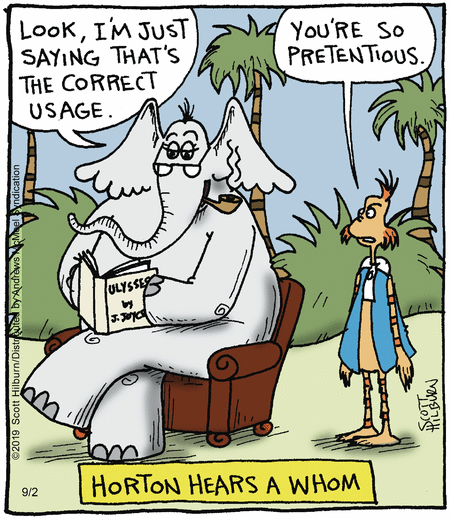
One of the most annoying varieties of would-be pedants is the one who gratuitously replaces “who” with “whom,” or “me” with “I,” thinking it makes them sound smarter.
They don’t think it makes them sound smarter. They do it because of what they experienced growing up. I did that when I was young, until a good friend helped me realize how much people didn’t like it. I was doing it because that’s what people (parents and teachers) did to me. In my mind I still hear them correcting, like a recurring bad dream, but I no longer say it out loud. Go easy on others, please. You don’t know what hell they might have gone through that makes them do what they do.
I can’t NOT use “whom” in the objective case. Physically can’t. The bumper stickers of dog paws that say “Who Saved Who?” is literally painful to me.
I don’t correct other people, and I recognize that there is no practical reason for “whom” in English, because all the information you get from the objective case switch is already in the position in the sentence, and, as a descriptivist, I have no philosophical grounds upon which to object to the use of “who” in the objective/accusative case, but I Just Can’t.
It’s odd that most people use “he” and “him” (and “she” and “her”) perfectly well without much thought, but “who” and “whom” causes some confusion and/or laziness (including for me, so I leave out the “m” more often than not) even though it amounts to the same sort of usage.
Maybe in the future the “m” in “him” will be considered pretentious and archaic too, and everything will be “he” as in “give he the bicycle – he doesn’t have a car anymore, so let that be a lesson to he” (which sounds a bit rural Somerset, which is where I live. I’ll get me coat).
Though maybe, as in dumping “thou” and “thy” and exclusively using “you”/”your” for both singular and plural, perhaps it will all be “they” anyway.
New York Times editor Theodore Bernstein is known for saying ‘I favor whom’s doom except after a preposition’, and I’m with him. So I say ‘Who did you give it to?’ and ‘The guy who I met’, but I can live with incorrect ‘whom’s. What really bothers me is people who were so traumatized by attacks on their ‘Me and him went to the store’ that they say ‘Give it to John and I.’ Brrrr!
What really grates on my ears is the Quaker use of “thee” in the nominative case, like “Will thee come with me?” I know that replacing “wilt thou” with “will thee” is a deliberate feature of Quaker “plain speech” that was decided at some time for some reason or other, but I do not understand how anyone who has actually read the Bible can stand to hear it. It just tells me that Quakers do not read the Bible.
But I do like the story of the Quaker gentleman who pointed his shotgun at a trespasser and said “Friend, I would not hurt thee for the world, but thee stand where I am about to shoot.”
I agree with Arthur, but this elephant doesn’t need the extra “m” to qualify as “pretentious”. Our local bookstore has two racks of books in English. I recently discovered a copy of “Ulysses”, opened it up, read about half of a page, and realized that there is no way that I would make it through hundreds of pages of that compact drivel. I don’t care if the book is supposed to be funny: I wouldn’t get any of the jokes without a syllabus.
@Mark: That’s a dialectic variation. When used in place of the nominative thou, thee uses the third-person singular form of verbs:
•”It isn’t any use, mother,” he said; ” thee knows my mind. I tell thee I can’t. I must go.”
— from “Bob Rocket, the Yorkshire Tramp”, James Smith, 1879
Apparently not only the Quakers, but Amish, Pennsylvania Dutch, and West Country English use this construction. AFAIK, tho’, the Quaker and West Country forms are falling out of use with the younger generation.
And English had a second-person plural with “ye.” For some weird reason, they got rid of it, and people have been replacing it with “youse” and “yiz” and “y’all” ever since, because it’s needed.
And if you thought Ulysses was too much, you should try Finnegans Wake.
My pretentious reading is usually stuff like Shakespeare, Dante, Virgil, or Homer, which have the advantage of actually being good.
In far southern Illinois, which is much closer to the Ozarks than to Chicago, the plural of you is “you-uns”, sometimes pronounced with two distinct syllables and sometimes squished together into “yins”. Those who are not native to the area rarely use it, and even some native speakers try to eliminate it from their vocabulary, considering it to be uncouth.
@ianosmond, I hear you. I can’t split an infinitive. For example, “It’s five year mission: to seek out new life and new civilizations, to go boldly where no one has gone before.”
@DanV
My grandmother in Northern Indiana also said “you-ins” and pronounced it with both syllables (like “yuwins”). She’s the only person I’ve ever heard say it.
Talk of pretentious. There is no legitimate reason to not split an infinitive. The rule exists only to artificially replicate Latin where infinitives are construed to only be single words so to actually split them is in practice an impossibility to linguistically achieve. It’s a rule with no logistics other than to illegitimately presume Latin to by fiat be the standard bearer of all languages.
So what is grammatically correct to say when the doorbell rings and you peek out and it’s the people you especially never want to see and so you say “Oh no! It’s THEM!”
a. Oh no! It’s they!
b. Oh no! It are them!
c. Oh no! They are they!
d. Oh no! They are them!
e. Oh no! Them it is!
ignatzz – I agree the problem is trying to find a plural version of “you”. I did not know that “ye” was a plural version. I thought that it was both singular and plural as “you” is (are?). I know that when John Dickinson who refused to sign the Declaration of Independence, there was comment made about it -“I say ye, John Dickinson!” when he said that he would leave the Congress of the colonies and would enlist and fight for Independence, such being a compliment to him and only him – no other person to make it plural.
There’s a book about that (of course there is); two men go on a road trip with red Sharpies in hand, correcting signs and recording what happened after they did. I read it years ago; can’t remember the name of it anymore.
It took me years to be able to bite my tongue when people get me/I wrong (I agree, people using “I” when it should be “me” because they overcorrect is extremely unpleasant.)
@Mark in Boston – The Bible is a religious text, not a language primer, I wouldn’t expect it to help much with using the informal second person. It’s my understanding that by the time that the Quakers started using “plain speech” the informal second person had fallen by the wayside, so it didn’t grate on them as much as it might have otherwise to simplify the usage.
@ Christine – As my kids started to become bilingual, they both went through a phase in which they would use a hypercorrect “I”, instead of the more common slang forms with “me”. One typical example: instead of saying “Me too!” when they wanted to be included in something, they would say “I too!“. This had nothing to do with their wanting to be “correct”, it was a simple case of translation effects, because the standard German form for that same situation uses the nominative case: “Ich auch!“
Kilby, your comment is funny, because as I was reading through the thread I was thinking “people manage to keep track of this sort of thing in German”. (Since I’ve already outed myself as a linguistic pedant in this thread, I’ll point out that I’d use “hypercorrect” for the sort of person who uses “whom” correctly, i.e. who is being correct to an extreme degree, rather than someone who overcorrects for a common mistake.)
@ Christine – If you don’t know the background, and you hear a little kid say something like “It is I!” (instead of the normal “It’s me!“), then it definitely sounds “correct to an extreme degree”, not to mention “extremely cute”. ;-)
The “it is I”/”it is me” argument has been going on for centuries. At its heart is the “Latin doesn’t do it so English shouldn’t” thing that has plagued our grammar. One source pointed out that not even all Latin-derived languages follow the rule, “c’est moi” for example.
 Comics I Don't Understand
Also the one who uses “one” and “them” . . .
LikeLike
But we’re OK with the ones who use “youse”, right?
LikeLike
They don’t think it makes them sound smarter. They do it because of what they experienced growing up. I did that when I was young, until a good friend helped me realize how much people didn’t like it. I was doing it because that’s what people (parents and teachers) did to me. In my mind I still hear them correcting, like a recurring bad dream, but I no longer say it out loud. Go easy on others, please. You don’t know what hell they might have gone through that makes them do what they do.
LikeLike
Don’t forget ‘youse guys’.
LikeLike
I can’t NOT use “whom” in the objective case. Physically can’t. The bumper stickers of dog paws that say “Who Saved Who?” is literally painful to me.
I don’t correct other people, and I recognize that there is no practical reason for “whom” in English, because all the information you get from the objective case switch is already in the position in the sentence, and, as a descriptivist, I have no philosophical grounds upon which to object to the use of “who” in the objective/accusative case, but I Just Can’t.
LikeLike
“The bumper stickers of dog paws that say “Who Saved Who?” is literally painful to me.”
I always have an urge to take a red Sharpie with me to correct those . . . how great not to be the ONLY person in the world who feels like that!
LikeLike
https://proberts633.wordpress.com/2011/03/29/who-rescued-who-or-who-rescused-whom/
LikeLike
It’s odd that most people use “he” and “him” (and “she” and “her”) perfectly well without much thought, but “who” and “whom” causes some confusion and/or laziness (including for me, so I leave out the “m” more often than not) even though it amounts to the same sort of usage.
Maybe in the future the “m” in “him” will be considered pretentious and archaic too, and everything will be “he” as in “give he the bicycle – he doesn’t have a car anymore, so let that be a lesson to he” (which sounds a bit rural Somerset, which is where I live. I’ll get me coat).
Though maybe, as in dumping “thou” and “thy” and exclusively using “you”/”your” for both singular and plural, perhaps it will all be “they” anyway.
LikeLike
“perhaps it will all be “they” anyway.”
Singular “they” is already correct when gendered pronouns are disfavored.
LikeLike
New York Times editor Theodore Bernstein is known for saying ‘I favor whom’s doom except after a preposition’, and I’m with him. So I say ‘Who did you give it to?’ and ‘The guy who I met’, but I can live with incorrect ‘whom’s. What really bothers me is people who were so traumatized by attacks on their ‘Me and him went to the store’ that they say ‘Give it to John and I.’ Brrrr!
LikeLike
What really grates on my ears is the Quaker use of “thee” in the nominative case, like “Will thee come with me?” I know that replacing “wilt thou” with “will thee” is a deliberate feature of Quaker “plain speech” that was decided at some time for some reason or other, but I do not understand how anyone who has actually read the Bible can stand to hear it. It just tells me that Quakers do not read the Bible.
But I do like the story of the Quaker gentleman who pointed his shotgun at a trespasser and said “Friend, I would not hurt thee for the world, but thee stand where I am about to shoot.”
LikeLike
This comic makes me wonder if the village in The Grinch should’ve been called WhomVille.
LikeLike
And, of course, Horton isn’t being pretentious (or not just pretentious), he’s wrong. The “a” makes all the difference.
LikeLike
BTW, I know a linguist who calls himself “Dr. Whom”, humorously rather than pretentiously.
LikeLike
I agree with Arthur, but this elephant doesn’t need the extra “m” to qualify as “pretentious”. Our local bookstore has two racks of books in English. I recently discovered a copy of “Ulysses”, opened it up, read about half of a page, and realized that there is no way that I would make it through hundreds of pages of that compact drivel. I don’t care if the book is supposed to be funny: I wouldn’t get any of the jokes without a syllabus.
LikeLike
P.S. Apologies to Shrug, who confessed to liking the book in the other “who(m)” thread.
LikeLike
@Mark: That’s a dialectic variation. When used in place of the nominative thou, thee uses the third-person singular form of verbs:
•”It isn’t any use, mother,” he said; ” thee knows my mind. I tell thee I can’t. I must go.”
— from “Bob Rocket, the Yorkshire Tramp”, James Smith, 1879
Apparently not only the Quakers, but Amish, Pennsylvania Dutch, and West Country English use this construction. AFAIK, tho’, the Quaker and West Country forms are falling out of use with the younger generation.
LikeLike
It’s not “youse.” Properly, it’s “yiz.”
And English had a second-person plural with “ye.” For some weird reason, they got rid of it, and people have been replacing it with “youse” and “yiz” and “y’all” ever since, because it’s needed.
And if you thought Ulysses was too much, you should try Finnegans Wake.
My pretentious reading is usually stuff like Shakespeare, Dante, Virgil, or Homer, which have the advantage of actually being good.
LikeLike
@ ignatzz – In certain parts of Pennsylvania, the 2nd-person plural pronoun is “yins” (sometimes spelled “yinz”).
LikeLike
In far southern Illinois, which is much closer to the Ozarks than to Chicago, the plural of you is “you-uns”, sometimes pronounced with two distinct syllables and sometimes squished together into “yins”. Those who are not native to the area rarely use it, and even some native speakers try to eliminate it from their vocabulary, considering it to be uncouth.
LikeLike
Well in Oklahoma, it’s not “y’all,” it’s “you all.” And plural is “all you all”.
LikeLike
@ianosmond, I hear you. I can’t split an infinitive. For example, “It’s five year mission: to seek out new life and new civilizations, to go boldly where no one has gone before.”
LikeLike
https://proberts633.wordpress.com/2011/03/29/who-rescued-who-or-who-rescused-whom/
I was amazed that the URL had the word “rescused” in it and then even more so that it was used once in the article itself. Urg.
LikeLike
Chak: Its. :-)
LikeLike
Chak: Its.
….MONTY PYTHON’S FLYING CIRCUS
LikeLike
Then it would be it’s . . .
LikeLike
@DanV
My grandmother in Northern Indiana also said “you-ins” and pronounced it with both syllables (like “yuwins”). She’s the only person I’ve ever heard say it.
LikeLike
“BTW, I know a linguist who calls himself “Dr. Whom”, humorously rather than pretentiously.”
Also legally safer.
LikeLike
” I can’t split an infinitive”.
Talk of pretentious. There is no legitimate reason to not split an infinitive. The rule exists only to artificially replicate Latin where infinitives are construed to only be single words so to actually split them is in practice an impossibility to linguistically achieve. It’s a rule with no logistics other than to illegitimately presume Latin to by fiat be the standard bearer of all languages.
LikeLike
I have a particular local translation of that book: “Youse-lysses”.
LikeLike
It’s not even true in Latin. The people pushing this rubbish were not as edumacated as they thought they were.
Arthur: you’re making me wonder if I know _you_ :-)
LikeLike
woozy: I am beginning to what you did there see…
(and suddenly we’re speaking German…)
LikeLike
Dave in Boston: Both Dr. Whom and I are filkers. Both currently in Philly.
LikeLike
To me “to boldly go” has a good rhythm to the phrase. Good for emphasis.
A lot of songs might have questionable grammar as well, but clinically-correct grammar doesn’t always work in poetry. :-)
LikeLike
@treesong, oops! So it is. Or should I say, so it’s.
LikeLike
@Woozy,
I know! That’s what makes it so annoying. I know it’s fine, I just can’t do it.
LikeLike
“Then it would be it’s . . .”
Unless “Monty Python’s Flying Circus” belongs to “it”.
LikeLike
So what is grammatically correct to say when the doorbell rings and you peek out and it’s the people you especially never want to see and so you say “Oh no! It’s THEM!”
a. Oh no! It’s they!
b. Oh no! It are them!
c. Oh no! They are they!
d. Oh no! They are them!
e. Oh no! Them it is!
LikeLike
f. It’s Melvin!
LikeLike
ignatzz – I agree the problem is trying to find a plural version of “you”. I did not know that “ye” was a plural version. I thought that it was both singular and plural as “you” is (are?). I know that when John Dickinson who refused to sign the Declaration of Independence, there was comment made about it -“I say ye, John Dickinson!” when he said that he would leave the Congress of the colonies and would enlist and fight for Independence, such being a compliment to him and only him – no other person to make it plural.
LikeLike
‘Unless “Monty Python’s Flying Circus” belongs to “it”.’
Probably belongs to BBC.
LikeLike
@ James Pollock,
Sorry, MPFC references go right over my head. I’ve never seen anything from it except the Galaxy Song.
LikeLike
“I always have an urge to take a red Sharpie with me to correct those . . . how great not to be the ONLY person in the world who feels like that!”
Add me to the list, Andréa.
LikeLike
“Sorry, MPFC references go right over my head”
I didn’t make an MPFC reference.
LikeLike
There’s a book about that (of course there is); two men go on a road trip with red Sharpies in hand, correcting signs and recording what happened after they did. I read it years ago; can’t remember the name of it anymore.
LikeLike
I Googled: The Great Typo Hunt: Two Friends Changing the World, One Correction at a Time, by Jeff Deck and Benjamin D. Herson (Crown, 2010).
LikeLike
Thanks for that (what terms did you use to find it?); I think I’ll reserve and read it again.
LikeLike
After “red sharpies” got me too much junk I used “road trip” and “correcting signs”.
LikeLike
The Great Typo Hunt
My library has that as an ebook, so it’s downloaded and I’ll peruse it later.
LikeLike
I didn’t read the book, but I’ve read some commentary on it. As I recall, they got fined for defacing a historical sign in some national park.
LikeLike
I’m well into The Great Typo Hunt. It’s just past the existential crisis in Santa Fe.
LikeLike
It took me years to be able to bite my tongue when people get me/I wrong (I agree, people using “I” when it should be “me” because they overcorrect is extremely unpleasant.)
@Mark in Boston – The Bible is a religious text, not a language primer, I wouldn’t expect it to help much with using the informal second person. It’s my understanding that by the time that the Quakers started using “plain speech” the informal second person had fallen by the wayside, so it didn’t grate on them as much as it might have otherwise to simplify the usage.
LikeLike
@ Christine – As my kids started to become bilingual, they both went through a phase in which they would use a hypercorrect “I”, instead of the more common slang forms with “me”. One typical example: instead of saying “Me too!” when they wanted to be included in something, they would say “I too!“. This had nothing to do with their wanting to be “correct”, it was a simple case of translation effects, because the standard German form for that same situation uses the nominative case: “Ich auch!“
LikeLike
Kilby, your comment is funny, because as I was reading through the thread I was thinking “people manage to keep track of this sort of thing in German”. (Since I’ve already outed myself as a linguistic pedant in this thread, I’ll point out that I’d use “hypercorrect” for the sort of person who uses “whom” correctly, i.e. who is being correct to an extreme degree, rather than someone who overcorrects for a common mistake.)
LikeLike
@ Christine – If you don’t know the background, and you hear a little kid say something like “It is I!” (instead of the normal “It’s me!“), then it definitely sounds “correct to an extreme degree”, not to mention “extremely cute”. ;-)
LikeLike
The “it is I”/”it is me” argument has been going on for centuries. At its heart is the “Latin doesn’t do it so English shouldn’t” thing that has plagued our grammar. One source pointed out that not even all Latin-derived languages follow the rule, “c’est moi” for example.
LikeLike