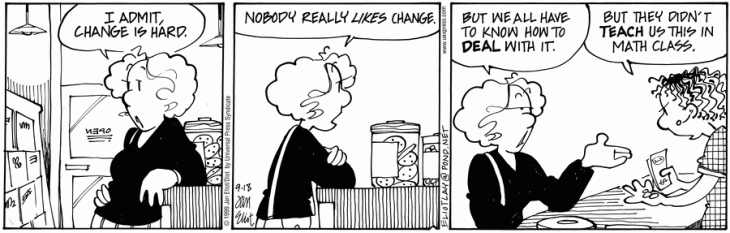
So… the joke somehow relates to the fact that “change” has two meanings?
Related
73 Comments
Yes, Bill, that’s really all there is in this strip.
yes
Three (well,two and a half) meanings perhaps. (1) Mutability in general. (2) Making change in retail transaction — returning the correct amount of money to a customer. (3) Coins.
“Forget it, Jake. It’s a Saturday comic.”
Since the POS revolution and that the register tells them how much change to give, nobody seems to know how to count change like they did in the olden days.
“plus ça change, plus c’est la même chose” – the more change there is, the more there is the same amount of change, even with some falling down the back of the sofa. That’s some kind of static inflation, I guess.
It’s a legitimate joke. We think she’s talking about personal change and turns out she’s talking to an incompetent sales clerk who can’t make change.
I personally don’t like the dialog balloon in which the sales person says “They didn’t teach this in math”. Of course, they (were supposed to have) taught that in math. I assumed at first this was supposed to be about learning personal change in math but… it’s determined that the are talking about regular change. I suppose it is supposed to emphasize that the clerk can’t make change but it just makes him/her seem whiny and stupid and detracts. (And seems a little snottish…)
For what it’s worth, I teach high school maths, and I’m nowhere as good at arithmetic as my friends who’ve worked retail.
I’m reminded of my colleague who recollected how his grandmother thought studying maths at uni just meant he had to use bigger numbers.
POS revolution?
“Point of sale”
Oh, yeah, well that makes a little more sense than what first popped into my mind, heh.
Change is good; more change is better.
You can save that one for a future geezer tag.
I guess this is a rerun from when not every cash register figured out change by itself.
And what on earth is this woman doing in this sort of job if she can’t do it?
There’s probably a larger percentage of people who can’t make change on their own than ever before.
DO they even teach it in schools anymore? Or this being phased out along with cursive and reading analog clicks?
My training when I went to work at Sears as a retail clerk (1968) was about 20% customer service and 80% math — writing down and then adding up the cost of the items (the cash registers didn’t add), looking up the sales tax, making change.
That was also the most common way to wash out of training and get fired before you started.
Now, of course, there’s no math required. But I think I would go crazy if I had to explain to people all day how to use the specific chip machine the store has. It’s maddening that the different manufacturers couldn’t agree on a standard, so each @#$% machine is different
I used to work in a pool hall that charged players by the time ($0.25 for the first 15 minutes, a penny a minute after that, to give you some idea how long ago that was.) I’d punch them in on a time clock when they started, and punch them out when they finished, then mentally calculate the time played. Making change was the easy part.
FWIW, common core math includes methods that model proper change-making.
I don’t think I’ve ever met a clerk who couldn’t make change. I don’t think it’s as common as cartoonists would have you believe.
One thing worth teaching is the technique of issuing change while counting UP from the amount charged to the amount tendered.
My own personal synchronicity:
Yesterday I made a purchase that came to $87.26 and gave over a $100 bill I happened to have. The clerk was concerned over the amount of change in the cash register (which had computed the $12.74 change) and said “well, I think I’ll have to give you a lot of ones, if you don’t mind”. I had a fair number of ones and so I produced and additional $7.26. It took the cashier at least five minutes and a calculator to decide that, yes, that would mean giving me a $20 bill as change.
[But I have heard that there is a scam in which a fast talking customer asks for change and then rapidly changes the request with the objective of walking away with more money than they ever handed over. So maybe acting obtuse and slow is a defense cashiers are taught (or learn on their own).]
More likely than saying “they didn’t teach us this in math class” would be someone saying “I was never any good at math!” Wear a math themed T-shirt or tell people you minored in mathematics and they’ll quickly and cheerfully volunteer that information, but nobody gleefully boasts of being almost illiterate. It’s weird.
[ Meta-remark: It’s always a sad thing when some fondly-remembered piece of writing, or perhaps music or film/tv, turns out on revisiting to be filled with what seem to a contemporary observer to be rather unfortunate outlooks or attitudes. This may be a separate dimension from whether it still seems as funny / dramatic / moving as before. And it may be better if it fails on both dimensions, as then you have just the sadness of giving up a disappointing memento, rather than a conflict over principle ]
A classic treatment of the difficulties of making change is Thurber’s “The Figgerin of Aunt Wilma”. As with MJSR’s anecdote, it includes the attempt to add an extra amount to one side of the transaction to make the return result rounder. And unlike most of the noted comic takes, the confused party here is the customer, and the arithmetically sound party is the storekeeper or cashier. It’s a bit hard to swallow the pervasive misogynist assumptions and remarks, but that’s almost inseparable from the still-hilarious humor.
I don’t know anything more about the site where I found this reprinted. It was just the first search result that yielded the full text easily accessible.
Powers: whereas my experience is that when I come across a cashier who can make change, it’s notable (and notably rare). I wonder, your use of the word “clerk” where I use “cashier” makes me wonder if it’s a regional difference: city vs. country, country vs. country, east vs west, what have you. Here in the US midlantic east coast, most cashiers are minimum wage, minimum trained, often teenagers, and can’t make change at all — if the register doesn’t tell them what to give back, they have no clue, so don’t even try to reduce your coinage by the timely inclusion of an extra coin — they won’t know what to do with it, look at you funny, get totally confused. Sometimes, though, they are so well robot trained, they will just punch in the amount you give them, and the register will spit back the (round amount) change they need to give back, and they never even notice that you give “too much” money to them.
Sort of related, I enjoy using unused denominations (dollar coins, 2 dollar bills), and often have to fight to get them accepted; the best though was when one cashier took my dollar coin, looking very confused, but didn’t argue, and somehow (maybe I asked?) explained she thought it was a foreign coin, but chose to accept it anyway (??!)
Point being, where I’m from, stores want to pay the least possible amount for their help, and it shows.
(And let me squeeze in one last anecdote: the cashiers at Aldi back in the day in Germany were so well trained and fast that it was a pain in the ass to try and minimize your change there short of bringing a calculator and keeping a running total as you shopped, because they would punch up your order so fast and then anticipate the most likely payment form and have that change ready and give it to you, before you even had a chance to figure out what the total they just told you was, let alone poke around your wallet to see if you could collect the exact amount — no, they’d just give you the change for the nearest higher bill, and you sort of just had to go along, unless you wanted to cause an obstruction, which of course, being a good German, you don’t want to do… So unless you already had exact change because you’d summed up your order beforehand, you just had to passively accept the change and pay with the bill they anticipated you’d pay with, instead of getting rid of your change — which was a big deal, because change in Germany was real money, and it got heavy fast, so you’d rather scrape together 9 marks out of coins rather than pay with a 10 bill and get yet more coins back… And if you were one of those smarty pants who wanted to give them extra coins so that you could have less, that was a battle of wills, because while giving them exact change in challenge of their pre-anticipated change was easily dealt with by just putting all the money into the drawer, forcing them to recalculate change, and pull out different change from the drawer from what they had already pulled out would be inefficient for them, and they really didn’t want to do that, so they would glare at you, and you would have to glare back, and it would be quite a show-down to see who would back off — which also meant you had to be damn sure of your calculations, which I never am, so I rarely had the fortitude to enter, let alone win, one of those confrontations (though every now and then for a simple purchase with rock solid math, I would venture it….))
I think there are two jokes here. The obvious one being the double definition of “change”, and the second one being that while the clerk is bemoaning the education she received having been not complete, in actuality that is the opposite of what happened. They did teach this in math class but she (he?) probably didn’t think math would be useful and didn’t pay attention and now thinks it was never taught.
About 15 years ago, when I was a math grad student, my professor and I went to the snack bar, where the power was out. No problem, it’s daylight, right? Except that the electronic register didn’t work. So this innumerate cashier spent ten minutes trying to figure out the total and tax. The prof kept telling her the answer, but she wouldn’t listen, saying something about how difficult it was to figure all that, and it’s not like he should just guess at it.
My favorite impossible-to-figure-out-proper-change scenario is the March 25, 1941 radio episode of VIC AND SADE:
I had the same experience: it was a farm store (so sales tax wasn’t even an issue), and the young lady at the register was only accepting exact change. Our purchase was something like $3.76 and I wanted to pay with a $5 bill, an I tried talking her through the procedure, but she was giving me a deer-in-the-headlights look.
In hindsight I realized I should have suggested she use her phone’s calculator for the rest of the day.
In Claughton, it was simpler than this: power’s out? Store’s closed. We were told to drive out of the powerless zone to find an open store.
LarK’s anecdote about inflexible German cashiers is (or was) right on target, but there have been major changes in the last five or ten years. Some cashiers still prefer to do the “simple” subtraction, but many supermarkets and store chains have discovered that they can save money by reducing the amount of “dead” cash in the registers. Cashiers now have a major incentive to lower the amount of change they have to disburse (otherwise they will run out), so that it has become much more common that the cashier will actually ask for an appropriate amount of small change to reduce the amount of outgoing coins.
I was once in a supermarket in Oregon that had not lost power, but their central computer had crashed, so that none of the registers worked. Rather than close, they gave each incoming customer a black crayon, to mark the price on each item taken from the shelves. The cashiers had oversized calculators to rack up the totals. Luckily, Oregon has no sales tax at all, so there wasn’t any hassle about taxable or non-taxable items.
I never use cash; saves everyone lots of trouble . . . and I get cash back every few months.
And I never use credit cards, so we are matter/antimatter and, if we ever meet in person, will cause a major explosion.
(Still worth it to me, though. What’s one little explosion compared to bowing the knee to the credit card overlords?)
I use a credit card, pay off every month, and receive over $1000/year. Yes, I know I’m paying more BUT I’d be paying that same amount whether I use cash, debit or credit. I have YET to see a place that offers a 6% lower price if you pay cash.
I only wish I could put the entire new roof on my card . . .
Some gas stations I used to use gave one a 5% discount for using cash, but they don’t seem to be around any more.
But I don’t really care — matter of principle to me trumps matter of cash. Back in my student days or early working days when I had to watch pence, I might have struggled more, but credit cards weren’t really a consistent blight on my landscape back then.
@Shrug, so you were in Indiana and worried about what you governor might do?
I’ve given up putting a few coins in my pocket when I go out, which used to be part of my routine, as I have so few cash transactions anymore. Once in a while I will use cash expressly to get a few singles in my wallet — it’s awkward to tell a street corner supplicant or street-newspaper vendor Okay then only find larger bills. (Was there a moment in some recent comic — perhaps Barney and Clyde? — where someone asked a panhandler if he could make change?)
Responding to both Mitch and Shrug: here in New Jersey, discounts for buying gasoline with cash are still common, and my wife and I often go weeks at a time without paying cash for anything BUT gas.
@Shrug, both in your 1941 radio clip, and the 1950 Thurber story, they were tracking amounts in cents to be concerned over. I can’t separate to what extent that is because of what economic stratum these characters are drawn from, and to what extent overall inflation.
Towards the bottom of the page there are links to tables with more detailed examples of items by decade. With just a quick perusal of 1940 food, it looks like one could get a dozen eggs, 5 lbs of flour, a pound of bacon, a pound of chicken, a loaf of bread, a pound of margarine, and a box of corn flakes for a little over $3.00
I guess I should add, that while that all sounds incredibly cheap, the average annual salary/wage was $1,725.00 so that $3.00 was half a days labor.
If we heard it once, we heard it a hundred times, from Hubby’s Mother: ‘Bread used to cost 25 cents in my day.’ NEVER admitting that people were making a couple bucks an hour, if that. Some people only remember what they want to remember, and conveniently ‘forget’ the rest.
“I have YET to see a place that offers a 6% lower price if you pay cash.”
There are ice cream machines in a couple of malls I go to. They accept cash or credit card. The credit price is $4.50 and the cash price is $4.00. That’s almost an eleven percent discount for cash.
I’ve seen a number of vending machines that list a price for a selection and then fine print advises that these are the cash prices, and that using a credit card adds an 11% “convenience charge.”
Most people, I’m sure, don’t even realize their card is being charged 11% more than they thought.
And side-note: I don’t think I’ve ever seen a “convenience charge” that had anything to do with convenience: it’s just a surcharge that shows up at the end of a transaction. When, I guess, it’s inconvenient to just cancel the whole thing.
Arthur, it’s not 6%, but restaurants in my neck of the woods are beginning to add a 4% surcharge for credit card payments.
I do my bit by not eating there.
Est. Price …… $1.82
Tax ….. $0.18
[large font]. Total ….. $ 2.00
Signage at movie theatre box offices, circa 1965.
You can still sometimes see the breakdown , with “EST. Price” on some kinds of tickets and the like.
At one time I figured it meant “estimated” . But that can’t be — it’s definite and fixed, not an estimate. So “establishment price” maybe?
( no I don’t know why the iPad signed me in differently)
It used to be against credit card company rules for a vendor to charge extra to a card-using patron, though it was fine to give a discount for cash. Either they’ve changed the rules, or those restaurants are flirting with danger.
Discounts or surcharges are not common here. I try to use credit cards as much as possible, for convenience and for the rewards mentioned. My Bank of America card gets 3% back on a category you choose (used to be only gas), 2% on grocery, and 1% other.
With my Merrill Edge investments (which I got bonuses for transferring in), I qualify for Platinum Rewards, so all of the credit cards get a 75% increase in rewards. I get 5.25%/3.5%/1.75%.
I found out that I could get another BofA credit card, collect another $200 sign-up bonus, and assign a different 3% category to it. So one gets 5.25% (with the boost) on gas and the other at drug stores.
My US Bank card (another sign-up bonus) gets 5% on two categories, so I have it for online and cable/internet/streaming.
All I have to do is keep track of which card to use ;)
Hmm, Bill, when I see a restaurant or cafe that doesn’t accept cash, I do *my* part by not eating there. So I guess… we cancel out? (As an aside, it’s amazing how people perceive a cash discount vs. a credit card surcharge. Same effect, massively different psychology.)
That’s nice, but how much ice cream can one eat? It’d be more effective if the discount was on necessities, like groceries and gasoline.
This used to be illegal, but that restriction was lifted a few years ago.
Isn’t it illegal to not accept cash? It says right on the money that it’s legal tender for all debts, public and private.
Is this just a way to discourage poor and/or brown people?
It’s not illegal to refuse cash for a purchase. My understanding of “legal tender for all debts” is that you have to accept cash for an *existing* debt but you are free to refuse a new purchase. A few cities and states, though, are beginning to pass laws requiring businesses accept cash.
CaroZ, I don’t see us as working in opposite directions: we both want customers to pay the way it’s convenient for us, and not be pressured to use one method or the other to suit the merchant.
. . . and to get away from people who don’t pull out their checkbooks until ALL the items have been added up, then look for (or borrow) a pen, then look for (and can’t find) the check-cashing card, etc., etc. I’ve begun to choose self-checkout to avoid this. So then we have the person whose credit card limit is reached; she tries another; that one is no good. So everything has to be voided and begun over, ’cause once you put in CREDIT, you can’t pay any other way. In the famous word of Cathy – ACK!!! Or, ARGHGHGHGHGHGHGHGH!
Hubby does most of the shopping now – he has infinite patience (which comes from living with me for over 30 years, I s’pose). I only have patience if my service dog is with me, and that isn’t the case all the time.
Chak: In general [*], if you’re contracting for goods and services, you can state what you’ll accept for your goods and services however you want. So you can say that you’ll only accept chickens, or interpretive dances, in payment. OTOH, as CaroZ says, there’s a difference if you’re paying and existing debt, and there weren’t specific requirements on how the debt had to be paid back when you incurred it.
[*] Many exceptions apply.
Andréa: I have YET to see a place that offers a 6% lower price if you pay cash.
Doesn’t any place that charges you fee for using a credit card therby offer you a lower price if you pay cash?
In all my years of using credit cards (I think my first ones were chiseled in stone), I’ve only ever seen ONE place that charged more for using a credit card. AND that was before that restriction was lifted.
AND the amount was $2.50, no matter what the total [dry cleaning] bill was.
What’s the discount for paying via interpretive dance?
Most of the places that I have heard of that didn’t take have been fast-casual restaurants with high customer volume. They claim that there is significant time saved with cards only.
re: paying more for using a credit-card/less for paying with cash
In my experience, the first to go with an expressed difference in pricing were gas stations. They weren’t allowed to charge more for accepting a credit card (because of the merchant agreement) even though the cost of accepting credit was significant. But they figured a cash discount was OK under the merchant agreement.
Many stores resolved the problem (a cost of 2-5% on credit-card sales) by not taking credit card payment at all. The banks fought this by creating the debit-card system, with a lower cost charged to merchants (because the customer had funds available to pay, so no risk of the end of the month coming and the customer saying “no check for you this month, maybe next month?”) They got debit-card terminals installed in a lot of places that had declined to take credit, and then piggybacked credit-card services on top of the debit-card services. So grocery stores and fast-food restaurants, which previously declined all credit card sales, now generally accept them.
Credit card reward programs (whether they give you money on account, or airline miles, or whatever) are funded by the fact that the merchant pays the credit-card company a percentage of all sales made by credit card. People who pay cash are effectively paying more for products and services to fund these programs. On the other hand, their end-of-the-month financing fee is 0 x prime rate + 0%. Yes, you can get the same rate from your credit card company… IF you can pay the entire balance every month. Americans are notoriously poor at achieving this goal, as a whole.
And they save even more time by not having to serve me, since I’m not about to eat in such a place.
There was a “food hall” in St. Paul that opened three or four months ago with that “no dirty old-fashioned actual cash accepted” policy. It closed a few weeks ago.
I remembered reading somewhere that there was a law against refusing cash. Turns out I was remembering an article about a law introduced in 2018 banning cashless restaurants in DC. And I don’t even know if the law passed.
But I did just learn that 5% of Americans are unbanked, and 18% are underbanked, meaning they don’t have debit cards or credit cards.
Andréa – we do the same with our credit cards. I don’t know about a roof, but we did put our fence on a card. Also had a general credit card whose “points” were towards the purchase of a vehicle from a major car mfgr whose vehicles we normally bought. Thinking quickly as we bought a car, I asked if we could charge the downpayment – so those points went towards the car also.
Powers – yes, there are that many people who cannot make change. We eat lunch almost every day at a local Wendys (makes husband feel like he is going to office every day – I don’t get it, but it makes him happy). We buy the same meal every day. Until a recent price increase, it came to $3.23 for the two of us. Every day he would make sure he exact change or $3.25 to pay them with. (I drew the line at charging this daily.) I asked why – it seems that the employees have trouble making change and he has to tell them what to give him. This is despite the fact that their register will calculate the change. Problem is that every employee enters the amount of the sale as the amount given to them so it does not show the change. I did not believe him until his shoulder last October and I had to buy our lunches (while he did my job of getting a table) and they had the same problem and always entered the amount of the sale as the amount received.
I will post another story about making change later in my posts.
Brian in STL – it drives Robert crazy keeping track of which card to use for which purpose to maximize points. He had me make tapes (from Brother tape machine) to put in his wallet with which to use for what – and when I go for the 5% for a quarter I have to tell him and make him a tape. (We have three basic cards we use. We have one credit card with a very low maximum allowed line – at our request – which is only used on for online/mail/phone purchases. Then we have 3 cards we use once a year for as cheap a purchase as we can find (say $1.50) to keep them active.)
Andréa – My first job that was not working for my dad started in my second year in college at a supermarket. House brand of bread came in 2 sizes – 4/$1 and 3/$1, so yes, bread was 25c a loaf for the small loaf. I remember no other prices other than those two.
We could not ring up an item for more than $9.99 – what could possibly cost more? The occasional large holiday turkey or such had to be rung up for $9.99 and the the difference between the price and same calculated and the item rung up again for same.
No scanners – they had just invented the “coupon” key. Customers were not used to same and would argue with us. “I gave you a coupon for 10 cents off that item and you did not subtract it.” (Think about the math of subtracting the coupons before ringing up an item). “Yes, ma’am. I have to ring the item at full price and then at the end I will ring up the coupons with the coupon key and it will subtract the amount of the coupons.” (and I had to manually enter the amount of each coupon of course).
No credit cards in supermarkets. Checks though were probably more commonly used than I imagine they are now.
Arthur – I don’t think it was against the credit card rules. In NYS it was illegal to do so.
In the 1970s gas crisis this was a big deal as the rule was that a gas station could offer a cash discount price, but not charge a premium for using ones. When the more recent high prices they seem to have forgotten this law and gas stations started with cash only – followed by cash/debit card only pricing. We always make sure that the station we go to does not charge extra for using a credit card.
Andréa – you are lucky – Robert won’t go shopping without me. He needs a package of 5 screws at Home Depot – I have to go along with him. Ask him to buy something on a day I have to work – I get hemming and hawing and “do I have to?”.
James Pollack – in all the decades that husband and I have had credit cards – separately before we were married and joint also since we married, we have only not paid our credit card in full – ONCE.
We used to get his unused sick pay in September if he did not use it. So at the beginning we filled the allowable bank with the days he did not use, but then each year we asked for the days after the end of the year (they were on a school year basis in general). Since we went on vacation in August we used that money to pay the vacation bills and then left the rest of what was received in our savings account. One year there was some problem and the sick pay was not coming until October – but we had to pay the credit card bill. it was an odd time when our savings account rate and the credit card rate were not that far apart, so we decided to pay half the bill and pay the other half plus any new charges the following month in full – and did so.
Chak – this is coming up in several states- at least in the NE US. Stores are refusing to take cash. There are people who do not have bank accounts or credit cards and have a problem with same and the states are passing laws that cash has to be accepted.
On another list I am on, with people not as intelligent as those on this list, I was told when this subject came up, that EVERYONE uses credit cards – “even panhandlers take credit cards these days” !
We use credit cards as much as we can. We carry cash – and will carry more cash when we go out of state. However, if we use the credit cards – we don’t have to pay until next month, we don’t have to worry if we have enough cash with us, we don’t have to worry about losing a large sum of cash or having it stolen, I know where the money went (Robert, what did we buy that would be listed as REtqb sv23? – made up the designation), plus we get the points back against the account balance. I normally call as soon as I get a statement with our points higher than minimum to redeem – once I was juggling to cover the credit card bill (we have months like that these days and I don’t want to take out IRA money if I don’t have to) and I called for what I thought was $25 credit from the points. Turned out I had forgotten to call for same and it was $250 – paid so much of the statement that I had overpay it to pay the minimum amount in addition.
Meryl,
I find that if I pay cash everywhere, I spend less. Impulse buying is to a minimum because I just don’t have the cash on me. I do have a credit card in case there’s something I really do need, tho.
I have noticed that people pay closer attention to cash, and how much they’re spending. For instance, sometimes when I helped a student do research in the library, they had to feed dimes into the copier. They got very stingy with the dimes, but when I asked how much they’d pay to have someone just find and copy all the articles for them, they’d tell me amounts that would have covered hundreds of copies. There’s just something about forking over money that makes us cautious.
The only things I pay by card are online purchases and gas.
Chak: What I meant was that the fact that cash is “legal tender” doesn’t impose a general requirement that every business accept it. But specific municipalities can and have made such requirements.
I’m sure some people do spend more with credit. I don’t. I have a wicked frugal streak. “Impulse buying” doesn’t happen for me. All purchases, no matter how small, are carefully considered. The form of payment does not enter into the consideration. Price is usually, but not always, involved.
They got very stingy with the dimes, but when I asked how much they’d pay to have someone just find and copy all the articles for them, they’d tell me amounts that would have covered hundreds of copies.
Your analysis is faulty because you are equating the cost of copying with the cost of having someone else locate and copy the articles. You are not factoring in the time for the extra activities. Would people have spent more on copying if the copier took credit/debit? How would you know?
Winter Wallaby, yes I understood what you meant, thanks.
Chak – I understand what you mean. One reason road tolls in the northeast US have been rising at the rate they are is that people pay them with EZPass (transponder on the windshield to an account) and not in cash so every two months one is billed for the tolls – I used to know the toll from every place in PA and NJ that we would go – now I am shocked to find out how much they are when I look at the statement – and PA managed to split off the turnpike toll – at the same rate from/to the eastern end as before, while adding a new toll for the Delaware River Bridge in addition (before covered in turnpike toll).
I also understand that children in particular need to see and use cash to understand the concept of money and that it has a value in that it can it be exchanged for something to understand the value of same. (Niece when she was maybe 4 or 5 to my mom – “Grandma I want that.” “I don’t have enough money.” “We can stop at your bank and get more.” And she is the niece who actually as an adult understands the concept of money.)
We plan our purchases (well, except for the $4000-$5000 in car/RV repairs we have gone through in the past month and a half and other emergencies) in advance, even small ones. It is extremely hard to get me to buy something that I have not though over and over – even for $2, whether it is cash or credit. If something catches my eye – and it will be generally under $5, Robert will keep walking me past the item until he can talk me to into spending the money to buy it. There are places we pay in cash and make sure we bring extra, such as at farmer’s markets when go in PA (one gift vendor that I have bought bear figurines from, if I am buying a few of them – she has ones from a collection I have – I will always offer cash if she can do better on the price and she does.)
But for everyday and large purchases, it is credit card. I don’t have to worry about enough cash. I don’t have to worry that I lose the cash or it stolen. I also am the sort of crazy person who likes to know where the money went – credit cards help a lot with that. (Several years ago I came across a columnar book that I used to keep track of cash spent while in college. It was really interesting to relive the year by going through it and I realized it was from the year we started dating – first Broadway show we saw together was in the book (I was the sort of girl who rather pay my own way than not do something we wanted to do as it was too expensive for him to pay – such as the $3 for the Broadway show ticket – for both of us). But, every week there is an adjustment for “?”. That is gone with credit cards. Now it is just a question of what the abbreviations on the receipt mean – especially when Robert bought the item.
 Comics I Don't Understand
Yes, Bill, that’s really all there is in this strip.
yes
Three (well,two and a half) meanings perhaps. (1) Mutability in general. (2) Making change in retail transaction — returning the correct amount of money to a customer. (3) Coins.
“Forget it, Jake. It’s a Saturday comic.”
Since the POS revolution and that the register tells them how much change to give, nobody seems to know how to count change like they did in the olden days.
“plus ça change, plus c’est la même chose” – the more change there is, the more there is the same amount of change, even with some falling down the back of the sofa. That’s some kind of static inflation, I guess.
It’s a legitimate joke. We think she’s talking about personal change and turns out she’s talking to an incompetent sales clerk who can’t make change.
I personally don’t like the dialog balloon in which the sales person says “They didn’t teach this in math”. Of course, they (were supposed to have) taught that in math. I assumed at first this was supposed to be about learning personal change in math but… it’s determined that the are talking about regular change. I suppose it is supposed to emphasize that the clerk can’t make change but it just makes him/her seem whiny and stupid and detracts. (And seems a little snottish…)
For what it’s worth, I teach high school maths, and I’m nowhere as good at arithmetic as my friends who’ve worked retail.
I’m reminded of my colleague who recollected how his grandmother thought studying maths at uni just meant he had to use bigger numbers.
POS revolution?
“Point of sale”
Oh, yeah, well that makes a little more sense than what first popped into my mind, heh.
Change is good; more change is better.
You can save that one for a future geezer tag.
I guess this is a rerun from when not every cash register figured out change by itself.
And what on earth is this woman doing in this sort of job if she can’t do it?
There’s probably a larger percentage of people who can’t make change on their own than ever before.
DO they even teach it in schools anymore? Or this being phased out along with cursive and reading analog clicks?
My training when I went to work at Sears as a retail clerk (1968) was about 20% customer service and 80% math — writing down and then adding up the cost of the items (the cash registers didn’t add), looking up the sales tax, making change.
That was also the most common way to wash out of training and get fired before you started.
Now, of course, there’s no math required. But I think I would go crazy if I had to explain to people all day how to use the specific chip machine the store has. It’s maddening that the different manufacturers couldn’t agree on a standard, so each @#$% machine is different
I used to work in a pool hall that charged players by the time ($0.25 for the first 15 minutes, a penny a minute after that, to give you some idea how long ago that was.) I’d punch them in on a time clock when they started, and punch them out when they finished, then mentally calculate the time played. Making change was the easy part.
FWIW, common core math includes methods that model proper change-making.
I don’t think I’ve ever met a clerk who couldn’t make change. I don’t think it’s as common as cartoonists would have you believe.
One thing worth teaching is the technique of issuing change while counting UP from the amount charged to the amount tendered.
My own personal synchronicity:
Yesterday I made a purchase that came to $87.26 and gave over a $100 bill I happened to have. The clerk was concerned over the amount of change in the cash register (which had computed the $12.74 change) and said “well, I think I’ll have to give you a lot of ones, if you don’t mind”. I had a fair number of ones and so I produced and additional $7.26. It took the cashier at least five minutes and a calculator to decide that, yes, that would mean giving me a $20 bill as change.
[But I have heard that there is a scam in which a fast talking customer asks for change and then rapidly changes the request with the objective of walking away with more money than they ever handed over. So maybe acting obtuse and slow is a defense cashiers are taught (or learn on their own).]
More likely than saying “they didn’t teach us this in math class” would be someone saying “I was never any good at math!” Wear a math themed T-shirt or tell people you minored in mathematics and they’ll quickly and cheerfully volunteer that information, but nobody gleefully boasts of being almost illiterate. It’s weird.
[ Meta-remark: It’s always a sad thing when some fondly-remembered piece of writing, or perhaps music or film/tv, turns out on revisiting to be filled with what seem to a contemporary observer to be rather unfortunate outlooks or attitudes. This may be a separate dimension from whether it still seems as funny / dramatic / moving as before. And it may be better if it fails on both dimensions, as then you have just the sadness of giving up a disappointing memento, rather than a conflict over principle ]
A classic treatment of the difficulties of making change is Thurber’s “The Figgerin of Aunt Wilma”. As with MJSR’s anecdote, it includes the attempt to add an extra amount to one side of the transaction to make the return result rounder. And unlike most of the noted comic takes, the confused party here is the customer, and the arithmetically sound party is the storekeeper or cashier. It’s a bit hard to swallow the pervasive misogynist assumptions and remarks, but that’s almost inseparable from the still-hilarious humor.
I don’t know anything more about the site where I found this reprinted. It was just the first search result that yielded the full text easily accessible.
http://downwithtyranny.blogspot.com/2011/02/thurber-tonight-figgerin-of-aunt-wilma.html
Powers: whereas my experience is that when I come across a cashier who can make change, it’s notable (and notably rare). I wonder, your use of the word “clerk” where I use “cashier” makes me wonder if it’s a regional difference: city vs. country, country vs. country, east vs west, what have you. Here in the US midlantic east coast, most cashiers are minimum wage, minimum trained, often teenagers, and can’t make change at all — if the register doesn’t tell them what to give back, they have no clue, so don’t even try to reduce your coinage by the timely inclusion of an extra coin — they won’t know what to do with it, look at you funny, get totally confused. Sometimes, though, they are so well robot trained, they will just punch in the amount you give them, and the register will spit back the (round amount) change they need to give back, and they never even notice that you give “too much” money to them.
Sort of related, I enjoy using unused denominations (dollar coins, 2 dollar bills), and often have to fight to get them accepted; the best though was when one cashier took my dollar coin, looking very confused, but didn’t argue, and somehow (maybe I asked?) explained she thought it was a foreign coin, but chose to accept it anyway (??!)
Point being, where I’m from, stores want to pay the least possible amount for their help, and it shows.
(And let me squeeze in one last anecdote: the cashiers at Aldi back in the day in Germany were so well trained and fast that it was a pain in the ass to try and minimize your change there short of bringing a calculator and keeping a running total as you shopped, because they would punch up your order so fast and then anticipate the most likely payment form and have that change ready and give it to you, before you even had a chance to figure out what the total they just told you was, let alone poke around your wallet to see if you could collect the exact amount — no, they’d just give you the change for the nearest higher bill, and you sort of just had to go along, unless you wanted to cause an obstruction, which of course, being a good German, you don’t want to do… So unless you already had exact change because you’d summed up your order beforehand, you just had to passively accept the change and pay with the bill they anticipated you’d pay with, instead of getting rid of your change — which was a big deal, because change in Germany was real money, and it got heavy fast, so you’d rather scrape together 9 marks out of coins rather than pay with a 10 bill and get yet more coins back… And if you were one of those smarty pants who wanted to give them extra coins so that you could have less, that was a battle of wills, because while giving them exact change in challenge of their pre-anticipated change was easily dealt with by just putting all the money into the drawer, forcing them to recalculate change, and pull out different change from the drawer from what they had already pulled out would be inefficient for them, and they really didn’t want to do that, so they would glare at you, and you would have to glare back, and it would be quite a show-down to see who would back off — which also meant you had to be damn sure of your calculations, which I never am, so I rarely had the fortitude to enter, let alone win, one of those confrontations (though every now and then for a simple purchase with rock solid math, I would venture it….))
I think there are two jokes here. The obvious one being the double definition of “change”, and the second one being that while the clerk is bemoaning the education she received having been not complete, in actuality that is the opposite of what happened. They did teach this in math class but she (he?) probably didn’t think math would be useful and didn’t pay attention and now thinks it was never taught.
About 15 years ago, when I was a math grad student, my professor and I went to the snack bar, where the power was out. No problem, it’s daylight, right? Except that the electronic register didn’t work. So this innumerate cashier spent ten minutes trying to figure out the total and tax. The prof kept telling her the answer, but she wouldn’t listen, saying something about how difficult it was to figure all that, and it’s not like he should just guess at it.
My favorite impossible-to-figure-out-proper-change scenario is the March 25, 1941 radio episode of VIC AND SADE:
https://www.oldtimeradiodownloads.com/comedy/vic-and-sade/muddled-shopping-money-1941-03-25
I had the same experience: it was a farm store (so sales tax wasn’t even an issue), and the young lady at the register was only accepting exact change. Our purchase was something like $3.76 and I wanted to pay with a $5 bill, an I tried talking her through the procedure, but she was giving me a deer-in-the-headlights look.
In hindsight I realized I should have suggested she use her phone’s calculator for the rest of the day.
In Claughton, it was simpler than this: power’s out? Store’s closed. We were told to drive out of the powerless zone to find an open store.
LarK’s anecdote about inflexible German cashiers is (or was) right on target, but there have been major changes in the last five or ten years. Some cashiers still prefer to do the “simple” subtraction, but many supermarkets and store chains have discovered that they can save money by reducing the amount of “dead” cash in the registers. Cashiers now have a major incentive to lower the amount of change they have to disburse (otherwise they will run out), so that it has become much more common that the cashier will actually ask for an appropriate amount of small change to reduce the amount of outgoing coins.
I was once in a supermarket in Oregon that had not lost power, but their central computer had crashed, so that none of the registers worked. Rather than close, they gave each incoming customer a black crayon, to mark the price on each item taken from the shelves. The cashiers had oversized calculators to rack up the totals. Luckily, Oregon has no sales tax at all, so there wasn’t any hassle about taxable or non-taxable items.
I never use cash; saves everyone lots of trouble . . . and I get cash back every few months.
And I never use credit cards, so we are matter/antimatter and, if we ever meet in person, will cause a major explosion.
(Still worth it to me, though. What’s one little explosion compared to bowing the knee to the credit card overlords?)
I use a credit card, pay off every month, and receive over $1000/year. Yes, I know I’m paying more BUT I’d be paying that same amount whether I use cash, debit or credit. I have YET to see a place that offers a 6% lower price if you pay cash.
I only wish I could put the entire new roof on my card . . .
Some gas stations I used to use gave one a 5% discount for using cash, but they don’t seem to be around any more.
But I don’t really care — matter of principle to me trumps matter of cash. Back in my student days or early working days when I had to watch pence, I might have struggled more, but credit cards weren’t really a consistent blight on my landscape back then.
@Shrug, so you were in Indiana and worried about what you governor might do?
I’ve given up putting a few coins in my pocket when I go out, which used to be part of my routine, as I have so few cash transactions anymore. Once in a while I will use cash expressly to get a few singles in my wallet — it’s awkward to tell a street corner supplicant or street-newspaper vendor Okay then only find larger bills. (Was there a moment in some recent comic — perhaps Barney and Clyde? — where someone asked a panhandler if he could make change?)
Responding to both Mitch and Shrug: here in New Jersey, discounts for buying gasoline with cash are still common, and my wife and I often go weeks at a time without paying cash for anything BUT gas.
@Shrug, both in your 1941 radio clip, and the 1950 Thurber story, they were tracking amounts in cents to be concerned over. I can’t separate to what extent that is because of what economic stratum these characters are drawn from, and to what extent overall inflation.
http://www.thepeoplehistory.com/70yearsofpricechange.htm
Towards the bottom of the page there are links to tables with more detailed examples of items by decade. With just a quick perusal of 1940 food, it looks like one could get a dozen eggs, 5 lbs of flour, a pound of bacon, a pound of chicken, a loaf of bread, a pound of margarine, and a box of corn flakes for a little over $3.00
I guess I should add, that while that all sounds incredibly cheap, the average annual salary/wage was $1,725.00 so that $3.00 was half a days labor.
If we heard it once, we heard it a hundred times, from Hubby’s Mother: ‘Bread used to cost 25 cents in my day.’ NEVER admitting that people were making a couple bucks an hour, if that. Some people only remember what they want to remember, and conveniently ‘forget’ the rest.
“I have YET to see a place that offers a 6% lower price if you pay cash.”
There are ice cream machines in a couple of malls I go to. They accept cash or credit card. The credit price is $4.50 and the cash price is $4.00. That’s almost an eleven percent discount for cash.
I’ve seen a number of vending machines that list a price for a selection and then fine print advises that these are the cash prices, and that using a credit card adds an 11% “convenience charge.”
Most people, I’m sure, don’t even realize their card is being charged 11% more than they thought.
And side-note: I don’t think I’ve ever seen a “convenience charge” that had anything to do with convenience: it’s just a surcharge that shows up at the end of a transaction. When, I guess, it’s inconvenient to just cancel the whole thing.
Arthur, it’s not 6%, but restaurants in my neck of the woods are beginning to add a 4% surcharge for credit card payments.
I do my bit by not eating there.
Est. Price …… $1.82
Tax ….. $0.18
[large font]. Total ….. $ 2.00
Signage at movie theatre box offices, circa 1965.
You can still sometimes see the breakdown , with “EST. Price” on some kinds of tickets and the like.
At one time I figured it meant “estimated” . But that can’t be — it’s definite and fixed, not an estimate. So “establishment price” maybe?
( no I don’t know why the iPad signed me in differently)
It used to be against credit card company rules for a vendor to charge extra to a card-using patron, though it was fine to give a discount for cash. Either they’ve changed the rules, or those restaurants are flirting with danger.
Discounts or surcharges are not common here. I try to use credit cards as much as possible, for convenience and for the rewards mentioned. My Bank of America card gets 3% back on a category you choose (used to be only gas), 2% on grocery, and 1% other.
With my Merrill Edge investments (which I got bonuses for transferring in), I qualify for Platinum Rewards, so all of the credit cards get a 75% increase in rewards. I get 5.25%/3.5%/1.75%.
I found out that I could get another BofA credit card, collect another $200 sign-up bonus, and assign a different 3% category to it. So one gets 5.25% (with the boost) on gas and the other at drug stores.
My US Bank card (another sign-up bonus) gets 5% on two categories, so I have it for online and cable/internet/streaming.
All I have to do is keep track of which card to use ;)
Hmm, Bill, when I see a restaurant or cafe that doesn’t accept cash, I do *my* part by not eating there. So I guess… we cancel out? (As an aside, it’s amazing how people perceive a cash discount vs. a credit card surcharge. Same effect, massively different psychology.)
That’s nice, but how much ice cream can one eat? It’d be more effective if the discount was on necessities, like groceries and gasoline.
This used to be illegal, but that restriction was lifted a few years ago.
Isn’t it illegal to not accept cash? It says right on the money that it’s legal tender for all debts, public and private.
Is this just a way to discourage poor and/or brown people?
It’s not illegal to refuse cash for a purchase. My understanding of “legal tender for all debts” is that you have to accept cash for an *existing* debt but you are free to refuse a new purchase. A few cities and states, though, are beginning to pass laws requiring businesses accept cash.
CaroZ, I don’t see us as working in opposite directions: we both want customers to pay the way it’s convenient for us, and not be pressured to use one method or the other to suit the merchant.
. . . and to get away from people who don’t pull out their checkbooks until ALL the items have been added up, then look for (or borrow) a pen, then look for (and can’t find) the check-cashing card, etc., etc. I’ve begun to choose self-checkout to avoid this. So then we have the person whose credit card limit is reached; she tries another; that one is no good. So everything has to be voided and begun over, ’cause once you put in CREDIT, you can’t pay any other way. In the famous word of Cathy – ACK!!! Or, ARGHGHGHGHGHGHGHGH!
Hubby does most of the shopping now – he has infinite patience (which comes from living with me for over 30 years, I s’pose). I only have patience if my service dog is with me, and that isn’t the case all the time.
Chak: In general [*], if you’re contracting for goods and services, you can state what you’ll accept for your goods and services however you want. So you can say that you’ll only accept chickens, or interpretive dances, in payment. OTOH, as CaroZ says, there’s a difference if you’re paying and existing debt, and there weren’t specific requirements on how the debt had to be paid back when you incurred it.
[*] Many exceptions apply.
Andréa: I have YET to see a place that offers a 6% lower price if you pay cash.
Doesn’t any place that charges you fee for using a credit card therby offer you a lower price if you pay cash?
In all my years of using credit cards (I think my first ones were chiseled in stone), I’ve only ever seen ONE place that charged more for using a credit card. AND that was before that restriction was lifted.
AND the amount was $2.50, no matter what the total [dry cleaning] bill was.
What’s the discount for paying via interpretive dance?
Most of the places that I have heard of that didn’t take have been fast-casual restaurants with high customer volume. They claim that there is significant time saved with cards only.
re: paying more for using a credit-card/less for paying with cash
In my experience, the first to go with an expressed difference in pricing were gas stations. They weren’t allowed to charge more for accepting a credit card (because of the merchant agreement) even though the cost of accepting credit was significant. But they figured a cash discount was OK under the merchant agreement.
Many stores resolved the problem (a cost of 2-5% on credit-card sales) by not taking credit card payment at all. The banks fought this by creating the debit-card system, with a lower cost charged to merchants (because the customer had funds available to pay, so no risk of the end of the month coming and the customer saying “no check for you this month, maybe next month?”) They got debit-card terminals installed in a lot of places that had declined to take credit, and then piggybacked credit-card services on top of the debit-card services. So grocery stores and fast-food restaurants, which previously declined all credit card sales, now generally accept them.
Credit card reward programs (whether they give you money on account, or airline miles, or whatever) are funded by the fact that the merchant pays the credit-card company a percentage of all sales made by credit card. People who pay cash are effectively paying more for products and services to fund these programs. On the other hand, their end-of-the-month financing fee is 0 x prime rate + 0%. Yes, you can get the same rate from your credit card company… IF you can pay the entire balance every month. Americans are notoriously poor at achieving this goal, as a whole.
And they save even more time by not having to serve me, since I’m not about to eat in such a place.
There was a “food hall” in St. Paul that opened three or four months ago with that “no dirty old-fashioned actual cash accepted” policy. It closed a few weeks ago.
I remembered reading somewhere that there was a law against refusing cash. Turns out I was remembering an article about a law introduced in 2018 banning cashless restaurants in DC. And I don’t even know if the law passed.
But I did just learn that 5% of Americans are unbanked, and 18% are underbanked, meaning they don’t have debit cards or credit cards.
Andréa – we do the same with our credit cards. I don’t know about a roof, but we did put our fence on a card. Also had a general credit card whose “points” were towards the purchase of a vehicle from a major car mfgr whose vehicles we normally bought. Thinking quickly as we bought a car, I asked if we could charge the downpayment – so those points went towards the car also.
Powers – yes, there are that many people who cannot make change. We eat lunch almost every day at a local Wendys (makes husband feel like he is going to office every day – I don’t get it, but it makes him happy). We buy the same meal every day. Until a recent price increase, it came to $3.23 for the two of us. Every day he would make sure he exact change or $3.25 to pay them with. (I drew the line at charging this daily.) I asked why – it seems that the employees have trouble making change and he has to tell them what to give him. This is despite the fact that their register will calculate the change. Problem is that every employee enters the amount of the sale as the amount given to them so it does not show the change. I did not believe him until his shoulder last October and I had to buy our lunches (while he did my job of getting a table) and they had the same problem and always entered the amount of the sale as the amount received.
I will post another story about making change later in my posts.
Brian in STL – it drives Robert crazy keeping track of which card to use for which purpose to maximize points. He had me make tapes (from Brother tape machine) to put in his wallet with which to use for what – and when I go for the 5% for a quarter I have to tell him and make him a tape. (We have three basic cards we use. We have one credit card with a very low maximum allowed line – at our request – which is only used on for online/mail/phone purchases. Then we have 3 cards we use once a year for as cheap a purchase as we can find (say $1.50) to keep them active.)
Andréa – My first job that was not working for my dad started in my second year in college at a supermarket. House brand of bread came in 2 sizes – 4/$1 and 3/$1, so yes, bread was 25c a loaf for the small loaf. I remember no other prices other than those two.
We could not ring up an item for more than $9.99 – what could possibly cost more? The occasional large holiday turkey or such had to be rung up for $9.99 and the the difference between the price and same calculated and the item rung up again for same.
No scanners – they had just invented the “coupon” key. Customers were not used to same and would argue with us. “I gave you a coupon for 10 cents off that item and you did not subtract it.” (Think about the math of subtracting the coupons before ringing up an item). “Yes, ma’am. I have to ring the item at full price and then at the end I will ring up the coupons with the coupon key and it will subtract the amount of the coupons.” (and I had to manually enter the amount of each coupon of course).
No credit cards in supermarkets. Checks though were probably more commonly used than I imagine they are now.
Arthur – I don’t think it was against the credit card rules. In NYS it was illegal to do so.
In the 1970s gas crisis this was a big deal as the rule was that a gas station could offer a cash discount price, but not charge a premium for using ones. When the more recent high prices they seem to have forgotten this law and gas stations started with cash only – followed by cash/debit card only pricing. We always make sure that the station we go to does not charge extra for using a credit card.
Andréa – you are lucky – Robert won’t go shopping without me. He needs a package of 5 screws at Home Depot – I have to go along with him. Ask him to buy something on a day I have to work – I get hemming and hawing and “do I have to?”.
James Pollack – in all the decades that husband and I have had credit cards – separately before we were married and joint also since we married, we have only not paid our credit card in full – ONCE.
We used to get his unused sick pay in September if he did not use it. So at the beginning we filled the allowable bank with the days he did not use, but then each year we asked for the days after the end of the year (they were on a school year basis in general). Since we went on vacation in August we used that money to pay the vacation bills and then left the rest of what was received in our savings account. One year there was some problem and the sick pay was not coming until October – but we had to pay the credit card bill. it was an odd time when our savings account rate and the credit card rate were not that far apart, so we decided to pay half the bill and pay the other half plus any new charges the following month in full – and did so.
Chak – this is coming up in several states- at least in the NE US. Stores are refusing to take cash. There are people who do not have bank accounts or credit cards and have a problem with same and the states are passing laws that cash has to be accepted.
On another list I am on, with people not as intelligent as those on this list, I was told when this subject came up, that EVERYONE uses credit cards – “even panhandlers take credit cards these days” !
We use credit cards as much as we can. We carry cash – and will carry more cash when we go out of state. However, if we use the credit cards – we don’t have to pay until next month, we don’t have to worry if we have enough cash with us, we don’t have to worry about losing a large sum of cash or having it stolen, I know where the money went (Robert, what did we buy that would be listed as REtqb sv23? – made up the designation), plus we get the points back against the account balance. I normally call as soon as I get a statement with our points higher than minimum to redeem – once I was juggling to cover the credit card bill (we have months like that these days and I don’t want to take out IRA money if I don’t have to) and I called for what I thought was $25 credit from the points. Turned out I had forgotten to call for same and it was $250 – paid so much of the statement that I had overpay it to pay the minimum amount in addition.
Meryl,
I find that if I pay cash everywhere, I spend less. Impulse buying is to a minimum because I just don’t have the cash on me. I do have a credit card in case there’s something I really do need, tho.
I have noticed that people pay closer attention to cash, and how much they’re spending. For instance, sometimes when I helped a student do research in the library, they had to feed dimes into the copier. They got very stingy with the dimes, but when I asked how much they’d pay to have someone just find and copy all the articles for them, they’d tell me amounts that would have covered hundreds of copies. There’s just something about forking over money that makes us cautious.
The only things I pay by card are online purchases and gas.
Chak: What I meant was that the fact that cash is “legal tender” doesn’t impose a general requirement that every business accept it. But specific municipalities can and have made such requirements.
I’m sure some people do spend more with credit. I don’t. I have a wicked frugal streak. “Impulse buying” doesn’t happen for me. All purchases, no matter how small, are carefully considered. The form of payment does not enter into the consideration. Price is usually, but not always, involved.
They got very stingy with the dimes, but when I asked how much they’d pay to have someone just find and copy all the articles for them, they’d tell me amounts that would have covered hundreds of copies.
Your analysis is faulty because you are equating the cost of copying with the cost of having someone else locate and copy the articles. You are not factoring in the time for the extra activities. Would people have spent more on copying if the copier took credit/debit? How would you know?
Winter Wallaby, yes I understood what you meant, thanks.
Chak – I understand what you mean. One reason road tolls in the northeast US have been rising at the rate they are is that people pay them with EZPass (transponder on the windshield to an account) and not in cash so every two months one is billed for the tolls – I used to know the toll from every place in PA and NJ that we would go – now I am shocked to find out how much they are when I look at the statement – and PA managed to split off the turnpike toll – at the same rate from/to the eastern end as before, while adding a new toll for the Delaware River Bridge in addition (before covered in turnpike toll).
I also understand that children in particular need to see and use cash to understand the concept of money and that it has a value in that it can it be exchanged for something to understand the value of same. (Niece when she was maybe 4 or 5 to my mom – “Grandma I want that.” “I don’t have enough money.” “We can stop at your bank and get more.” And she is the niece who actually as an adult understands the concept of money.)
We plan our purchases (well, except for the $4000-$5000 in car/RV repairs we have gone through in the past month and a half and other emergencies) in advance, even small ones. It is extremely hard to get me to buy something that I have not though over and over – even for $2, whether it is cash or credit. If something catches my eye – and it will be generally under $5, Robert will keep walking me past the item until he can talk me to into spending the money to buy it. There are places we pay in cash and make sure we bring extra, such as at farmer’s markets when go in PA (one gift vendor that I have bought bear figurines from, if I am buying a few of them – she has ones from a collection I have – I will always offer cash if she can do better on the price and she does.)
But for everyday and large purchases, it is credit card. I don’t have to worry about enough cash. I don’t have to worry that I lose the cash or it stolen. I also am the sort of crazy person who likes to know where the money went – credit cards help a lot with that. (Several years ago I came across a columnar book that I used to keep track of cash spent while in college. It was really interesting to relive the year by going through it and I realized it was from the year we started dating – first Broadway show we saw together was in the book (I was the sort of girl who rather pay my own way than not do something we wanted to do as it was too expensive for him to pay – such as the $3 for the Broadway show ticket – for both of us). But, every week there is an adjustment for “?”. That is gone with credit cards. Now it is just a question of what the abbreviations on the receipt mean – especially when Robert bought the item.