Submitted by somebody whose name cannot be revealed due to Witness Protection Program protocols
It would be faster to list everybody who DIDN’T send me this one.
Related
15 Comments
A mole is a spicy Mexican sauce made with chilies and often cocoa, or a dish using it. Did you think he was whacking a little furry beast? Given the brown color and the (un-Spanish) accent mark, not bloody likely. Messy, but not ewww.
I, too, didn’t think of it as an EWW, except that I once tasted mole and it was horrible. Narmitaj’s comment would make a funnier comic, but then it’d be an OY.
I didn’t see the accent mark. I think that does change the interpretation. Even though “mole” doesn’t have one in Spanish, it seems clearly intended to change the pronunciation.
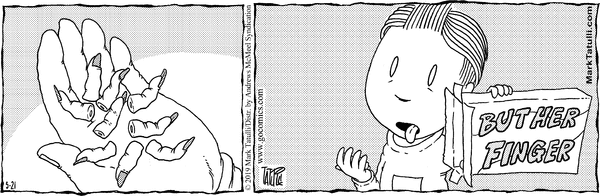
As for the Lio strip, at least it’s not “Butt Her Finger”.
There are many types of mole in Mexico. The one most familiar to Americans is mole poblano, This features ground red chiles and unsweetened chocolate. I like it quite a bit.
I think the incorrect accent in “Molé” is necessary to make the joke work. It (improperly) signals the presence of a “foreign” language, forging the connection to the Mexican sauce. Without it, one might just as well assume that the plate was offering up a real for a whack. Of course, then the splat would have been red, and the comic would have been “Ewww”.
It’s incorrect (in two ways, really), but I mostly agree with Kilby and previous comments to the effect that it helps some readers recognize that it is not the (monosyllabic) English word for the animal or the skin growth. But maybe not as a generic “foreign” marker, as much as an indication that the final e is pronounced as a separate syllable. (That’s not how the accent mark is used in Spanish, but no matter.)
Generally this pronunciation-guide function is served in English by topping the e with a dieresis ë (not properly called “umlaut” in these cases) or sometimes a grave accent è. The dieresis marking is also used on other vowels, most often ö, but the grave is not so much. However, the grave-acccented è can be used impromptu.
Somebody pointed out to me that I was not saying it in the standard way when I asked about Agèd Swiss Cheese, and that the participial adjective is “aged” in one syllable, just like the simple past of the verb.
See how the è told you I meant a separate syllable, even before explicitly stating it? That’s how I take the mistaken Spanish acute accent in the cartoon.
bonus example:
But at my back I always hear
Time’s wingèd chariot hurrying near;

 Comics I Don't Understand
A mole is a spicy Mexican sauce made with chilies and often cocoa, or a dish using it. Did you think he was whacking a little furry beast? Given the brown color and the (un-Spanish) accent mark, not bloody likely. Messy, but not ewww.
LikeLike
Shouldn’t it be green with red bits, so looking a bit more like “guack-a-mole”?
LikeLike
Not a CIDU,@Treesong.
LikeLike
I, too, didn’t think of it as an EWW, except that I once tasted mole and it was horrible. Narmitaj’s comment would make a funnier comic, but then it’d be an OY.
LikeLike
I suppose the accent mark is meant to relate it to the exclamation “Olé!”.
This standup routine from Cameron Esposito is absolutely the best joke ever on guacamole and whack-a-mole. https://youtu.be/esFP8eO7Ojo
LikeLike
This link skips her somewhat lengthy intro remarks:
LikeLike
I didn’t see the accent mark. I think that does change the interpretation. Even though “mole” doesn’t have one in Spanish, it seems clearly intended to change the pronunciation.
As for the Lio strip, at least it’s not “Butt Her Finger”.
LikeLike
it tasted like BURNT chocolate.
LikeLike
There are many types of mole in Mexico. The one most familiar to Americans is mole poblano, This features ground red chiles and unsweetened chocolate. I like it quite a bit.
LikeLike
Well, CIDU or not, I needed the explanation.
LikeLike
I think the incorrect accent in “Molé” is necessary to make the joke work. It (improperly) signals the presence of a “foreign” language, forging the connection to the Mexican sauce. Without it, one might just as well assume that the plate was offering up a real for a whack. Of course, then the splat would have been red, and the comic would have been “Ewww”.
LikeLike
It’s incorrect (in two ways, really), but I mostly agree with Kilby and previous comments to the effect that it helps some readers recognize that it is not the (monosyllabic) English word for the animal or the skin growth. But maybe not as a generic “foreign” marker, as much as an indication that the final e is pronounced as a separate syllable. (That’s not how the accent mark is used in Spanish, but no matter.)
Generally this pronunciation-guide function is served in English by topping the e with a dieresis ë (not properly called “umlaut” in these cases) or sometimes a grave accent è. The dieresis marking is also used on other vowels, most often ö, but the grave is not so much. However, the grave-acccented è can be used impromptu.
Somebody pointed out to me that I was not saying it in the standard way when I asked about Agèd Swiss Cheese, and that the participial adjective is “aged” in one syllable, just like the simple past of the verb.
See how the è told you I meant a separate syllable, even before explicitly stating it? That’s how I take the mistaken Spanish acute accent in the cartoon.
bonus example:
But at my back I always hear
Time’s wingèd chariot hurrying near;
LikeLike
Before I realized he was whacking a pepper/cocoa sauce, I interpreted the object as a skin growth- and that would have been an EWW for me.
BTW, Guak-a-mole would have been more better.
LikeLike
And then there’s WHACKASCAPULA . . . a new one on me!

LikeLike
Pity the poor mole . . .
https://www.arcamax.com/thefunnies/mothergooseandgrimm/s-2218385
LikeLike