Not advice, but Death would be literally informing what you do, albeit in a negative way.
Does Death tell you how to do your job as an EMT? Damn straight! If Death says not doing X will result in the patient coming with him, I damn well will do X!
“Does Death tell you how to do your job as an EMT?”
I got delivered via ambulance to the emergency room, where the doctors proceeded to stop my heart from beating. That didn’t fix the problem, so after two days in cardiac intensive care, they did it again, and the second time worked.
Most people don’t use a nutcracker to shell peanuts, but would the comic work if it were an almond or walnut that answered the door? It would be hard to draw it in such a way that most people would get the joke.
I remember a Planter’s Peanuts commercial from a few years ago in which Mr. Peanut was hosting a party, and Tchaikovsky’s nutcracker showed up. Mr. Peanut used his cane to jam the nutcracker’s mouth open.
Grawlix, by your logic boned chicken should still have the bones in it, peeled fruit should still have their peels, and a skinned knee should still have the skin on it.
@ Andréa – I am extremely happy to have English as my “native” tongue, and German as a second language. Even Germans harp about how “difficult” their language rules are, but the advantage is that those rules are generally followed, whereas English has more exceptions and special cases than it has actual rules (this is especially true for pronunciation).
Oh, you mean like trough, through, tough, though, etc.? Dutch is my ‘native’ language; I learned English by being tossed into school when we came to the US, without any ‘English as a second language’ classes or teachers at that time. Languages are easy to pick up at a young age; I was six when I came here; seven when I first went to school.
I still have report cards from then . . . I had mostly ‘U’s (of course, ’cause I had no idea what anyone was saying!), but by the third quarter/report card, I was changing over to ‘S’. The only ‘complaint’ the teacher had was that I wasn’t singing along . . . well, d’oh. An area in which I greatly improved, and no one’s been able to shut me up since.
All languages have some things that make them hard to learn. Spelling is one of the biggest problems with English. It’s not really phonetic, but partially phonetic. There are clues in the spelling for how to pronounce a word, but even native speakers can get it wrong when confronted with an unfamiliar word. And going the other way is worse. There are many very intelligent native English speakers who are poor spellers. The key to success seems to be a good visual memory.
On the other hand, English is not a highly-inflected language, which means there aren’t many word endings to learn, and not many rules about different parts of a sentence agreeing with each other.
German plurals are hard. There is more than one way to pluralize a noun, and there’s no easy way to tell which is the proper plural form. One has to memorize the plural for each noun. English has some irregular plurals, but outside of these it’s easy to pluralize a noun (just add an “-s” or “-es” to the end.).
The biggest hidden difficulty in mastering English are phrasal verbs (get out, ring in, pull through); they are essentially ambiguous extra vocabulary that needs to be memorized, but they look like they follow rules and should thus be easily mastered. Native speakers don’t really understand what it is they know, and often fall into the trap of believing they are merely rule based extensions to known vocabulary (look at that exercise in hubris known as Basic English) — they are instead completely arbitrary, basically new vocabulary units (hold on / hold off; put out / put in; throw up / throw down; etc., etc.) Prepositions are hard in and of themselves, another hidden difficulty in learning English if you come from a language that has basically three of them, but learning prepositions will not help you, even though it seems like it should, in mastering phrasal verbs.
Verb transitivity is another difficulty in learning English that gets short shrift.
Yes, English does not have genders, and the verb conjugations are relatively easy — celebrate while you can, because true mastery will be a bitch.
swazoo: in most East Asian languages (and quite a few others) making plural forms is easy because there’s no special-case singular form. If you want to specifically talk about one sheep, you say “one sheep”, otherwise “sheep”. Of course, there are other complexities…
 Comics I Don't Understand
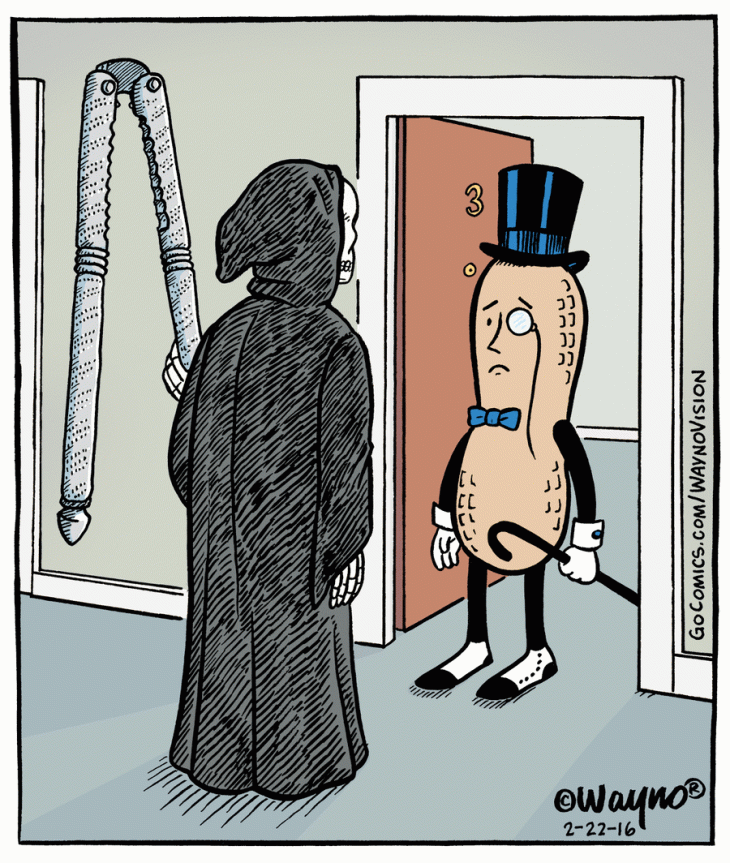
Who the heck needs a nutcracker for peanuts?
LikeLike
DemetriosX, does Death tell YOU how to do YOUR job?
LikeLike
Bill, if Demetri is in any way a health care professional, I’d say the answer would be “yes”…
LikeLike
As peanuts go, Mr. Peanut always appeared rather effete and soft. He’s probably leaking peanut butter, and the artist just didn’t show it.
LikeLike
I guess the implication is supposed to be that people are wheat.
LikeLike
larK, if he’s in any way a health care professional, Death is the last “person” he’d want advice from.
LikeLike
Not advice, but Death would be literally informing what you do, albeit in a negative way.
Does Death tell you how to do your job as an EMT? Damn straight! If Death says not doing X will result in the patient coming with him, I damn well will do X!
LikeLike
“Does Death tell you how to do your job as an EMT?”
I got delivered via ambulance to the emergency room, where the doctors proceeded to stop my heart from beating. That didn’t fix the problem, so after two days in cardiac intensive care, they did it again, and the second time worked.
LikeLike
I seem to have a vague memory of using a nutcracker for peanuts in the past.
LikeLike
Is it wrong of me that I’m suddenly in the mood for some peanuts?
LikeLike
Most people don’t use a nutcracker to shell peanuts, but would the comic work if it were an almond or walnut that answered the door? It would be hard to draw it in such a way that most people would get the joke.
I remember a Planter’s Peanuts commercial from a few years ago in which Mr. Peanut was hosting a party, and Tchaikovsky’s nutcracker showed up. Mr. Peanut used his cane to jam the nutcracker’s mouth open.
LikeLike
Shouldn’t a nut that has had its shell removed be called “unshelled” ?
Shelled should mean it still has its shell intact.
:-)
LikeLike
Grawlix, by your logic boned chicken should still have the bones in it, peeled fruit should still have their peels, and a skinned knee should still have the skin on it.
LikeLike
Sitting here following this discussion while eating unshelled, unsalted pistachios, which DO have shells, but DON’T have salt.
LikeLike
I don’t know WHY people think English is a difficult language to learn . . .
LikeLike
@ Andréa – I am extremely happy to have English as my “native” tongue, and German as a second language. Even Germans harp about how “difficult” their language rules are, but the advantage is that those rules are generally followed, whereas English has more exceptions and special cases than it has actual rules (this is especially true for pronunciation).
LikeLike
Oh, you mean like trough, through, tough, though, etc.? Dutch is my ‘native’ language; I learned English by being tossed into school when we came to the US, without any ‘English as a second language’ classes or teachers at that time. Languages are easy to pick up at a young age; I was six when I came here; seven when I first went to school.
I still have report cards from then . . . I had mostly ‘U’s (of course, ’cause I had no idea what anyone was saying!), but by the third quarter/report card, I was changing over to ‘S’. The only ‘complaint’ the teacher had was that I wasn’t singing along . . . well, d’oh. An area in which I greatly improved, and no one’s been able to shut me up since.
LikeLike
Just ’cause there are big English words in this, I thought it worth sharing . . . I thought it an LOL, too.
http://zitscomics.com/comics/december-13-2018/
LikeLike
All languages have some things that make them hard to learn. Spelling is one of the biggest problems with English. It’s not really phonetic, but partially phonetic. There are clues in the spelling for how to pronounce a word, but even native speakers can get it wrong when confronted with an unfamiliar word. And going the other way is worse. There are many very intelligent native English speakers who are poor spellers. The key to success seems to be a good visual memory.
On the other hand, English is not a highly-inflected language, which means there aren’t many word endings to learn, and not many rules about different parts of a sentence agreeing with each other.
German plurals are hard. There is more than one way to pluralize a noun, and there’s no easy way to tell which is the proper plural form. One has to memorize the plural for each noun. English has some irregular plurals, but outside of these it’s easy to pluralize a noun (just add an “-s” or “-es” to the end.).
LikeLike
The biggest hidden difficulty in mastering English are phrasal verbs (get out, ring in, pull through); they are essentially ambiguous extra vocabulary that needs to be memorized, but they look like they follow rules and should thus be easily mastered. Native speakers don’t really understand what it is they know, and often fall into the trap of believing they are merely rule based extensions to known vocabulary (look at that exercise in hubris known as Basic English) — they are instead completely arbitrary, basically new vocabulary units (hold on / hold off; put out / put in; throw up / throw down; etc., etc.) Prepositions are hard in and of themselves, another hidden difficulty in learning English if you come from a language that has basically three of them, but learning prepositions will not help you, even though it seems like it should, in mastering phrasal verbs.
Verb transitivity is another difficulty in learning English that gets short shrift.
Yes, English does not have genders, and the verb conjugations are relatively easy — celebrate while you can, because true mastery will be a bitch.
LikeLike
swazoo: in most East Asian languages (and quite a few others) making plural forms is easy because there’s no special-case singular form. If you want to specifically talk about one sheep, you say “one sheep”, otherwise “sheep”. Of course, there are other complexities…
LikeLike