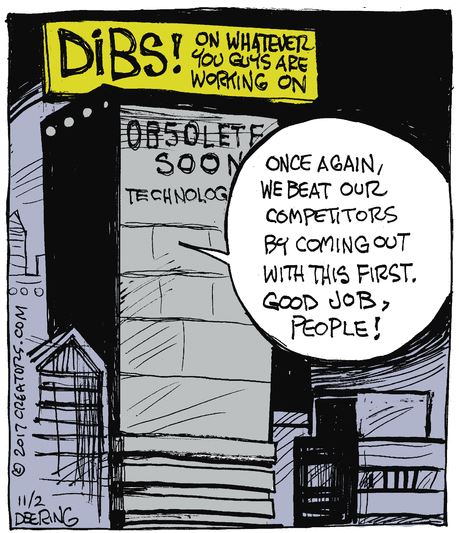
When something new comes out, it gives clues to others as to how it could be made better. He’s suggesting that being first to market just means you’re also first to see your product stop selling well.
They think they’ve beaten their competitors simply by putting up that sign and unilaterally calling “Dibs!” on all possible innovations — a children’s strategy for claiming, say, the sofa in front of the TV. “Tom the Dancing Bug” often riffs on this sort of thing through Harvey Richards, Lawyer for Children.
It might be compared to filing or buying patents for broad ideas and then litigating when somebody eventually develops a working model, or making a tenuous claim that a new product infringes on an existing one. Big conglomerates and small nuisance litigants both indulge from time to time; the former to break a potential competitor and the latter to wring out some go-away money.
But I think the cartoonist’s intended gag was that in an age of rapid obsolescence, simply following or even keeping pace is not enough. One must reach into the future and pre-emptively claim upcoming breakthroughs, although “dibs” in and of itself is not likely to get very far in court.
This might work as a patent trolling joke as MA suggests, but I don’t think that’s what Deering was going for. With the company being called Obsolete Soon Technology, I suspect he thinks he’s being profound about corporations in dying tech trying to grab onto the next big thing to stay relevant and more importantly keep making money.
The thing I picked up on was that the creator apparently thought better of the company name and changed it (clumsily) to OB5OLETE SOON (or OB50LETE) by typing in a 5 and maybe a 0 over an O.
Rather than “patent trolling”, this reminded me of Microsoft’s time-honored “vaporware” strategy. Every once in a while, Redmond would announce that they were working on a product, even when they did not have anything visible to show for it. This method of calling “Dibs!” was designed to keep potential customers from wandering over to other suppliers (some of which actually had real products to sell).
This reminds me of an essay Paul Graham wrote about a start-up company he created. Using the Lisp programming language, his small team of software programmers was often able to include competitors’ new features within a day or two after the competitors had announced them:
“…our development cycle was so fast that we could sometimes duplicate a new feature within a day or two of a competitor announcing it in a press release. By the time journalists covering the press release got round to calling us, we would have the new feature too.”
Like the cartoon above, company A would announce a soon-to-be-released new feature, and the next day company B would have that same feature ready to use!
Good ol’ LISP. No truth to the rumor that it stands for Lots of Idiotic Single Parentheses. When I was back in school in the mid-90s getting an MSCS, some of the AI courses used LISP.
If your editor is set up well, it can flash the opening paren that matches the one you are typing. Helps keep them balanced.
There are some pre-processors that will understand right-square-bracket to mean “close all open parens”. If your editor is looking for normal round parens to balance, using that ‘]’ shorthand is an abomination!
 Comics I Don't Understand
When something new comes out, it gives clues to others as to how it could be made better. He’s suggesting that being first to market just means you’re also first to see your product stop selling well.
LikeLiked by 1 person
They think they’ve beaten their competitors simply by putting up that sign and unilaterally calling “Dibs!” on all possible innovations — a children’s strategy for claiming, say, the sofa in front of the TV. “Tom the Dancing Bug” often riffs on this sort of thing through Harvey Richards, Lawyer for Children.
It might be compared to filing or buying patents for broad ideas and then litigating when somebody eventually develops a working model, or making a tenuous claim that a new product infringes on an existing one. Big conglomerates and small nuisance litigants both indulge from time to time; the former to break a potential competitor and the latter to wring out some go-away money.
But I think the cartoonist’s intended gag was that in an age of rapid obsolescence, simply following or even keeping pace is not enough. One must reach into the future and pre-emptively claim upcoming breakthroughs, although “dibs” in and of itself is not likely to get very far in court.
LikeLike
This might work as a patent trolling joke as MA suggests, but I don’t think that’s what Deering was going for. With the company being called Obsolete Soon Technology, I suspect he thinks he’s being profound about corporations in dying tech trying to grab onto the next big thing to stay relevant and more importantly keep making money.
LikeLike
The thing I picked up on was that the creator apparently thought better of the company name and changed it (clumsily) to OB5OLETE SOON (or OB50LETE) by typing in a 5 and maybe a 0 over an O.
LikeLike
Rather than “patent trolling”, this reminded me of Microsoft’s time-honored “vaporware” strategy. Every once in a while, Redmond would announce that they were working on a product, even when they did not have anything visible to show for it. This method of calling “Dibs!” was designed to keep potential customers from wandering over to other suppliers (some of which actually had real products to sell).
LikeLike
What I thought upon seeing it was in line with Kilby #5.
LikeLike
This reminds me of an essay Paul Graham wrote about a start-up company he created. Using the Lisp programming language, his small team of software programmers was often able to include competitors’ new features within a day or two after the competitors had announced them:
“…our development cycle was so fast that we could sometimes duplicate a new feature within a day or two of a competitor announcing it in a press release. By the time journalists covering the press release got round to calling us, we would have the new feature too.”
( http://www.paulgraham.com/avg.html )
Like the cartoon above, company A would announce a soon-to-be-released new feature, and the next day company B would have that same feature ready to use!
LikeLike
Good ol’ LISP. No truth to the rumor that it stands for Lots of Idiotic Single Parentheses. When I was back in school in the mid-90s getting an MSCS, some of the AI courses used LISP.
LikeLike
Steele’s Common LISP was actually a fun read!
If your editor is set up well, it can flash the opening paren that matches the one you are typing. Helps keep them balanced.
There are some pre-processors that will understand right-square-bracket to mean “close all open parens”. If your editor is looking for normal round parens to balance, using that ‘]’ shorthand is an abomination!
LikeLike
Anyone remember the book “The Little LISPer”?
LikeLike
My course in language theory included some use of pure LISP. That made Common LISP seem a lot easier.
LikeLike