Ah, I was stumped by the bakery one too. Thanks gang for asking and answering. I didn’t look clearly at the big thing on the counter, called it “that lady’s shopping basket”. Or laundry basket, raising one joke possibility, which fizzled.
The phones don’t work, so he’s resorting to mime. The idea seems to be that he’s so dependent on telephony that he can’t use any of the workarounds (instant message, email, walking over to someone’s desk).
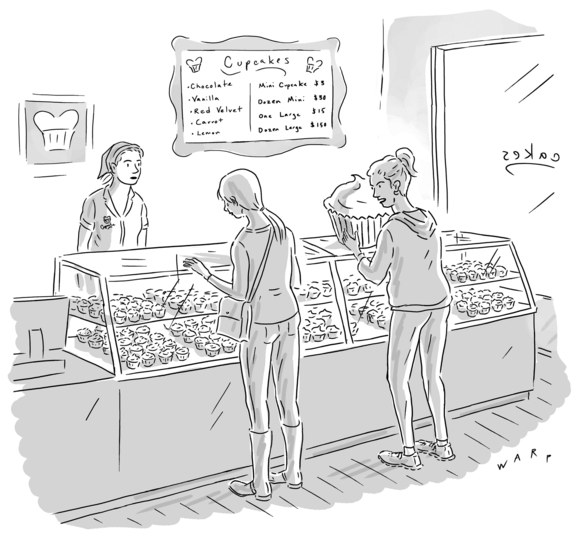
The cupcake caption works for me. A spin on the stereotypical image of a depressed woman eating ice cream from the carton as a form of self-medication.
My favorite Kim Warp cartoon: A sleek convertible with an irate woman sitting in the passenger seat, arms crossed. It was titled “CORVETTE WITH SPOILER”.
Thank you MinorAnnoyance, your interpretation actually works for me. I might also point out that this might be one of those rare instances where the classic New Yorker caption doesn’t really work (unless, maybe you swap speakers.)
Stan: maybe because mini cupcakes supposedly won’t ruin your line as fast as the regular size (comfort without guilt). The other woman, with her giant cupcake, knows this line of reasoning doesn’t work.
Tangent: in French, people always offer “un petit café” (= a small coffee), “un petit biscuit” (= a small cookie), etc. “Small” meaning “not important”, hence “no consequence / no retribution expected”.
Anyway, at the supermarket, once, the cashier was asking the customer in front of me for “une petite pièce d’identité” (= a small proof of ID, because the customer was paying with a check) and I laughed and told her to go the whole hog (“allez-y carrément”) and ask for a gigantic proof of ID. It was a good day, because they laughed, too.
Back to the comic: I take it as a line taken from home improvement comedies where some guy always laughs at another guy about the size of his tools, showing off what real / efficient tools look like. (I know I’ve wandered into Arlo territory).
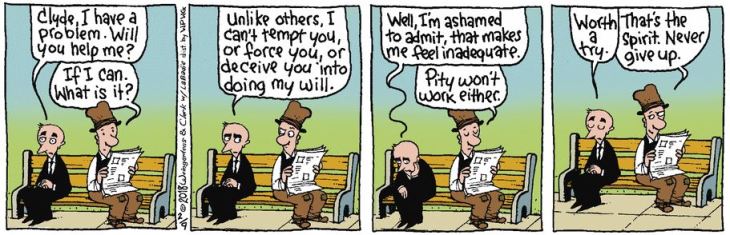
Am I the only one who doesn’t get the first strip? He asks the guy if he’ll help, who agrees “if I can.” He then proceeds to tell him how he can’t make him help? And tries pity, which also doesn’t work? Even though Clyde already agreed to try to help him? What?
Dr Shrinker — it may help to understand who the characters are, and what their interactions are.
If you don’t actually care, please feel free to skip… Barney is a high-powered pharmaceutical company CEO, a billionaire who takes pride in his ability to control everybody and everything around him. (Somehow, he’s not actually slightly less of a jerk than this makes him sound.) While he can control MOST of the things and people around him, he is limited in his ability to influence his wife or daughter, and has no ability to influence Clyde. Clyde is a homeless-by-choice man who went to the same elementary school as Barney, and basically has a Buddha-level amount of no attachments.
Barney spends a lot of time trying to get hooks into Clyde to control him, largely by being decent and offering him resources, jobs, and so forth. Clyde refuses all this help in order to remain completely independent. This becomes a sort of game between them. (If Barney uses force or coercion to get Clyde to do something, they both are aware that that would mean Clyde wins and Barney loses.)
In this case, Barney is straight-out acknowledging this dynamic, and is trying pity to control Clyde. And this, too, fails.


 Comics I Don't Understand
I don’t get the “cupcake” cartoon. It looks like there should have been a caption.
LikeLike
The caption is: “Mini-cupcakes never solved anything.” Can’t say that helps much, it is a New Yorker cartoon, after all.
LikeLike
For some problems, mini-cupcakes won’t do: it takes a BIG cupcake.
LikeLike
The caption helps a little bit.
The phones don’t work because he doesn’t have one? Just dumb.
LikeLike
Ah, I was stumped by the bakery one too. Thanks gang for asking and answering. I didn’t look clearly at the big thing on the counter, called it “that lady’s shopping basket”. Or laundry basket, raising one joke possibility, which fizzled.
LikeLike
The phones don’t work, so he’s resorting to mime. The idea seems to be that he’s so dependent on telephony that he can’t use any of the workarounds (instant message, email, walking over to someone’s desk).
LikeLike
Sorry, I didn’t realize the cupcàke caption (somehow) didn’t make it to the page.
What Irene sent me DID have a caption.
LikeLike
For the phone one, I read a blog of dumb IT stories, and managers telling IT people to email that the email is out is fairly common.
LikeLike
The cupcake caption works for me. A spin on the stereotypical image of a depressed woman eating ice cream from the carton as a form of self-medication.
My favorite Kim Warp cartoon: A sleek convertible with an irate woman sitting in the passenger seat, arms crossed. It was titled “CORVETTE WITH SPOILER”.
LikeLike
Thank you MinorAnnoyance, your interpretation actually works for me. I might also point out that this might be one of those rare instances where the classic New Yorker caption doesn’t really work (unless, maybe you swap speakers.)
LikeLike
“A spin on the stereotypical image of a depressed woman eating ice cream from the carton as a form of self-medication.”
Yea, I figured that was the point of the comic too, but do people eat mini-cupcakes for that reason? Is this a thing?
LikeLike
WRT cupcakes: “Go big or go on a diet.”
LikeLike
Stan: maybe because mini cupcakes supposedly won’t ruin your line as fast as the regular size (comfort without guilt). The other woman, with her giant cupcake, knows this line of reasoning doesn’t work.
Tangent: in French, people always offer “un petit café” (= a small coffee), “un petit biscuit” (= a small cookie), etc. “Small” meaning “not important”, hence “no consequence / no retribution expected”.
Anyway, at the supermarket, once, the cashier was asking the customer in front of me for “une petite pièce d’identité” (= a small proof of ID, because the customer was paying with a check) and I laughed and told her to go the whole hog (“allez-y carrément”) and ask for a gigantic proof of ID. It was a good day, because they laughed, too.
Back to the comic: I take it as a line taken from home improvement comedies where some guy always laughs at another guy about the size of his tools, showing off what real / efficient tools look like. (I know I’ve wandered into Arlo territory).
LikeLike
There’s just something delightful about cute, tiny food – maybe the same way that puppies elicit a different gut response than adult dogs do.
LikeLike
Am I the only one who doesn’t get the first strip? He asks the guy if he’ll help, who agrees “if I can.” He then proceeds to tell him how he can’t make him help? And tries pity, which also doesn’t work? Even though Clyde already agreed to try to help him? What?
LikeLike
Dr Shrinker — it may help to understand who the characters are, and what their interactions are.
If you don’t actually care, please feel free to skip… Barney is a high-powered pharmaceutical company CEO, a billionaire who takes pride in his ability to control everybody and everything around him. (Somehow, he’s not actually slightly less of a jerk than this makes him sound.) While he can control MOST of the things and people around him, he is limited in his ability to influence his wife or daughter, and has no ability to influence Clyde. Clyde is a homeless-by-choice man who went to the same elementary school as Barney, and basically has a Buddha-level amount of no attachments.
Barney spends a lot of time trying to get hooks into Clyde to control him, largely by being decent and offering him resources, jobs, and so forth. Clyde refuses all this help in order to remain completely independent. This becomes a sort of game between them. (If Barney uses force or coercion to get Clyde to do something, they both are aware that that would mean Clyde wins and Barney loses.)
In this case, Barney is straight-out acknowledging this dynamic, and is trying pity to control Clyde. And this, too, fails.
LikeLike