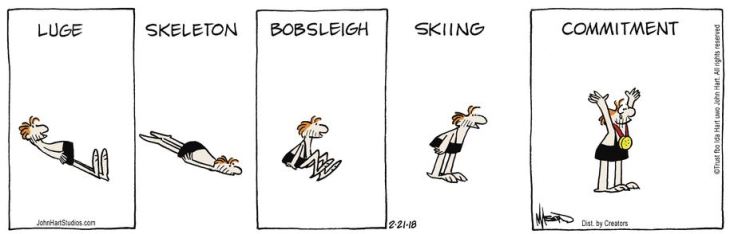
The luge is a sled you ride feet-first, skeleton is one you ride head-first, bobsled is one you can sit in, and skiing is done standing up. But you only get to stand with a medal if you’ve spent a LOT of time in one of those other positions.
It’s a tribute to the athletes of the Olympics, although the B.C. incarnation of the Olympics didn’t have medals. Or, I’d wager, sleds or skis, but that’s another issue entirely.
Just hear those sleigh bells jingling,
Ring-ting-tingling too,
Come on, it’s lovely weather
For a sleigh ride together with you,
The Jamaican bob-sleigh team!
The current iteration of BC seems to consist of the writer introducing a concept on Monday, and hammering it every day for a week. Whether it actually has humor or not. This week it’s the Olympics.
Maybe the joke is that he is participating in each of these sports without equipment?
Reminds me of the “running mode” code in Sega’s Winter Heat, which allowed you to compete without equipment in each of the 11 winter sports events. For the most part, it allowed you to just run down slopes and courses, but there were a couple fun variations. For skeleton, you slid on your back with no sled and in ski jumping you would “swim” through the air after running off the end of the jump. It was a good game.
Has anybody here done luge? Or does anybody understand it? I can’t quite figure out how the athlete deserves credit – it seems grabbity does the work. I know I’m wrong, I just can’t figure out how.
The athlete makes decisions regarding steering. Gravity IS doing all the work, but a poor luge rider (luger? I don’t think so. Better stick with “rider”) a poor rider does a bad job steering and keeps hitting the walls. Gravity still pulls them down the track, but slower. A good rider steers down the middle of the track and lets gravity keep accelerating him (or her) for the whole ride, until they want to stop at the bottom.
For some reason, I can’t seem to remember how a luge run starts. In the other sliding sports, it starts with running and pushing the sled… so a fast runner takes less time to push the sled and get in, and starts the ride travelling faster. Many bobsled athletes are converted track athletes. The driver has to understand bobsled, but the other guys are there mostly for the push at the beginning. In 4-person bobsledding, two of them are there SOLELY as “pushers”… their job is to be deadweight with their heads down for all but the first 5 seconds of the ride.
Finally, the only things slowing down the sled are friction on the runners and air resistance as the sled and rider have to move air out of the way to pass through. This means that a rider who can assume and hold an aerodynamic pose go faster than one who can’t. In bobsled, the riders get to climb inside the sled and let the sled’s aerodynamics take over. Skeleton and luge, however, depend on the aerodynamic pose of the rider.
The track is a mile long, and the difference between a winning ride and a silver medal sometimes requires timing accuracy to the thousandth of a second.
As a young person, I was a bit of an adrenaline junkie. I also lived on flat ground where it mostly didn’t get cold enough to freeze water… skiing and sledding required a trip to place where the ground is both inclined and colder. By the time I was old enough to drive there, well… car surfing was closer, and didn’t require expensive equipment.
Thank you, that was very clear and helpful. I think it looked so easy just because these guys are so good at it – if they don’t touch the walls, it looks like they’re just lying there.
The perennial problem of the expert: you make it look too easy, and people don’t value your skill.
I wonder if an empty luge?sled?toboggan? is ever used as a base measurement.
@ chakolate – I don’t think an empty device would work as a base measure; on the BBC one of the retired bobsleighers in the studio was asked how far an empty bobsleigh could go without being driven… she said it would probably get through the first corner but crash at about the second. Presumably skeleton bobs and luges also bang off the walls and flip over and crash too.
 Comics I Don't Understand
The luge is a sled you ride feet-first, skeleton is one you ride head-first, bobsled is one you can sit in, and skiing is done standing up. But you only get to stand with a medal if you’ve spent a LOT of time in one of those other positions.
LikeLike
I think it’s supposed to be inspirational, not funny. Is B.C. sometimes inspirational?
LikeLike
It’s a tribute to the athletes of the Olympics, although the B.C. incarnation of the Olympics didn’t have medals. Or, I’d wager, sleds or skis, but that’s another issue entirely.
LikeLike
Winning shows commitment? As opposed to everybody else who competed?
LikeLike
“Winning shows commitment? As opposed to everybody else who competed?”
No, as opposed to people who DIDN’T compete, and just watched on TV.
LikeLike
Just hear those sleigh bells jingling,
Ring-ting-tingling too,
Come on, it’s lovely weather
For a sleigh ride together with you,
The Jamaican bob-sleigh team!
LikeLike
“The Jamaican bob-sleigh team!”
That’s old news. Now it’s the Nigerians.
LikeLike
There is no such thing as a bobsleigh. I think someone may be conflating ‘bobtails’ and ‘sleighing’ from ‘Jingle Bells’.
LikeLike
The other reading is that he isn’t getting awards in any of the events, but he deserves one anyway for effort.
LikeLike
@ Treesong – Unfortunately, that is in fact the official spelling as propagated by the IOC; see:
> https://www.olympic.org/bobsleigh
LikeLike
That spelling goes further than the IOC: http://www.le-tresor-de-la-langue.fr/definition/bobsleigh
Bobsled since 1848, bobsleigh since 1889.
LikeLike
The current iteration of BC seems to consist of the writer introducing a concept on Monday, and hammering it every day for a week. Whether it actually has humor or not. This week it’s the Olympics.
LikeLike
Maybe the joke is that he is participating in each of these sports without equipment?
Reminds me of the “running mode” code in Sega’s Winter Heat, which allowed you to compete without equipment in each of the 11 winter sports events. For the most part, it allowed you to just run down slopes and courses, but there were a couple fun variations. For skeleton, you slid on your back with no sled and in ski jumping you would “swim” through the air after running off the end of the jump. It was a good game.
LikeLike
Has anybody here done luge? Or does anybody understand it? I can’t quite figure out how the athlete deserves credit – it seems grabbity does the work. I know I’m wrong, I just can’t figure out how.
LikeLike
The athlete makes decisions regarding steering. Gravity IS doing all the work, but a poor luge rider (luger? I don’t think so. Better stick with “rider”) a poor rider does a bad job steering and keeps hitting the walls. Gravity still pulls them down the track, but slower. A good rider steers down the middle of the track and lets gravity keep accelerating him (or her) for the whole ride, until they want to stop at the bottom.
For some reason, I can’t seem to remember how a luge run starts. In the other sliding sports, it starts with running and pushing the sled… so a fast runner takes less time to push the sled and get in, and starts the ride travelling faster. Many bobsled athletes are converted track athletes. The driver has to understand bobsled, but the other guys are there mostly for the push at the beginning. In 4-person bobsledding, two of them are there SOLELY as “pushers”… their job is to be deadweight with their heads down for all but the first 5 seconds of the ride.
Finally, the only things slowing down the sled are friction on the runners and air resistance as the sled and rider have to move air out of the way to pass through. This means that a rider who can assume and hold an aerodynamic pose go faster than one who can’t. In bobsled, the riders get to climb inside the sled and let the sled’s aerodynamics take over. Skeleton and luge, however, depend on the aerodynamic pose of the rider.
The track is a mile long, and the difference between a winning ride and a silver medal sometimes requires timing accuracy to the thousandth of a second.
As a young person, I was a bit of an adrenaline junkie. I also lived on flat ground where it mostly didn’t get cold enough to freeze water… skiing and sledding required a trip to place where the ground is both inclined and colder. By the time I was old enough to drive there, well… car surfing was closer, and didn’t require expensive equipment.
LikeLike
Thank you, that was very clear and helpful. I think it looked so easy just because these guys are so good at it – if they don’t touch the walls, it looks like they’re just lying there.
The perennial problem of the expert: you make it look too easy, and people don’t value your skill.
I wonder if an empty luge?sled?toboggan? is ever used as a base measurement.
LikeLike
Luge riders fixed handles to get an initial surge, then use spiked gloves to push on the ice (sitting on the sled) when starting.
LikeLike
@ chakolate – I don’t think an empty device would work as a base measure; on the BBC one of the retired bobsleighers in the studio was asked how far an empty bobsleigh could go without being driven… she said it would probably get through the first corner but crash at about the second. Presumably skeleton bobs and luges also bang off the walls and flip over and crash too.
LikeLike
Kilby and Olivier: thanks. My Merriam-Webster Collegiate (©2003) and unabridged New International (©1971) hadn’t gotten the news.
Just checked https://www.merriam-webster.com/ (©2018) and it doesn’t have it either! Other online dictionaries, like Collins and OED, do better.
LikeLike
Empty bobsleigh?
http://www.gocomics.com/brewsterrockit/2018/02/22
LikeLike