“Scott Adams, whose popular comic strip “Dilbert” captured the frustration of beleaguered, white-collar cubicle workers and satirized the ridiculousness of modern office culture until he was abruptly dropped from syndication in 2023 for racist remarks, has died of prostate cancer at 68.” [ I’m extensively quoting from the AP article]
At its height, Dilbert appeared in 2,000 newspapers.
For me, working in the space between tech and marketing departments, Dilbert had a particular resonance.
It all came crashing down in 2023 when Adams repeatedly referred to Black people as members of a hate group (etc.). Bill Holbrook, the creator of the strip “On the Fastrack,” told The Associated Press at the time. “I am in full support with him saying anything he wants to, but then he has to own the consequences of saying them.”
But in the fine tradition of not speaking too ill of the dead, here are some of the Dilbert strips I particularly enjoyed over the years:


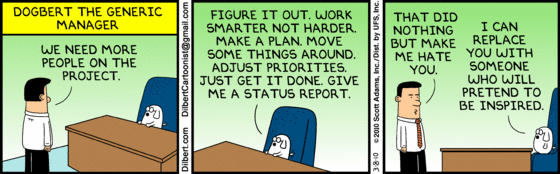
I had a mug made of that one, which reminded me of a couple of C-level bosses I had who had risen to their level of incompetence. Didn’t take it in to the office, though; I’m not an idiot.
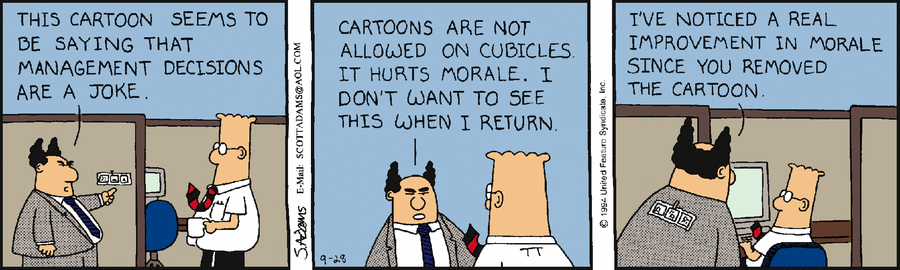
I remember this bit of advice: “Don’t ask your employees why they have Dilbert strips hung up in their cubicles.”
 Comics I Don't Understand
I was a big fan of Adams for the first ten years or so of Dilbert and his old stuff still holds up well. I worked for quite a few years in a telecom engineering department as an analyst, which I think gives me an extra layer of appreciation. Adams captured the zeitgeist of ’90s and 2000s business culture and had a real eye for absurdity. He had a knack for seeing past corporate pageantry. And I’m glad he was able to share that vision with us.
I won’t endorse either his comic or behavior in the last decade of his life, but I won’t belabor it now. He gave us a lot.
Well said, Andrew. I think for a lot of us, Dilbert gave voice to our corporate desperation.
Here’s one I’ve used more often than I care to think about, including within the last six months: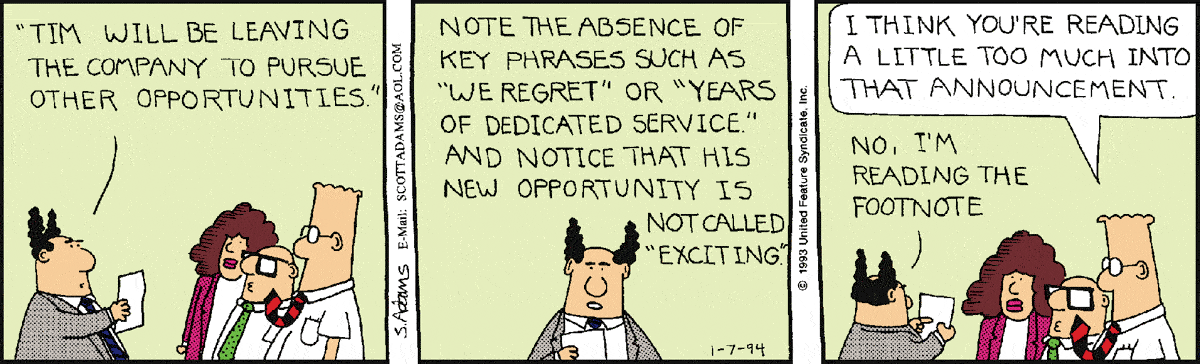
The “bad data” strip was especially good. It’s part of why I was astounded when Adams aligned himself with the “bad data” people. Of course, he also pointed out often that brains usually did not translate into power. Anyway, I’ll choose to remember the good times with Adams, including a brief e-mail exchange I once had with him. I hope some day I’ll do the same for Elon Musk.
I wonder if everyone has a favorite Dilbert. Here’s mine: https://ztfnews.wordpress.com/wp-content/uploads/2013/07/7178-strip.gif
Stages of Dilbert understanding.
Undergrad: I don’t get it
Newly employed: This is hilarious!
Seasoned employee: This is a documentary
TedD, that’s great!
There might be a fourth:
Retired person: I don’t get it
I suggest that based on experience with the HBO series Silicon Valley, which I consider to be practically a documentary. A friend who retired ~30 years ago from the software vendor biz watched the first ep and didn’t get it. I told him he’d been out of tech too long.
Back in my callow youth, I had to train my replacement at a University EFL school, and was dismayed to discover that she was a Dilbert “fan”, with a plushie Dilbert doll, who seemed to be genuinely expecting and even yearning for the Dilbert work place experience. We were not that kind of shop, teaching English to foreigners, almost everyone without exception, from the teachers to the administrators to the front desk staff, were genuinely into the mission, every aspect of our dealing with the students was seen as an opportunity to teach them either the language or the culture (and not the Dilbert culture!). I had applied because of previous teaching experience, but because I didn’t have a Masters in ESL, wasn’t qualified to teach, so they put me in the front desk instead. I eventually rose to head of administration, but as my soon-to-be wife was finishing her Masters in IT, we were leaving for greener pastures more remunerative, so I was trying to show the outside hired replacement that we were not a Dilbert shop, but she seemed hell bent on having one, to the point of creating it if necessary. She came with the attitude of “if only we didn’t have these pesky clients, we could do our jobs”, and would eye-roll when I tried to get her to understand that the clients were our job and we actually genuinely cared about our students. She, unsurprisingly, didn’t last more than a year I later heard.
(Discussed this and more Dilbert in this previous classic thread:
https://cidu.info/2022/03/10/vsadd/ )
re: Silicon Valley
Right in the first minutes of the first episode, they had a reference to Balmer’s “I’ve got four words for you”, and I was hooked.
In the wake of both Adams’ 2023 comments and now in his death there has been a considerable amount of negative retrospection about the strip Dilbert itself; a view that Adams was an untalented hack who was simply lucky Dilbert was a sort of “first-mover” in modern office humor and launched into a receptive environment with an underserved audience. There is some truth in the claim that Dilbert benefited from the timing of its launch… just as there is talent in understanding that there is an environment for such humor and meeting the moment.
Adams had his weaknesses as a comic strip creator, he was not much of an artist (one of the few things he was willing to be self-deprecating about) and he sacrificed any potential depth his characters might have to a premise that required nearly everyone to be an archetype. However, his insight into what was ridiculous about a modern computer-oriented office environment was quite keen, especially early on in the strip, and the strip got laughs for years and years because it was indeed funny to those who shared the office experience it explored. Adams was also wise to realize that he could make his spartan artwork serve the strip’s humor well, lampooning madness that came from mundanity. Dilbert was good because it was effective.
Adams seemed to be a pretty miserable and off-putting guy, particularly in his later years, and I hold nothing against those who choose to dislike him and his comics because of his demeanor and opinions… but to call him a hack does not stand up to scrutiny. Not everyone is either Walt Kelly or the worst. There is plenty of room in between, and as a comic strip creator Adams was closer to Kelly than the bottom by any objective measure.
Billy, I think you’re right, and assume there’s a tendency to over-dismiss (? over-something negative) Adams because people thought he was “one of us”, and then when he went weird, felt betrayed. I know I’ve sort of avoided thinking about him since whenever that was, because it just made me feel bad.
Him killing the daily Dilbert email was really dumb, too, IMHO. Coupled with the decline in print newspaper readership, I think it condemned Dilbert to obscurity in the last few years. I can’t remember when I last saw a new strip. We don’t get a daily paper any more, which is one factor, but folks used to send the good ones around, and that stopped too. Brilliant.
I worked for a software company from 1986 until I retired two years ago. The Dilbert strips in the 90s so accurately described our work environment that there were rumors that Adams really worked for our company, or that someone from our company was feeding him ideas. There was probably not a single cubicle that didn’t have one of his strips tacked to their wall. The one with Wally planning to “write a new minivan” was a crowd favorite. I wasn’t as much of a regular reader as I got into the 2000s, and I was very shaken when he kind of went off the deep end, but I will always salute his role in exposing the absurdity of the tech industry in a humorous way.
As a working software engineer for a NASA contractor in the 90s Dilbert was so on point it was unreal. In those days of monthly re-orgs and ISO 9000 BS it was amazing. “Dogbert the ISO inspector” and the “bungee boss” were on my cubicle wall.
Dilbert the strip: For many years a fun, sometimes insightful, poke at american office life.
Scott Adams the person: Never meet your idols is all I can say.
I got off social media almost entirely because too many people I liked would share some way out there ideas of all sorts. I didn’t need to know about those aspects of people I otherwise had fun being around.
Earlier in my career I had a rule: If Dilbert cartoons become documentaries, leave. Served me well.
I also liked a story that Adams conveyed in a book that I read during a boring flight about some engineers in a basement office with no plumbing… so they’d dump cold/old coffee in a bucket with the intension of a rotating schedule to dump it… but the janitorial staff started emptying it for them … which was nice… until one day that janitorial staff stopped emptying it… and they intended to empty it themselves, but kept not doting that. Eventually the bucket got so full that only surface tension was keeping the liquid from spilling over. Then a layer of mold grew on the top. About that time a new hire/trainee came in and the guy showing him around pointed to what they called “the spooge bucket” and told him that the new guy had to empty it. So, later, after orientation, the new guy went to take “the lid” off the bucket to be able to empty it… and his hand went through the mold “lid” and into the rancid liquid. Telling that story and watching people cringe in revulsion is lots of fun.
Adams’ descent into the “bad data people” crowd was sad…. and I agree that he had immense talent and insight earlier on. The “problematic artist” issues can evolve in both directions: Dr. Seuss’s WWII-era propaganda work could get very racist… and that occasionally bled into some of his more famous later work…. but then again he was always plenty anti-fascist/anti-totalitarian. People are trouble… and nobody deserves prostate cancer.
My time as an engineer at Megacorp, initially Test and Evaluation, later Software, had some resonance with Dilbert. That being said, in general it was a pretty decent place to work. I wouldn’t have spent 36 years there otherwise.
I was not really fond of the strip (mostly), maybe because I didn’t work in that environment, but I did like the one shown on this page …
Rule of thumb when visiting the offices of a tech company:
A few Dilbert cartoons posted here and there: Company is healthy. You could work there.
Lots and lots of Dilbert cartoons posted everywhere: Company is in trouble. You won’t enjoy working there.
No Dilbert cartoons anywhere: Company is doomed. Stay away.
A major part of Adams’s tragedy was a sort of hubris. He believed he was the smartest guy in the room, and he usually was. But not always, and he had trouble with that as he ventured further from his core strengths. He experimented with food products, restaurant management, apps, and television, writing increasingly bitter explanations of why nothing was as successful as his comic. He was a proto-Elon Musk, but Dilbert couldn’t prop up an empire the way Tesla did.
There was also the problem of aging. The gags stayed sharp because he’d base them on current horror stories from readers (something he’d frequently point out), but the characters and setting were drifting into abstract fantasy, like Mr. Dithers’s company or Camp Swampy. Stable corporate cultures with dress codes and places where Wally could exist have given way to gig economy, aggressive shrinkage, and rapid evolution. Adams presumably could have pitted his characters against this new world, but he may have been bound by all the weight the formula was carrying. He finally dispensed with white shirts and neckties, and I’d bet even then he heard from angry licensees.
Perhaps most importantly, Adams was convinced he had Solved Everything with his philosophy of “Persuasion”. In his mind it superseded traditional logic-based arguments, and appeared to claim it rendered actual facts irrelevant. He embraced Trump’s success as proof he was right, and that triggered a shift in his fan base. His new audience conditioned him to embrace everything Trump was peddling, because he thought it all vindicated his own brilliance. And he got angry because his old audience (and the world at large) was NOT persuaded.
A footnote: Adams would periodically bring up his extensive study of hypnotism. In recent years he replaced his written blog with videos. Perhaps he believed his ideas would persuade if people actually watched him speak.
El Cucui’s story of the new guy certainly fits a common stereotype, but not the small companies that I usually worked for in Silicon Valley. We usually welcomed the new guy, not treating him like a “probie.”
That said, I had some managers who probably should have had pointy hair. I often found Dilbert spot on, but I hope my coworkers didn’t see me as a “Tina.”
I enjoyed his strips/story lines also. I did not work in this sort of office – mine was was 3 or less with boss and employees – and in later life my dad took over my boss’s accounting practice so it became even less so – so it was enjoyable by those not in similar situations.
(And of the end of the coming tax season I will shutting down the practice as with only 5 clients left and IRS adding all sorts of new requirements I cannot no longer keep the practice going – when I was a kid learning to use a copying machine to help dad (before I grew up and had a job with my boss) I was copying a couple of these clients tax returns for dad. – Been a LONG time doing accounting and taxes.)
And Dilbert continues to be a documentary–colleague reports that our “helpdesk” will now no longer perform password resets unless you open a ticket first.
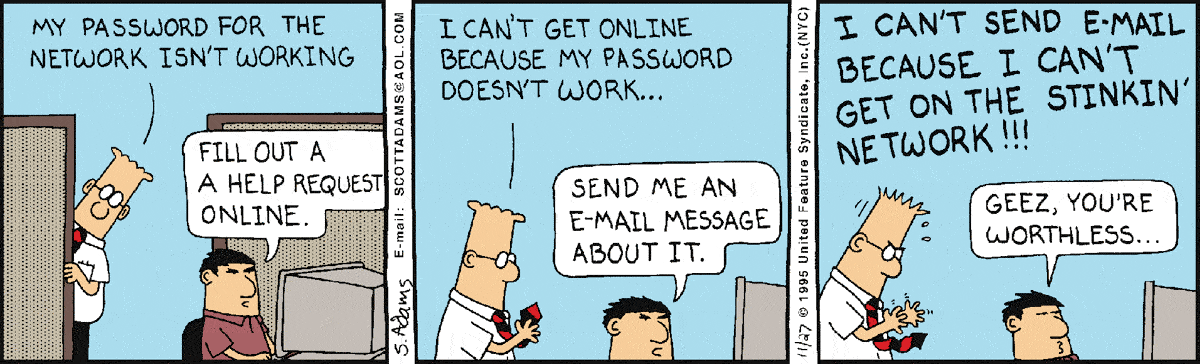
(Their proposed solution is to have your MANAGER open a ticket; I’m sure that will be popular with managers!)