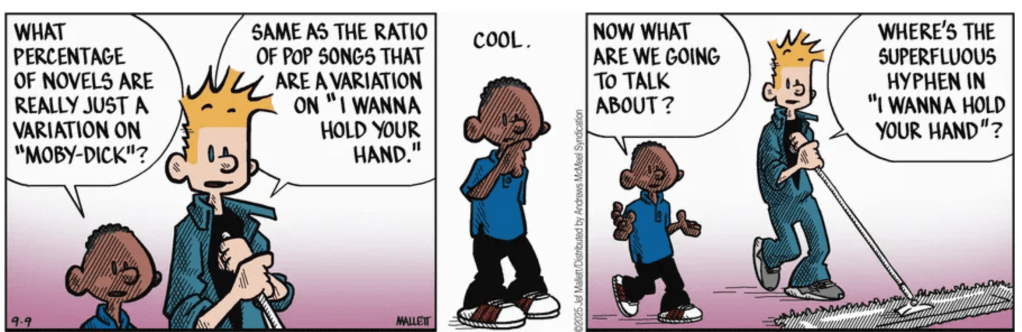
As Frazz and Caulfield discussed on previous days, the novel’s title is really Moby-Dick, even though the name of the whale is Moby Dick; the hyphen in the title therefore seems to be superfluous.
I think the first panel is trying to say that plot and theme similarities in art aren’t important if the presentation is different, and I would largely agree with that. The rest appears to be a non-sequitur into trivia about the titles.
The hyphen in “Moby-Dick” was probably added to the title by Herman’s brother, Thomas. Herman called it “the Whale” and referred to the whale as “Moby Dick.” Victorian-era novels often had decoratively hyphenated titles and it’s quite possible Thomas or Herman thought it would improve sales. The title came out as “Moby-Dick; or, the Whale.”
The Beatles song is “I Want to Hold Your Hand,” which doesn’t quite match the lyrics (“I wanna hold your hand”) and perhaps was done that way because McCartney had just written “I Wanna Be Your Man.” I don’t think history recorded who titled it or why.
This all reminds me of the Horace gags in Barney & Clyde. They aren’t very funny but I enjoy them when I have a few minutes to look up relevant facts and think about it.
I’m not sure I’ve read any variation on Moby Dick. The only other novel I’ve read that puts in lots of chapters of possibly educational but only somewhat related and largely superfluous material is “Les Miserables”, unless we count the supposed original version of “The Princess Bride” of which the narrator’s father only told him the good parts.
Narrator attempts to treat severe depression by going on an adventure that possibly offers a worthwhile monetary reward. Makes friends who help him but the whole enterprise is doomed by a mentally ill leader, and everybody but the narrator dies. I got nothing.
There was a musical version of Moby-Dick at the ART.
The first half was OK.
After intermission, there was a lonnnnng, long, song about Pip that had us all wishing for death.
I had heard lots of warnings about the interminable fishing minutia in Moby Dick. But when I finally got around to reading it, I didn’t really notice anything like that. I don’t recall thinking the novel was wonderful, but it was much easier going for me than some of the other gaps in my literature that I tried to fill.
Well, as with the 50-page digressions about Waterloo and other battles in Les Miserables, the whale lore in Moby Dick is told in an interesting-enough way. If you’re interested in that sort of thing.
 Comics I Don't Understand
As Frazz and Caulfield discussed on previous days, the novel’s title is really Moby-Dick, even though the name of the whale is Moby Dick; the hyphen in the title therefore seems to be superfluous.
I think the first panel is trying to say that plot and theme similarities in art aren’t important if the presentation is different, and I would largely agree with that. The rest appears to be a non-sequitur into trivia about the titles.
The hyphen in “Moby-Dick” was probably added to the title by Herman’s brother, Thomas. Herman called it “the Whale” and referred to the whale as “Moby Dick.” Victorian-era novels often had decoratively hyphenated titles and it’s quite possible Thomas or Herman thought it would improve sales. The title came out as “Moby-Dick; or, the Whale.”
The Beatles song is “I Want to Hold Your Hand,” which doesn’t quite match the lyrics (“I wanna hold your hand”) and perhaps was done that way because McCartney had just written “I Wanna Be Your Man.” I don’t think history recorded who titled it or why.
This all reminds me of the Horace gags in Barney & Clyde. They aren’t very funny but I enjoy them when I have a few minutes to look up relevant facts and think about it.
Still, though, where-would-you-put-a-hyphen-in-that-Beatles’-song-title?
wan-na. Otherwise I got nothing
Usual John got it in one.
I’m not sure I’ve read any variation on Moby Dick. The only other novel I’ve read that puts in lots of chapters of possibly educational but only somewhat related and largely superfluous material is “Les Miserables”, unless we count the supposed original version of “The Princess Bride” of which the narrator’s father only told him the good parts.
Narrator attempts to treat severe depression by going on an adventure that possibly offers a worthwhile monetary reward. Makes friends who help him but the whole enterprise is doomed by a mentally ill leader, and everybody but the narrator dies. I got nothing.
There was a musical version of Moby-Dick at the ART.
The first half was OK.
After intermission, there was a lonnnnng, long, song about Pip that had us all wishing for death.
I had heard lots of warnings about the interminable fishing minutia in Moby Dick. But when I finally got around to reading it, I didn’t really notice anything like that. I don’t recall thinking the novel was wonderful, but it was much easier going for me than some of the other gaps in my literature that I tried to fill.
Well, as with the 50-page digressions about Waterloo and other battles in Les Miserables, the whale lore in Moby Dick is told in an interesting-enough way. If you’re interested in that sort of thing.