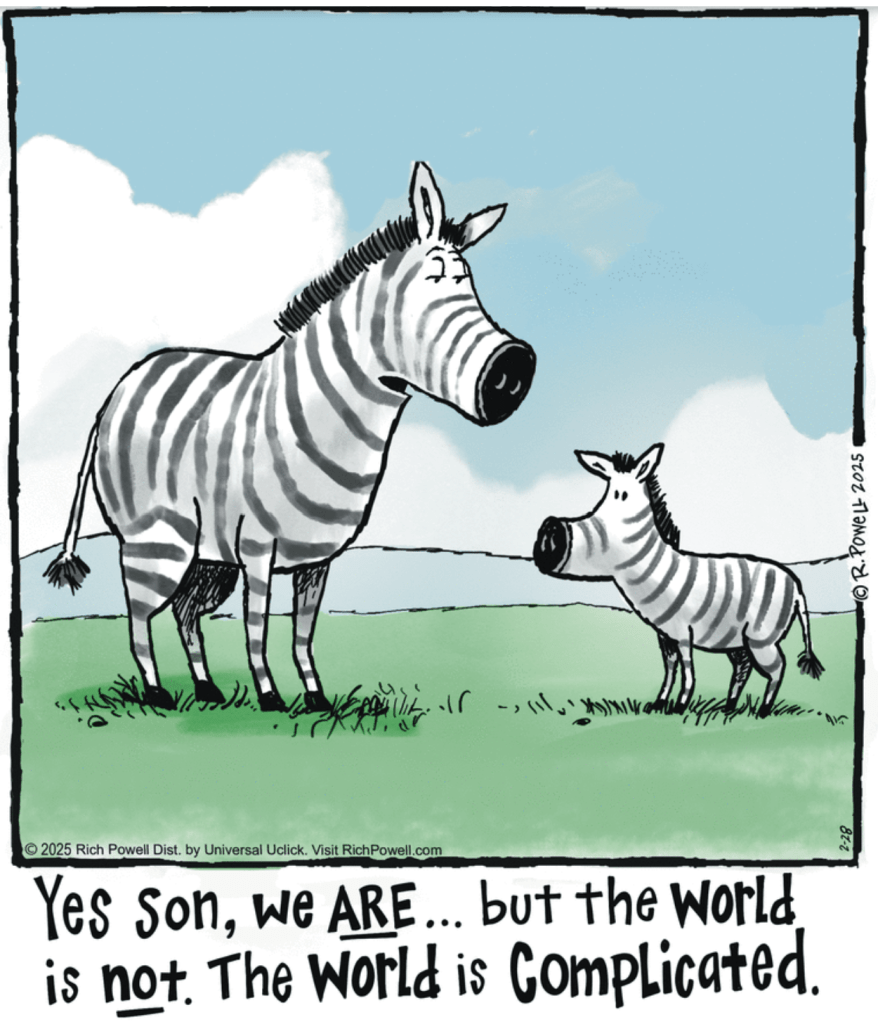
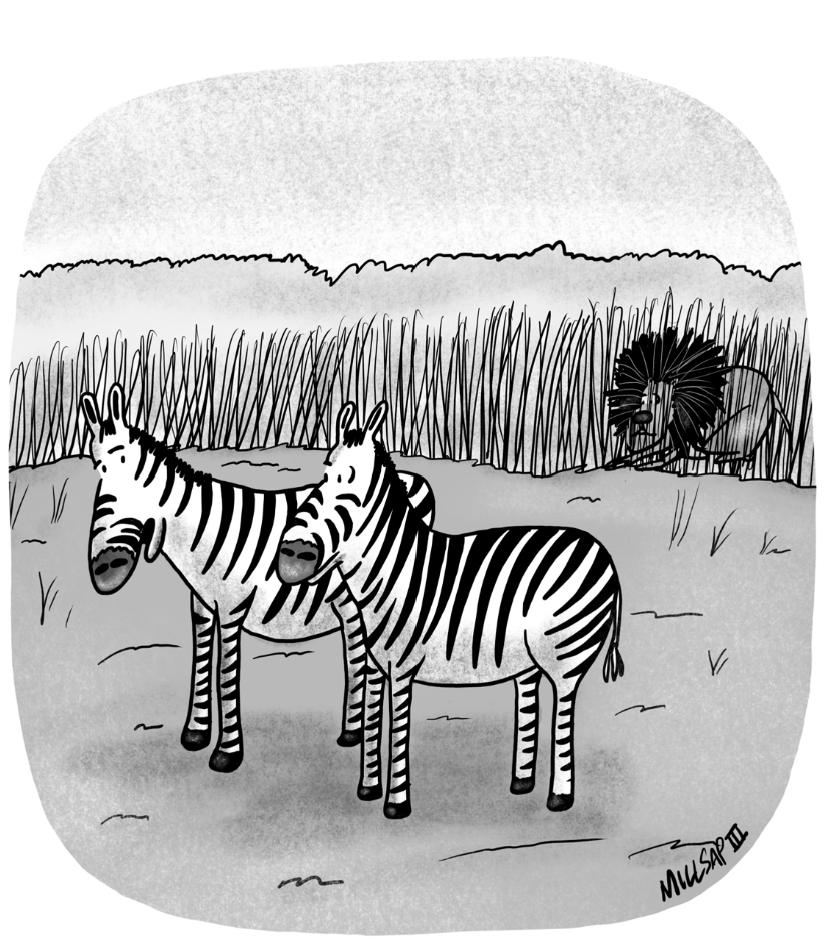
In other zebra cartoon news, the New Yorker’s caption contest had a zebra theme recently.
The finalists for winning caption are these:
Related
6 Comments
Is it that they are black and white?
Yes, it’s a black-and-white comment, but I’m confused about their snouts. Why did the artist make them look like pigs?
I vaguely recall from several years ago a genetics/evolutionary popularization article that said there is a meaningful difference between having a white coat with black stripes and having a black coat with white stripes, and that the traditional question of which one is a zebra has a genuine answer. (I think traditionally it had been asked as a way of saying “some things make no difference”.)
P.s., I agree with Chemgal about that problem with the drawing.
Oh! You’re probably right about the black-and-white explanation. I thought they were referring to people saying if you hear hoofbeats, think horse, not zebra.
Here is a 1981 news agency story on the zebra question, invoking Stephen Jay Gould:
I’ve never bought the argument that we should determine a zebra’s base color by looking at how the stripes are formed. To me, the question is a visual one, not a genetic one, and the white underbelly is definitive as far as I’m concerned.
The problem is science communicators have taken Gould’s opinion and repeated it as incontrovertible fact without even questioning the assumptions that lead to his conclusion.

 Comics I Don't Understand
Is it that they are black and white?
Yes, it’s a black-and-white comment, but I’m confused about their snouts. Why did the artist make them look like pigs?
I vaguely recall from several years ago a genetics/evolutionary popularization article that said there is a meaningful difference between having a white coat with black stripes and having a black coat with white stripes, and that the traditional question of which one is a zebra has a genuine answer. (I think traditionally it had been asked as a way of saying “some things make no difference”.)
P.s., I agree with Chemgal about that problem with the drawing.
Oh! You’re probably right about the black-and-white explanation. I thought they were referring to people saying if you hear hoofbeats, think horse, not zebra.
Here is a 1981 news agency story on the zebra question, invoking Stephen Jay Gould:
https://www.upi.com/Archives/1981/07/31/And-By-The-Way-What-color-is-a-zebra/4720365400000/
I’ve never bought the argument that we should determine a zebra’s base color by looking at how the stripes are formed. To me, the question is a visual one, not a genetic one, and the white underbelly is definitive as far as I’m concerned.
The problem is science communicators have taken Gould’s opinion and repeated it as incontrovertible fact without even questioning the assumptions that lead to his conclusion.