For those artists whose work deals primarily in mixed messages, this place seems ideal:
Related
11 Comments
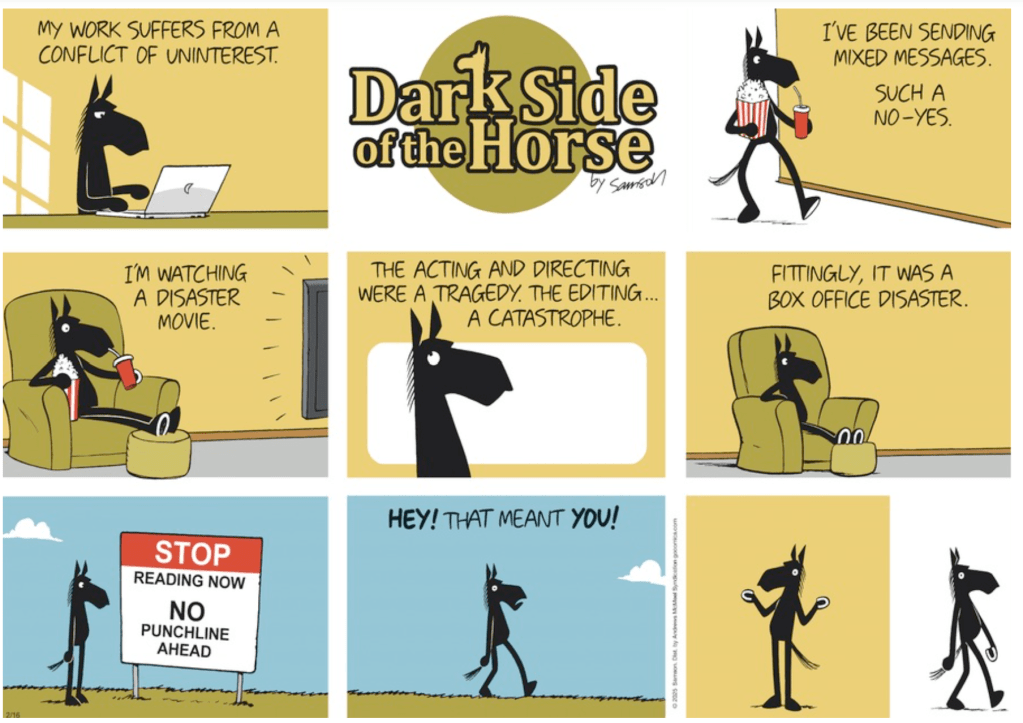
I don’t get the joke in the top-right Horse panel.
Sort of in the spirit of No-Yes, I get mailings from a gallery / oollectors group / auction house of offbeat art called Boo-Hooray.
@Powers: If Horse is answering a question sometimes yes, sometimes no, he would be sending mixed messages.
There an old IT joke about management asking for something to be made better, and made faster, and made cheaper. Better, faster, cheaper: you can only choose two of those three. Management insisting on all 3 is sending a mixed message about what they really need — i.e. failing in the basic management task of setting clear priorities.
Well, yes, zbicyclist, but that’s not a joke on its own. It would be a joke if “No-Yes” was a pun or a reference to something related.
The Noyes Art Center, after a bit of consideration, seems a bit of a stretch, even if they do specialize in “mixed media” (which I don’t know that they do): it seems a bit of an obscure reference (I’d never heard of it, and Evanston, Illinois is not exactly the cultural center of the world…) Plus, there’s the awkward “such a Noyes” phrasing, if that were the referent. I then thought maybe it’s a pun for “noise”, but that doesn’t really work, either. So I’m back to thinking this might be one of those rare instances where the author’s non-native English might be to blame, but I still can’t figure out what he’s getting at.
@zbicyclist: I’ve been thinking that it’s not even true that you can get most of the two of the three: OK, cheap and fast and crappy, obviously; but cheap and good? And good and fast? Cheap and good — what is cheap? The final product, or the development of the product? Maybe if you spend a lot of time you can get a good cheap final product, but obviously this costs a lot of time, which is to say, at the end, when you account for all the time, it isn’t really cheap anymore; time is money. after all. But OK, maybe having a cheap product at the end like the Model T Ford after a decade of production and improvement and price reduction, is worth the investment of time, so cheap and good, maybe. But good and fast? I think this is a fallacy that you can get good if you’re willing to pay. Yes, it can be true for mature products, but then again, there are Veblin goods, so the absolute correlation I don’t think is there. And often times you get hucksters selling you crap for lots of money, expressly because so many people believe in this shaky correlation. If I need something new, I don’t know that I can just buy it for a bunch of money — I can spend a bunch of money, but I don’t know that it will get me the final product any faster.
So in the end, really, it’s : if you want good, you can’t have fast or cheap; if you want fast, you can’t have good, but you can feel free to spend a lot of money anyway; and if you want cheap, you have to define what you want to be cheap: if the process, then you probably can’t get good (unless you’re lucky by a fluke) because it will cost time, which is to say you can’t have fast; and if you want the product cheap, then you can’t have fast — and in either case, good doesn’t seem to be guaranteed, more of a luck thing.
Re Noyes, there is a Noyes family not too far from where I live. I think they pronounce it like “noise”. I always read it as “no yes” anyway.
Re good, cheap and fast: this refers to projects. A “project” has a definite beginning and end, and a “definition of done” that defines the end. For example, setting up a factory to produce Model T Fords. The project is complete when Fords start to roll off the line. Producing the actual Fords is “operations” and does not have a definite end known in advance. (Wasn’t it something like fifteen years for the Model T Ford?) A “program” consists of projects and operations. The Model T Ford program involved setting up to make Model T’s and then making them, advertising them and selling them.
Of course there is an art to making things better, faster and cheaper. For the first few years of the Model T, the price of the final product came down at the same time quality was improved. But that was because of projects to improve quality and reduce cost, and additional assembly lines. “Fast” for operations is how many units can be produced per unit of time. “Fast” for a project is elapsed time from beginning to end.
If you really want a project to be done fast (i.e. shorter elapsed time) you have to “fast-track” it. Say you have a portion that must be complete before you can start on the next part. For instance, you have to complete the factory building before you can fabricate and set up the equipment. What you may do is start to build the brick factory but at the same time build a temporary wooden shed in which you can begin to fabricate the equipment while the brick building is under construction. Then when the brick building is ready you move in the equipment. Finally you tear down the shed. So you have shortened the time by moving forward the start time for the equipment fabrication, at the expense of constructing a temporary building and then tearing it down and restoring the terrain.
So is this Noyes Art Center item an advertisement for the museum?
A “project” has a definite beginning and end, and a “definition of done” that defines the end.
I had another example I considered with regards to this: the Manhattan Project. They were clearly going for fast and good, with cheap not being a consideration, and yet they still just barely came in with a “good” product — one theater of the war was already over, the other all but for the shooting. Clearly you can only make things so fast, no matter how much money and expertise you throw at it.
larK (9): Right, as the saying goes, “It takes nine months to make a baby, no matter how many men you put on the job”. Aka The Mythical Man-Month (Fred Brooks).
I read “noyes” as noise as I have always heard it pronounced that way in different situations.



 Comics I Don't Understand
I don’t get the joke in the top-right Horse panel.
Sort of in the spirit of No-Yes, I get mailings from a gallery / oollectors group / auction house of offbeat art called Boo-Hooray.
@Powers: If Horse is answering a question sometimes yes, sometimes no, he would be sending mixed messages.
There an old IT joke about management asking for something to be made better, and made faster, and made cheaper. Better, faster, cheaper: you can only choose two of those three. Management insisting on all 3 is sending a mixed message about what they really need — i.e. failing in the basic management task of setting clear priorities.
Well, yes, zbicyclist, but that’s not a joke on its own. It would be a joke if “No-Yes” was a pun or a reference to something related.
The Noyes Art Center, after a bit of consideration, seems a bit of a stretch, even if they do specialize in “mixed media” (which I don’t know that they do): it seems a bit of an obscure reference (I’d never heard of it, and Evanston, Illinois is not exactly the cultural center of the world…) Plus, there’s the awkward “such a Noyes” phrasing, if that were the referent. I then thought maybe it’s a pun for “noise”, but that doesn’t really work, either. So I’m back to thinking this might be one of those rare instances where the author’s non-native English might be to blame, but I still can’t figure out what he’s getting at.
@zbicyclist: I’ve been thinking that it’s not even true that you can get most of the two of the three: OK, cheap and fast and crappy, obviously; but cheap and good? And good and fast? Cheap and good — what is cheap? The final product, or the development of the product? Maybe if you spend a lot of time you can get a good cheap final product, but obviously this costs a lot of time, which is to say, at the end, when you account for all the time, it isn’t really cheap anymore; time is money. after all. But OK, maybe having a cheap product at the end like the Model T Ford after a decade of production and improvement and price reduction, is worth the investment of time, so cheap and good, maybe. But good and fast? I think this is a fallacy that you can get good if you’re willing to pay. Yes, it can be true for mature products, but then again, there are Veblin goods, so the absolute correlation I don’t think is there. And often times you get hucksters selling you crap for lots of money, expressly because so many people believe in this shaky correlation. If I need something new, I don’t know that I can just buy it for a bunch of money — I can spend a bunch of money, but I don’t know that it will get me the final product any faster.
So in the end, really, it’s : if you want good, you can’t have fast or cheap; if you want fast, you can’t have good, but you can feel free to spend a lot of money anyway; and if you want cheap, you have to define what you want to be cheap: if the process, then you probably can’t get good (unless you’re lucky by a fluke) because it will cost time, which is to say you can’t have fast; and if you want the product cheap, then you can’t have fast — and in either case, good doesn’t seem to be guaranteed, more of a luck thing.
Re Noyes, there is a Noyes family not too far from where I live. I think they pronounce it like “noise”. I always read it as “no yes” anyway.
Re good, cheap and fast: this refers to projects. A “project” has a definite beginning and end, and a “definition of done” that defines the end. For example, setting up a factory to produce Model T Fords. The project is complete when Fords start to roll off the line. Producing the actual Fords is “operations” and does not have a definite end known in advance. (Wasn’t it something like fifteen years for the Model T Ford?) A “program” consists of projects and operations. The Model T Ford program involved setting up to make Model T’s and then making them, advertising them and selling them.
Of course there is an art to making things better, faster and cheaper. For the first few years of the Model T, the price of the final product came down at the same time quality was improved. But that was because of projects to improve quality and reduce cost, and additional assembly lines. “Fast” for operations is how many units can be produced per unit of time. “Fast” for a project is elapsed time from beginning to end.
If you really want a project to be done fast (i.e. shorter elapsed time) you have to “fast-track” it. Say you have a portion that must be complete before you can start on the next part. For instance, you have to complete the factory building before you can fabricate and set up the equipment. What you may do is start to build the brick factory but at the same time build a temporary wooden shed in which you can begin to fabricate the equipment while the brick building is under construction. Then when the brick building is ready you move in the equipment. Finally you tear down the shed. So you have shortened the time by moving forward the start time for the equipment fabrication, at the expense of constructing a temporary building and then tearing it down and restoring the terrain.
So is this Noyes Art Center item an advertisement for the museum?
A “project” has a definite beginning and end, and a “definition of done” that defines the end.
I had another example I considered with regards to this: the Manhattan Project. They were clearly going for fast and good, with cheap not being a consideration, and yet they still just barely came in with a “good” product — one theater of the war was already over, the other all but for the shooting. Clearly you can only make things so fast, no matter how much money and expertise you throw at it.
larK (9): Right, as the saying goes, “It takes nine months to make a baby, no matter how many men you put on the job”. Aka The Mythical Man-Month (Fred Brooks).
I read “noyes” as noise as I have always heard it pronounced that way in different situations.