I guess I’m not entirely sure about the first one. Is it as simple as “Bill in a china shop” or does the winter coat figure into the pun?
@Brian, I’d say the coat doesn’t “figure into the pun”, but is part of the situation or setup — it’s the reason Bill is wreaking havoc.
Because of math, the sentence “I am real, but i is not real” is both true and grammatically correct.
I am not a number, I am a free man!
Bwah ha ha ha….
Timing. Couple hours ago saw an episode of Young Sheldon where YS is blown away when his sister is miffed that zero is nothing so doesn’t exist and he and his mentors one-by-one melt down too because of….semantics.
I’ve just been corrected – it started with the neighbor kid needing tutoring.
Numbers are my life! And it is hard to add, etc. Roman numerals as someone who was not born during their popular time.
Hmmm, thinking about doing formal bookkeeping with Roman numerals…
Meryl A:
In Western Europe, bookkeepers were among the first to adopt Arabic numerals, which at the time they called Saracen numbers.
There were several reasons for adoption. One is that international merchants in their travels were exposed to them and curious to learn about them. A second is that multiplication and division are easier, and very large numbers can be handled almost as easily as smaller numbers. A third is that the two systems are isomorphic; a number can easily be converted from one to the other, and the common abacus is easy to read either as Arabic or as Roman.
Resistance was partly because of suspicion of something that came from non-Christian lands, and mainly that the old system worked just fine for most people, and the time spent learning the new system did not pay off for people who were not doing a lot of multiplying and dividing.
One thing about the adoption of arabic numbers that doesn’t get considered nearly enough is that we ripped out the system and installed it wholesale into our own writing system, without taking into consideration that Arabic writes right-to-left, while we write left-to-right. Even though we try to fool ourselves with “Most Significant Digits” coming first, it is really a pain in the ass, because just to figure out what that “Most Significant Digit” signifies, we have to go all the way to the end of the number and count back to the front before we can even know what it represents — this is not a feature, it is a bug, and wholey because we barbarians didn’t fully understand the system we were ripping off and adjust it to fit our writing system.
I realized this back when I was learning how to write binary numbers, and the disconnect that the easier way to do it was to write the binary numbers “backwards” — it was then that it dawned on me that we were writing all our decimal numbers ass to front, and how stupid it was.
Read this out loud: “The package weights 21.5 pounds.” I bet you said “The package weighs twenty-one point five pounds.” This would indicate that we think of numbers high-order first.
Roman numerals also put high-order first: MCMXXXVII.
It’s true that you have to look ahead to the decimal point so that you say “twenty-one” instead of “two hundred oops twenty-one”, but if numbers were written in reverse you would still have to look ahead — either way it’s a two-pass algorithm.
Hmm, the two-pass thing is of course correct, but fails to explain one of my pet peeves: text-to-voice that’s too “smart”. I’ve had rental cars that read text messages to you, and they say things like “United flight nine hundred and four leaves at six hundred twenty-three PM”.
So it’s clearly making two passes, so it knows to say “nine hundred and four” and “twenty-three”. “leaves at six two three PM” would be a bit fugly, but would be better than “six hundred twenty-three”! But if it’s going to do two passes, I can think of no cases where “six twenty-three” wouldn’t be OK. (“flight nine zero four” is of course fine.)
It’s interesting to think of a little-endian culture where all numbers are done smallest to largest. I’m not sure how you’d ask for a quarter pound of something using decimals: “Give me five two point”? There’s no particular reason that couldn’t have happened somewhere.
Note that in Unicode-land there’s BIDI — BiDirectional text, where the letters are right-to-left but then embedded numbers are left-to-right. So
fed123cba
would be read as “abc 123 def”. Ouch! (And I can never read “BIDI” without thinking of Buck Rogers in the 25th Century.)
Read this out loud: “The package weights 21.5 pounds.”
The package weighs twenty-one and a half pounds.
Das Paket wiegt einundzwanzigeinhalb Pfund.
[the package weighs one and twenty one-half pounds]
We used to do our numbers little-endian up to a hundred (and some languages still do). But we seem to like grouping our numbers, especially after a thousand (ten thousand, hundred thousand), and confusingly between hundreds and thousands (fifteen hundred, …, ninety-nine hundred, ten thousand), and decimals add even more complexity. But if we had logical extra words for ten thousand and hundred thousand, sort of like India’s Lakh, but not quite, we could go little endian for quite a while.
Consider: 1,435,956,321, or 123,659,534,1 as it would be little-endian: one and twenty and three-hundred and six-thousand and five-decigrand and nine-centigrand and five million and three-decimeg and four-centimeg and one billion … (or is that “milliard”? ;-)
Compare to: one milliard four hundred thirty-five million nine hundred fifty-six thousand three hundred twenty-one
We are more familiar with the latter, but there’s a lot of processing and grouping going on in that version that we are just so used to we don’t notice it. Whereas the first version, assuming you have memorized and have familiarity with all the number names, you are more just reading what you see. (Yes, technically you are grouping and counting when you use deci-grand and centi-grand, but with use you would stop noticing and just treat them as chunks, much like you really don’t notice that “thirty” really means “three times ten”; the main thing is it’s just one pass…)
(Yeah, I just ignored your main point, decimals — they really confuse things. Are we interested in precision, or is it enough to tack on a half or a quarter at the end? Or would you lead with it? “one-half and one and twenty pounds, please”? There’s no reason you couldn’t read the decimals little-endian too, assuming the decimal is rational; it gets hairy if it’s and an irrational decimal, ’cause I guess you could never start...)
Actually, to my chagrin, of course you can’t “just” read the decimals little-endian; decimals confuse things: you have to read toward (or away from) the decimal, so either system is going to have challenges, because once you hit the decimal, you have to reverse the way your grouping works. Decimals are weird…
And yes, the biggest problem with little-endian would be irrational numbers…
Sing a song of sixpence, pocket full of rye,
Four and twenty blackbirds baked in a pie.
So I guess Mother Goose could sometimes be little-endian.
Now if you were buying them in England, before “new pence”, you might have paid four-and-eighteen for them, or four-and-nineteen, but if you paid four-and-twenty that would mean you paid five. If that seems weird and trippy it’s because they were all on LSD at the time.
but if you paid four-and-twenty that would mean you paid five
Yet if you’d paid four-and-twenty-five you’d also have paid five; or if you paid four-and-four you’d have paid four…
LSD indeed…
“But whatever his weight in pounds, shillings, and ounces,. He always seems bigger because of his bounces.” — Pooh
Pooh said that the “shillings” just seemed to belong there after the pounds. He must have been under the influence of LSoz.
I read it as 21 and a half pounds.
Luckily the numbers I work with are US money numbers so they are always done by decimals.
When I was 10 years old my dad had me adding up payroll books for him on an adding machine. So I have actually WORKED with numbers since then – before that my number usage was for school work and keeping track of my allowance spending.
Before I was 10 – back when I was around 8 or so – my dad bought a marvelous machine – it made copies of papers. He no longer had to fill in tax returns using carbon paper to have a copy for himself and one for the client – how wonderful. A piece of special coated paper and the page to be copied were inserted into the top slot of this machine, the papers entered the slot together and a green light came on inside the machine. The papers would come back out. The coated paper – now with the original photocopied onto it – would then be inserted on its own into the bottom slot. Here it would be processed in the liquid used for this process and would come out – seemingly magically – with an exact (black and white – though a bit more black and light gray than actual white) copy of the original. Since the copy came out wet (not damp – wet) my job was to take the copy and hang it up on a laundry type line by laying it over the line where it sat until the paper dried.
Now I all I have to do is open the top of one of the two printer/scanners in our home office, put the original on top, close the top and either scan it to the computer or make a copy of it – which is printed out dry! On a good day the scanner which one can feed through and copy both sides at once feels like doing its job – the work can be done even faster.
I have a tax client who I was charging $10 for her tax return – which upset husband – and as of last year I am not charging her at all. She is only filing a NYS/NYC return and only doing as her income is so low that she gets a NYC refund even though nothing was withheld. (She is retired.) Why do her return so cheap? Well – that first payroll book I added up on the adding machine for my dad when I was a kid was her dad’s business’s payroll! After a relationship this long – I am not going to charge her anything more than this.


 Comics I Don't Understand
This DSOH was pretty darn brilliant!
Second @Mitch4. Those are some prime math puns.
“prime math puns” :)
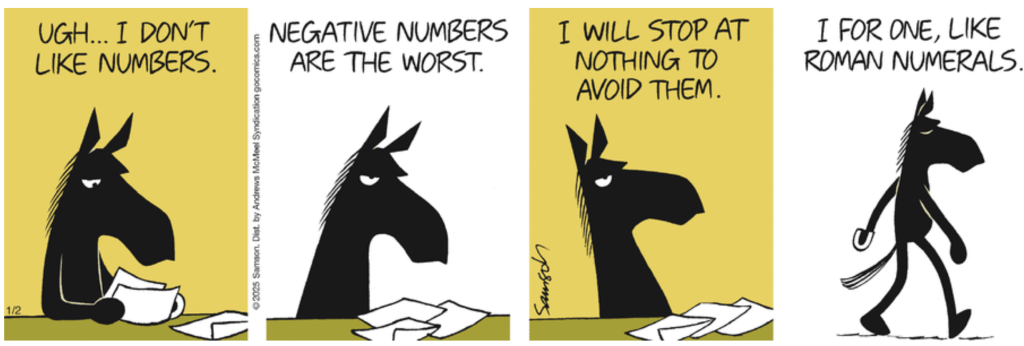
Negative numbers aren’t natural.
I guess I’m not entirely sure about the first one. Is it as simple as “Bill in a china shop” or does the winter coat figure into the pun?
@Brian, I’d say the coat doesn’t “figure into the pun”, but is part of the situation or setup — it’s the reason Bill is wreaking havoc.
Because of math, the sentence “I am real, but i is not real” is both true and grammatically correct.
I am not a number, I am a free man!
Bwah ha ha ha….
Timing. Couple hours ago saw an episode of Young Sheldon where YS is blown away when his sister is miffed that zero is nothing so doesn’t exist and he and his mentors one-by-one melt down too because of….semantics.
I’ve just been corrected – it started with the neighbor kid needing tutoring.
Numbers are my life! And it is hard to add, etc. Roman numerals as someone who was not born during their popular time.
Hmmm, thinking about doing formal bookkeeping with Roman numerals…
Meryl A:
In Western Europe, bookkeepers were among the first to adopt Arabic numerals, which at the time they called Saracen numbers.
There were several reasons for adoption. One is that international merchants in their travels were exposed to them and curious to learn about them. A second is that multiplication and division are easier, and very large numbers can be handled almost as easily as smaller numbers. A third is that the two systems are isomorphic; a number can easily be converted from one to the other, and the common abacus is easy to read either as Arabic or as Roman.
Resistance was partly because of suspicion of something that came from non-Christian lands, and mainly that the old system worked just fine for most people, and the time spent learning the new system did not pay off for people who were not doing a lot of multiplying and dividing.
One thing about the adoption of arabic numbers that doesn’t get considered nearly enough is that we ripped out the system and installed it wholesale into our own writing system, without taking into consideration that Arabic writes right-to-left, while we write left-to-right. Even though we try to fool ourselves with “Most Significant Digits” coming first, it is really a pain in the ass, because just to figure out what that “Most Significant Digit” signifies, we have to go all the way to the end of the number and count back to the front before we can even know what it represents — this is not a feature, it is a bug, and wholey because we barbarians didn’t fully understand the system we were ripping off and adjust it to fit our writing system.
I realized this back when I was learning how to write binary numbers, and the disconnect that the easier way to do it was to write the binary numbers “backwards” — it was then that it dawned on me that we were writing all our decimal numbers ass to front, and how stupid it was.
Obligatory comic:
And for the non-programmers, there’s this thing called “endianness”: https://en.wikipedia.org/wiki/Endianness
Lots of fun (not).
Read this out loud: “The package weights 21.5 pounds.” I bet you said “The package weighs twenty-one point five pounds.” This would indicate that we think of numbers high-order first.
Roman numerals also put high-order first: MCMXXXVII.
It’s true that you have to look ahead to the decimal point so that you say “twenty-one” instead of “two hundred oops twenty-one”, but if numbers were written in reverse you would still have to look ahead — either way it’s a two-pass algorithm.
Hmm, the two-pass thing is of course correct, but fails to explain one of my pet peeves: text-to-voice that’s too “smart”. I’ve had rental cars that read text messages to you, and they say things like “United flight nine hundred and four leaves at six hundred twenty-three PM”.
So it’s clearly making two passes, so it knows to say “nine hundred and four” and “twenty-three”. “leaves at six two three PM” would be a bit fugly, but would be better than “six hundred twenty-three”! But if it’s going to do two passes, I can think of no cases where “six twenty-three” wouldn’t be OK. (“flight nine zero four” is of course fine.)
It’s interesting to think of a little-endian culture where all numbers are done smallest to largest. I’m not sure how you’d ask for a quarter pound of something using decimals: “Give me five two point”? There’s no particular reason that couldn’t have happened somewhere.
Note that in Unicode-land there’s BIDI — BiDirectional text, where the letters are right-to-left but then embedded numbers are left-to-right. So
fed123cba
would be read as “abc 123 def”. Ouch! (And I can never read “BIDI” without thinking of Buck Rogers in the 25th Century.)
Read this out loud: “The package weights 21.5 pounds.”
The package weighs twenty-one and a half pounds.
Das Paket wiegt einundzwanzigeinhalb Pfund.
[the package weighs one and twenty one-half pounds]
We used to do our numbers little-endian up to a hundred (and some languages still do). But we seem to like grouping our numbers, especially after a thousand (ten thousand, hundred thousand), and confusingly between hundreds and thousands (fifteen hundred, …, ninety-nine hundred, ten thousand), and decimals add even more complexity. But if we had logical extra words for ten thousand and hundred thousand, sort of like India’s Lakh, but not quite, we could go little endian for quite a while.
Consider: 1,435,956,321, or 123,659,534,1 as it would be little-endian: one and twenty and three-hundred and six-thousand and five-decigrand and nine-centigrand and five million and three-decimeg and four-centimeg and one billion … (or is that “milliard”? ;-)
Compare to: one milliard four hundred thirty-five million nine hundred fifty-six thousand three hundred twenty-one
We are more familiar with the latter, but there’s a lot of processing and grouping going on in that version that we are just so used to we don’t notice it. Whereas the first version, assuming you have memorized and have familiarity with all the number names, you are more just reading what you see. (Yes, technically you are grouping and counting when you use deci-grand and centi-grand, but with use you would stop noticing and just treat them as chunks, much like you really don’t notice that “thirty” really means “three times ten”; the main thing is it’s just one pass…)
(Yeah, I just ignored your main point, decimals — they really confuse things. Are we interested in precision, or is it enough to tack on a half or a quarter at the end? Or would you lead with it? “one-half and one and twenty pounds, please”? There’s no reason you couldn’t read the decimals little-endian too, assuming the decimal is rational; it gets hairy if it’s and an irrational decimal, ’cause I guess you could never start...)
Actually, to my chagrin, of course you can’t “just” read the decimals little-endian; decimals confuse things: you have to read toward (or away from) the decimal, so either system is going to have challenges, because once you hit the decimal, you have to reverse the way your grouping works. Decimals are weird…
And yes, the biggest problem with little-endian would be irrational numbers…
Sing a song of sixpence, pocket full of rye,
Four and twenty blackbirds baked in a pie.
So I guess Mother Goose could sometimes be little-endian.
Now if you were buying them in England, before “new pence”, you might have paid four-and-eighteen for them, or four-and-nineteen, but if you paid four-and-twenty that would mean you paid five. If that seems weird and trippy it’s because they were all on LSD at the time.
but if you paid four-and-twenty that would mean you paid five
Yet if you’d paid four-and-twenty-five you’d also have paid five; or if you paid four-and-four you’d have paid four…
LSD indeed…
“But whatever his weight in pounds, shillings, and ounces,. He always seems bigger because of his bounces.” — Pooh
Pooh said that the “shillings” just seemed to belong there after the pounds. He must have been under the influence of LSoz.
I read it as 21 and a half pounds.
Luckily the numbers I work with are US money numbers so they are always done by decimals.
When I was 10 years old my dad had me adding up payroll books for him on an adding machine. So I have actually WORKED with numbers since then – before that my number usage was for school work and keeping track of my allowance spending.
Before I was 10 – back when I was around 8 or so – my dad bought a marvelous machine – it made copies of papers. He no longer had to fill in tax returns using carbon paper to have a copy for himself and one for the client – how wonderful. A piece of special coated paper and the page to be copied were inserted into the top slot of this machine, the papers entered the slot together and a green light came on inside the machine. The papers would come back out. The coated paper – now with the original photocopied onto it – would then be inserted on its own into the bottom slot. Here it would be processed in the liquid used for this process and would come out – seemingly magically – with an exact (black and white – though a bit more black and light gray than actual white) copy of the original. Since the copy came out wet (not damp – wet) my job was to take the copy and hang it up on a laundry type line by laying it over the line where it sat until the paper dried.
Now I all I have to do is open the top of one of the two printer/scanners in our home office, put the original on top, close the top and either scan it to the computer or make a copy of it – which is printed out dry! On a good day the scanner which one can feed through and copy both sides at once feels like doing its job – the work can be done even faster.
I have a tax client who I was charging $10 for her tax return – which upset husband – and as of last year I am not charging her at all. She is only filing a NYS/NYC return and only doing as her income is so low that she gets a NYC refund even though nothing was withheld. (She is retired.) Why do her return so cheap? Well – that first payroll book I added up on the adding machine for my dad when I was a kid was her dad’s business’s payroll! After a relationship this long – I am not going to charge her anything more than this.