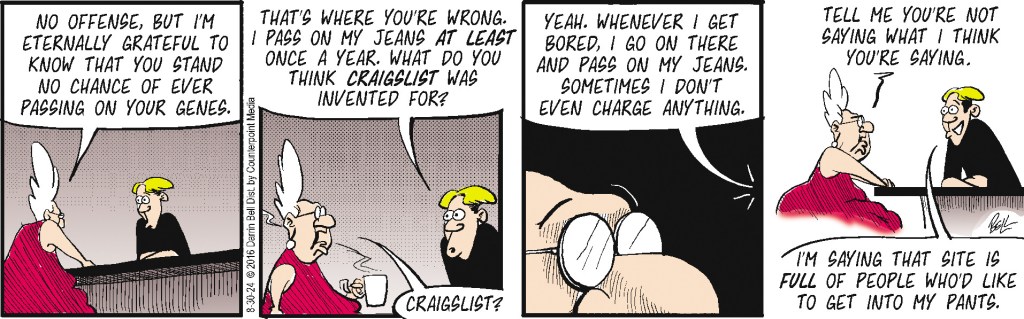
Recently surfaced by Dan Piraro for use in his Naked Cartoonist premium essay series.
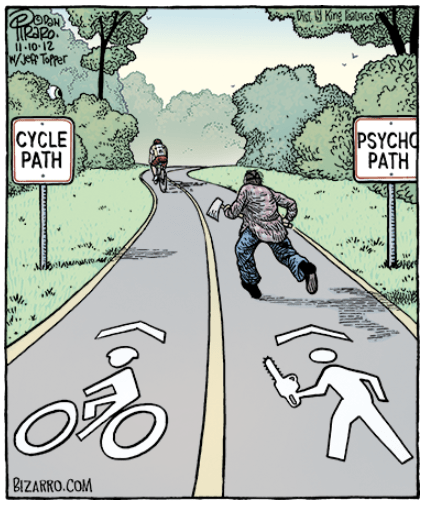
And his Bizarro partner Wayno on his weekly blog posts sometimes chooses a panel and shows the changes he made to turn it into the strip version. In this case, the strip had to become a column.

…
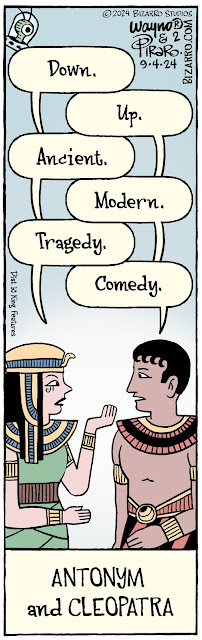
For both versions, I had a mental-block kind of a problem, as the order of names in the caption does not agree with the placement of the characters in the drawing if taken left-to-right. No, there’s no reason they need to agree, so this is not a criticism, just a note on the mental twitch that left me studying them in puzzlement for a good minute. Anyone else?
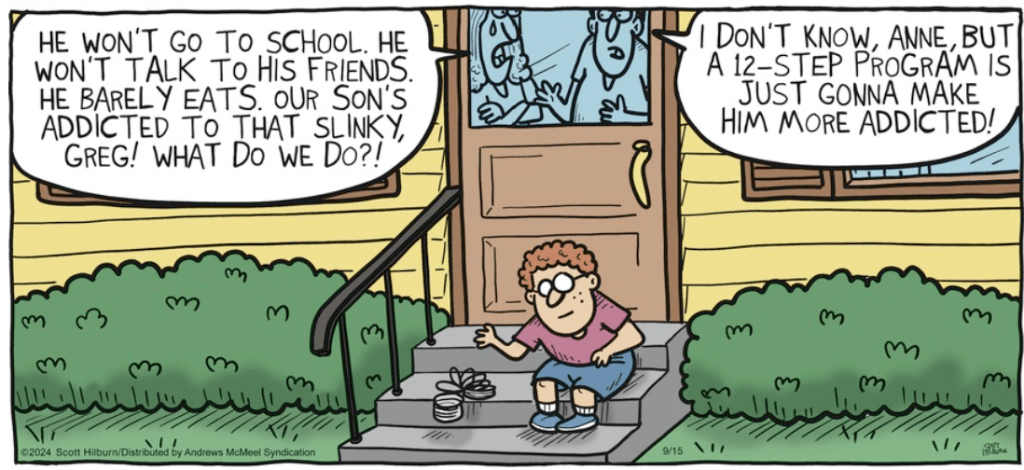

 Comics I Don't Understand
I’ll be really glad when McDonnell finally finishes his sabbatical and starts producing new comics.
P.S. But why? What was wrong with the old ones? Well, nothing, really, that’s the problem. He could retire and nobody would miss him for another 30 years.
You can’t see a new moon because they don’t appear at night. By definition, it’s washed out by the sun and only is above the horizon when the sun is.
Yes, the order of the characters vs the names in the Cleopatra comic threw me off. But if you swap the characters, Cleopatra still has to speak first, so you’d be reading the word bubbles right to left and that’s weird too.
I didn’t like the “reversed” visual order, either, but the caption has to stay the way it is, because that’s the way the play is titled. However, that doesn’t mean that it would be impossible to rearrange the composition to match:
…
P.S. As a minor added bonus, the horizontal flip has Cleopatra “speaking” with her right hand, instead of her left.
Could you invite Wayno to have a look at this thread?
The core problem is that the rules of blocking for English-language comics say you should have the first speaker in a panel on the left if at all possible. And since these are just talking heads rather than some sort of action sequence, the rule gets followed even though it contradicts the caption.
Sometimes you can faintly see the new moon right around sunset (or sunrise) as it reflects some of the earthshine.
…But it doesn’t appear the way Mr. McDonnell’s got it drawn.
No, that’s an annular eclipse. Which…I don’t think happens for the moon (or it’s even rarer than an annular solar eclipse). I don’t think the moon gets far enough from the Earth to get a full-circle shadow on it – and even if it did, the times that the shadow would be so perfectly placed would be vanishingly rare.
On the other hand, how _would_ you draw a new moon? Black on black, or with the faintest light glowing it up – it could be done in paint, but in a comic strip? It’s less silly than the very standard “star between the horns of the moon” image.
@ jjmcgaffey – The reason that an annular solar eclipse is possible is that the relative diameters of the sun and the moon (as seen from earth) are nearly identical: when the moon is a little farther away than usual, it cannot cover the entire sun. An annular lunar eclipse is impossible, because the diameter of the earth (as seen from the moon) is much bigger than the sun, so there is always more than enough coverage, even when the earth is at its most distant point in its orbit.
P.S. @4 – The aspect ratio of the modified version seemed a bit too wide, so I tried tightening it up a bit:
The time you see (and comment) on the new moon is when it’s first visible. So a thin crescent, near the horizon, just after sunset.
P.S. @ jjmcgaffey – After looking at a few lunar eclipse animations, I realized that the explanation I gave @10 is not precisely correct, because nobody is viewing a lunar eclipse from the surface of the moon. Neverthess, it turns out that the diameter of the Earth’s “umbra” (shadow) is about three times as large as the moon’s diameter, so the bottom line is that an annular lunar eclipse is still impossible.