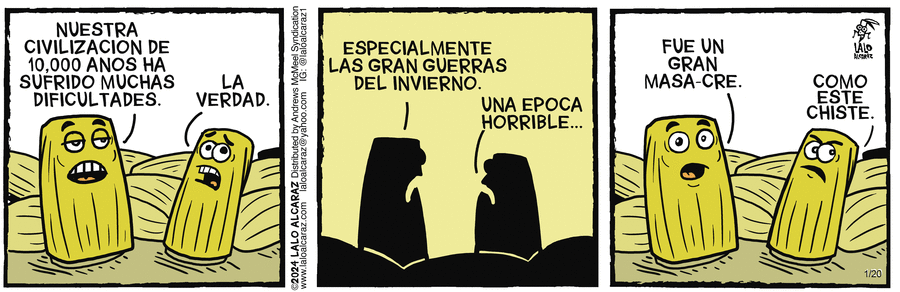

Very considerate of the English captioning to inform us these are tamales, which is not mentioned in the Spanish, and may not have been that obvious. In panel 2, invierno means winter, but I’m glad to learn that it might be a way Spanish speakers refer to what Anglophone North America calls “the holidays” or “the holiday period”.
But the crux of the puzzlement is in the final panel. We have the material for a pun, in partial split meanings: masa by itself can mean dough, and masacre written solid would be the obvious massacre, or as Google Translate for some reason prefers, slaughter. But we have to ask, if there are fluent or native Spanish speakers here, does this work for you as a joke?
 Comics I Don't Understand
Masa is the flour used to make tortillas, tacos, etc. He’s using it as a pun for massacre.
Masa is also the main ingredient of tamales. Many families (usually the women) have a tradition of making tamales for the “winter” holidays.
OK, but does the pun then work in English? (I don’t think it really needs to.) That is, is masa by now a known loan-word in English?
Danny Boy: I’d think so. I’ve known it for over 40 years.
(How am I so sure about that? Because back when I was in my 20s and living in small-town Ontario, I got into making Mexican food. There was NOWHERE to buy tortillas locally: I could drive into Toronto and buy frozen ones, but ick. So I learned to make my own [badly], which meant I had to buy masa [also in Toronto].)
This brings up a question I’ve had for a while. In English, we make lots of puns, subbing a similar word in a common phrase, like “Snow much fun”, or any of the puns discussed on this site. Do other languages do that too? And do they do it often, or is it much more rare?
phsiii,
And if you dropped the bag of corn flour in a snowbank, you can always sing about it: “Masa’s in de cold cold ground.”
That’s enough pun-ishment for one day.
Ouch.
Wendy: Other languages do wordplay, but it varies. For example, I don’t believe there are Chinese crossword puzzles–ideograms don’t lend themselves to that. And some languages’ pronunciation is so regular that homophones like there/they’re/their don’t exist.
This would make an interesting book, “Wordplay Around the World”!
I found this: https://wonderfulwordplay.weebly.com/blog/wordplay-in-different-languages — not particularly well written, but it’s something.
https://www.google.com/search?q=wordplay+in+different+languages&newwindow=1 finds some Reddit and Quora threads, too.
And now I need to pretend to^w^wpay attention to this meeting…
Technically masa is a fresh dough made from ground processed corn. Most Americans are familiar with masa harina, which is masa that has been dried and ground further into a flour.
While I think the translation is accurate, and the pun on “massacre” works acceptably well in either language, I do not think that all (or even most) American English speakers will get the joke. It requires knowledge of Latin American cooking traditions, and while that may be found anywhere in North America (including Ontario @4 and St. Louis @8), it is more likely to be found in large cities and states along the southern US border.
P.S. While I enjoy eating a wide variety of things that can be made with tortillas, I have never attempted to prepare them from scratch, and had never heard of “masa” before encountering the word in this thread.
We tried making tortillas last year. They were not very good. I suspect it’s a skill you have to grow up with, or at least learn at length.
As for the comic, even the second tamale character admits that it’s not that funny.
I’ve seen the product and process on various PBS cooking shows. Masa harina is readily available in the supermarket here.
I’ve made tamales (for a cooking group I’m in) and therefore bought masa harina. Made sense to me…but it probably wouldn’t have a couple years ago, before that purchase. (Northern California)
A rather brief search shows there are indeed Chinese crossword puzzles.
Boise Ed – There is indeed a skill to making tortillas. My MiL refused to teach my (future) wife how to make them as a young girl, “You’ll spend the rest of your life in the kitchen making tortillas.” After we had been married for a while, she asked her mother to show her, and she did. It took her quite a few tries to get it down. (Most of the skill is in getting the right consistency to the dough.). They never looked as good as store bought, but the taste was <i>muy bueno</i>.
So html tags no longer work?
Guero, it depends on the editing interface you land in. But yes, WordPress has made changes to the comment-writing tool that gets invoked when you were reading in standard web-browser mode.
… (As I am now using) This is like (a reduced version of) the block-oriented editor used by their post-creation editing tool.
Though it does not accept HTML markup, this mode does have some minimal styling tools while you are in a Paragraph block. You can get italic and bold via a couple quick buttons. In Paragraph you also can use text-align, and links.
Another block type is Image, but this accepts only URLs, not uploads from your local device. So in effect this accomplishes what we have been doing under our own term of “embedding an image”. They do also have a block type called Embed, which asks for a website URL — I haven’t seen just what it does, but it’s not the way to accomplish what we have been calling embedding an image — as noted, that is now via an Image block.
There are also specialized embed blocks, for example for X (Twitter.)
I can cook Jewish food and I can cook my mother-in-laws’ (and her mother’s and Robert’s other grandmother’s) Italian recipes which were taught to me by Robert in the early days of our marriage – and I can cook “American”, I can cook 18th century (including over the fire), and can even cook Diabetic friendlier versions of all, but when it comes to other ethnic/countries’ food - I buy what is needed and assemble it or buy ready to pop into the oven.
There is a YouTube channel called Early American. A couple has a cabin outfitted as late 18th/early 19th Century. She often demonstrates cooking and other household chores from the period.
Brian in STL – Thank you!
When we joined our reenacting unit back in the 1990s there was an older woman who did cooking demonstrations. Between watching her and what I had learned by listening at the various historic buildings/Colonial Williamsburg we had been I managed to take over when she no longer could come to events. The other board members asked me (the only female on the board) if I could do a cooking demonstration in her place and I said that I could – but I did not guaranty it would edible (the demo serves as “dinner” -the main and midday meal in period for the members to eat as modern lunch). I cooked for about 20 years – then we had fellow join who wanted to take over. He cooks well, but does not talk about cooking in the period. But I get to sit on my rear end and embroider again, so I am not complaining.