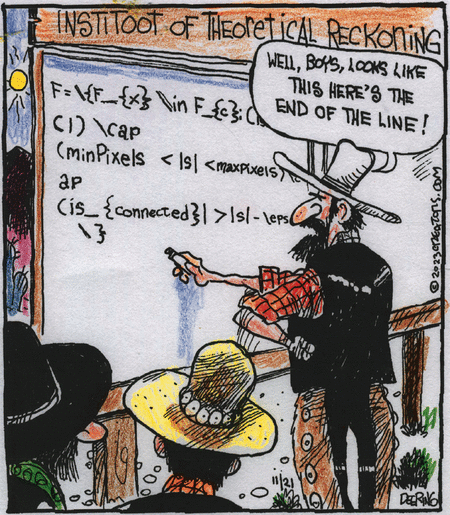
The GoComics comments for this 21 November Strange Brew seem to not hit the target until they start asking if it’s Fortran or what programming language it’s in, or what the backslashes are for. Well, it’s not Fortran! But I am ready to accept remarks from one commenter (with a posting name that makes me think of one regular CIDU commenter!) explaining that This is in TeX or LaTeX or MathTeX. They use backslash all the time, for various things including, say , names for symbols. So the “\\in” you see in the top line produces an “element of” symbol…
Whether we can then go on to say that the represented math might be defining “line segment” or something like that, I can’t venture. We can’t go further, it looks like we’ve reached, erm, reached the terminus …
 Comics I Don't Understand
It’s been a few decades since I last did anything in LaTeX, but yeah, that looks like a function defining a line on the page.
While not as common as some other cowboy cliches, “Ah reckon this is the end of the line fer you,” is in keeping with the general theme. In this case, the “Institoot” is considering theoretical lines and their ends.
Was I the only one reminded of Tron, where Master Control’s key phrase was “End of line”?
The places where we see an underscore (like “F_{x}”, “F_{c}”, and “is_{connected}” would be rendered with subscripting, what you would vocally read off as “F sub x” and “F sub c” and — a little oddly– “is sub connected” or perhaps just spoken “is-connected” .
I was just assuming that it was the close bracket. Even if a line of code goes over multiple lines on the screen or on the page, it’s still only one line of code. But I don’t know LaTeX, so if someone says it’s defining the actual end of a line rather than a line of code, that seems reasonable to me, too.
Ian Osmond, I’m not sure what you mean. LaTeX is a formatting or typesetting language (really a huge bunch of macros on its parent, TeX) and does not itself use lineation for important syntactic requirements. It does use curly braces for grouping, all over the place!
But then if we look at this and ask “What if we ran it in our LaTeX processor and looked at the output, what would that be like?” It would be a nicely typeset passage or page or part of something — maybe a mostly-prose paper, maybe some math (not involving programming languages), maybe something in a programming language we can recognize or narrow down.
And this case, I think, would be math. Possibly some programming language, but there are actual subscripts here in the LaTeX source, so the output would not look entirely like something that could be the input to your compiler or interpreter. So I say math, even though expressions like the middle lines “minPixels < |s| < maxpixels” do look like maybe a test in a conditional construction in a program. But a math definition could also have a test like that and even have those verbose variable names.
I don’t even see the code. All I see is blonde, brunette, redhead.
Is one of the cowboys in the comic named Tex? :-)
Ach, not unless that cowboy is from Loch Ness! (Or maybe old Mexico…) L’chaim!
Grawlix, I’m not sure if your comment was “in on the joke” or not. But in any case, for anybody who may be wondering what larK’s reply-comment is getting at, it’s part of the TeX / LaTeX cult that the X is not pronounced /ks/ (as in “Texas” or the personal/cowboy name “Tex”), but rather some kind of back fricative — of which larK gives four examples!
Nope, not a clue. I kept reading “LaTex” to rhyme with the rubbery milky white tree sap. Oddly enough in a quick web search the first three entries were related to the markup language. Rubbery tree sap came in fourth. I had no idea. I was expecting it at the top of the page.
@ mitch (9) – That “fricative”† pronunciation of the “X” is precisely what lends so much meaning to Elon Muxk’s renamed “Xitter” platform.
P.S. (†) – Don’t forget the “R”, it’s very important.