When that’s the punch line, the setup of course has to be “What does Mrs. Attila call out from the back when she hears noise at the tent entrance?”
But in this Hagar the Horrible, sent in by Boise Ed, Helga and Hagar are at home, not in a Hunnish encampment. The Huns are outside — for now.
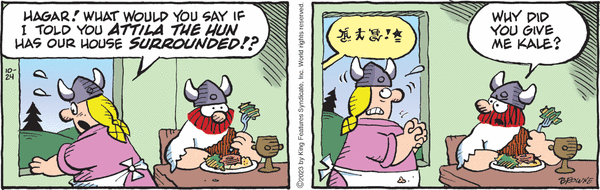
In case you think the outdoor shouting might prove legible, here is a blowup; but we think at least parts of it must just be Chinese Grawlix!

Setting and shouting aside, what’s the joke here? Some of the point must be Hagar’s equanimity in the face of attack, to the point that he is much more attentive to the culinary choice before him. But that’s pretty much his established character just being reinforced, so is that meant to be a joke?
 Comics I Don't Understand
Did the Huns make it to… uh, Norway?
“What was the home of the Vikings?”
“Isn’t it Minnesota?”
The Huns and Vikings didn’t interact. From ChatGPT3.5:
“The Vikings and the Huns did not meet in any significant way in recorded history. The two groups lived in different time periods and regions, and there is no documented direct interaction between them.
The Huns, led by Attila, were a nomadic group from Central Asia who rose to prominence in the late 4th and early 5th centuries AD. They played a significant role in the fall of the Western Roman Empire and were active in Eastern and Central Europe during their time.
The Vikings, on the other hand, were seafaring Norse people who lived in what is now Scandinavia during the Viking Age, which is generally considered to have taken place from the late 8th century to the early 11th century AD. The Vikings are known for their exploration, raids, and trade across the North Atlantic and other parts of Europe.
Since the Huns were active in Eastern and Central Europe during the late 4th and early 5th centuries, and the Viking Age occurred several centuries later, there is no historical record of direct interactions or conflicts between these two groups. They were separated by both time and geography.”
Of course, compared to the anachronistic world of B.C., this is a minor temporal violation.
Did Viking women really wear their horned helmets around the house?
The joke is (IMO)
“It might be my last meal? and you couldn’t serve me something better?”
or alternately
“Huns? not even worth fussing over, but here’s the important question: what’s with this green stuff?”
@M: no Old Norse women or men wore horned helmets except in a ritual setting, according to archaeologists and historians. They’re not even very good at protecting your head from a sword blow.
I would go with the second of m5rammy’s suggestions.
I tried running the first three characters of Browne’s “pseudo-Hun” through a number of image-based translators, but none of them were able to identify anything.
Ahem, did you’all forget to do Thursday’s posting?
Horned Viking helmets were a 19th century convention. They appear in engravings illustrating translated volumes of the ancient sagas.
@ Danny (9) – Just remember, the person who gripes first forfeits any rights to a refund on subscription fees. :-)
P.S. @8 – Since none of the online translation systems was able to do anything with those three ideograms, I sent the “Hagar” comic to a cousin of mine who has been living in the Far East for several decades, which led to some amusing results.
His first visual approximation of the characters was meant as a joke:
“总无思” translates to “I didn’t think about it at all“,
but he went on more seriously to say that “…the middle one resembles 大 (meaning “big”). The one on the right looks like 馬 (meaning “horse”) except backwards, as I’ve seen it used ornamentally.† The left one doesn’t look like anything…”
(†) Here’s an example of a reversed “horse” ornament:

The amusing part was that when I put those two characters (for “big horse”) into Google Translate, it produced the translation “Malaysia University”. (I was secretly hoping it would produce something like “trojan horse”.) Surprisingly, my cousin thought that the translation wasn’t that far-fetched. As he explained:
“馬 (“ma”) is phonetically the first syllable of Malaysia.
大学 (big study) means college or university, so
馬大 is a plausible abbreviation…”
P.S. The two of us finally agreed that Chris Browne was just making up the dialog to look like something “Chinese-y”. I just wonder whether that was why the colorist chose to fill in the balloon with yellow.
Umm, how to put this as it is rude, old fashioned to match the characters- Chinese people are yellow people?
In the 1960s there was a song “I’m love in with Attila the Hun”. I forget whose recording I used to hear of the song, but researching it online it was written by Bill Persky and Sam Denoff. Wrote for “Dick Van Dyke Show” so I am guessing that is where I heard it.
@ Meryl (13) – That’s exactly the point I was making: coloring in a dialog balloon is unusual to begin with, so was the color chosen just a coincidence, or subconscious antiquated racism?
kilby – Understand now – I can be a bit thick.