Andertoons doesn’t get talked about much, but it’s a really solid strip. It’s reliably good, and that’s all you can really ask.
@ U.V. – One reason for the solidity is that he actively markets his comics to corporate clients. Yes, it is an eminently reliable feature, but that also means that it never gets edgy, or political, or dares to offend any segment of the population.
The Bishop may tire of diagonal this and diagonal that, but math and logic fans cannot stop admiring Cantor’s diagonal proofs.
It might have been in Portnoy’s Complaint, I don’t really remember where I saw it but do remember the bit of story, where the character as a schoolboy in class one day appears unable to identify a cooking tool as a “spatula”. But he does know the word, but thinks it can’t be the proper English term that you can say in school, because he has only heard it at home and assumes it is Yiddish.
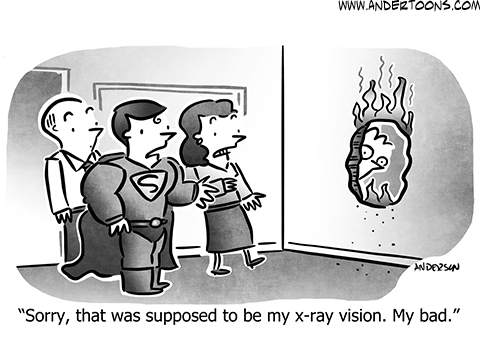
“The floor is lava!” This one cracks me up. 🤓🤷♀️🤡😉
“The end is near” // “You betcha”
Did we ever drop this one into either of the Grim Reaper Jokes threads?
A somewhat CIDU one – the “This is the co-pilot speaking” one. What is it that they’ve always wanted to try? Speaking over the p.a. tannoy; or doing some kind of aerobatic tricks?
P.S. Is anyone else following the Idris Elba “Hijack”?
I like the something-something chicken. I sometimes get peri-peri chicken 🍗
@ Mitch (6) – I knew that I had seen an Andertoons Grim Reaper before, but the Loose Death thread proved that he has probably drawn dozens of them. In any case, the one shown here was already added to the Memorial post in April.
I think the one I like best is the “coffee order” (second from the top, on the right), not because the joke is that great, but because Anderson did his homework: the molecule on the lower left of the whiteboard is sugar, and the ones at the upper right are caffeine and water.
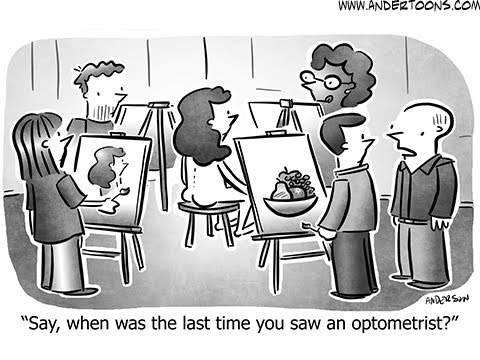
P.S. The artist who needs glasses (second to last row, on the left) reminded me of a scene in “Mr. Bean”, in which he refuses to look at the naked model, inventing a series of subterfuges to avoid the necessity.
@Mitch4 (7) That one made me think of the late 70s ?Hughes Airwest? flight where one of the pilots went a bit off the rails and apparently tried to do a loop in a 707 (or maybe 727). It didn’t quite work–he wound up basically doing an Immelman. And ending his career. ISTR reports said the Boeing engineers were pretty happy, because they’d thought the wings would come off if you tried it.
I remember this clearly, but can’t find it on the web. I don’t think I imagined it!
P.S. Is anyone else following the Idris Elba “Hijack”?
Should I be? Is it any good? I like Idris Elba, though I didn’t like Luthor; this sounds like more of the same, style over substance, that I didn’t like about Luthor…
@ Phil (11) – I heard a similar story (probably in one of my Engineering classes), except that it was a airline test pilot, who did a clockwise roll. According to the story, his co-pilot told him, “You can’t do that!“, to which he replied, “OK, I’ll put it back.“, and did a counter-clockwise roll.
P.S. I pulled a similar trick on each of my kids, back when they were small enough to ride in a grocery cart: spin the cart clockwise, wait for the kid to object that it was “wrong”, then spin the cart back the other way.
@Kilby That story I’ve found. But this I remember not only from the story, but because BAM (an alternative free newspaper, Bay Area Music) had a cartoon with a demented-looking pilot muttering “loop da loop”.
If this is an imagined memory, it’s remarkably robust. (But I’m not ruling that out!)
ride in a grocery cart: spin the cart clockwise,
Proving you are not in the US, ’cause only in Europe do the shopping carts have free rotating rear wheels allowing you to do that, something I’ve never quite understood other than, “we’ve always done it this way” — you’d think one way or the other would prove superior, and settle the question. (Judging by the fact that in the US, the carts inevitably have a bum wheel, I’m inclined to think free rotating rear wheels must be superior, but that might just be faulty correlative reasoning — it might be in the US they are too cheap to buy new carts when the old ones wear out (or at least fix them), and in Germany they spend to keep their carts in better repair.
Anyway, if this were a WWII movie, you would have just outed yourself as the German spy…
@ larK – It’s the other way around: spinning the cart instantly outed me here as the oddball foreigner. No self respecting German would do something so silly and irresponsible as spinning a grocery cart (even my own kids thought I was wacko).
P.S. I may have stolen the idea from the “Toro! Toro! Toro! Precision Lawn Mower Drill Team” that used to march in the “Doo Dah Parade” in Pasadena (it used to be held on the Sunday before the Rose Bowl Parade, until the city forced them to move it to a different date).
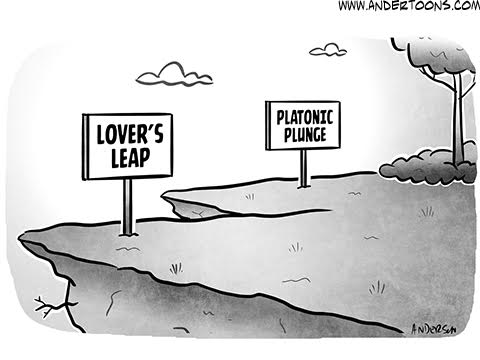
Reminds me of one I saw..I can’t find it….’\
“Lover’s Leap” next to “Second Thought Bungee”
P.P.S. The Washington Post article is probably behind their paywall, so here’s a better reference to the Doo Dah Parade.
@ Maggie (18) – The “Platonic Plunge” appears to be the earlier version (#8207). Perhaps Anderson had second thoughts, and decided to add the bungee cord to #8965:
Thank you Kilby. Now that I think about it, I think I saw it on this webpage.
Boeing test pilot Tex Johnston famously did a barrel roll in a prototype 707 (the Dash 80) in front of a lot of industry executives at a convention in Seattle – see https://www.youtube.com/watch?v=AaA7kPfC5Hk
The auto subtitling is quite fun: a “one G manoeuvre” is rendered as a “luncheon maneuver” and “test flying” is “chess flying”. What is rendered as a “shot down” is probably “Chandelle” manoeuvre.
My father was an airline pilot who flew Boeing 707s from 1968 to his retirement in 1974 (and he was converted to them in Seattle). He, of course, never did a barrel roll in one, or any big plane he flew (B-24 Consolidated Liberator, Handley Page Hermes, , Douglas DC-3 Dakota, Vickers Viking and Viscount, de Havilland Comet, Hawker Siddeley Trident) though he did in smaller training-type planes like the de Havilland Tiger Moth.
My local supermarket got new carts a while back. These are largely plastic rather than wire. The structural components have to be relatively larger for strength, so when they get wet they collect more water. I’ve noted where the store has paper towels available to dry them off. Usually I try to avoid going there on rainy days.
The carts come with a new feature, a wheel lock if you get too far away. Sometimes the cart decides that’s when you are barely out the door, or even still in the store. It beeps and the security guard has to run over with a remote to unlock it.
@ Maggie – I think I’ve seen the bungee version before, too (and it must have been here at CIDU, because I don’t follow Andertoons at all), but I’ve looked back through more than a year’s worth of posts tagged “Andertoons“, and could not find it anywhere. I suspect that someone may have embedded it in a comic, or maybe the relevant post wasn’t tagged. Looking for the image’s URL didn’t help, either.
@ Brian (23) – Re: “wheel lock” – The universal German solution for the problem of pilfered carts is much simpler: there’s a little chain that locks the cart to the one in front of it when it is stacked in line. To disengage the chain, you have to insert a Euro coin into a slot. This “deposit” makes sure that everyone returns their carts to the stack (to get the Euro back)†. Some people use plastic chips that various companies give out for free (I bought a short stack of Euro-sized washers at the hardware store, which work perfectly), but even then, people still return the cart to get their chips back.
P.S. † – Some European airports use this system, too, meaning that a baggage cart costs only a temporary deposit of one Euro, and not the mercenary three to five dollars with which American airports rip off travelers.
The “moment we’ve been preparing for” one looked at first like they were in a flood — a common enough thing these days. Then I noticed what looks like a volcano in the window. So if they’ve been preparing for a volcanic eruption, why are they still there, and how do they expect to escape? Or are they just mentally prepared to become Pompeiian?
Ed, there’s a popular children’s pastime of walking around the house on top of the furniture and wall-fixtures in “parkour” style, with the overall rule that you never even touch the floor …. because “The Floor is Lava!” as you announce when the game starts.
So, the many years of playing that game is what the dad(?) is referring to when he talks about preparation. Because at this moment, at long last, it has turned out true that the floor is lava!
The goal of the lock is not to force people to return them, just not take them far away or steal them. The supermarket I use most has an adjoining parking lot (not the actual lot for the store) that abuts an apartment complex. It was common to see bunches of carts at the berm separating the two parking areas.
Now it’s common to see a few carts there, and a bunch at a point near the edge of the building.
We do have the chain system at Aldi, but it has to use quarters because of the usual American resistance to dollar coins.
Kilby – I’m curious, does the system reserve the specific individual’s Euro/chip/slug for their cart when it is returned? Or is it more put a Euro in, get a Euro when returned? Because in the later, you could use your slug and get a Euro back, while some poor schlub down the line gets your slug. But I don’t off hand see how the former would work.
Guero, I was pondering the same question.
I did run into a U.S. version of that system somewhere, maybe an airport, and as far as I might remember it was not token identity but just an equal value coin that you got upon return.
But in thinking how it could work with return of the selfsame deposit money physically, that could happen if the coin you put in for release stays with the cart you take, and not left behind in the mechanism of the rack. It would need a lock mechanism on the cart, which receives a coin and holds it, opening a grip that holds the cart to the rack of the next cart. Then when you return it, forcefully pushing it to engage with a rack, the holding compartment drops the original coin back out. This also helps with how a place could have multiple racks and provide carts for one-way use, say between the airport entrance and a departure gate.
Mitch4: that’s how they work, at least the ones I’ve seen.
That certainly makes sense, although it also adds expense (and complexity) to a cart, for something that is essentially a convenience, rather than income generating. Unlike grocery carts, theft is probably not a big concern, but I can see how it would encourage people to return their carts to a dock rather than leave them scattered about.
Never having sentenced myself to child-raising, I didn’t know about that. Thanks.
The Aldi carts retain the quarter placed within, but you rarely get your own back at mine because the cashier takes items from the belt and puts them in an empty cart, then swaps that for your recently emptied one. Reportedly some Aldis have started having self-check, but not here.
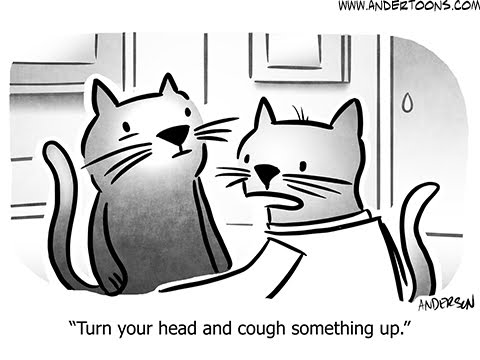
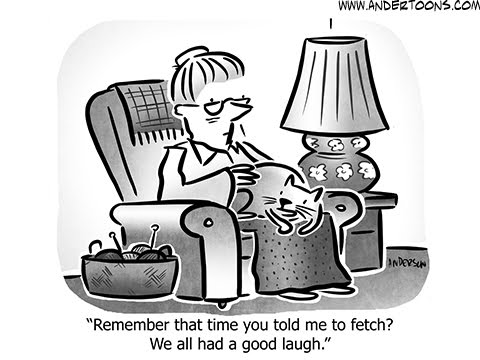
Re: Cat laughing about playing fetch.
I’ve seen videos of cats enthusiastically playing fetch.
Re: Painting
I don’t know where, but I’ve seen the trope of painting a still life instead of a nude model. I think Anderson’s punchline is new to me, but I’m not sure it works here.
Re: Shopping carts
Someone should do a documentary on the Migratory Habits of Shopping Carts.
Although “shopping cart” is perhaps the more common term around here, It’s interesting to note how many different terms are used interchangeably. I have heard “trolley”, but that person sounded like she was from the UK elsewhere.
Re: “carts” – Sorry, I should have mentioned that the coin slot is always on the handle of the cart you take, so there’s never any risk of “losing” whatever you put in. It releases a short chain that is attached to the next cart in the stack. The “exchange” that Brian (@34) reported at Aldi in America never happens at Aldi in Germany (or anywhere else here), because German cashiers do not “bag” or “cart” anything, the customer is always responsible for doing that alone.
P.S. @ Grawlix (35) – One German comedian quipped that when he wants to do a cookout at the park, he never buys a disposable grill, because you can get a big metal rack at any grocery store, and they only “cost” one Euro.
P.P.S. I remember hearing “trolley” used in New Zealand, where they also called a “cooler” a “chilly bin”, and the little trays for fruit were called “punnets”.
cashiers do not “bag” or “cart” anything, the customer is always responsible for doing that alone.
The cashiers are merely picking up the item from the belt, then scanning or weighing it, then placing it in a previously empty cart. There is certainly no bagging, the customer needs to take the cart over to the bagging shelf. The exception is for customers that didn’t use a cart, they have to take their items out of the cart and carry them away.
I’m not sure what the setup at a German store is or what the cashier does with an item after scanning.
Here’s an image of a US setup in action, although the ones at my store are mirror-image of that.
One German comedian quipped that when he wants to do a cookout at the park, he never buys a disposable grill, because you can get a big metal rack at any grocery store, and they only “cost” one Euro.
I can’t think of anything in a US store that would be suitable for grilling on that was anywhere near that cheap. You can get some cooling racks or things like that, but they’re not in that price category. A “grill topper” is $5, but I don’t know how sturdy it is by itself. A “big metal” anything for a euro sounds really cheap.
At what point do those two kids get transferred to the other cart? And it looks like the cashier has used the child seat of the transfer cart for groceries.
The joke is that you use the cart as a grill…
The joke is that you use the cart as a grill
Ah, I see.
The shopping conveyances here were always called “carts”. I have noticed that some younger people at Aldi have called them “buggies”. These younger people are of a different heritage than I, which might be a factor.
At what point do those two kids get transferred to the other cart?
I’m not sure if the older one is of walking age or not. I spot a third child behind the woman that I suspect is part of the family (slow down woman, this ain’t the 60s) and would be ordered to, “Help your brother over to the bagging area.”
Brian: that’s bizarre. I don’t think I’ve ever seen an arrangement like that. For whatever that’s worth. Did they do it that way before the pandemic?
Aldis here have been like that since I started going to them.
I’ve never seen a German cashier’s table that ends right after the scanner (neither at Aldi nor anywhere else). The nearest similarity is at Lidl, which provides only about two or three square feet of counter space after the scanner (which is further complicated by the plexiglass anti-corona chambers that were installed during the pandemic). For this reason, at Lidl it really is necessary to empty the whole cart onto the conveyor belt and push it through to the end before the cashier starts ringing anything up. The cashier pushes the items onto that small space, and the customer has to work quickly to deposit it all into the cart.
So Aldi has always been about low/no frills shopping, passing the savings on to you: no display shelving, just the boxes containing the product, no free bags, no credit cards, deposits on shopping carts, store brands only; in olden days before scanners (in Germany), the cashiers had to memorize the three or four digit codes for every item in the store (and in olden days, there weren’t many items), and they were ruthless ringing stuff up, punching in the three digit codes, moving you through as fast as possible, anticipating your change and having it ready for you before you even knew the total. (If you wanted to get rid of your small change, you really needed to bring a calculator to tote up your purchases as you put them in the cart, so you could know the total before you hit the register so you could have your payment ready to give before the cashier finished — they didn’t like it much, because it threw them off their rhythm, especially when it wasn’t exact change, but a variation to get rid of some of your small change, but it was a satisfactory victory when you could pull it off.) The cashier was at the middle of the conveyor belt, punching in your items and passing them down to you at the end, where you were frantically trying to dump everything back into your cart and get out your money to pay before the next customer ‘s stuff would pile up on you. It was an art form, especially if you were cheap and didn’t tie up some of your capital in a cart deposit, so you had to make do with discarded boxes from the store.
Aldi has been relaxing a lot of these traditional things — big one was when they finally started taking credit cards. I have always been amazed how much they kept when they expanded into the US, ie: cart deposits, and no free bags, self bagging. Lidl came way late to the US, after Aldi had started taking credit cards, or at least around then, might have been part of the reason for the switch, and Lidl I think was trying to position themselves as some kind of hip alternative ala Trader Joe (owned by Aldi), and get away from their no-frills, copied-from-Aldi roots, so they didn’t bring the cart deposit system (and as such, always have their carts scattered all over), and in the US I think always took credit cards. Interestingly, their store layout still has a bagging area, which in Germany, and in the old days, was essential, because the way they ruthlessly shoved your items through the ring-up system meant you had no chance to nicely pack them, and even if you were an expert with your boxes, strategically pre-laying out your items so they would best fit back in the box as they were rung up, you would still need to rearrange and tighten things up before you could carry the box home or strap it to your bicycle.
Also interesting that Aldi in the US went with the cashier at the end of the conveyor belt set-up, which necessitated the ad hoc solution of having another cart at the ready, and the stupidity that involves of having to change carts (in our case that just means having to transfer our reusable bags, but as Brian’s picture above shows, there are much more awkward transfers for some people…) I don’t really understand why they didn’t go with the cashier in the middle of the conveyor belt system: the Shop-rites around here have those, along with a bunch of other set-ups, you can choose: if you want to do self bagging, they have a dual secondary conveyor belt system with a shunt to let the stuff go to the left or right conveyor, so the person behind you’s stuff doesn’t pile into your stuff; they have a bagger at the end of the single secondary conveyor belt ones; for the express lanes, they have revolving carrousels for the cashier to dump your stuff into bags as they ring it up. They now even have self check out where you do it all. What I’m saying is, I don’t understand why Aldo didn’t just import the already tested and working system they have in Germany to the US, because a) those systems already exist here, b) since they are insisting on the deposit for carts, it is actually a vital part of the system, and c) they imported so much else that really was very strange and unusual for Americans. And they kept at it, and even seemed to double down on the ad hoc system when they went through their store refresh a couple years ago and updated the aisles and stuff in all their stores.
Anyway, I’m currently mad at the next local Aldi that has the best prices (even better than other Aldis including the nearer one, because it is right next door to a Lidl), because they are sloppy/lazy or possibly nefarious, and insist on leaving signage up for stuff they don’t have, possibly never had, and don’t seem to be ever going to get, and so you mistakenly grab an adjacent item that has inevitably overflowed into the empty space, and which is the same product as the signage, only not the special flavor or whatever, and then you get to the cashier, and it rings up at the regular price, not what the sign says, and when you complain, they’ll walk you through the small print to prove the sign is for butter flavor, and you have the olive oil flavor; when you ask for the butter flavor then, they say they don’t have it, and when you say, then take the damn sign down, they tell you to watch your language, and pretend to be all offended when they are engaging in what is, legally — or, rather, illegally — bait-and-switch.
I’m in a quandary now, because I’m cheap enough to know they are the best deal in town, but I am miffed enough that I don’t want to go back. First world problems, sure, but also the universal problem of how much is your pride worth to you, and calibrating that has surely always been a hominid issue…
We do go to the local Lidl from time to time, because they carry a reliable stock of fish and relatively high-quality beef (and occasionally lamb). The only time we ever visit Aldi is when they have special offers, almost always only for non-food items. Even if the prices are somewhat lower, the quality of their house brands (for example: chocolate, and cheese) is miserable, and it’s simply not worth saving a minor percentage to deal with their bargain basement treatment of customers and employees.
Whereas in the states, I’m happy for Aldi and Lidl imported German chocolate, even if it is “cheap” German chocolate. (Though when I was in Berlin visiting my aunt, she took a page from me, because the inexpensive luxury chocolate I bought at Lidl apparently was quite good…)
When I was doing my junior year abroad in Austria back in the day, my roommate was pining for real Peter Paul Mounds bars — all they had were the European brand “Bounty”, which he did not like at all. The Aldi in Austria is called Hoffer, and he was delighted to find that they had done some kind of close-out purchase on actual, Peter Paul Mounds bars — and they were cheap, to boot! He was thrilled. He showed his Austrian acquaintances his happiness at having actual Mounds bars, and they looked at it, and sniffed, “oh, Hoffer Bounty…”
Kilby, that matches my (limited) experience with Aldi. When the first one opened near us, I went in, walked through, and left, not having seen anything that made me want to buy it. That doesn’t mean it’s not there, but it sure didn’t speak to me.
We now finally have a Lidl, a couple of years late (I assume due to the pandemic); have not been there, but I’ll check it out soon.
Of course, “Aldi” isn’t just one brand, it’s actually two, the brothers split Germany, and the rest of the world, between them. I don’t much like Aldi Nord; the Aldi Süd stores are just much nicer (even though, in the end, most of the actual products are the same). The US is Aldi Süd (except for Trader Joe, which is Aldi Nord). I just realized there must be places in Germany along the Aldi Nord/Süd border where you can have both relatively close to each other. I wonder how close they let them get? Do they have a gentleman’s agreement not to compete directly? Or are there places where there is an Aldi Nord right next to a Lidl right next to an Aldi Süd? And if so, which does better?
@ larK – I don’t know where the Aldiquator runs through Germany, but there’s a similar replication with another (even cheaper) discount supermarket† called “Netto”, distinguished by their variant logo colors (red vs. black). These are not separated at all, as far as I know, we have one of the two colors in our town, and one with the “other” color is located just two towns up the road.
P.S. † – It seems a little out of place to call a cheap market “super”.
Interestingly, the other specific item you mentioned besides chocolate, namely cheese, was a way to confirm that despite being two different stores, Aldi Nord / Trader Joe and Aldi Süd in the US do in fact collaborate to avoid competition:
Aldi used to carry Kerrygold cheese from Ireland. There was one variety especially that we really liked (Skellig? Dubliner? I can’t remember), and the reason we were exposed to it was because once at Trader Joe’s they were giving out samples, trying to sell you on the Kerrygold cheese. But we found it was usually cheaper at Aldi rather than Trader Joe’s, so that’s where we would buy it. Then, shortly after, Kerrygold was suddenly replaced at Aldi with a similar looking “Irish cheese”, but not Kerrygold, which didn’t really taste like much of anything. Trader Joe is the only remaining cheap source of Kerrygold. Either they’re collaborating, or they are in such cut-throat competition that they require their suppliers to deny their product to the other.
(Another cheese that I’ve only found at Aldi that I really like is the Swiss Lustenberger, which doesn’t taste at all like “Swiss” cheese, or Cheddar, or the few other varieties you usually can find in the US outside specialty shops.)
I go to Aldi about every other week. Some things aren’t a great value, especially if you are smart about the supermarket sales and promotions. Others are a substantial savings.
The heavy whipping cream is much cheaper than the supermarket brand, same for 20oz canisters of raisins. The big containers of oatmeal are 1.50 less.
Several produce items are a bit cheaper, I get the broccoli, romaine hearts, and iceberg lettuce. Asparagus is usually poor quality. 16oz bags of fresh green beans are under $2. The yellow potatoes and mandarins are substantial savings.
The key, if you’re a thrifty sort, is to know your prices and how sales work. I don’t need to be focused on savings, it would make essentially no difference in my life, but it feeds a corner of my psyche, one that was there when saving money did make a difference.
Well, finally found a comic strip which actually made Robert smile. (He is NOT a comics reader – but I keep him anyway as he is good at fixing my computer.)
Meryl, are you saying that Andertoons in general seems to work for him, or was there a particular instance that he found appealing?
I have no objection to scoring an occasional bargain(†), but I’m no longer willing to experiment with oddball store brands just to save a few cents. I agree that Aldi chocolate is quite good when compared to most American brands, but it just doesn’t cut it when compared to average European brands.
This is not to say that I refuse to buy any store brands. I actually prefer our local supermarket’s “plainwrap” milk and eggs, especially because the rapid turnover usually ensures that they are notably fresher than brand name equivalents. In the case of eggs, the difference in “sell buy” date can be as much as a week.
Two other “plainwrap” items that have proved their worth are grated mozzerella (it has much less of the annoying “powder” that is supposed to prevent clumping), and smoked salmon (a.k.a. “lox”), which for many years has been both a superior product, and at a far lower price. The quality of the lox has been uneven lately, but we don’t buy it that often anymore.
P.S. (†) – Just today I happened to buy about three pounds of Philadelphia brand cream cheese, which had been marked down by about 50%. However, this was not “bargain hunting”: I would have bought the same amount even if it had been full price; I need it to make an oversized cheesecake.
Mitch – the particular one.
When I was young my dad would read me the comics (the funnies as he called them) so later I always read them also. Dad would tell me about how during a newspaper strike in the Depression Mayor LaGuardia would read them on the radio and I love of sharing them with dad has stayed with me. I read the rest of the newspaper and then go back and read the comics.
Whenever I mention this to Robert (together almost 50 years so he has heard all my stories before and I have heard all of his) his big comment is that his great aunt worked for LaGuardia – but apparently he still not got attached to reading the newspaper comics (comic books – yes, newspaper comics – no – he is a villain in a “Man-Bat” comic book).
@ Meryl (@ 58 & 61) – Please don’t leave us all hanging like that. Which of the Andertoons comics did Robert like? We’re all dying to know the answer!
I was wondering about that, too, but then thought Meryl meant Andertoons in general, as a comic strip.










 Comics I Don't Understand
Andertoons doesn’t get talked about much, but it’s a really solid strip. It’s reliably good, and that’s all you can really ask.
@ U.V. – One reason for the solidity is that he actively markets his comics to corporate clients. Yes, it is an eminently reliable feature, but that also means that it never gets edgy, or political, or dares to offend any segment of the population.
The Bishop may tire of diagonal this and diagonal that, but math and logic fans cannot stop admiring Cantor’s diagonal proofs.
https://en.wikipedia.org/wiki/Cantor%27s_diagonal_argument
It might have been in Portnoy’s Complaint, I don’t really remember where I saw it but do remember the bit of story, where the character as a schoolboy in class one day appears unable to identify a cooking tool as a “spatula”. But he does know the word, but thinks it can’t be the proper English term that you can say in school, because he has only heard it at home and assumes it is Yiddish.
“The floor is lava!” This one cracks me up. 🤓🤷♀️🤡😉
“The end is near” // “You betcha”
Did we ever drop this one into either of the Grim Reaper Jokes threads?
A somewhat CIDU one – the “This is the co-pilot speaking” one. What is it that they’ve always wanted to try? Speaking over the p.a. tannoy; or doing some kind of aerobatic tricks?
P.S. Is anyone else following the Idris Elba “Hijack”?
I like the something-something chicken. I sometimes get peri-peri chicken 🍗
@ Mitch (6) – I knew that I had seen an Andertoons Grim Reaper before, but the Loose Death thread proved that he has probably drawn dozens of them. In any case, the one shown here was already added to the Memorial post in April.
I think the one I like best is the “coffee order” (second from the top, on the right), not because the joke is that great, but because Anderson did his homework: the molecule on the lower left of the whiteboard is sugar, and the ones at the upper right are caffeine and water.
P.S. The artist who needs glasses (second to last row, on the left) reminded me of a scene in “Mr. Bean”, in which he refuses to look at the naked model, inventing a series of subterfuges to avoid the necessity.
@Mitch4 (7) That one made me think of the late 70s ?Hughes Airwest? flight where one of the pilots went a bit off the rails and apparently tried to do a loop in a 707 (or maybe 727). It didn’t quite work–he wound up basically doing an Immelman. And ending his career. ISTR reports said the Boeing engineers were pretty happy, because they’d thought the wings would come off if you tried it.
I remember this clearly, but can’t find it on the web. I don’t think I imagined it!
P.S. Is anyone else following the Idris Elba “Hijack”?
Should I be? Is it any good? I like Idris Elba, though I didn’t like Luthor; this sounds like more of the same, style over substance, that I didn’t like about Luthor…
@ Phil (11) – I heard a similar story (probably in one of my Engineering classes), except that it was a airline test pilot, who did a clockwise roll. According to the story, his co-pilot told him, “You can’t do that!“, to which he replied, “OK, I’ll put it back.“, and did a counter-clockwise roll.
P.S. I pulled a similar trick on each of my kids, back when they were small enough to ride in a grocery cart: spin the cart clockwise, wait for the kid to object that it was “wrong”, then spin the cart back the other way.
@Kilby That story I’ve found. But this I remember not only from the story, but because BAM (an alternative free newspaper, Bay Area Music) had a cartoon with a demented-looking pilot muttering “loop da loop”.
If this is an imagined memory, it’s remarkably robust. (But I’m not ruling that out!)
ride in a grocery cart: spin the cart clockwise,
Proving you are not in the US, ’cause only in Europe do the shopping carts have free rotating rear wheels allowing you to do that, something I’ve never quite understood other than, “we’ve always done it this way” — you’d think one way or the other would prove superior, and settle the question. (Judging by the fact that in the US, the carts inevitably have a bum wheel, I’m inclined to think free rotating rear wheels must be superior, but that might just be faulty correlative reasoning — it might be in the US they are too cheap to buy new carts when the old ones wear out (or at least fix them), and in Germany they spend to keep their carts in better repair.
Anyway, if this were a WWII movie, you would have just outed yourself as the German spy…
@ larK – It’s the other way around: spinning the cart instantly outed me here as the oddball foreigner. No self respecting German would do something so silly and irresponsible as spinning a grocery cart (even my own kids thought I was wacko).
P.S. I may have stolen the idea from the “Toro! Toro! Toro! Precision Lawn Mower Drill Team” that used to march in the “Doo Dah Parade” in Pasadena (it used to be held on the Sunday before the Rose Bowl Parade, until the city forced them to move it to a different date).
Reminds me of one I saw..I can’t find it….’\
“Lover’s Leap” next to “Second Thought Bungee”
P.P.S. The Washington Post article is probably behind their paywall, so here’s a better reference to the Doo Dah Parade.
@ Maggie (18) – The “Platonic Plunge” appears to be the earlier version (#8207). Perhaps Anderson had second thoughts, and decided to add the bungee cord to #8965:
Thank you Kilby. Now that I think about it, I think I saw it on this webpage.
Boeing test pilot Tex Johnston famously did a barrel roll in a prototype 707 (the Dash 80) in front of a lot of industry executives at a convention in Seattle – see https://www.youtube.com/watch?v=AaA7kPfC5Hk
The auto subtitling is quite fun: a “one G manoeuvre” is rendered as a “luncheon maneuver” and “test flying” is “chess flying”. What is rendered as a “shot down” is probably “Chandelle” manoeuvre.
My father was an airline pilot who flew Boeing 707s from 1968 to his retirement in 1974 (and he was converted to them in Seattle). He, of course, never did a barrel roll in one, or any big plane he flew (B-24 Consolidated Liberator, Handley Page Hermes, , Douglas DC-3 Dakota, Vickers Viking and Viscount, de Havilland Comet, Hawker Siddeley Trident) though he did in smaller training-type planes like the de Havilland Tiger Moth.
My local supermarket got new carts a while back. These are largely plastic rather than wire. The structural components have to be relatively larger for strength, so when they get wet they collect more water. I’ve noted where the store has paper towels available to dry them off. Usually I try to avoid going there on rainy days.
The carts come with a new feature, a wheel lock if you get too far away. Sometimes the cart decides that’s when you are barely out the door, or even still in the store. It beeps and the security guard has to run over with a remote to unlock it.
@ Maggie – I think I’ve seen the bungee version before, too (and it must have been here at CIDU, because I don’t follow Andertoons at all), but I’ve looked back through more than a year’s worth of posts tagged “Andertoons“, and could not find it anywhere. I suspect that someone may have embedded it in a comic, or maybe the relevant post wasn’t tagged. Looking for the image’s URL didn’t help, either.
@ Brian (23) – Re: “wheel lock” – The universal German solution for the problem of pilfered carts is much simpler: there’s a little chain that locks the cart to the one in front of it when it is stacked in line. To disengage the chain, you have to insert a Euro coin into a slot. This “deposit” makes sure that everyone returns their carts to the stack (to get the Euro back)†. Some people use plastic chips that various companies give out for free (I bought a short stack of Euro-sized washers at the hardware store, which work perfectly), but even then, people still return the cart to get their chips back.
P.S. † – Some European airports use this system, too, meaning that a baggage cart costs only a temporary deposit of one Euro, and not the mercenary three to five dollars with which American airports rip off travelers.
The “moment we’ve been preparing for” one looked at first like they were in a flood — a common enough thing these days. Then I noticed what looks like a volcano in the window. So if they’ve been preparing for a volcanic eruption, why are they still there, and how do they expect to escape? Or are they just mentally prepared to become Pompeiian?
Ed, there’s a popular children’s pastime of walking around the house on top of the furniture and wall-fixtures in “parkour” style, with the overall rule that you never even touch the floor …. because “The Floor is Lava!” as you announce when the game starts.
So, the many years of playing that game is what the dad(?) is referring to when he talks about preparation. Because at this moment, at long last, it has turned out true that the floor is lava!
The goal of the lock is not to force people to return them, just not take them far away or steal them. The supermarket I use most has an adjoining parking lot (not the actual lot for the store) that abuts an apartment complex. It was common to see bunches of carts at the berm separating the two parking areas.
Now it’s common to see a few carts there, and a bunch at a point near the edge of the building.
We do have the chain system at Aldi, but it has to use quarters because of the usual American resistance to dollar coins.
Kilby – I’m curious, does the system reserve the specific individual’s Euro/chip/slug for their cart when it is returned? Or is it more put a Euro in, get a Euro when returned? Because in the later, you could use your slug and get a Euro back, while some poor schlub down the line gets your slug. But I don’t off hand see how the former would work.
Guero, I was pondering the same question.
I did run into a U.S. version of that system somewhere, maybe an airport, and as far as I might remember it was not token identity but just an equal value coin that you got upon return.
But in thinking how it could work with return of the selfsame deposit money physically, that could happen if the coin you put in for release stays with the cart you take, and not left behind in the mechanism of the rack. It would need a lock mechanism on the cart, which receives a coin and holds it, opening a grip that holds the cart to the rack of the next cart. Then when you return it, forcefully pushing it to engage with a rack, the holding compartment drops the original coin back out. This also helps with how a place could have multiple racks and provide carts for one-way use, say between the airport entrance and a departure gate.
Mitch4: that’s how they work, at least the ones I’ve seen.
That certainly makes sense, although it also adds expense (and complexity) to a cart, for something that is essentially a convenience, rather than income generating. Unlike grocery carts, theft is probably not a big concern, but I can see how it would encourage people to return their carts to a dock rather than leave them scattered about.
Never having sentenced myself to child-raising, I didn’t know about that. Thanks.
The Aldi carts retain the quarter placed within, but you rarely get your own back at mine because the cashier takes items from the belt and puts them in an empty cart, then swaps that for your recently emptied one. Reportedly some Aldis have started having self-check, but not here.
Re: Cat laughing about playing fetch.
I’ve seen videos of cats enthusiastically playing fetch.
Re: Painting
I don’t know where, but I’ve seen the trope of painting a still life instead of a nude model. I think Anderson’s punchline is new to me, but I’m not sure it works here.
Re: Shopping carts
Someone should do a documentary on the Migratory Habits of Shopping Carts.
Although “shopping cart” is perhaps the more common term around here, It’s interesting to note how many different terms are used interchangeably. I have heard “trolley”, but that person sounded like she was from the UK elsewhere.
Re: “carts” – Sorry, I should have mentioned that the coin slot is always on the handle of the cart you take, so there’s never any risk of “losing” whatever you put in. It releases a short chain that is attached to the next cart in the stack. The “exchange” that Brian (@34) reported at Aldi in America never happens at Aldi in Germany (or anywhere else here), because German cashiers do not “bag” or “cart” anything, the customer is always responsible for doing that alone.
P.S. @ Grawlix (35) – One German comedian quipped that when he wants to do a cookout at the park, he never buys a disposable grill, because you can get a big metal rack at any grocery store, and they only “cost” one Euro.
P.P.S. I remember hearing “trolley” used in New Zealand, where they also called a “cooler” a “chilly bin”, and the little trays for fruit were called “punnets”.
cashiers do not “bag” or “cart” anything, the customer is always responsible for doing that alone.
The cashiers are merely picking up the item from the belt, then scanning or weighing it, then placing it in a previously empty cart. There is certainly no bagging, the customer needs to take the cart over to the bagging shelf. The exception is for customers that didn’t use a cart, they have to take their items out of the cart and carry them away.
I’m not sure what the setup at a German store is or what the cashier does with an item after scanning.
Here’s an image of a US setup in action, although the ones at my store are mirror-image of that.
One German comedian quipped that when he wants to do a cookout at the park, he never buys a disposable grill, because you can get a big metal rack at any grocery store, and they only “cost” one Euro.
I can’t think of anything in a US store that would be suitable for grilling on that was anywhere near that cheap. You can get some cooling racks or things like that, but they’re not in that price category. A “grill topper” is $5, but I don’t know how sturdy it is by itself. A “big metal” anything for a euro sounds really cheap.
At what point do those two kids get transferred to the other cart? And it looks like the cashier has used the child seat of the transfer cart for groceries.
The joke is that you use the cart as a grill…
The joke is that you use the cart as a grill
Ah, I see.
The shopping conveyances here were always called “carts”. I have noticed that some younger people at Aldi have called them “buggies”. These younger people are of a different heritage than I, which might be a factor.
At what point do those two kids get transferred to the other cart?
I’m not sure if the older one is of walking age or not. I spot a third child behind the woman that I suspect is part of the family (slow down woman, this ain’t the 60s) and would be ordered to, “Help your brother over to the bagging area.”
Brian: that’s bizarre. I don’t think I’ve ever seen an arrangement like that. For whatever that’s worth. Did they do it that way before the pandemic?
Aldis here have been like that since I started going to them.
I’ve never seen a German cashier’s table that ends right after the scanner (neither at Aldi nor anywhere else). The nearest similarity is at Lidl, which provides only about two or three square feet of counter space after the scanner (which is further complicated by the plexiglass anti-corona chambers that were installed during the pandemic). For this reason, at Lidl it really is necessary to empty the whole cart onto the conveyor belt and push it through to the end before the cashier starts ringing anything up. The cashier pushes the items onto that small space, and the customer has to work quickly to deposit it all into the cart.
So Aldi has always been about low/no frills shopping, passing the savings on to you: no display shelving, just the boxes containing the product, no free bags, no credit cards, deposits on shopping carts, store brands only; in olden days before scanners (in Germany), the cashiers had to memorize the three or four digit codes for every item in the store (and in olden days, there weren’t many items), and they were ruthless ringing stuff up, punching in the three digit codes, moving you through as fast as possible, anticipating your change and having it ready for you before you even knew the total. (If you wanted to get rid of your small change, you really needed to bring a calculator to tote up your purchases as you put them in the cart, so you could know the total before you hit the register so you could have your payment ready to give before the cashier finished — they didn’t like it much, because it threw them off their rhythm, especially when it wasn’t exact change, but a variation to get rid of some of your small change, but it was a satisfactory victory when you could pull it off.) The cashier was at the middle of the conveyor belt, punching in your items and passing them down to you at the end, where you were frantically trying to dump everything back into your cart and get out your money to pay before the next customer ‘s stuff would pile up on you. It was an art form, especially if you were cheap and didn’t tie up some of your capital in a cart deposit, so you had to make do with discarded boxes from the store.
Aldi has been relaxing a lot of these traditional things — big one was when they finally started taking credit cards. I have always been amazed how much they kept when they expanded into the US, ie: cart deposits, and no free bags, self bagging. Lidl came way late to the US, after Aldi had started taking credit cards, or at least around then, might have been part of the reason for the switch, and Lidl I think was trying to position themselves as some kind of hip alternative ala Trader Joe (owned by Aldi), and get away from their no-frills, copied-from-Aldi roots, so they didn’t bring the cart deposit system (and as such, always have their carts scattered all over), and in the US I think always took credit cards. Interestingly, their store layout still has a bagging area, which in Germany, and in the old days, was essential, because the way they ruthlessly shoved your items through the ring-up system meant you had no chance to nicely pack them, and even if you were an expert with your boxes, strategically pre-laying out your items so they would best fit back in the box as they were rung up, you would still need to rearrange and tighten things up before you could carry the box home or strap it to your bicycle.
Also interesting that Aldi in the US went with the cashier at the end of the conveyor belt set-up, which necessitated the ad hoc solution of having another cart at the ready, and the stupidity that involves of having to change carts (in our case that just means having to transfer our reusable bags, but as Brian’s picture above shows, there are much more awkward transfers for some people…) I don’t really understand why they didn’t go with the cashier in the middle of the conveyor belt system: the Shop-rites around here have those, along with a bunch of other set-ups, you can choose: if you want to do self bagging, they have a dual secondary conveyor belt system with a shunt to let the stuff go to the left or right conveyor, so the person behind you’s stuff doesn’t pile into your stuff; they have a bagger at the end of the single secondary conveyor belt ones; for the express lanes, they have revolving carrousels for the cashier to dump your stuff into bags as they ring it up. They now even have self check out where you do it all. What I’m saying is, I don’t understand why Aldo didn’t just import the already tested and working system they have in Germany to the US, because a) those systems already exist here, b) since they are insisting on the deposit for carts, it is actually a vital part of the system, and c) they imported so much else that really was very strange and unusual for Americans. And they kept at it, and even seemed to double down on the ad hoc system when they went through their store refresh a couple years ago and updated the aisles and stuff in all their stores.
Anyway, I’m currently mad at the next local Aldi that has the best prices (even better than other Aldis including the nearer one, because it is right next door to a Lidl), because they are sloppy/lazy or possibly nefarious, and insist on leaving signage up for stuff they don’t have, possibly never had, and don’t seem to be ever going to get, and so you mistakenly grab an adjacent item that has inevitably overflowed into the empty space, and which is the same product as the signage, only not the special flavor or whatever, and then you get to the cashier, and it rings up at the regular price, not what the sign says, and when you complain, they’ll walk you through the small print to prove the sign is for butter flavor, and you have the olive oil flavor; when you ask for the butter flavor then, they say they don’t have it, and when you say, then take the damn sign down, they tell you to watch your language, and pretend to be all offended when they are engaging in what is, legally — or, rather, illegally — bait-and-switch.
I’m in a quandary now, because I’m cheap enough to know they are the best deal in town, but I am miffed enough that I don’t want to go back. First world problems, sure, but also the universal problem of how much is your pride worth to you, and calibrating that has surely always been a hominid issue…
We do go to the local Lidl from time to time, because they carry a reliable stock of fish and relatively high-quality beef (and occasionally lamb). The only time we ever visit Aldi is when they have special offers, almost always only for non-food items. Even if the prices are somewhat lower, the quality of their house brands (for example: chocolate, and cheese) is miserable, and it’s simply not worth saving a minor percentage to deal with their bargain basement treatment of customers and employees.
Whereas in the states, I’m happy for Aldi and Lidl imported German chocolate, even if it is “cheap” German chocolate. (Though when I was in Berlin visiting my aunt, she took a page from me, because the inexpensive luxury chocolate I bought at Lidl apparently was quite good…)
When I was doing my junior year abroad in Austria back in the day, my roommate was pining for real Peter Paul Mounds bars — all they had were the European brand “Bounty”, which he did not like at all. The Aldi in Austria is called Hoffer, and he was delighted to find that they had done some kind of close-out purchase on actual, Peter Paul Mounds bars — and they were cheap, to boot! He was thrilled. He showed his Austrian acquaintances his happiness at having actual Mounds bars, and they looked at it, and sniffed, “oh, Hoffer Bounty…”
Kilby, that matches my (limited) experience with Aldi. When the first one opened near us, I went in, walked through, and left, not having seen anything that made me want to buy it. That doesn’t mean it’s not there, but it sure didn’t speak to me.
We now finally have a Lidl, a couple of years late (I assume due to the pandemic); have not been there, but I’ll check it out soon.
Of course, “Aldi” isn’t just one brand, it’s actually two, the brothers split Germany, and the rest of the world, between them. I don’t much like Aldi Nord; the Aldi Süd stores are just much nicer (even though, in the end, most of the actual products are the same). The US is Aldi Süd (except for Trader Joe, which is Aldi Nord). I just realized there must be places in Germany along the Aldi Nord/Süd border where you can have both relatively close to each other. I wonder how close they let them get? Do they have a gentleman’s agreement not to compete directly? Or are there places where there is an Aldi Nord right next to a Lidl right next to an Aldi Süd? And if so, which does better?
@ larK – I don’t know where the Aldiquator runs through Germany, but there’s a similar replication with another (even cheaper) discount supermarket† called “Netto”, distinguished by their variant logo colors (red vs. black). These are not separated at all, as far as I know, we have one of the two colors in our town, and one with the “other” color is located just two towns up the road.
P.S. † – It seems a little out of place to call a cheap market “super”.
Interestingly, the other specific item you mentioned besides chocolate, namely cheese, was a way to confirm that despite being two different stores, Aldi Nord / Trader Joe and Aldi Süd in the US do in fact collaborate to avoid competition:
Aldi used to carry Kerrygold cheese from Ireland. There was one variety especially that we really liked (Skellig? Dubliner? I can’t remember), and the reason we were exposed to it was because once at Trader Joe’s they were giving out samples, trying to sell you on the Kerrygold cheese. But we found it was usually cheaper at Aldi rather than Trader Joe’s, so that’s where we would buy it. Then, shortly after, Kerrygold was suddenly replaced at Aldi with a similar looking “Irish cheese”, but not Kerrygold, which didn’t really taste like much of anything. Trader Joe is the only remaining cheap source of Kerrygold. Either they’re collaborating, or they are in such cut-throat competition that they require their suppliers to deny their product to the other.
(Another cheese that I’ve only found at Aldi that I really like is the Swiss Lustenberger, which doesn’t taste at all like “Swiss” cheese, or Cheddar, or the few other varieties you usually can find in the US outside specialty shops.)
I go to Aldi about every other week. Some things aren’t a great value, especially if you are smart about the supermarket sales and promotions. Others are a substantial savings.
The heavy whipping cream is much cheaper than the supermarket brand, same for 20oz canisters of raisins. The big containers of oatmeal are 1.50 less.
Several produce items are a bit cheaper, I get the broccoli, romaine hearts, and iceberg lettuce. Asparagus is usually poor quality. 16oz bags of fresh green beans are under $2. The yellow potatoes and mandarins are substantial savings.
The key, if you’re a thrifty sort, is to know your prices and how sales work. I don’t need to be focused on savings, it would make essentially no difference in my life, but it feeds a corner of my psyche, one that was there when saving money did make a difference.
Well, finally found a comic strip which actually made Robert smile. (He is NOT a comics reader – but I keep him anyway as he is good at fixing my computer.)
Meryl, are you saying that Andertoons in general seems to work for him, or was there a particular instance that he found appealing?
I have no objection to scoring an occasional bargain(†), but I’m no longer willing to experiment with oddball store brands just to save a few cents. I agree that Aldi chocolate is quite good when compared to most American brands, but it just doesn’t cut it when compared to average European brands.
This is not to say that I refuse to buy any store brands. I actually prefer our local supermarket’s “plainwrap” milk and eggs, especially because the rapid turnover usually ensures that they are notably fresher than brand name equivalents. In the case of eggs, the difference in “sell buy” date can be as much as a week.
Two other “plainwrap” items that have proved their worth are grated mozzerella (it has much less of the annoying “powder” that is supposed to prevent clumping), and smoked salmon (a.k.a. “lox”), which for many years has been both a superior product, and at a far lower price. The quality of the lox has been uneven lately, but we don’t buy it that often anymore.
P.S. (†) – Just today I happened to buy about three pounds of Philadelphia brand cream cheese, which had been marked down by about 50%. However, this was not “bargain hunting”: I would have bought the same amount even if it had been full price; I need it to make an oversized cheesecake.
Mitch – the particular one.
When I was young my dad would read me the comics (the funnies as he called them) so later I always read them also. Dad would tell me about how during a newspaper strike in the Depression Mayor LaGuardia would read them on the radio and I love of sharing them with dad has stayed with me. I read the rest of the newspaper and then go back and read the comics.
Whenever I mention this to Robert (together almost 50 years so he has heard all my stories before and I have heard all of his) his big comment is that his great aunt worked for LaGuardia – but apparently he still not got attached to reading the newspaper comics (comic books – yes, newspaper comics – no – he is a villain in a “Man-Bat” comic book).
@ Meryl (@ 58 & 61) – Please don’t leave us all hanging like that. Which of the Andertoons comics did Robert like? We’re all dying to know the answer!
I was wondering about that, too, but then thought Meryl meant Andertoons in general, as a comic strip.
Mitch 4 – this particular one made him laugh.
And here an allusion to “the floors are lava”: