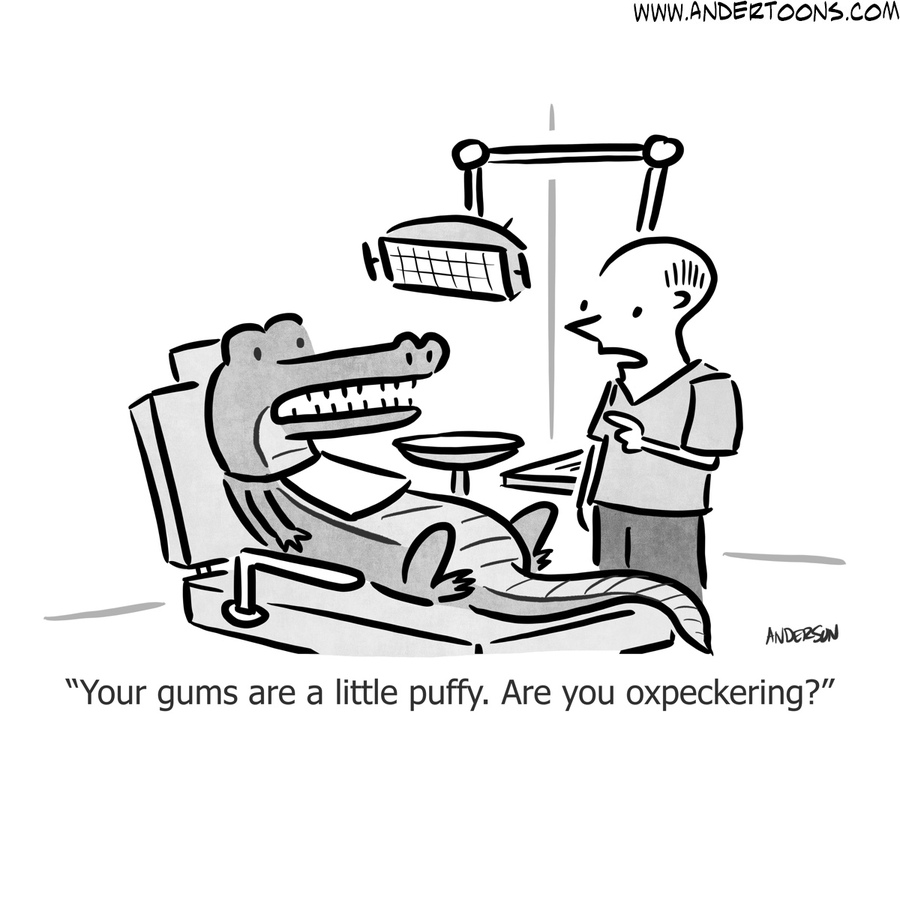
Oxpeckers are small African birds that perch on the backs of large animals, eating bugs and so on. It helps keep the animal healthier, and obviously the birds benefit too. I guess premise of the joke is that the birds will also perch on crocodiles and clean teeth. But AFAIK they don’t…
They don’t. But plovers do.
Evidently oxpeckers only hang out with mammals. Plovers are the birds reputed to eat food residue from the mouths of crocodiles, performing a function roughly analogous to humans flossing. The dentist has the right idea but the wrong birds.
I think most people know oxpeckers, and that’s why the cartoonist chose those. I didn’t even know what a plover was until just now.
I think most people know oxpeckers, and that’s why the cartoonist chose those. I didn’t even know what a plover was until just now.
Hunh, remarkable — it was exactly the opposite for me!
I had never heard of “oxpeckers” before now, but I did (dimly) recall hearing of “oxbirds“, although that led to three unrelated species that did not have any bearing on this comic.
However, unlike the “Egyptian plovers” mentioned by Miss Nomer and SteveHL (which are supposed to benefit their symbiotes), the “oxpeckers” are parasites: instead of just eating the available insects, they also peck at the animals and feed on the resulting blood.
You know how to tell alligators and crocodiles apart?
It’s all in whether they plan to see you later or in a while.
I think another joke here is how the dentist always asks if you are flossing?
Interesting. I never knew oxpeckers were parasites.
Judging by the comments, I think the cartoonist must have meant plovers. But I can’t see why he would put oxpeckers unless he didn’t know what plovers were called?
I found the Plover on Wikipedia, unusually short article though. https://en.wikipedia.org/wiki/Plover
I think they were using oxpeckers because some people use toothpicks to remove things caught between their teeth. And toothpick and oxpick are close.
Interesting. The only plovers that I knew of were shorebirds picking up critters on the beach.
I think they used oxpecker just because it sounds funnier than plover.
It turns out that if you follow the path far enough, the entire premise falls down like a house of cards. Maggie correctly identified the relationship to flossing, and Guero explained the reason why Anderson preferred using the word “pecker” in the caption. However, “plover” would not have been correct, either. The “crocodile bird” has an ancient tradition, going all the way back to Herodotus (440 B.C.), who described the behavior of the legendary “Trochilus“, and THAT is precisely the problem (the bird is legendary): “…research has not confirmed these observations, and there is no reliable evidence that this or any other species … has such a relationship with the crocodile” (emphasis mine). I thought that there was something odd about all the online images of plovers standing in the open mouths of crocodiles; it appears that they were Photoshopped.
P.S. Nevertheless, the concept has a long comic tradition: Walt Kelly once did a sequence in “Pogo”, in which Miz Grackle’s children did a teeth-cleaning job on Albert:
Same for me too as Mitch 4 for me!
Robert, sitting next to me says I should tell you that he saw a picture which showed a sign that said on the first line “crocodiles” and on the second “do not swim here” – so instead of being a being a warning that there were crocodiles there and one should not swim it said that “crocodiles do not swim here”.
@ Meryl – Sort of like the warning signs near schools that say “Slow Children Crossing” (meaning that they are easier to hit).
Yep, that “Crocodiles | do not swim here” sign has been in heavy circulation for a couple weeks!
For me, even though “oxpeckers” is wrong and “plovers” is right, I understood it this way and wouldn’t have the other. I associate “plover” with piping plovers, the small shorebird, and oxpeckers with “some kind of African bird that sits on bigger animals and eats stuff off of them.” I made the same mistake the cartoonist did, so thought it was funny.
I am never 100% sure of the definition of “irony”, but I think that’s close.
@ Ian Osmond – As Baldrick once said (to Blackadder), “…it’s like ‘goldy’ or ‘bronzy’…” (but much harder, of course).
…And Percy might have added, “and like greeny”.
I kind of agree that while oxpecker was wrong in a sense, it was more likely to be understood.
Kilby – per Ogden Nash – the signs near school with big Xs on them and pictures of children walking mean “Cross children walk, happy children ride.”
 Comics I Don't Understand
Oxpeckers are small African birds that perch on the backs of large animals, eating bugs and so on. It helps keep the animal healthier, and obviously the birds benefit too. I guess premise of the joke is that the birds will also perch on crocodiles and clean teeth. But AFAIK they don’t…
They don’t. But plovers do.
Evidently oxpeckers only hang out with mammals. Plovers are the birds reputed to eat food residue from the mouths of crocodiles, performing a function roughly analogous to humans flossing. The dentist has the right idea but the wrong birds.
I think most people know oxpeckers, and that’s why the cartoonist chose those. I didn’t even know what a plover was until just now.
I think most people know oxpeckers, and that’s why the cartoonist chose those. I didn’t even know what a plover was until just now.Hunh, remarkable — it was exactly the opposite for me!
I had never heard of “oxpeckers” before now, but I did (dimly) recall hearing of “oxbirds“, although that led to three unrelated species that did not have any bearing on this comic.
However, unlike the “Egyptian plovers” mentioned by Miss Nomer and SteveHL (which are supposed to benefit their symbiotes), the “oxpeckers” are parasites: instead of just eating the available insects, they also peck at the animals and feed on the resulting blood.
You know how to tell alligators and crocodiles apart?
It’s all in whether they plan to see you later or in a while.
I think another joke here is how the dentist always asks if you are flossing?
Interesting. I never knew oxpeckers were parasites.
Judging by the comments, I think the cartoonist must have meant plovers. But I can’t see why he would put oxpeckers unless he didn’t know what plovers were called?
I found the Plover on Wikipedia, unusually short article though.
https://en.wikipedia.org/wiki/Plover
I think they were using oxpeckers because some people use toothpicks to remove things caught between their teeth. And toothpick and oxpick are close.
Interesting. The only plovers that I knew of were shorebirds picking up critters on the beach.
I think they used oxpecker just because it sounds funnier than plover.
It turns out that if you follow the path far enough, the entire premise falls down like a house of cards. Maggie correctly identified the relationship to flossing, and Guero explained the reason why Anderson preferred using the word “pecker” in the caption. However, “plover” would not have been correct, either. The “crocodile bird” has an ancient tradition, going all the way back to Herodotus (440 B.C.), who described the behavior of the legendary “Trochilus“, and THAT is precisely the problem (the bird is legendary): “…research has not confirmed these observations, and there is no reliable evidence that this or any other species … has such a relationship with the crocodile” (emphasis mine). I thought that there was something odd about all the online images of plovers standing in the open mouths of crocodiles; it appears that they were Photoshopped.
P.S. Nevertheless, the concept has a long comic tradition: Walt Kelly once did a sequence in “Pogo”, in which Miz Grackle’s children did a teeth-cleaning job on Albert:
Same for me too as Mitch 4 for me!
Robert, sitting next to me says I should tell you that he saw a picture which showed a sign that said on the first line “crocodiles” and on the second “do not swim here” – so instead of being a being a warning that there were crocodiles there and one should not swim it said that “crocodiles do not swim here”.
@ Meryl – Sort of like the warning signs near schools that say “Slow Children Crossing” (meaning that they are easier to hit).
Yep, that “Crocodiles | do not swim here” sign has been in heavy circulation for a couple weeks!
For me, even though “oxpeckers” is wrong and “plovers” is right, I understood it this way and wouldn’t have the other. I associate “plover” with piping plovers, the small shorebird, and oxpeckers with “some kind of African bird that sits on bigger animals and eats stuff off of them.” I made the same mistake the cartoonist did, so thought it was funny.
I am never 100% sure of the definition of “irony”, but I think that’s close.
@ Ian Osmond – As Baldrick once said (to Blackadder), “…it’s like ‘goldy’ or ‘bronzy’…” (but much harder, of course).
…And Percy might have added, “and like greeny”.
I kind of agree that while oxpecker was wrong in a sense, it was more likely to be understood.
Kilby – per Ogden Nash – the signs near school with big Xs on them and pictures of children walking mean “Cross children walk, happy children ride.”