At a certain point in the development of orthodox Chomskyan theory, the definitive text for his current thinking was circulating as “The Pisa Lectures”. (later published as a book with a more specific title). Among dissenters, it was a popular sarcastic move to refer to “The Bologna Lectures”.
Who says it doesn’t? I do remote yoga; my yogini is in WI, I’m in FL. Why NOT do remote lunch, to make the [home]school day like normal. Complete with mystery meat and fish fingers, and NEVER peanut butter samiches.
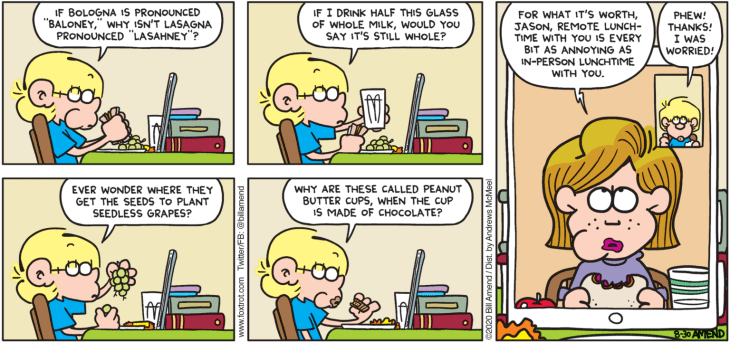
But remote lunchtime does exist. Everyone fixes their lunch, sits down at their computers, and uses Zoom or an equivalent to chat while they eat. I thought the comic was amusing. There’s not a zinger of a punchline, but getting to it was fun.
I wouldn’t have said Bologna was pronounced baloney.
I’m with Andrea and Bookworm. Seems like a great idea to me.
narmitaj, ‘baloney’ is how it was always pronounced in my house, unless somebody was trying to be funny, in which case it was ‘Please pass the buh-LOG-nuh.’ ten-year-olds are so funny, aren’t they?
Remote Happy Hours exist so why wouldn’t remote lunch times? I can’t stand watching people eat or be seen eating and think remote lunch would be one of the most disgusting ideas I can think of, but I know I am in the extreme minority.
Not as funny as when it is compared to ‘a cross-section of a dachshund’.
I’m with Bookworm. We do remote lunches every week at work, just as they said.
I’m with Chak, the normal word was “baloney” and it was long time before I knew the written word bologna was [also] pronounced that way. I didn’t really see the written bologna until late, anyway.
I can’t look it up right now, but I think part of the perceived rudeness of “baloney” is that it may sound like you’re going to say “balls”, it’s like “bollix” which is “ballocks”.
Surely Bill knew when he posted such a provocative headline, that the comments would be full of people saying, “I do it all the time.” Heck, you could post “nobody ever picks their nose with a chainsaw” on the internet, and receive multiple contrary responses. There are no longer any absolutes.
Also, someone as smart as Jason should already know how they get seedless fruit.
Looking up Bologna sausage on Wikipedia I see this sub-bit of info: “Lebanon bologna is a Pennsylvania Dutch prepared meat” which seems at first sight like a four-way crash of cultures, though I am guessing the Lebanon part has nothing to do do with the country.
And Pennsylvania Dutch has nothing to do with Holland.
There have been so many ZOOM cartoons (ZOOMtoons?) that I’m surprised this hasn’t happened. Of course, Bill Watterson would have to come out of retirement, unless he’d rather not participate and just let whoever do the drawing and the jokes. That’d be funny, tho.
For that matter, Pennsylvania has Bickel Pretzels that have nothing to do with me.
@ Narmitaj – I used to like it a lot, but some people might consider Lebanon bologna to be an acquired taste. It’s closer to salami than bologna, and has a fairy strong, smoky flavor. The name probably comes from the town “Lebanon, Pennsylvania”, and not the country. There’s also a neighborhood in Pittsburgh called “Mount Lebanon”.
So how come pasta e fagioli is pronounced “pasta fazool”?
@MarkInBoston, because the Italiano is something like, “fazhyolee”.
So how come pasta e fagioli is pronounced “pasta fazool”?
This was something that interested my Irish-American New York Uncle Ted (actually Thaddeus), who found out it was really a matter of regional dialect in New York. (Probably along the lines Carl suggests.) It was also something of a joke, as one could mock-threaten a child or buddy by cocking an arm and shaking your fist and saying “Ohhh pasta faZOOOL!!”.
Generally I think of bologna as being pronounced “bo-lona” in the US, not to be confused with “baloney”, which is just nonsense…literally. :-)
Cidu Bill: “I was of course referring to school lunch period, mandatory for both students and teacher.”
Why, “of course”? Nothing in the cartoon says that that’s what’s happening here.
…oh, and I think Jason might already know about the grape thing, he’s just being weird. He’s doing sort of a stand-up routine. Next time he’ll go on about parking in driveways and driving on parkways and such…
It would be fun to speculate how kids from various comics might get along together.
Generally I think of bologna as being pronounced “bo-lona” in the US, not to be confused with “baloney”, which is just nonsense…literally.
Not in my experience. I’ve never heard the lunch meat called anything by “baloney” expect for an Oscar Mayer TV commercial with a little kid singing the B-O-L-O-G-N-A song.
The kid says baloney, but the announcer at the end says ba-lona. It was always baloney where I grew up, though my Depression-born father called it “minced ham”.
Huh. My first attempt appeared to just disappear, so I tried again with comments added. Sorry about the double post.
Winter, why else would he be having a virtual lunch with his teacher?
B.A. Oh, I thought that was a student.
Although, last year in 1st grade daughter did have an online lunch with her teacher and a group of students.So either way, this is a thing.
@Mitch: Given that the first syllable in baloney is often pronounced “buh”, I suspect it euphemizes a slightly different B-word meaning nonsense. One referring to the byproduct of a male bovine.
@MiB: It’s pasta fazool, because the name comes from pasta e fasule, which is the Neapolitan dialect for pasta e fagiole. Somebody used the name as the basis of a novelty song back in the 20s, snippets of which filtered down to us through, I think, Warner Bros. cartoons, thus cementing the name in American culture.
“Winter, why else would he be having a virtual lunch with his teacher?”
She IS a student, Eileen Jacobson.
There was a pasta fast food (chain) restaurant in Kenosha called Fazoli’s. They had unlimited breadsticks WAAAAAY before Olive Garden did. Altho there is a website for the chain, I don’t know if the one in Kenosha still exists.
Aaaaand this came into my InBox today . . .
[BTW – EW! & OUCH!]
Not surprised . . . I rarely saw many people in there; I think we ate there twice.
DanV, thank you for the trip down memory lane. My mother absolutely loved that commercial when it was on the air; I remember her getting very angry at my brother (who would have been around 12 at the time) who “ruined it” by singing along once.
Woozy, I’m with you–I don’t like watching (or hearing, yuck!) other people eat, and I don’t particularly care for others to be around when I’m eating.
This was researched in a local district, as a support to “social time” between students and an attempt at normalcy. The conflict is: positive side is more social and normal time, negative side was they were also attempting to reduce screen time. Lots of discussion. I no longer have children in school, so I don’t know how it ended.
But if it is Eileen Jacobson, why is she lunching with him if she doesn’t enjoy it? If it were a teacher, it could have been something mandatory.
I also thought it was the teacher. I noted the apple on the desk and what appears to be lipstick. I guess that latter could be jelly from her sandwich, though.
I had wondered why it was called Fazoli’s; I thought it was a last name, like McDonald’s. The things you learn with CIDUers.
She’s eating with Jason so that Amend could make a Sunday funny. Yes, that’s jelly; Amend always draws messes around the characters’ mouths like that.
“Woozy, I’m with you–I don’t like watching (or hearing, yuck!) other people eat,”
If you have misophonia, as I do, it’s worse at home than in a restaurant, where the noise level is high enough (cutlery, talking, music) to obliterate the noise of the person eating at the same table. At home, not so much (I can only turn up the music so high before Hubby gets insulted). And it’s NOT that he chews or chomps; it’s that I can hear jaw muscles moving (I kid you not), and he can’t do anything about that.
Now that I was dx’d and understood the issue, I can control my feelings about what I hear, to some extent.
Next thing you know, they’ll be trying virtual recess.
My kids don’t have any shared lunch time. Lunch is hard enough without the screens. At least at school, you wander to the cafeteria and get what they got. At home, class finishes up and then you have to decide what to have and then prep it. Unless you’re unlike my kids and do the prep early, lunch takes longer when there’s not someone hired to serve it to you.
If they did zoom with their friends between classes, I would foresee a few days of “Oh, next class in 5 minutes. I haven’t eaten yet…”
@ Andréa – My son is already doing that, sans electronics. His class has a designated section of the schoolyard, and they end up sitting there and chatting, since they are supposed to maintain distance (masks are not required outside, as long as they can stay far enough apart).
Which is ironic; the original point of recess was for kids to have some exercise and get their ya-yas out.
“ I had wondered why it was called Fazoli’s; I thought it was a last name, like McDonald’s”
No reason it wouldn’t be both. There are for instance people named Bean.
Okay, this makes sense to me if that’s Eileen: she and Jason would be eating lunch “together” because they hate each other/are dating/whatever.
@ Mitch4 – “Ecce homo, qui est faba!“
“DanV, thank you for the trip down memory lane. My mother absolutely loved that commercial when it was on the air;”
What…..?
Yeah, Jason and Eileen are in a more friendly state. He still tries to do some silly stuff around her.
Don’t most kids just eat in front of the screen during “class time”? I know I certainly would.
Andréa – Despite the two windmill shaped restaurants (although one is only a gift shop and bakery for a number of years now) in the greater “Pennsylvania Dutch area” the name is an anglicized version of the German word Deutch for German.
In addition to the Amish and/or Mennonites that most people think of when they hear the term Pennsylvania Dutch if one goes further away from Lancaster County there are also Lutherans, Church of the Bretheran, Reformed, Moravians, Hutterite, and some other Protestant sects that are not coming to mind. Many of these other sects live extremely modern lives.
A couple of decades ago we came across an annual Folk festival called Goschenhoppen which is held in August north east of Philadelphia in Montgomery County. The variety of Germans who had come to Pennsylvania had not occurred to us before then. It is one of the more interesting craft/history events we go to (except this year of course) as it purpose is education. Those demonstrating crafts, cooking, etc are allowed to sell, but the focus is not on the selling, but on teaching the old ways. They have an apprenticeship program for children to learn the traditional crafts and cooking. Some of those demonstrating work only at the event – the piece they are working on is put away at the end of the event until the following year. It is done for the community to the point that when speaking people there they are shocked that someone in NY knows about it and bothers to come to it. Before we had the RV we would time out our vacation to leave the Friday of the festival, stop at it on our way, have dinner in Lancaster and then drive down to DC that day.
It is on the grounds of an 18th century farm and the house has been restored. It is rather different than English colonial houses of the period in how it arranged – apparently in the house kitchens were common for them, as opposed to the English having their kitchen in a separate building or in some cases (particularly among the actual Dutch larger houses ) in the cellar. Main bedroom in on the first level and there will be a very decorative (hand) embroidered white on white “towel” that was embroidered by the lady of the house in anticipation of her marriage. (Entire huge book written about this towels.)
A street runs through the property (closed off for this event) and the property on the side of the street with the house has 18th century “lifeskills” and crafts with the 19th century ones across the street on the larger section of the property. There is a large seminar stage for talks and music. There is a section on the 19th century side on farming. Each side has a 4 room house with no outer walls so one can see the house – cooking in the kitchens and other activities such as quilting in the 19th c house in the other rooms. Even butchering demonstrations (which I avoid). Of course local food for sale for lunches or to take home – there is something called “funny cake” which we have only found there and at one local supermarket – it sort of like a cake in a pie shell with liquid chocolate below the cakes and swirled into the cake. When one pays their admission one gets a wooden nickel with that year’s theme on it.
Canceled this year of course.
According to Robert (from a 2nd generation Italian parents with grandparents living in the same house and around the corner – Fazoli is pronounced Fa zool.
Gee I wonder if the two of us could have a Zoom lunch – one of us in the dining room and the other in the kitchen? It would involving figuring out where to store the excess emergency canned and packaged goods that currently take up all of the dining room table plus.
“Andréa – Despite the two windmill shaped restaurants (although one is only a gift shop and bakery for a number of years now) in the greater “Pennsylvania Dutch area” the name is an anglicized version of the German word Deutch for German.”
Yes, I know that; that’s why I mentioned it. I have a personal resentment for having anything German being ‘misteaken’ for Dutch, and vice versa.
“In addition to the Amish and/or Mennonites that most people think of when they hear the term Pennsylvania Dutch if one goes further away from Lancaster County . . . ”
As a side note and seemingly little-known fact, the Amish are the largest owners of puppy mills.
To be fair, the separation between the Dutch and Deutsch is arbitrary. They all descend from proto-Germanic speakers from neighboring regions of Europe. The language spoken in the Netherlands is no more different from the modern “high German” than modern “low German” is, really. The difference ends up being historical/political, as the various regions were ruled by different polities and encouraged to think of each other as foreign.
“The language spoken in the Netherlands is no more different from the modern “high German” than modern “low German” is, really.”
Proof?
My first language is Dutch (not the Queen’s [now, King’s] Dutch, but ‘city’ Dutch [Amsterdam]), and I can’t say I understand German, either ‘low’ or ‘high’.
I’m not quite sure what kind of “proof” you mean, Andréa. It is not in dispute that Dutch is much closer to “low” German than it (or its close sister languages like West Frisian) is to other Germanic languages like English or Icelandic. You could see the language tree about 3/4 of the way down in this article: https://www.britannica.com/topic/Germanic-languages/Vowels
You can’t understand German, any dialect, sure. But a speaker of only, say, High Franconian would also find Standard German unintelligible. (There are almost none, or none, left in 2020, because the standard language is dominant, just as there are few sole-speakers of the various Italian dialects outside of very rural areas.) I’m not saying a modern Nederlander can talk to a Berliner without translating in 2020, I’m saying that there was originally a language continuum all the way from the North Sea to the Rhine, and the division between “Dutch” and “Deutsch” peoples and languages falls where it does for contingent historical reasons, not because of separate origin.
I tend to agree with Carl Fink that the respective separations between “standard” German, Dutch, and (for instance) the “friesische” dialects (in northwestern German) are probably of (approximately) the same order of magnitude, but it is important to note that this magnitude is (for non-linguists) fairly extreme. For obvious reasons, schools only teach standard (“high”) German, but if you use that when speaking to a rural farmer in “Ostfriesland” (or Bavaria, for that matter), you probably won’t understand very much at all.
Andrea, I don’t know if it’s misophonia with me; I just happen to know some particularly loud, lip-smacking, slobbery-sounding eaters and it grosses me out. The worst was when I could hear my MIL eating a slice of cake–cake!–when she was at least six feet away from me. Cake is soft, you shouldn’t make noise when you eat it! And no, my hearing isn’t overly-sensitive; she was just that loud. (For what it’s worth, I’m also grossed out by super-messy eating, such as those “cute” pictures of babies covered in spaghetti.)
Woozy, yup, that was mom’s favorite commercial. Weird, I know.
‘Misophonia is a disorder in which certain sounds trigger emotional or physiological responses that some might perceive as unreasonable given the circumstance. Those who have misophonia might describe it as when a sound “drives you crazy.” Their reactions can range from anger and annoyance to panic and the need to flee.’
For loud noises, such as a sneeze, a lawnmower/leaf blower/airplane/fireworks, I can feel an adrenaline rush, a ‘fight or flight’ response, heart pounding. For noise of non-messy eaters, crunching of potato chips, I just get EXTREMELY annoyed, even angry. Now that we know what the issue is, I’m no longer considered just a PITA, and I try to control my response.
Two effects of fibromyalgia are heightened hearing and smelling abilities. The hearing aspect is good for bird watching/listening [trying to look on the bright side of FMS].
‘ (For what it’s worth, I’m also grossed out by super-messy eating, such as those “cute” pictures of babies covered in spaghetti.)’
I’m with you there, but then, ANY “cute” picture of “cute” babies grosses me out, to a certain degree. I’d rather see dog-p**ping pictures (I mean, if I HAD to choose).
AFAIK, knowing some german and some old English helps with learning dutch. Flemish people do understand dutch (that’s what’s taught in schools), but they really speak dialects, with variations from town to town, to the point they can’t understand each other, sometimes.
I’ve had a few “social” lunch meetings since the pandemic, and I felt very uncomfortable seeing this large picture of me chewing, gulping, etc. . . on the screen. Sometimes I duck off to the side to eat, which I know probably looks even weirder.
@Andréa: The plural of anecdote is not data, but my wife grew up in southern Lower Saxony and understood the local Plattdeutsch and could speak some. When her sister lived in the Netherlands and she visited, she was able to have some idea of what the locals were saying and make herself understood. Later, she learned Dutch and can no longer speak any Platt (though she can still understand it). On the difficulty scale it probably falls somewhere between an Italian and a Spaniard trying to communicate only in their native tongues and an American trying to communicate with someone who speaks only Lowland Scots. For me, with my English and German, I can make my way laboriously through written Dutch, but listening to it is like hearing a conversation in another room. The rhythms are right and you can make out a word here and there, but can’t really understand what’s being said,
You probably haven’t heard much Platt, and what you’ve heard is most likely the formal Platt they use in the media and to teach Platt in schools. I bet if you ran into someone speaking a Westphalian Platt or Lower Rhineland Platt, you’d pick it up pretty quickly. Not that that’s likely to happen, since mass communication has pretty much put an end to actual dialects (except in rare cases like Bavarian) and reduced things to local accents like in America.
From fiction:
Rick smiled. “The trouble with Dutch is that it seems as though I should be able to understand it.”
“I’m sure you could learn it very quickly,” the Dutchman said politely. “You probably find that the spelling looks difficult, but when you hear the words they sound much like English.”
“That’s true,” Rick agreed.
“Actually, Dutch and English are very close. They both originated with the ancient Low German. In your case, it merged into the old Anglo-Saxon, then blended with many words from the Romance languages. Ours still resembles the original more closely, but many words have the same roots, and even the same meaning.”
“certain sounds trigger emotional or physiological responses”
Like the sound of fingernails on a blackboard for instance?
No, more like abrupt sounds.
Shortly after my first year in Germany, I happened to be in an obscure shop somewhere in the Pacific Northwest, and picked up an interesting looking volume. The contents were very puzzling: I couldn’t “read” it, but by skipping along and freely associating cognates from English and my newly learned German, I discovered that I could understand perhaps 75% of the text. I had no idea whether it was a serious book or just some sort of linguistic parody, but when I asked the owner, I discovered that the whole store was devoted to specialities from the Netherlands (which I might have guessed, given that the building had a windmill on the corner), and the book was in standard Dutch.
P.S. At a previous job, I had two older colleagues who spoke extremely strong “Ostfriesisch” Platt. I could understand either one of them alone (they could speak fairly normal, although heavily accented standard German), but when the two of them were together, the result was utterly unintelligible.
P.P.S. Way down in southern Bavaria, I observed on several occasions that shopkeepers would make an effort to standardize their German for me (since they could hear that I was a “furriner”), but they made no allowances for my northern German compatriots: they were treated with standard Bavarian, whether they liked it or not.
“. . ., I happened to be in an obscure shop somewhere in the Pacific Northwest,”
Wouldn’t it be funny if that was the same shop – on Vancouver Island – that my first Hubby and I wandered into in 1972 . . . but I knew IMMEDIATELY that it was a shop selling Dutch merchandise (probably from the foods available; I remember we bought a LOT of if to bring home to WI, but I think we ate it all before we got there . . . we were on a month-long ‘tour’ of the US).
It may have been this one . . . https://shop.iloveoma.com/ . . . altho I can’t imagine that 48 years later, the same shop would STILL be there.
This conversation seems a bit deja entendu . . . didn’t we go here before?
@ Andréa – The BC shop is not the right one, it was in the US, not Canada, and we did talk about this before, but that was direct (via e-mail), not in a CIDU thread. Back then you found a likely candidate (for the building, at least) at 618 Front St., in Lynden, WA. I have no idea whether the shop still exists in that building.
Right . . . good memory
@ Andréa – Memory has very little to do with it (I looked up the screenshot you had sent).
 Comics I Don't Understand
At a certain point in the development of orthodox Chomskyan theory, the definitive text for his current thinking was circulating as “The Pisa Lectures”. (later published as a book with a more specific title). Among dissenters, it was a popular sarcastic move to refer to “The Bologna Lectures”.
Who says it doesn’t? I do remote yoga; my yogini is in WI, I’m in FL. Why NOT do remote lunch, to make the [home]school day like normal. Complete with mystery meat and fish fingers, and NEVER peanut butter samiches.
But remote lunchtime does exist. Everyone fixes their lunch, sits down at their computers, and uses Zoom or an equivalent to chat while they eat. I thought the comic was amusing. There’s not a zinger of a punchline, but getting to it was fun.
I wouldn’t have said Bologna was pronounced baloney.
I’m with Andrea and Bookworm. Seems like a great idea to me.
narmitaj, ‘baloney’ is how it was always pronounced in my house, unless somebody was trying to be funny, in which case it was ‘Please pass the buh-LOG-nuh.’ ten-year-olds are so funny, aren’t they?
Remote Happy Hours exist so why wouldn’t remote lunch times? I can’t stand watching people eat or be seen eating and think remote lunch would be one of the most disgusting ideas I can think of, but I know I am in the extreme minority.
Not as funny as when it is compared to ‘a cross-section of a dachshund’.
I’m with Bookworm. We do remote lunches every week at work, just as they said.
I’m with Chak, the normal word was “baloney” and it was long time before I knew the written word bologna was [also] pronounced that way. I didn’t really see the written bologna until late, anyway.
I can’t look it up right now, but I think part of the perceived rudeness of “baloney” is that it may sound like you’re going to say “balls”, it’s like “bollix” which is “ballocks”.
Surely Bill knew when he posted such a provocative headline, that the comments would be full of people saying, “I do it all the time.” Heck, you could post “nobody ever picks their nose with a chainsaw” on the internet, and receive multiple contrary responses. There are no longer any absolutes.
Also, someone as smart as Jason should already know how they get seedless fruit.
@ Olivier – I think that if she had been offered the chance, Susi would definitely have preferred a virtual lunch:
Mmmm… dachshund.
Certainly a lot of people “eat together” using Zoom: I was of course referring to school lunch period, mandatory for both students and teacher.
Maybe Jason should have virtual lunch with Caulfield, and they can drive each other crazy.
Or give each other pointers.
My office has a mandatory remote dinner each month so we get to remember what one another’s faces look like.
We get to expense pizzas, so instead of a team meeting, it’s called a pizza party.
@Chak – Ah, I was thinking of the city Bologna, not the foodstuff. Which is presumably named after the city.
https://en.wikipedia.org/wiki/File:It-Bologna.ogg for the pronunciation of that.
Looking up Bologna sausage on Wikipedia I see this sub-bit of info: “Lebanon bologna is a Pennsylvania Dutch prepared meat” which seems at first sight like a four-way crash of cultures, though I am guessing the Lebanon part has nothing to do do with the country.
And Pennsylvania Dutch has nothing to do with Holland.
There have been so many ZOOM cartoons (ZOOMtoons?) that I’m surprised this hasn’t happened. Of course, Bill Watterson would have to come out of retirement, unless he’d rather not participate and just let whoever do the drawing and the jokes. That’d be funny, tho.
For that matter, Pennsylvania has Bickel Pretzels that have nothing to do with me.
@ Narmitaj – I used to like it a lot, but some people might consider Lebanon bologna to be an acquired taste. It’s closer to salami than bologna, and has a fairy strong, smoky flavor. The name probably comes from the town “Lebanon, Pennsylvania”, and not the country. There’s also a neighborhood in Pittsburgh called “Mount Lebanon”.
So how come pasta e fagioli is pronounced “pasta fazool”?
@MarkInBoston, because the Italiano is something like, “fazhyolee”.
So how come pasta e fagioli is pronounced “pasta fazool”?
This was something that interested my Irish-American New York Uncle Ted (actually Thaddeus), who found out it was really a matter of regional dialect in New York. (Probably along the lines Carl suggests.) It was also something of a joke, as one could mock-threaten a child or buddy by cocking an arm and shaking your fist and saying “Ohhh pasta faZOOOL!!”.
Generally I think of bologna as being pronounced “bo-lona” in the US, not to be confused with “baloney”, which is just nonsense…literally. :-)
Cidu Bill: “I was of course referring to school lunch period, mandatory for both students and teacher.”
Why, “of course”? Nothing in the cartoon says that that’s what’s happening here.
…oh, and I think Jason might already know about the grape thing, he’s just being weird. He’s doing sort of a stand-up routine. Next time he’ll go on about parking in driveways and driving on parkways and such…
It would be fun to speculate how kids from various comics might get along together.
Generally I think of bologna as being pronounced “bo-lona” in the US, not to be confused with “baloney”, which is just nonsense…literally.
Not in my experience. I’ve never heard the lunch meat called anything by “baloney” expect for an Oscar Mayer TV commercial with a little kid singing the B-O-L-O-G-N-A song.
The kid says baloney, but the announcer at the end says ba-lona. It was always baloney where I grew up, though my Depression-born father called it “minced ham”.
Huh. My first attempt appeared to just disappear, so I tried again with comments added. Sorry about the double post.
Winter, why else would he be having a virtual lunch with his teacher?
B.A. Oh, I thought that was a student.
Although, last year in 1st grade daughter did have an online lunch with her teacher and a group of students.So either way, this is a thing.
@Mitch: Given that the first syllable in baloney is often pronounced “buh”, I suspect it euphemizes a slightly different B-word meaning nonsense. One referring to the byproduct of a male bovine.
@MiB: It’s pasta fazool, because the name comes from pasta e fasule, which is the Neapolitan dialect for pasta e fagiole. Somebody used the name as the basis of a novelty song back in the 20s, snippets of which filtered down to us through, I think, Warner Bros. cartoons, thus cementing the name in American culture.
“Winter, why else would he be having a virtual lunch with his teacher?”
She IS a student, Eileen Jacobson.
There was a pasta fast food (chain) restaurant in Kenosha called Fazoli’s. They had unlimited breadsticks WAAAAAY before Olive Garden did. Altho there is a website for the chain, I don’t know if the one in Kenosha still exists.
@ Andréa – It would appear that it does not.
Aaaaand this came into my InBox today . . .

[BTW – EW! & OUCH!]
Not surprised . . . I rarely saw many people in there; I think we ate there twice.
DanV, thank you for the trip down memory lane. My mother absolutely loved that commercial when it was on the air; I remember her getting very angry at my brother (who would have been around 12 at the time) who “ruined it” by singing along once.
Woozy, I’m with you–I don’t like watching (or hearing, yuck!) other people eat, and I don’t particularly care for others to be around when I’m eating.
This was researched in a local district, as a support to “social time” between students and an attempt at normalcy. The conflict is: positive side is more social and normal time, negative side was they were also attempting to reduce screen time. Lots of discussion. I no longer have children in school, so I don’t know how it ended.
But if it is Eileen Jacobson, why is she lunching with him if she doesn’t enjoy it? If it were a teacher, it could have been something mandatory.
I also thought it was the teacher. I noted the apple on the desk and what appears to be lipstick. I guess that latter could be jelly from her sandwich, though.
I had wondered why it was called Fazoli’s; I thought it was a last name, like McDonald’s. The things you learn with CIDUers.
She’s eating with Jason so that Amend could make a Sunday funny. Yes, that’s jelly; Amend always draws messes around the characters’ mouths like that.
“Woozy, I’m with you–I don’t like watching (or hearing, yuck!) other people eat,”
If you have misophonia, as I do, it’s worse at home than in a restaurant, where the noise level is high enough (cutlery, talking, music) to obliterate the noise of the person eating at the same table. At home, not so much (I can only turn up the music so high before Hubby gets insulted). And it’s NOT that he chews or chomps; it’s that I can hear jaw muscles moving (I kid you not), and he can’t do anything about that.
Now that I was dx’d and understood the issue, I can control my feelings about what I hear, to some extent.
Next thing you know, they’ll be trying virtual recess.
My kids don’t have any shared lunch time. Lunch is hard enough without the screens. At least at school, you wander to the cafeteria and get what they got. At home, class finishes up and then you have to decide what to have and then prep it. Unless you’re unlike my kids and do the prep early, lunch takes longer when there’s not someone hired to serve it to you.
If they did zoom with their friends between classes, I would foresee a few days of “Oh, next class in 5 minutes. I haven’t eaten yet…”
@ Andréa – My son is already doing that, sans electronics. His class has a designated section of the schoolyard, and they end up sitting there and chatting, since they are supposed to maintain distance (masks are not required outside, as long as they can stay far enough apart).
Which is ironic; the original point of recess was for kids to have some exercise and get their ya-yas out.
“ I had wondered why it was called Fazoli’s; I thought it was a last name, like McDonald’s”
No reason it wouldn’t be both. There are for instance people named Bean.
Okay, this makes sense to me if that’s Eileen: she and Jason would be eating lunch “together” because they hate each other/are dating/whatever.
@ Mitch4 – “Ecce homo, qui est faba!“
“DanV, thank you for the trip down memory lane. My mother absolutely loved that commercial when it was on the air;”
What…..?
Yeah, Jason and Eileen are in a more friendly state. He still tries to do some silly stuff around her.
https://www.gocomics.com/foxtrot/2019/12/29
Don’t most kids just eat in front of the screen during “class time”? I know I certainly would.
Andréa – Despite the two windmill shaped restaurants (although one is only a gift shop and bakery for a number of years now) in the greater “Pennsylvania Dutch area” the name is an anglicized version of the German word Deutch for German.
In addition to the Amish and/or Mennonites that most people think of when they hear the term Pennsylvania Dutch if one goes further away from Lancaster County there are also Lutherans, Church of the Bretheran, Reformed, Moravians, Hutterite, and some other Protestant sects that are not coming to mind. Many of these other sects live extremely modern lives.
A couple of decades ago we came across an annual Folk festival called Goschenhoppen which is held in August north east of Philadelphia in Montgomery County. The variety of Germans who had come to Pennsylvania had not occurred to us before then. It is one of the more interesting craft/history events we go to (except this year of course) as it purpose is education. Those demonstrating crafts, cooking, etc are allowed to sell, but the focus is not on the selling, but on teaching the old ways. They have an apprenticeship program for children to learn the traditional crafts and cooking. Some of those demonstrating work only at the event – the piece they are working on is put away at the end of the event until the following year. It is done for the community to the point that when speaking people there they are shocked that someone in NY knows about it and bothers to come to it. Before we had the RV we would time out our vacation to leave the Friday of the festival, stop at it on our way, have dinner in Lancaster and then drive down to DC that day.
It is on the grounds of an 18th century farm and the house has been restored. It is rather different than English colonial houses of the period in how it arranged – apparently in the house kitchens were common for them, as opposed to the English having their kitchen in a separate building or in some cases (particularly among the actual Dutch larger houses ) in the cellar. Main bedroom in on the first level and there will be a very decorative (hand) embroidered white on white “towel” that was embroidered by the lady of the house in anticipation of her marriage. (Entire huge book written about this towels.)
A street runs through the property (closed off for this event) and the property on the side of the street with the house has 18th century “lifeskills” and crafts with the 19th century ones across the street on the larger section of the property. There is a large seminar stage for talks and music. There is a section on the 19th century side on farming. Each side has a 4 room house with no outer walls so one can see the house – cooking in the kitchens and other activities such as quilting in the 19th c house in the other rooms. Even butchering demonstrations (which I avoid). Of course local food for sale for lunches or to take home – there is something called “funny cake” which we have only found there and at one local supermarket – it sort of like a cake in a pie shell with liquid chocolate below the cakes and swirled into the cake. When one pays their admission one gets a wooden nickel with that year’s theme on it.
Canceled this year of course.
According to Robert (from a 2nd generation Italian parents with grandparents living in the same house and around the corner – Fazoli is pronounced Fa zool.
Gee I wonder if the two of us could have a Zoom lunch – one of us in the dining room and the other in the kitchen? It would involving figuring out where to store the excess emergency canned and packaged goods that currently take up all of the dining room table plus.
“Andréa – Despite the two windmill shaped restaurants (although one is only a gift shop and bakery for a number of years now) in the greater “Pennsylvania Dutch area” the name is an anglicized version of the German word Deutch for German.”
Yes, I know that; that’s why I mentioned it. I have a personal resentment for having anything German being ‘misteaken’ for Dutch, and vice versa.
“In addition to the Amish and/or Mennonites that most people think of when they hear the term Pennsylvania Dutch if one goes further away from Lancaster County . . . ”
As a side note and seemingly little-known fact, the Amish are the largest owners of puppy mills.
To be fair, the separation between the Dutch and Deutsch is arbitrary. They all descend from proto-Germanic speakers from neighboring regions of Europe. The language spoken in the Netherlands is no more different from the modern “high German” than modern “low German” is, really. The difference ends up being historical/political, as the various regions were ruled by different polities and encouraged to think of each other as foreign.
“The language spoken in the Netherlands is no more different from the modern “high German” than modern “low German” is, really.”
Proof?
My first language is Dutch (not the Queen’s [now, King’s] Dutch, but ‘city’ Dutch [Amsterdam]), and I can’t say I understand German, either ‘low’ or ‘high’.
I’m not quite sure what kind of “proof” you mean, Andréa. It is not in dispute that Dutch is much closer to “low” German than it (or its close sister languages like West Frisian) is to other Germanic languages like English or Icelandic. You could see the language tree about 3/4 of the way down in this article: https://www.britannica.com/topic/Germanic-languages/Vowels
You can’t understand German, any dialect, sure. But a speaker of only, say, High Franconian would also find Standard German unintelligible. (There are almost none, or none, left in 2020, because the standard language is dominant, just as there are few sole-speakers of the various Italian dialects outside of very rural areas.) I’m not saying a modern Nederlander can talk to a Berliner without translating in 2020, I’m saying that there was originally a language continuum all the way from the North Sea to the Rhine, and the division between “Dutch” and “Deutsch” peoples and languages falls where it does for contingent historical reasons, not because of separate origin.
I tend to agree with Carl Fink that the respective separations between “standard” German, Dutch, and (for instance) the “friesische” dialects (in northwestern German) are probably of (approximately) the same order of magnitude, but it is important to note that this magnitude is (for non-linguists) fairly extreme. For obvious reasons, schools only teach standard (“high”) German, but if you use that when speaking to a rural farmer in “Ostfriesland” (or Bavaria, for that matter), you probably won’t understand very much at all.
Andrea, I don’t know if it’s misophonia with me; I just happen to know some particularly loud, lip-smacking, slobbery-sounding eaters and it grosses me out. The worst was when I could hear my MIL eating a slice of cake–cake!–when she was at least six feet away from me. Cake is soft, you shouldn’t make noise when you eat it! And no, my hearing isn’t overly-sensitive; she was just that loud. (For what it’s worth, I’m also grossed out by super-messy eating, such as those “cute” pictures of babies covered in spaghetti.)
Woozy, yup, that was mom’s favorite commercial. Weird, I know.
‘Misophonia is a disorder in which certain sounds trigger emotional or physiological responses that some might perceive as unreasonable given the circumstance. Those who have misophonia might describe it as when a sound “drives you crazy.” Their reactions can range from anger and annoyance to panic and the need to flee.’
For loud noises, such as a sneeze, a lawnmower/leaf blower/airplane/fireworks, I can feel an adrenaline rush, a ‘fight or flight’ response, heart pounding. For noise of non-messy eaters, crunching of potato chips, I just get EXTREMELY annoyed, even angry. Now that we know what the issue is, I’m no longer considered just a PITA, and I try to control my response.
Two effects of fibromyalgia are heightened hearing and smelling abilities. The hearing aspect is good for bird watching/listening [trying to look on the bright side of FMS].
‘ (For what it’s worth, I’m also grossed out by super-messy eating, such as those “cute” pictures of babies covered in spaghetti.)’
I’m with you there, but then, ANY “cute” picture of “cute” babies grosses me out, to a certain degree. I’d rather see dog-p**ping pictures (I mean, if I HAD to choose).
AFAIK, knowing some german and some old English helps with learning dutch. Flemish people do understand dutch (that’s what’s taught in schools), but they really speak dialects, with variations from town to town, to the point they can’t understand each other, sometimes.
I’ve had a few “social” lunch meetings since the pandemic, and I felt very uncomfortable seeing this large picture of me chewing, gulping, etc. . . on the screen. Sometimes I duck off to the side to eat, which I know probably looks even weirder.
@Andréa: The plural of anecdote is not data, but my wife grew up in southern Lower Saxony and understood the local Plattdeutsch and could speak some. When her sister lived in the Netherlands and she visited, she was able to have some idea of what the locals were saying and make herself understood. Later, she learned Dutch and can no longer speak any Platt (though she can still understand it). On the difficulty scale it probably falls somewhere between an Italian and a Spaniard trying to communicate only in their native tongues and an American trying to communicate with someone who speaks only Lowland Scots. For me, with my English and German, I can make my way laboriously through written Dutch, but listening to it is like hearing a conversation in another room. The rhythms are right and you can make out a word here and there, but can’t really understand what’s being said,
You probably haven’t heard much Platt, and what you’ve heard is most likely the formal Platt they use in the media and to teach Platt in schools. I bet if you ran into someone speaking a Westphalian Platt or Lower Rhineland Platt, you’d pick it up pretty quickly. Not that that’s likely to happen, since mass communication has pretty much put an end to actual dialects (except in rare cases like Bavarian) and reduced things to local accents like in America.
From fiction:
Rick smiled. “The trouble with Dutch is that it seems as though I should be able to understand it.”
“I’m sure you could learn it very quickly,” the Dutchman said politely. “You probably find that the spelling looks difficult, but when you hear the words they sound much like English.”
“That’s true,” Rick agreed.
“Actually, Dutch and English are very close. They both originated with the ancient Low German. In your case, it merged into the old Anglo-Saxon, then blended with many words from the Romance languages. Ours still resembles the original more closely, but many words have the same roots, and even the same meaning.”
“certain sounds trigger emotional or physiological responses”
Like the sound of fingernails on a blackboard for instance?
No, more like abrupt sounds.
Shortly after my first year in Germany, I happened to be in an obscure shop somewhere in the Pacific Northwest, and picked up an interesting looking volume. The contents were very puzzling: I couldn’t “read” it, but by skipping along and freely associating cognates from English and my newly learned German, I discovered that I could understand perhaps 75% of the text. I had no idea whether it was a serious book or just some sort of linguistic parody, but when I asked the owner, I discovered that the whole store was devoted to specialities from the Netherlands (which I might have guessed, given that the building had a windmill on the corner), and the book was in standard Dutch.
P.S. At a previous job, I had two older colleagues who spoke extremely strong “Ostfriesisch” Platt. I could understand either one of them alone (they could speak fairly normal, although heavily accented standard German), but when the two of them were together, the result was utterly unintelligible.
P.P.S. Way down in southern Bavaria, I observed on several occasions that shopkeepers would make an effort to standardize their German for me (since they could hear that I was a “furriner”), but they made no allowances for my northern German compatriots: they were treated with standard Bavarian, whether they liked it or not.
“. . ., I happened to be in an obscure shop somewhere in the Pacific Northwest,”
Wouldn’t it be funny if that was the same shop – on Vancouver Island – that my first Hubby and I wandered into in 1972 . . . but I knew IMMEDIATELY that it was a shop selling Dutch merchandise (probably from the foods available; I remember we bought a LOT of if to bring home to WI, but I think we ate it all before we got there . . . we were on a month-long ‘tour’ of the US).
It may have been this one . . . https://shop.iloveoma.com/ . . . altho I can’t imagine that 48 years later, the same shop would STILL be there.
This conversation seems a bit deja entendu . . . didn’t we go here before?
@ Andréa – The BC shop is not the right one, it was in the US, not Canada, and we did talk about this before, but that was direct (via e-mail), not in a CIDU thread. Back then you found a likely candidate (for the building, at least) at 618 Front St., in Lynden, WA. I have no idea whether the shop still exists in that building.
Right . . . good memory
@ Andréa – Memory has very little to do with it (I looked up the screenshot you had sent).
And another . . .
https://www.gocomics.com/calvinandhobbes/2020/09/13