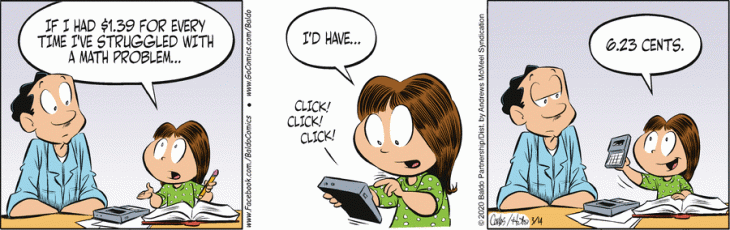
She only struggled very briefly with a problem before getting out the calculator. And the struggle was probably “Where’s the calculator?”
She’s struggles with a math problem 0.04482014388489208633093525179856 times.
That’s her phone number.
It’s not supposed to add (or multiply, or divide) up correctly. The whole point of the joke is that she’s utterly clueless and doesn’t have the faintest idea about how to do a math problem, even with a calculator.
P.S. Before anyone wastes too much time factoring any of this out: 139 is a prime number. 623 is not prime, but 7*89 isn’t going to produce anything useful.
If Baldo had said it, I’d agree with Kilby’s interpretation. But Gracie is the smart one, so it shouldn’t mean that.
How many calculators does she need to solve her math problems? There’s one in her hand, and another on the desk.
@ Arthur – Gracie is often precociously clever, but the mistake she made here doesn’t show “stupidity”, it’s “endearingly silly”.
P.S. The precision of woozy’s calculator is either impressive or suspicious.
How is it even possible to “struggle with a math problem” when you have a calculator?
@Woozy&Kilby: actually, since she’s talking about money, the final number, 6.23, is probably rounded. My guess is that she struggled 0.0448 times.
@ B.A. – A calculator can solve any arithmetic problem, but only if the user can formulate the appropriate equation. Even a simple word problem(*) can present unfathomable hurdles for a first- or second-grader who is missing even just one of the unstated assumptions.
P.S. (*) – For example: “John paid $1 for a pretzel and received 20¢ change back. What did the pretzel cost?” – that took me ten minutes of skull sweat before I was able to lead my kid to the discovery that it was a simple subtraction problem: “100 – 20 = 80¢“
Embarrassing admission: I initially got a different result for the number of times she’s struggled, because I did the division the wrong way around.
She has two calculators because almost all of the first frame was copied to the 3rd frame and only some features of the dad and her were changed. Everything else is a cut and paste, including the calculator.
“P.S. The precision of woozy’s calculator is either impressive or suspicious.”
It’s the one that comes with Windows 8.
“Embarrassing admission: I initially got a different result for the number of times she’s struggled, because I did the division the wrong way around.”
I did something like that a week or two ago.
I thought of Kilby’s interpretation but had Arthur’s reservations.
“How is it even possible to “struggle with a math problem” when you have a calculator?”
Are you *serious*?
B.A.: To supplement Kilby: When I was a physics professor, one of the biggest problems I saw was when students blindly stuck numbers in a calculator and wrote down the results without understand what they were doing. You need to understand the problem well enough to know what to stick in the calculator, and you need to have enough thinking about what makes sense to be suspicious if what comes out of the calculator is nonsensical.
I’m always serious, woozy.
What sort of math problem could an 8-year-old — especially an 8-year-old who’s apparently a math whiz — be assigned that would be a struggle for her with a calculator?
“I’m always serious, woozy.”
OK, but are you B.A.?
If you assume the 8-year is a math whiz, then I suppose you can also circularly assume that no problem they’re assigned in class should be a struggle, with or without a calculator. But for 8-year olds more generally, as Kilby said, the difficulty with word problems is often in turning the words into math, not doing the math. e.g. what do you type in the calculator for “Bob had 8 apples, and ate 2 of them. How many does he have left?”
And there’s this classic, particularly tricky problem: “Bob had 8 candy bars, and his sister asked for 2 of them. Now how many candy bars does Bob have?”
Sorry, I thought he meant was I serious about posting this as a CIDU. Too much multi-tasking.
My problem with Gracie — and I’ve come to think of this as the Gracie Syndrome — is that she alternates between being supernaturally brilliant and being, well, not the sharpest knife in the drawer.
Caulfield can do this as well, but he leans more heavily toward brilliant (except when he isn’t).
“John paid $1 for a pretzel and received 20¢ change back. What did the pretzel cost?”
If he paid a dollar for it, the pretzel cost a dollar. And the pretzel cart should train its staff better.
Seriously, that world problem is unacceptable. It is ambiguous. That’s the problem with working with words. We get no respect. Everyone thinks numbers are a big deal and so precise and you have to be a brainiac. But they can just slap any old words together and call it a day.
Singapore Bill: Language is generally ambiguous, and people usually understand how to resolve the ambiguities from context. As I’m pretty sure you were able to do with the proposed problem.
Similarly. I could pretend to be baffled by your comment because I don’t know what you mean by a “world problem,” but what would be the point?
Or maybe you were just being silly, instead of making a serious criticism of that kind of word problem. In which case, never mind.
Okay, someone help out this tired old brain. (I struggled with math in school, although I did better with algebra, since the numbers rarely got bigger than 3.) I come up with Gracie struggling 4.48… times. How does the decimal point get moved two places? If you’re going for a percentage, there isn’t enough information available to get there.
While language is often ambiguous in casual use, it does not need to be. That the question is ambiguous is lazy. Well, it might be. Kilby might be remembering it imperfectly, but as he related it, it’s ambiguous. That there are two “correct” answers to that question (three, if you consider “unknown” correct, because we only have data to guess at the selling price of the pretzel not what it cost the vendor to make or purchase) means it’s no good. The test taker should not have to guess.
“John paid for a pretzel using a $1 bill and received 20¢ change back. How much did he pay for the pretzel?”
Or
“John purchased a pretzel and tendered a $1 bill as payment. He received 20¢ change in return. How much did he pay for the pretzel?”
Those are off the top of my head but I think those are more precise.
guero, notice that the last number is in cents, not dollars.
And the light bulb comes on. Thanks.
“Bob had 8 candy bars, and his sister asked for 2 of them. Now how many candy bars does Bob have?”
Bob is sick and tired of his sister asking for his candy bars, especially as she already has 20 candy bars. (She doesn’t even eat them. She just hoards them to tease Bob with.) So Bob stole 2 of his sister’s candy bars and now he has 10 candy bars.
I hate ambiguous questions, especially since I tend to obsess over them. I still remember one from a test they gave us in 4th grade (they never told us what it was for, but we suspect it was an IQ test) where I know there were two equally correct answers. Presumably they wanted to see how many people would choose each question, for some mysterious reason. I, on the other hand, almost never finished the test.
Actually, she’s struggled with 4.482014388 math problems, according to her figures.
Oops. Just reread the strip. I hate it when I do that.
CIDU Bill, maybe you helped science. Perhaps they were studying how question design influences response so they could create fair, unbiased tests. Or…you know…the opposite.
I remember taking a pretty official psychological assessment test that had a t/f question “Washington was a greater President than Lincoln.” I now think that might have been in there as a validation question or filler, etc. But for a long time I thought of theories of how it could be a genuine personality indicator. Do you admire a figure of rectitude and Father of his country, or the Great Liberator?
@ Bill – The written test for a German driver’s license is “multiple multiple choicel: they provide four or five answers, but some of the questions require the candidate to mark “all of the answers that are correct”. They are a lot harder than questions that only need a single answer.
Kilby, sounds like a CAPTCHA.
Early on in grade school I faced a question as to which of these two sentences I preferred: “The horseman galloped down the road” or “Down the road galloped the horseman.” I chose the second (more dramatic etc.) and it was marked off as wrong.
Again, this wasn’t a question of which was “better” or “clearer” or something, but which one I *preferred.* I think a lot of my cynicism towards experts and authorities crystalized at that moment, since I still recall it some 65 years later.
“Washington was a greater President than Lincoln.”
He certainly was in some ways. Was Lincoln a greater president than Washington? He certainly was in some ways.
Obviously the test wasn’t written for residents of Lake Woebegon.
Seems to me the Washington/Lincoln question would play differently north an south of the Mason-Dixon Line.
Lincoln is the better president, of course. Washington was a traitor and owned black people. Lincoln was not a traitor, did not own black people, and stopped others from owning black people.
SBill, Lincoln only “stopped others from owning black people” because it was strategically necessary. In his own words, “If I could save the union without freeing any slaves I would do it; and if I could save it by freeing all the slaves I would do it; and if I could save it by freeing some and leaving others alone I would also do that.”
It’s true that Lincoln didn’t own any slaves, but that might have more to do with circumstance than morality: Washington also believed slavery was wrong in principle. So did Jefferson, though it’s not clear whether he ever discussed this with his wife’s half-sister.
CIDU Bill, I know what he said and I’m sure he meant it. He was a politician, after all. He didn’t want to be the president who lost the country, so they had a warm to stop the secession. It had to involve freeing the slaves because there was no other way, exactly as he said.
I think you’re right about the difference in circumstances too. The economy in the North did not lend itself so well to slave ownership. Large plantations that required a large amount of manual labour needed slaves to be economically viable. Just like Walmart needs poor people who will work for minimum wage. Without the large plantations in the North, it was too expensive to keep slaves for the small amount of labour you would get from them. Like how my dad made me mow our small lawn with a push mower rather than purchasing the riding mower I would have liked. So Mr. Lincoln would not have had the need.
All that said, there is certainly a moral element to enslaving human beings (and their progeny in perpetuity). To believe something is wrong in principle and still benefit from that thing is not principled.
Now, if technology had advanced more quickly or the war hadn’t come when it did, slavery would likely have been displaced by mechanisation.
“my dad made me mow our small lawn with a push mower ”
That made me laugh because I also made my son use a manual push mower (even though our yard was large enough that he had to mow twice a week). And he did make references to slavery.
At the end of the summer he admitted it wasn’t all that bad, because it gave him both upper-body and leg muscles his girlfriend was impressed with.
Oh, and you’re certainly right about how geography changes views. There are several references to Lincoln in Maryland My Maryland, the state song of Maryland. It refers to Lincoln as a tyrant, a despot, and a Vandal. It also refers to the Union as Northern scum.
The song was one of the most popular songs in the Confederacy during the Civil War. So says Wikipedia and so also had said my Maryland girlfriend, who told me this (and performed the whole song a capella at a party for my benefit) before the days of Wikipedia. In her defence, she wasn’t some “The South will rise again!” yee-haw. She was just really into being from Maryland and its history.
For anybody interested in the subject (and how did we get here from Gracie’s math homework???), I just listened to the Great Courses audiobook A New History of the American South. Excellent.
But whatever you do, don’t order it directly from Great Courses: much cheaper through Audible.
B.A, the diversions and excursions are the best part of CIDU. It’s what’s kept me coming here for 23 years. It’s probably why CIDU Bill still keeps at it.
The Great Courses says it is having a sale. It’s substantially cheaper there than at Audible at the moment, at least for a Canadian. Except Audible says it is free if I take a 30-day free trial. So, I guess you have to do some Gracie level calculations to figure out the best course (pun FTW!).
Of course, George Washington fiddled the books to hiw own profit:
(My own favorite president is Chester A. Arthur, who was expected to be a crook but upon being reaised to office deicded not to be. Also, he had Kool muttonchops.)
Singapore Bill, I hope you didn’t think for a moment I meant that in a negative way!
Regarding Great Courses: they’re offering them for under $14.95 (Audible’s monthy price)?
I just checked (should have done that before clicking “post”.) Sale price is $29.95, which is two months of Audible (even without factoring in the free month).
B.A: No, I know you were simply marvelling at the magic of CIDU. The comment was for lurking newcomers. I know you are a true believer. One of us! One of us! :)
So getting the thing from The Great Courses right now is cheaper than Audible, but if you’re a new subscriber at Audible you get one or two things you can take for free as part of the trial, so cheaper there if you’re a n00b…see? Gracie calculations needed!
Except… the actual “Audible price” for ANYTHING is $14.95, because that’s the cost of a month of membership, and each month of membership entitles you to one free book. If you’re already a member and you want a second book that month, you can temporarily change your membership level to 2/month for another $8 (or so).
There is no reason for anybody to ever pay the posted “Audible price” for anything: That’s just listed for show.
There is also “The Great Courses Plus” which is a streaming video service. It is available on their own website, as an app on Roku, and as one of those odd sub-subscriptions you can do within Amazon Priime Video. (But the Prime sub-subscription is a less complete selection.).
The video component is not a major thing. It doesn’t turn the lectures into documentaries. There are occasional pictures or written notes on screen. But mostly it is a matter of seeing someone talking to you instead of just hearing them.
And I should have made clear The Great Courses Plus (whatever way you access it) is distinct from The Great Courses Simpliciter. “Plus” is a subscription / streaming service, where you pay a monthly fee and can access anything in the library. “Original” sells courses as separate products, which you then own and can keep — I haven’t dealt with that side of their operation in a while but have a few boxed sets of discs from them. I didn’t know of their arrangement with Audible described above, but if I understand what you are saying that is for the Great Courses Original content, which is a related but independent roster from the Great Courses Plus roster. Is it video, btw?
If you buy a course from Great Courses, you get a CD or DVD and you *own* it. Are audio books via Audible DRMed?
When you buy something from Audible, you own it forever. Even if you quit, even if you delete the app. Five years from now, you can re-download the app and log in with your previous user name, and the book will be there for you.
Speaking of Audible: I just saw that an Audible offshoot, apparently created in response to C-19, is offering free-streaming of certain books for both children and adults (despite the misleading headline). Unlike “Audible Proper” you don’t own anything but, you know, it’s free.
B.A., If you buy something on CD, you’re not dependent on the company you bought from staying in business. If I understand you right, if Audible goes out of business, you’ve lost everything you “owned”. This has happened with books and whatever from other companies. A quick search strongly suggests that everything from Audible is indeed DRMed.
Okay, so far, this is what I have discerned (for reference, I am located in Canada and have an Amazon Prime subscription):
– I can buy the download of the audiobook of A New History of the American South from amazon.ca for $38.33 (all prices in Canada money). I can download and listen repeatedly. I do not know what DRM there is on the files, but I’ll bet there is some. I may be restricted in how I listen or on what devices.
– I can get a free trial to Audible for 30 days of service and A New History of the American South for free as one of the two selections I am allowed for free. I can download and listen repeatedly. I do not know what DRM there is on the files, but I’ll bet there is some. I may be restricted in how I listen or on what devices. If I continue subscription, I will be charged $14.95 per month.
Added bonus for existing Prime subscriber is that I will receive $10 credit at Amazon if I become a paying Audible subscriber (I continue past the 30 days and get billed). That means I could let them bill me for that month at $14.95 and download another audio selection of my choice to keep and then cancel, so I’d get three audiobooks for $4.95.
– At The Great Courses I have multiple choices:
INSTANT VIDEO ($49.95) INCLUDES:
Download 24 video lectures to your computer or mobile app
Downloadable PDF of the course guidebook
FREE video streaming of the course from our website and mobile apps
I would have the digital files I purchased available from TGC’s site and could be saved on a drive. I may or may not be able to burn them to CDs or DVDs to archive, depending on if they have DRM (I bet they do).
INSTANT AUDIO ($29.95) INCLUDES:
Download 24 audio lectures to your computer or mobile app
Downloadable PDF of the course guidebook
FREE audio streaming of the course from our website and mobile apps
I would have the digital files I purchased available from TGC’s site and could be saved on a drive. I may or may not be able to burn them to CDs or DVDs to archive, depending on if they have DRM (I bet they do).
DVD ($69.95) INCLUDES:
24 lectures on 4 DVDs
155-page printed course guidebook
Downloadable PDF of the course guidebook
FREE video streaming of the course from our website and mobile apps
Closed captioning available
I’d have these in my possession, always available.
– Over at The Great Courses Plus, it is a subscription service. I can get a two-week free trial, so I could listen at no cost but I would lose access after the trial, unless I started paying. TGCP currently offers me two subscription options: $19.95/month for a monthly subscription; $10/month for a quarterly subscription billed quarterly i.e. $30 on day 15, when I become a paying subscriber and $30 every three months thereafter. If I stop subscribing, I have access until the end of the period I’ve paid for, then no access at all.
I’ve worked at home for two years now, so I no longer have the lengthy commutes that audiobooks are useful for. I have also found that I can’t listen to stuff that is really difficult or that I can about because I get distracted by whatever I’m doing in the real world and have to rewind. However, I have found myself listening lots of podcasts and such whild working. It’s hard to find ones that have just the right mix of what I want. Audio courses might be good.
P.S. If you’re thinking that that ^^^ must have taken a long time to do, yeah…
Arthur, the book is saved in your Audible app. So unless you delete it intending to re-download it later, you don’t have to worry.
And as far as Audible going out of business, they’re part of a little company some guy named Bezos owns.
Oh, there is another option which violates civil law and, in some places, criminal law as well. Selection is likely to be hit and miss, as is quality, and their is a chance the files will contain malicious code (but probably not).
As an added bonus, since I’m posting again, here’s the penultimate para with typos corrected:
I’ve worked at home for two years now, so I no longer have the lengthy commutes that audiobooks are useful for. I have also found that I can’t listen to stuff that is really difficult or that I care about because I get distracted by whatever I’m doing in the real world and have to rewind. However, I have found myself listening lots of podcasts and such while working. It’s hard to find ones that have just the right mix of what I want. Audio courses might be good.
B.A., do you mean the same company that deleted the book 1984 from the devices of people who thought they bought it? Along with all of the notes many people had made for schoolwork?
I’ve listened to some books on multiple devices. In fact, a few years ago, I had a series of problems with my phone which resulted in me going through six devices in two months. My account and my books followed me from phone to phone, and didn’t even complain.
The DRM keeps me from listening on anything other than an Audible app, but other than that all’s good.
B.A., people who bought books from a little company run by a guy called Gates lost them because the company decided to quit that business. At least they refunded them. https://www.bbc.co.uk/news/technology-47810367
Other sites selling e-books have closed, though usually allowing people to download their stuff to read offline (some with DRM, like AdobeDRM, that was still working), others DRM free.
Well, if people got refunds, they didn’t lose anything, so all’s good.
If you’re questioning whether Audible works offline, it absolutely does: It’s great for long plane flights.
B.A. I’m not the one so worried about it. It seems Arthur is the person who is really concerned about owning physical objects. I understand the trade-off between convenience and ownership. I love books, I also have at least 2000 too many in my home. So being able to read the contents without having to bring a physical object into my home is a great idea. For special things (art books, special editions), well, I would buy that. I love music but haven’t bought a CD in ages (except a few from small indie artists when I went to their shows). I subscribe to Google Play Music streaming service and I find that the convenience of it is worth the modest fee and not adding to the 500+ CDs already in the house is great (and it will work offline, as long as remember to download the album or songs before I go into the subway). As for video, I’m quite a cinephile, but the streaming services offer a service that is quite good and convenient. For stuff I really care about, I’ve purchased discs (4K remasters of 2001: A Space Odyssey, Blade Runner) and they’re mind blowing. I also purchased a complete Columbo set of DVDs because I couldn’t find such a selection streaming. So I have 101 hours of Columbo I have to get started on at some point.
Too hard to keep track of who’s worried about what!
All I know is, as evil as Jeff Bezos is, when I had to escape from New York last week (think Kurt Russell, except in a Toyota), I was thankful to have months worth of books and audio books already “packed” in my phone’s Kindle and Audible apps.
Re: “a moral element to enslaving human beings (and their progeny in perpetuity).” — I think that should read “an amoral element“, but I also wanted to mention an article about “The Dark Side of Thomas Jefferson” that recently reappeared in the Smithsonian’s RSS feed. Basically, Jefferson sacrificed his moral objections to slavery after he discovered “that he was making a 4% profit every year on the birth of black children“, and later advanced “the notion that slavery presented an investment strategy for the future“. The article is a fascinating study, but contains a number of nasty details.
Kilby. what I wrote is correct (had to check myself because I’m not good at editing my posts here). Look at it in context:
“All that said, there is certainly a moral element to enslaving human beings (and their progeny in perpetuity). To believe something is wrong in principle and still benefit from that thing is not principled.”
Prior to that paragraph I’d been discussing the economic reasoning behind slavery and acknowledging that Lincoln’s circumstances meant slaves would not have been economically beneficial to him. Then I went on to saying that one could not discuss slavery without discussing the morality of it. It can’t be purely a discussion of economics. And I’d call the practice of slavery immoral, not amoral. I know that is an edgy and controversial stand, but that’s me. :)
Thank you for the link I’m looking forward to reading that.
Okay, in the end I got the Amazon Prime-linked Audible trial offer (30-days free trial, 2 free audiobooks and a $10 Amazon credit if I become a paying customer). And with all this talk about it, the first audiobook I took was A New History of the American South. B.A., I’ll let you know if I like it in 10 hours and 45 minutes. :)
Coincidentally, today for the first time (or maybe I just didn’t notice before) I received an emailed ad from Audible mentioning Great Courses.
The only Kindle books I have gotten from Amazon so far have been free ones. An easy way to find those is to do your normal search and arrange from lowest cost.
Most of the e-books I get are from the public library’s Overdrive system. That’s extra handy now that they physical library is closed. That must be hard on people who relied on it for computer and wifi access.
I use an ePub reader because public library here doesn’t do Kindle format. Borrowing books online from the library is cool, yes, but don’t forget the magic of Project Gutenberg. It has freely downloadable, no-DRM versions of books that have passed into public domain. Volunteers clean them up to take care of some of the worst formatting errors caused by the scanning. It’s a great way to catch up on all those books you “should” have read. There are Project Gutenberg sites for many countries and in many languages. I go to the Canadian one because I am in Canada. If you are a USer or EUer, please don’t go to it, because copyright protection in Canada is shorter (life of the creator + 50 years) than in USA and EU (life + 70 years). If you visited the site that me and my fellow Canadians use, you might accidentally download something that is still in copyright in your location, such as James Bond books, or Hemingway novels. So, only visit this link if you are in Canada or another life + 50 jurisdiction. Otherwise, find your country’s link.
Also, don’t forget many libraries offer video streaming services, music streaming, and online magazines to members.
As I understand it – from reading articles about it – with a DVD (CD, Beta tape,VHS tape, vinyl record) and your family can use the material also or they can be lent or given to someone – even after you shuffle off this mortal coil. However, online accounts are yours and yours alone – and cannot be used by family members or anyone else as it is only for your use.
 Comics I Don't Understand
She only struggled very briefly with a problem before getting out the calculator. And the struggle was probably “Where’s the calculator?”
She’s struggles with a math problem 0.04482014388489208633093525179856 times.
That’s her phone number.
It’s not supposed to add (or multiply, or divide) up correctly. The whole point of the joke is that she’s utterly clueless and doesn’t have the faintest idea about how to do a math problem, even with a calculator.
P.S. Before anyone wastes too much time factoring any of this out: 139 is a prime number. 623 is not prime, but 7*89 isn’t going to produce anything useful.
If Baldo had said it, I’d agree with Kilby’s interpretation. But Gracie is the smart one, so it shouldn’t mean that.
How many calculators does she need to solve her math problems? There’s one in her hand, and another on the desk.
@ Arthur – Gracie is often precociously clever, but the mistake she made here doesn’t show “stupidity”, it’s “endearingly silly”.
P.S. The precision of woozy’s calculator is either impressive or suspicious.
How is it even possible to “struggle with a math problem” when you have a calculator?
It’s an HP.
https://en.wikipedia.org/wiki/Reverse_Polish_notation#Hewlett-Packard
@Woozy&Kilby: actually, since she’s talking about money, the final number, 6.23, is probably rounded. My guess is that she struggled 0.0448 times.
@ B.A. – A calculator can solve any arithmetic problem, but only if the user can formulate the appropriate equation. Even a simple word problem(*) can present unfathomable hurdles for a first- or second-grader who is missing even just one of the unstated assumptions.
P.S. (*) – For example: “John paid $1 for a pretzel and received 20¢ change back. What did the pretzel cost?” – that took me ten minutes of skull sweat before I was able to lead my kid to the discovery that it was a simple subtraction problem: “100 – 20 = 80¢“
Embarrassing admission: I initially got a different result for the number of times she’s struggled, because I did the division the wrong way around.
She has two calculators because almost all of the first frame was copied to the 3rd frame and only some features of the dad and her were changed. Everything else is a cut and paste, including the calculator.
“P.S. The precision of woozy’s calculator is either impressive or suspicious.”
It’s the one that comes with Windows 8.
“Embarrassing admission: I initially got a different result for the number of times she’s struggled, because I did the division the wrong way around.”
I did something like that a week or two ago.
I thought of Kilby’s interpretation but had Arthur’s reservations.
“How is it even possible to “struggle with a math problem” when you have a calculator?”
Are you *serious*?
B.A.: To supplement Kilby: When I was a physics professor, one of the biggest problems I saw was when students blindly stuck numbers in a calculator and wrote down the results without understand what they were doing. You need to understand the problem well enough to know what to stick in the calculator, and you need to have enough thinking about what makes sense to be suspicious if what comes out of the calculator is nonsensical.
I’m always serious, woozy.
What sort of math problem could an 8-year-old — especially an 8-year-old who’s apparently a math whiz — be assigned that would be a struggle for her with a calculator?
“I’m always serious, woozy.”
OK, but are you B.A.?
If you assume the 8-year is a math whiz, then I suppose you can also circularly assume that no problem they’re assigned in class should be a struggle, with or without a calculator. But for 8-year olds more generally, as Kilby said, the difficulty with word problems is often in turning the words into math, not doing the math. e.g. what do you type in the calculator for “Bob had 8 apples, and ate 2 of them. How many does he have left?”
And there’s this classic, particularly tricky problem: “Bob had 8 candy bars, and his sister asked for 2 of them. Now how many candy bars does Bob have?”
Sorry, I thought he meant was I serious about posting this as a CIDU. Too much multi-tasking.
My problem with Gracie — and I’ve come to think of this as the Gracie Syndrome — is that she alternates between being supernaturally brilliant and being, well, not the sharpest knife in the drawer.
Caulfield can do this as well, but he leans more heavily toward brilliant (except when he isn’t).
“John paid $1 for a pretzel and received 20¢ change back. What did the pretzel cost?”
If he paid a dollar for it, the pretzel cost a dollar. And the pretzel cart should train its staff better.
Seriously, that world problem is unacceptable. It is ambiguous. That’s the problem with working with words. We get no respect. Everyone thinks numbers are a big deal and so precise and you have to be a brainiac. But they can just slap any old words together and call it a day.
Singapore Bill: Language is generally ambiguous, and people usually understand how to resolve the ambiguities from context. As I’m pretty sure you were able to do with the proposed problem.
Similarly. I could pretend to be baffled by your comment because I don’t know what you mean by a “world problem,” but what would be the point?
Or maybe you were just being silly, instead of making a serious criticism of that kind of word problem. In which case, never mind.
Okay, someone help out this tired old brain. (I struggled with math in school, although I did better with algebra, since the numbers rarely got bigger than 3.) I come up with Gracie struggling 4.48… times. How does the decimal point get moved two places? If you’re going for a percentage, there isn’t enough information available to get there.
While language is often ambiguous in casual use, it does not need to be. That the question is ambiguous is lazy. Well, it might be. Kilby might be remembering it imperfectly, but as he related it, it’s ambiguous. That there are two “correct” answers to that question (three, if you consider “unknown” correct, because we only have data to guess at the selling price of the pretzel not what it cost the vendor to make or purchase) means it’s no good. The test taker should not have to guess.
“John paid for a pretzel using a $1 bill and received 20¢ change back. How much did he pay for the pretzel?”
Or
“John purchased a pretzel and tendered a $1 bill as payment. He received 20¢ change in return. How much did he pay for the pretzel?”
Those are off the top of my head but I think those are more precise.
guero, notice that the last number is in cents, not dollars.
And the light bulb comes on. Thanks.
“Bob had 8 candy bars, and his sister asked for 2 of them. Now how many candy bars does Bob have?”
Bob is sick and tired of his sister asking for his candy bars, especially as she already has 20 candy bars. (She doesn’t even eat them. She just hoards them to tease Bob with.) So Bob stole 2 of his sister’s candy bars and now he has 10 candy bars.
I hate ambiguous questions, especially since I tend to obsess over them. I still remember one from a test they gave us in 4th grade (they never told us what it was for, but we suspect it was an IQ test) where I know there were two equally correct answers. Presumably they wanted to see how many people would choose each question, for some mysterious reason. I, on the other hand, almost never finished the test.
Actually, she’s struggled with 4.482014388 math problems, according to her figures.
Oops. Just reread the strip. I hate it when I do that.
CIDU Bill, maybe you helped science. Perhaps they were studying how question design influences response so they could create fair, unbiased tests. Or…you know…the opposite.
I remember taking a pretty official psychological assessment test that had a t/f question “Washington was a greater President than Lincoln.” I now think that might have been in there as a validation question or filler, etc. But for a long time I thought of theories of how it could be a genuine personality indicator. Do you admire a figure of rectitude and Father of his country, or the Great Liberator?
@ Bill – The written test for a German driver’s license is “multiple multiple choicel: they provide four or five answers, but some of the questions require the candidate to mark “all of the answers that are correct”. They are a lot harder than questions that only need a single answer.
Kilby, sounds like a CAPTCHA.
Early on in grade school I faced a question as to which of these two sentences I preferred: “The horseman galloped down the road” or “Down the road galloped the horseman.” I chose the second (more dramatic etc.) and it was marked off as wrong.
Again, this wasn’t a question of which was “better” or “clearer” or something, but which one I *preferred.* I think a lot of my cynicism towards experts and authorities crystalized at that moment, since I still recall it some 65 years later.
“Washington was a greater President than Lincoln.”
He certainly was in some ways. Was Lincoln a greater president than Washington? He certainly was in some ways.
Obviously the test wasn’t written for residents of Lake Woebegon.
Seems to me the Washington/Lincoln question would play differently north an south of the Mason-Dixon Line.
Lincoln is the better president, of course. Washington was a traitor and owned black people. Lincoln was not a traitor, did not own black people, and stopped others from owning black people.
SBill, Lincoln only “stopped others from owning black people” because it was strategically necessary. In his own words, “If I could save the union without freeing any slaves I would do it; and if I could save it by freeing all the slaves I would do it; and if I could save it by freeing some and leaving others alone I would also do that.”
It’s true that Lincoln didn’t own any slaves, but that might have more to do with circumstance than morality: Washington also believed slavery was wrong in principle. So did Jefferson, though it’s not clear whether he ever discussed this with his wife’s half-sister.
CIDU Bill, I know what he said and I’m sure he meant it. He was a politician, after all. He didn’t want to be the president who lost the country, so they had a warm to stop the secession. It had to involve freeing the slaves because there was no other way, exactly as he said.
I think you’re right about the difference in circumstances too. The economy in the North did not lend itself so well to slave ownership. Large plantations that required a large amount of manual labour needed slaves to be economically viable. Just like Walmart needs poor people who will work for minimum wage. Without the large plantations in the North, it was too expensive to keep slaves for the small amount of labour you would get from them. Like how my dad made me mow our small lawn with a push mower rather than purchasing the riding mower I would have liked. So Mr. Lincoln would not have had the need.
All that said, there is certainly a moral element to enslaving human beings (and their progeny in perpetuity). To believe something is wrong in principle and still benefit from that thing is not principled.
Now, if technology had advanced more quickly or the war hadn’t come when it did, slavery would likely have been displaced by mechanisation.
“my dad made me mow our small lawn with a push mower ”
That made me laugh because I also made my son use a manual push mower (even though our yard was large enough that he had to mow twice a week). And he did make references to slavery.
At the end of the summer he admitted it wasn’t all that bad, because it gave him both upper-body and leg muscles his girlfriend was impressed with.
Oh, and you’re certainly right about how geography changes views. There are several references to Lincoln in Maryland My Maryland, the state song of Maryland. It refers to Lincoln as a tyrant, a despot, and a Vandal. It also refers to the Union as Northern scum.
https://en.wikipedia.org/wiki/Maryland,_My_Maryland#Lyrics
The song was one of the most popular songs in the Confederacy during the Civil War. So says Wikipedia and so also had said my Maryland girlfriend, who told me this (and performed the whole song a capella at a party for my benefit) before the days of Wikipedia. In her defence, she wasn’t some “The South will rise again!” yee-haw. She was just really into being from Maryland and its history.
For anybody interested in the subject (and how did we get here from Gracie’s math homework???), I just listened to the Great Courses audiobook A New History of the American South. Excellent.
But whatever you do, don’t order it directly from Great Courses: much cheaper through Audible.
B.A, the diversions and excursions are the best part of CIDU. It’s what’s kept me coming here for 23 years. It’s probably why CIDU Bill still keeps at it.
The Great Courses says it is having a sale. It’s substantially cheaper there than at Audible at the moment, at least for a Canadian. Except Audible says it is free if I take a 30-day free trial. So, I guess you have to do some Gracie level calculations to figure out the best course (pun FTW!).
Of course, George Washington fiddled the books to hiw own profit:
http://www.accountingin.com/accounting-historians-journal/volume-17-number-1/george-washingtons-expense-account/
So there’s that.
(My own favorite president is Chester A. Arthur, who was expected to be a crook but upon being reaised to office deicded not to be. Also, he had Kool muttonchops.)
Singapore Bill, I hope you didn’t think for a moment I meant that in a negative way!
Regarding Great Courses: they’re offering them for under $14.95 (Audible’s monthy price)?
I just checked (should have done that before clicking “post”.) Sale price is $29.95, which is two months of Audible (even without factoring in the free month).
B.A: No, I know you were simply marvelling at the magic of CIDU. The comment was for lurking newcomers. I know you are a true believer. One of us! One of us! :)
So getting the thing from The Great Courses right now is cheaper than Audible, but if you’re a new subscriber at Audible you get one or two things you can take for free as part of the trial, so cheaper there if you’re a n00b…see? Gracie calculations needed!
Except… the actual “Audible price” for ANYTHING is $14.95, because that’s the cost of a month of membership, and each month of membership entitles you to one free book. If you’re already a member and you want a second book that month, you can temporarily change your membership level to 2/month for another $8 (or so).
There is no reason for anybody to ever pay the posted “Audible price” for anything: That’s just listed for show.
There is also “The Great Courses Plus” which is a streaming video service. It is available on their own website, as an app on Roku, and as one of those odd sub-subscriptions you can do within Amazon Priime Video. (But the Prime sub-subscription is a less complete selection.).
The video component is not a major thing. It doesn’t turn the lectures into documentaries. There are occasional pictures or written notes on screen. But mostly it is a matter of seeing someone talking to you instead of just hearing them.
And I should have made clear The Great Courses Plus (whatever way you access it) is distinct from The Great Courses Simpliciter. “Plus” is a subscription / streaming service, where you pay a monthly fee and can access anything in the library. “Original” sells courses as separate products, which you then own and can keep — I haven’t dealt with that side of their operation in a while but have a few boxed sets of discs from them. I didn’t know of their arrangement with Audible described above, but if I understand what you are saying that is for the Great Courses Original content, which is a related but independent roster from the Great Courses Plus roster. Is it video, btw?
If you buy a course from Great Courses, you get a CD or DVD and you *own* it. Are audio books via Audible DRMed?
When you buy something from Audible, you own it forever. Even if you quit, even if you delete the app. Five years from now, you can re-download the app and log in with your previous user name, and the book will be there for you.
Speaking of Audible: I just saw that an Audible offshoot, apparently created in response to C-19, is offering free-streaming of certain books for both children and adults (despite the misleading headline). Unlike “Audible Proper” you don’t own anything but, you know, it’s free.
https://www.nj.com/entertainment/2020/03/audible-is-offering-free-stories-for-kids-after-coronavirus-closes-schools.html
B.A., If you buy something on CD, you’re not dependent on the company you bought from staying in business. If I understand you right, if Audible goes out of business, you’ve lost everything you “owned”. This has happened with books and whatever from other companies. A quick search strongly suggests that everything from Audible is indeed DRMed.
Okay, so far, this is what I have discerned (for reference, I am located in Canada and have an Amazon Prime subscription):
– I can buy the download of the audiobook of A New History of the American South from amazon.ca for $38.33 (all prices in Canada money). I can download and listen repeatedly. I do not know what DRM there is on the files, but I’ll bet there is some. I may be restricted in how I listen or on what devices.
– I can get a free trial to Audible for 30 days of service and A New History of the American South for free as one of the two selections I am allowed for free. I can download and listen repeatedly. I do not know what DRM there is on the files, but I’ll bet there is some. I may be restricted in how I listen or on what devices. If I continue subscription, I will be charged $14.95 per month.
Added bonus for existing Prime subscriber is that I will receive $10 credit at Amazon if I become a paying Audible subscriber (I continue past the 30 days and get billed). That means I could let them bill me for that month at $14.95 and download another audio selection of my choice to keep and then cancel, so I’d get three audiobooks for $4.95.
– At The Great Courses I have multiple choices:
INSTANT VIDEO ($49.95) INCLUDES:
Download 24 video lectures to your computer or mobile app
Downloadable PDF of the course guidebook
FREE video streaming of the course from our website and mobile apps
I would have the digital files I purchased available from TGC’s site and could be saved on a drive. I may or may not be able to burn them to CDs or DVDs to archive, depending on if they have DRM (I bet they do).
INSTANT AUDIO ($29.95) INCLUDES:
Download 24 audio lectures to your computer or mobile app
Downloadable PDF of the course guidebook
FREE audio streaming of the course from our website and mobile apps
I would have the digital files I purchased available from TGC’s site and could be saved on a drive. I may or may not be able to burn them to CDs or DVDs to archive, depending on if they have DRM (I bet they do).
DVD ($69.95) INCLUDES:
24 lectures on 4 DVDs
155-page printed course guidebook
Downloadable PDF of the course guidebook
FREE video streaming of the course from our website and mobile apps
Closed captioning available
I’d have these in my possession, always available.
– Over at The Great Courses Plus, it is a subscription service. I can get a two-week free trial, so I could listen at no cost but I would lose access after the trial, unless I started paying. TGCP currently offers me two subscription options: $19.95/month for a monthly subscription; $10/month for a quarterly subscription billed quarterly i.e. $30 on day 15, when I become a paying subscriber and $30 every three months thereafter. If I stop subscribing, I have access until the end of the period I’ve paid for, then no access at all.
I’ve worked at home for two years now, so I no longer have the lengthy commutes that audiobooks are useful for. I have also found that I can’t listen to stuff that is really difficult or that I can about because I get distracted by whatever I’m doing in the real world and have to rewind. However, I have found myself listening lots of podcasts and such whild working. It’s hard to find ones that have just the right mix of what I want. Audio courses might be good.
P.S. If you’re thinking that that ^^^ must have taken a long time to do, yeah…
Arthur, the book is saved in your Audible app. So unless you delete it intending to re-download it later, you don’t have to worry.
And as far as Audible going out of business, they’re part of a little company some guy named Bezos owns.
Oh, there is another option which violates civil law and, in some places, criminal law as well. Selection is likely to be hit and miss, as is quality, and their is a chance the files will contain malicious code (but probably not).
As an added bonus, since I’m posting again, here’s the penultimate para with typos corrected:
I’ve worked at home for two years now, so I no longer have the lengthy commutes that audiobooks are useful for. I have also found that I can’t listen to stuff that is really difficult or that I care about because I get distracted by whatever I’m doing in the real world and have to rewind. However, I have found myself listening lots of podcasts and such while working. It’s hard to find ones that have just the right mix of what I want. Audio courses might be good.
B.A., do you mean the same company that deleted the book 1984 from the devices of people who thought they bought it? Along with all of the notes many people had made for schoolwork?
I’ve listened to some books on multiple devices. In fact, a few years ago, I had a series of problems with my phone which resulted in me going through six devices in two months. My account and my books followed me from phone to phone, and didn’t even complain.
The DRM keeps me from listening on anything other than an Audible app, but other than that all’s good.
B.A., people who bought books from a little company run by a guy called Gates lost them because the company decided to quit that business. At least they refunded them.
https://www.bbc.co.uk/news/technology-47810367
Other sites selling e-books have closed, though usually allowing people to download their stuff to read offline (some with DRM, like AdobeDRM, that was still working), others DRM free.
Well, if people got refunds, they didn’t lose anything, so all’s good.
If you’re questioning whether Audible works offline, it absolutely does: It’s great for long plane flights.
B.A. I’m not the one so worried about it. It seems Arthur is the person who is really concerned about owning physical objects. I understand the trade-off between convenience and ownership. I love books, I also have at least 2000 too many in my home. So being able to read the contents without having to bring a physical object into my home is a great idea. For special things (art books, special editions), well, I would buy that. I love music but haven’t bought a CD in ages (except a few from small indie artists when I went to their shows). I subscribe to Google Play Music streaming service and I find that the convenience of it is worth the modest fee and not adding to the 500+ CDs already in the house is great (and it will work offline, as long as remember to download the album or songs before I go into the subway). As for video, I’m quite a cinephile, but the streaming services offer a service that is quite good and convenient. For stuff I really care about, I’ve purchased discs (4K remasters of 2001: A Space Odyssey, Blade Runner) and they’re mind blowing. I also purchased a complete Columbo set of DVDs because I couldn’t find such a selection streaming. So I have 101 hours of Columbo I have to get started on at some point.
Too hard to keep track of who’s worried about what!
All I know is, as evil as Jeff Bezos is, when I had to escape from New York last week (think Kurt Russell, except in a Toyota), I was thankful to have months worth of books and audio books already “packed” in my phone’s Kindle and Audible apps.
Re: “a moral element to enslaving human beings (and their progeny in perpetuity).” — I think that should read “an amoral element“, but I also wanted to mention an article about “The Dark Side of Thomas Jefferson” that recently reappeared in the Smithsonian’s RSS feed. Basically, Jefferson sacrificed his moral objections to slavery after he discovered “that he was making a 4% profit every year on the birth of black children“, and later advanced “the notion that slavery presented an investment strategy for the future“. The article is a fascinating study, but contains a number of nasty details.
Kilby. what I wrote is correct (had to check myself because I’m not good at editing my posts here). Look at it in context:
“All that said, there is certainly a moral element to enslaving human beings (and their progeny in perpetuity). To believe something is wrong in principle and still benefit from that thing is not principled.”
Prior to that paragraph I’d been discussing the economic reasoning behind slavery and acknowledging that Lincoln’s circumstances meant slaves would not have been economically beneficial to him. Then I went on to saying that one could not discuss slavery without discussing the morality of it. It can’t be purely a discussion of economics. And I’d call the practice of slavery immoral, not amoral. I know that is an edgy and controversial stand, but that’s me. :)
Thank you for the link I’m looking forward to reading that.
Okay, in the end I got the Amazon Prime-linked Audible trial offer (30-days free trial, 2 free audiobooks and a $10 Amazon credit if I become a paying customer). And with all this talk about it, the first audiobook I took was A New History of the American South. B.A., I’ll let you know if I like it in 10 hours and 45 minutes. :)
Coincidentally, today for the first time (or maybe I just didn’t notice before) I received an emailed ad from Audible mentioning Great Courses.
The only Kindle books I have gotten from Amazon so far have been free ones. An easy way to find those is to do your normal search and arrange from lowest cost.
Most of the e-books I get are from the public library’s Overdrive system. That’s extra handy now that they physical library is closed. That must be hard on people who relied on it for computer and wifi access.
I use an ePub reader because public library here doesn’t do Kindle format. Borrowing books online from the library is cool, yes, but don’t forget the magic of Project Gutenberg. It has freely downloadable, no-DRM versions of books that have passed into public domain. Volunteers clean them up to take care of some of the worst formatting errors caused by the scanning. It’s a great way to catch up on all those books you “should” have read. There are Project Gutenberg sites for many countries and in many languages. I go to the Canadian one because I am in Canada. If you are a USer or EUer, please don’t go to it, because copyright protection in Canada is shorter (life of the creator + 50 years) than in USA and EU (life + 70 years). If you visited the site that me and my fellow Canadians use, you might accidentally download something that is still in copyright in your location, such as James Bond books, or Hemingway novels. So, only visit this link if you are in Canada or another life + 50 jurisdiction. Otherwise, find your country’s link.
http://gutenberg.ca/index.html
Also, don’t forget many libraries offer video streaming services, music streaming, and online magazines to members.
As I understand it – from reading articles about it – with a DVD (CD, Beta tape,VHS tape, vinyl record) and your family can use the material also or they can be lent or given to someone – even after you shuffle off this mortal coil. However, online accounts are yours and yours alone – and cannot be used by family members or anyone else as it is only for your use.